
(RVI, Newcastle. Age 13)
Five-year diary: Having been woken far too early—even for me—I lie back and listen to the world I cannot see: The quick footsteps of nurses; The slower roll of the breakfast trolley; The gathering voices when the consultant arrives—decisive, assured. Then, later, the softer murmur of families at visiting time.
I’m out of bed at last. I sit by the window. I’m there floors up looking over the car park.
Doctors arrive alone, by car steadily, purposefully, composed. Nurses arrive by bus in twos or threes. Other staffs in gaggles of two or three or more. Some people leave, their night shift over. A system that works without me yet because of patients like me.
After breakfast, Weetabix, I practise with the crutches again—stairs, corridor, turn, stop, begin again. The crutches are mine. Like a pair of skis. Enabling, apparently.
On the stairs for the first time, I have two nurses with me. Young, I think—late teens, early twenties perhaps. I am their assignment for the hour.
They talk as they help me. Not to me, particularly—but around me. Small talk. Light. Ordinary. The sort of conversation that belongs to the outside world.
They sound like freedom.
They have come in from somewhere—homes, buses, streets, lives—and will return to it later. I am here, fixed in place.
I am, in every sense, an inmate.
I’m wearing classical schoolboy striped pyjamas with a cord tie. I can’t remember whether the left trouser leg has been cut open, cut off, or dragged over the plaster.
The plaster runs from my toes to my crotch. It holds me rigid, like I’ve been sealed into something. I think of the man in the iron mask, or the Count of Monte Cristo—cut off, contained, waiting in a place I didn’t choose.
My arms loop over the wooden crutches, fingers gripping hard. I’m told how to move—how to swing the heavy leg like a pendulum, to build momentum, even speed. That will come later.
For now, something else takes over.
The cord at my waist is loosening.
I can feel it. The knot is slipping. The front is beginning to open. At any moment, I might be exposed—standing at the top of the stairs, held upright only by these crutches, and about to lose the last piece of dignity I have.
I freeze.
Completely flummoxed.
One of the nurses sees immediately. She steps in without fuss, tucks me in, tightens the cord, restores order. My pyjamas are secured again. Nothing is revealed.
But the feeling lingers.
A sudden, unmistakable return to something much earlier—nannies, hands intervening, being managed, corrected, contained. Back, for a moment, at potty-training age. Helpless. Exposed. Dependent.
We continue.
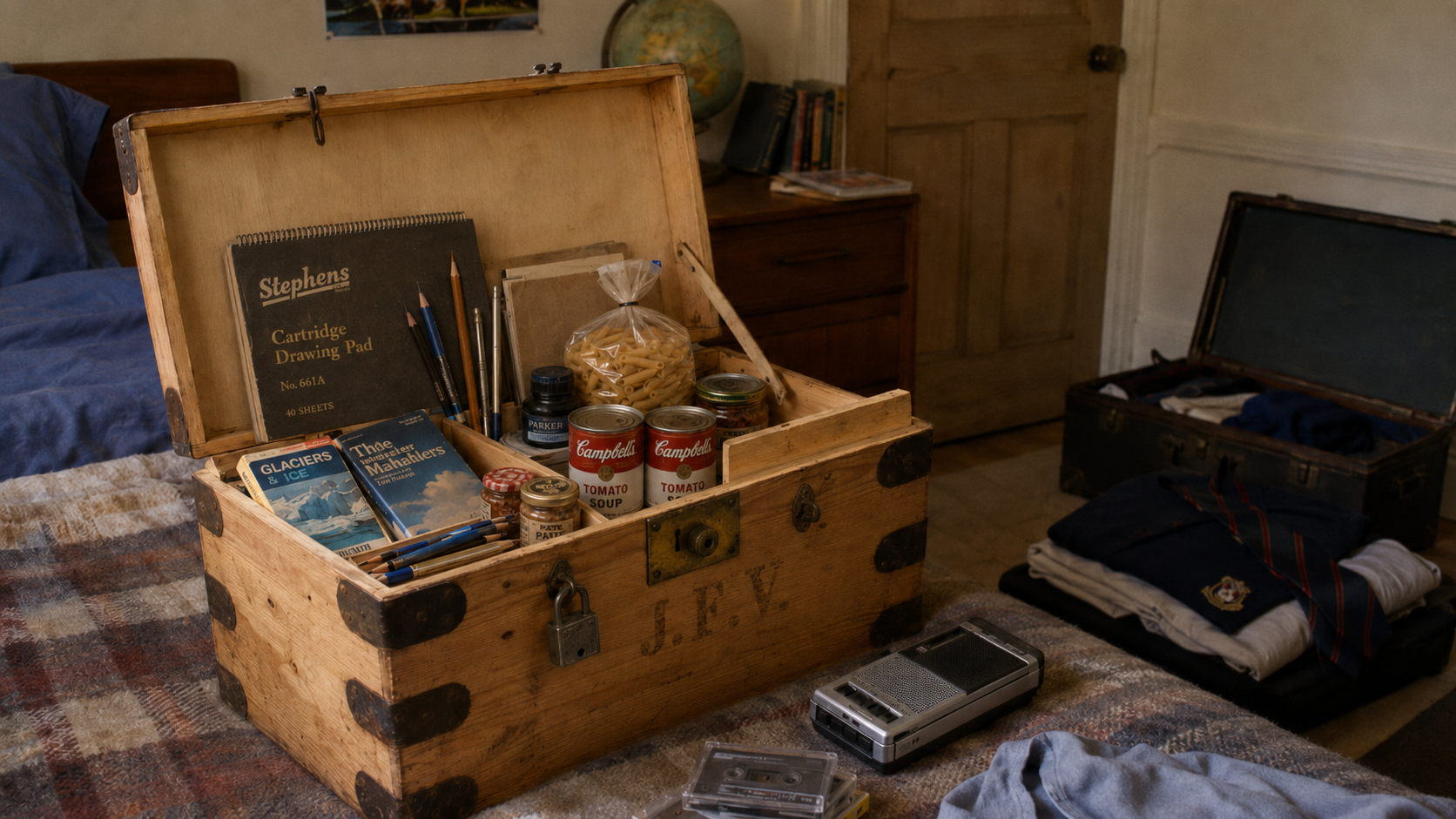
Later, Mum comes. Not for long. She has my younger sister and brother at home. Perhaps we play Risk. Perhaps she brings something for me to donor read – Dickens, she’s always trying to get me to read Duckens, or the Journal, or the Evening Chronicle, handed on by grandpa I imagine. Maybe a sketch pad. Something to occupy me.
Everything here is clean. Ordered. Contained.
And I watch.
50 Years On — Reflection
What returns most strongly now is not the pain (which was horrendous), nor even the immobility.
It is the vulnerability and isolation. A big alone.
Not just physical—but social. Existential.
To be held upright by others, instructed how to move and dependent on intervention for dignity and at the same time observing a world that continues, structured and purposeful, without you.
The moment on the stairs stays because it compresses everything:
exposure → fear → intervention → restoration → memory
And beneath it, the early formation of a pattern to manage vulnerability by observing, analysing, and containing.
If I could not control the situation, I could at least understand it. And if I could understand it, I could begin—slowly—to place myself within it again.
Leave a Reply