The Form Photo: Easter Antics 1978

During the 1978 Easter holidays, sixteen-year-old Robbie, temporarily freed from the constraints of ‘posh prison’—an all-male private boarding school—and permanently released from the limitations imposed by his orthodontic brace, embarked, with the connivance of his twin sister Kizzy, on a self-directed love-match challenge. Armed with Kizzy’s girls’ school Form Photo, a set of brass-tipped darts, and a copy of ‘Manwatching,’ they sought to direct his quest for affection.
Over twenty-eight days, alliances shifted, hearts fluttered, and the illusion of control unravelled.
Though brief, the events of Easter 1978 left emotional residues that rippled outward through the summer and into the following years. This is the record of that first chaotic bloom: a study of adolescence’s beautiful, inevitable failures.
Saturday 25th March 1978: Holiday Release from Posh Prison
Melton Park smelled of petrol and pine needles, as it always did when the private hire coach pulled in after a long haul from Cumbria via the A66, Scotch Corner, and the A1 ‘Great North Road.’ Robbie wore a standard-issue boarding school tweed jacket and black trousers. He has a slim build and a slightly rangy, expressive quality. His mousy brown hair is tousled, often falling into thoughtful blue eyes that convey curiosity and vulnerability, as if he’s fallen in love but hasn’t dared to tell anyone. At six feet tall, he has finally stopped growing physically; now, he must grow emotionally.
He stood awkwardly at the back of the bus, his school trunk and tuck box beside him like props from a BBC production of Tom Browns School Days. He used a dental pick to remove food from his brace. A charming sight for the few girls greeting their boyfriends. Not that they were looking at him. Not a chance. Not with that face of metal. The other boys were already being bundled into estate cars—Volvos, Saabs, and one gleaming new Audi—with their monogrammed trunks and tuck boxes; mothers fussed and gave orders; fathers, like chauffeurs, did as they were told, opened a boot, quickly stowed the trunks and tuck boxes, got in the car, and drove off.
“See you after the hols, Jaws,” said Pills, a boy Robbie’s age but more like a fourteen-year-old in appearance, as he waved from the rear passenger seat of a Volvo estate, which would then disappear up the Great North Road into Northumberland.
“It’s coming out!” Robbie shouted back while jabbing at his mouth.
No one had come to collect him, which was typical. He lived with his Mother and sister. His Mother was unwell and rarely left the house.
As he contemplated carrying his tuck box home and leaving his trunk to its fate, Robbie’s twin sister, Kizzy, appeared on foot, pushing a battered sack truck she’d liberated from the garage. She has sharp blue eyes, expressive eyebrows, and shoulder-length mousy brown hair with a natural fringe. She’s not that tall at all, but Robbie’s twin. Six minutes older than him. Her hair. He didn’t have the vocabulary and looked more significant; the advertising for the shampoo she had used would have said it gives hair bounce. Robbie reckoned she had even used a blow-drier on it. For him? Hardly. She wondered if she had an eye on one of his friends or one of the older boys. She had made an effort for someone. She looked faintly theatrical in a long green duffle coat and eyeliner that stretched ambitiously toward her temples.
“You look like a disappointed geography teacher,” she said, cheerfully ignoring his scowl. “Need a hand?”
He nodded.
Together, they heaved his trunk and tuck box onto the trolley and began the slow trundle home, up to the Great North Road, along to the Rugby Club—already filling with the muffled thud of someone’s disco setup—and the infamous stone edifice of No. 45 Bus Stop. Robbie noted it. The bus stop would be necessary. It always was. It was their link to the High Street and friends. To Newcastle and its cinemas. It’s where you copped a snog before your bus arrived.
Their house, set slightly apart from the others, had a quiet, forgotten, even unlived-in feel, as if no one had ever spent much time there. Their mum was sleeping in, and their father had long ago upped sticks and moved to Manchester with his girlfriend.
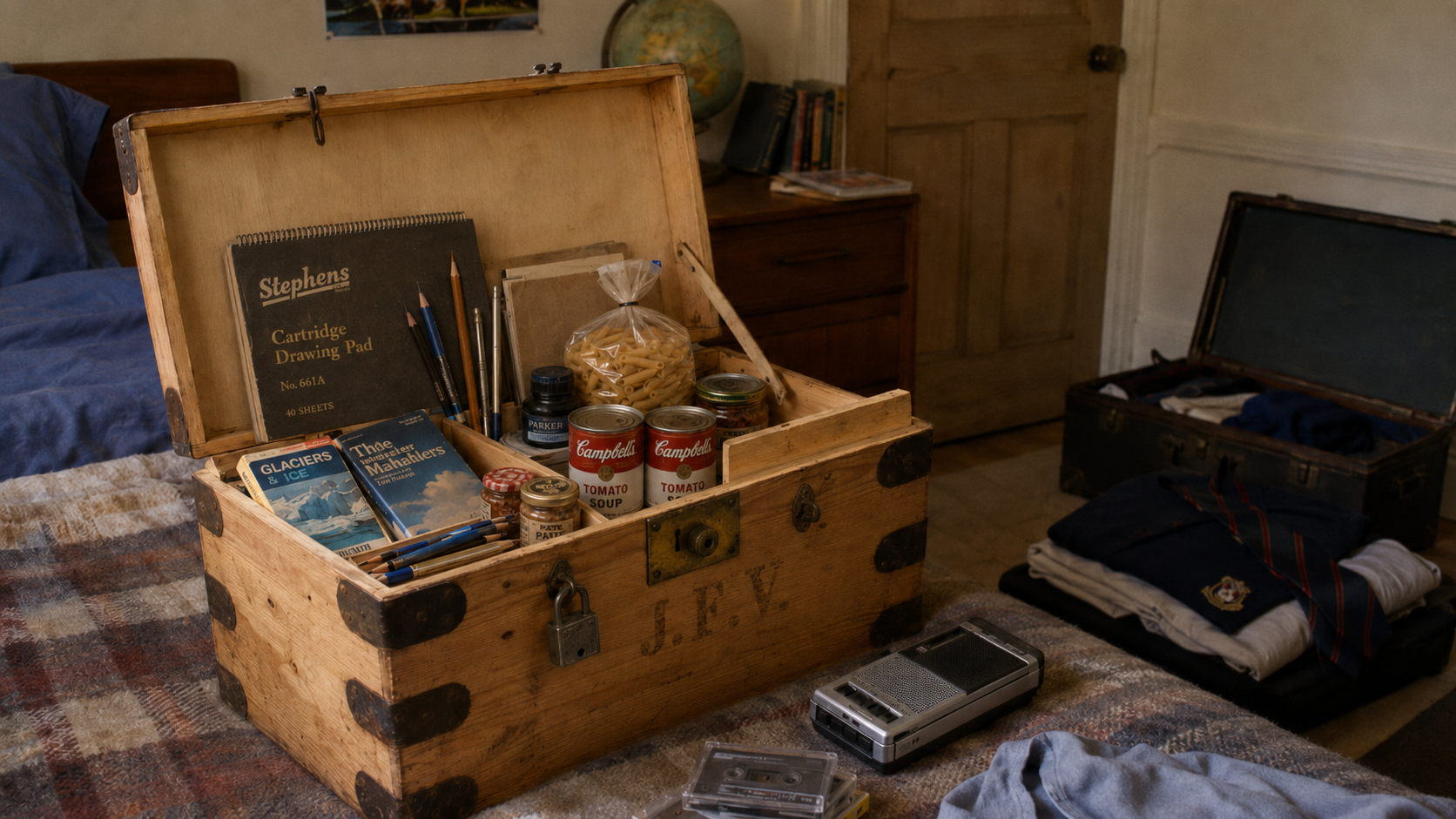
Together, Robbie and Kizzy swung open the double doors to the garage. Inside was just one car: their Mother’s rarely used British green Morris Minor Traveller, with its wooden frame tucked into one side and ample space left for whatever ‘tart trap’ their Mother called it that their father had recently acquired. Robbie and Kizzy were careful not to place the trunk over the oil patch on the concrete garage floor. The trunk and tuck box were redundant until he returned to boarding school, whether any of the items got washed or even aired out.
Robbie couldn’t get out of his school clothes quickly enough. His room, with its single bed, desk by the window, and fitted wardrobe, was reminiscent of his cubicle back at school. There was a wooden frame around a single bed, a chair, a chest of drawers, and a free-standing wardrobe, which partially blocked his view from the window of that particular ‘posh prison,’ as he called it.
Nothing had changed at home; he always wished it would.
Soon dressed in jeans and a T-shirt, he looked up the corridor along the top of their house to his parents’ room. The door was ajar. His mum was dozing. She could keep an eye on the world, in a way, noting the comings and goings between bedrooms and the bathroom, at least. He sat on the bed, and she stirred. He hugged her. She rubbed her finger along his mouth, gently pressing the brace behind.
“Dentist Tuesday, that comes out. We’ll have your smile back?” She said.
Robbie couldn’t wait.
Sunday 26th March 1978: Easter Sunday
Robbie was surprised to be woken the next morning by his bedroom door swinging open and his mother appearing with tea and toast on a tray. She was on a mission for no other reason.
“Easter Sunday, Church!” she announced, “The Rev. Jackson says he’s short of male singers for the choir.”
His mother presented the tray as communion, complete with toast and tea rather than bread and wine.
Robbie had given up on god the year before, dropping out of being confirmed a couple of weeks into First Communion Preparation as he’d felt too many participants were in it for cash prizes, a booze-fuelled retreat and a day out (he was right). He’d not sung in the choir since then, though he busked often enough. He could hold a tune.
“There’ll be girls, you know: Imogen Mackesy, Katie Thomlinson, the Pennys.”
Robbie’s mind drifted onto the irony of this, his mother, a practising Christian, using the ‘lust of the loins,’ a sin, he thought, to tempt him to Church. As his mother ran through the names of girls he’d never heard of, he realised she was thinking of their recently divorced or widowed father—the few ‘eligible’ men of Gosforth.
Robbie said ‘yes’. The key to a ‘good vac’: well spent was to spend as little time as possible at home, even if that meant Church. Moreover, Mum getting out of bed was a great sign. Kizzy had written to him about how worried they’d all been and how long she had been sleeping in her room.
Robbie returned to the present as Mum placed a copy of Hymns Ancient and Modern on the tray. She knew which hymns there would be. He’d be singing as a tenor. He should resist bursting in with any countertenor fanciness unless expressly indicated that he could do so in advance.
He would take a quick look. He promised. He looked at the time. He didn’t need to worry. It was only 6.30 a.m.
Robbie could look on the positive side – attending Church in the choir was always better than being in the congregation. Being in the choir was like being on stage with the lights up; you could see the audience.
“Here’s the Church, and here’s the steeple.
Open the doors, and here’re the people.”
The kid’s rhyme inevitably returned to him as he went through the motions with his fingers. This Church had family connections. His parents had been married here. He’d been christened here. It gave him a kind of authority.
Mum was right about Church that Easter Morning. Robbie noticed Fenella Penny in the congregation as he sang, ‘Christ the Lord is Risen Today. He was still getting letters from Fenny Penny; they’d had a bit of a thing at Christmas. Neither of them dared kiss as they had braces on their teeth. They’d given it a go. A kind of air kiss with tongues, which felt creepy and wrong, made them laugh, and they’d bonded over it. She’d had her brace out at half-term. He wasn’t sure if she’d still be interested in him. He hoped so.
After the service, Robbie was changing out of his cassock in the vestry when Julie-Anne brought up the ‘Disco’ in the Church Hall that coming Friday. He’d known Julie-Anne for a few years. She was Scandinavian in looks, with long bright blonde hair, soft plaits, and a floral dress like a young Agneta from ABBA. At age 12, they’d held hands once and then written to each other occasionally while he was away at school – he’d been away since he was 8. He’d still sit with her occasionally and stroke her rabbit while listening to David Soul.
“Could you attend choir practice?” Rev. Jackson asked.
Robbie wasn’t sure. He had exam revision. The ready-made excuse. They were all at it – exam revision. Supposedly.
Robbie made excuses before committing to anything. Kizzy was responsible for matters of the heart. Given that she was at home all the time, she always gave him the lowdown on who, why, whether, and if. He could miss a lot over a term away from school.
Katie Thomlinson came over and asked Robbie if he’d come over to play tennis. He wasn’t sure about that either, but appreciated that the tennis club across the road from the Church were a popular meeting place. Maybe he should play once he’d got the brace off his teeth.
Kizzy came to find him. They’d be getting the bus home. Mum had met someone and would be staying on. They didn’t see who, but were glad she was out of the house. They walked down to the High Street to catch the No.45, a short ride away towards Gosforth Park, the rugby club and where they lived.
Simply to stir a reaction in the stuffed shirts on the top of the bus who gave Kizzy and Robbie ‘the look,’ she announced loud enough for others to hear, ‘I’ve missed my period; I might be pregnant.’
Robbie wanted to disown her. Why would she say such a thing? She thought it was hilarious.
Monday 27th March 1978: Bank Holiday
Robbie made his presence known at the Tennis Club. Mum had prepared the way. If there’d been a waiting list, he’d been on it since birth. He didn’t play much tennis—he was rubbish and didn’t want to be shown up in front of his friends. This was just as well. Others like him were orbiting the courts with rackets and no real intention of playing. They were there to watch each other, not the game.
Robbie settled on a bench and opened his sketchbook. This was practice. At some point, he’d be sitting here for hours of unsupervised drawing—no warm-up, no guidance. He needed the hours. He required fluency. Besides, it gave him something to do and to anchor himself with while others clustered in pairs or drifted into conversation. And he enjoyed it.
If someone came to look, he’d tilt the page toward them. He might ask to draw them. They often said yes. He’d draw. They’d talk. Not too much. When it came to their mouths, he always asked them to stop speaking. Could they feel his eyes on them? He wondered that, sometimes.
When he got home he looked in on his sister. He tapped on the door but didn’t wait for her to answer. She was trying something on, her wardrobe door open, the full-length mirror showing a reflection of her in a Woodstock revival halter top and flairs with patches on them.
“If you think it makes you look older, you’ve failed,” he said.
“It’s for the rugby club disco tonight. ‘Woodstock revival’. Joan Baez, Janis Joplin, that kind of vibe.”
“Mum won’t let you go out like that”.
There was a shout from down the corridor.
“I heard that,” There Mum cried out, all-knowing but yet never quite there.
Kizzy dug her brother in the ribs. He wasn’t going to spoil her fun.
“I’ll dress for Mum like I’m going to a Christian Disco,” she whispered, “and stash this lot in the garage. Space in your trunk for some hippy-girl clobber?”
“You should come? It’ll be fun. Lots of girls. A few of my friends will be there.”
Robbie thinks not. He points at his teeth.
“Wear a suit, come as Jaws. I could dig out a pair of Rick’s platforms to give you the height.”
Kizzy knows his pain. Feels for him. She tousled his hair.
“You’re a good-looking boy. Someone’ll have you.”
Robbie refuses.
“Brace out tomorrow. Then, Gosforth, beware!” He said.
“Ok, I’ll check out the talent for you then,” Kizzy replied.
“The talent? Next, you’ll provide their vital statistics,” Robbie asked.
“This isn’t Miss World”. She said.
“But it is ‘Miss Gosforth,’” Robbie suggested.
“In your dreams.”
When she got back Robbie was keen to learn how the disco had gone. He asked blunt questions.
“Scored?” He asked.
Kizzy wasn’t telling, but she was smiling.
“Guess who was there?”
Robbie feigned a lack of interest.
“Cece Noble. I’m surprised. I thought she was waiting for a revival of the Debutante’s Ball. She’s dropping out of school, apparently, off to do ballet, so she says”.
Kizzy eyed the door along the landing. She should go in and see Mum. She’d enjoy knowing who was there, too. All the boys. All the girls. All the children of someone she’d been at school with in the day.’
Tuesday 28th March 1978: The Brace Comes Out
Breakfast was a quiet, bruised affair. No one seemed to have much to say.
Mum had spent Easter Sunday and the Bank Holiday away—with Colin, they guessed — and her absence had left a crack in the plaster of things.
The grandparents had been dispatched the next morning, like cautious inspectors. Granny, predictably, muttered about “living in sin,” which Robbie had imagined as a smorgasbord of lust, envy, and wrath.
When Robbie got a slightly larger portion of scrambled eggs from their Mum, it triggered an argument about gender favouritism.
Kizzy, freshly armed with The Female Eunuch, pounced.
“So that’s how it works now? Extra eggs for the one with a penis? Gloria Steinem warned me about this.” She said.
Their mother, restless and abstracted, left the kitchen and returned a few minutes later with a heavy object carried like a sacrament: the family Bible.
She set it down on the table with a thud.
“You need guidance as you enter adulthood,” she said. “You might start here.”
Robbie blinked at the cover. Kizzy leaned in, suspicious. She didn’t miss a beat.
“I am.” She said, “Germaine says women are ‘conditioned for constraint.’ This”—she tapped the Bible—“is the corset.”
“What does Dad say?” Robbie asked.
“Is he God?” Kizzy added.
Their mother sniffed, half a laugh, half a sigh.
“No,” she said tightly.
“But he’s told us where babies come from,” Kizzy lied, sweetly provocative.
Unusually, their mother didn’t bite. She returned to her chair, wrapping her hands around her coffee mug like it might shield her from something.
Robbie scraped half his eggs onto Kizzy’s plate in silent solidarity, excused himself, and disappeared upstairs.
He returned moments later carrying a thick hardback: Manwatching by Desmond Morris.
“Dad sent me this,” Robbie said. “Said it would help me navigate life.”
Their mother raised an eyebrow. “It was on TV last year,” she said. “I banned Kizzy from watching the mating rituals.”
Kizzy seized the book immediately, thumbing through the pages with hungry, gleeful curiosity.
Robbie poured coffee. They sat side by side at the kitchen table, heads bowed over Manwatching like novice priests discovering a newer, livelier gospel.
Their mother lingered in the doorway, one hand on the frame, half-turned to leave.
“Just try not to learn everything from each other,” she said, voice lighter now, almost affectionate. “Teenagers didn’t exist when I was your age. We went straight from pigtailed girls to someone’s wife.”
She slung her old leather satchel across her body, tugging it down by habit.
“I’m spending the day with Colin,” she announced casually, like mentioning a dental appointment.
Robbie stared. “Colin?”
“Her latest boyfriend,” Kizzy said, too calmly, as if reporting the weather.
Their mother paused at the kitchen door.
“We’re all guessing our way through this,” she said. “At least you’ve got diagrams now. Granny and Grandpa will come over later to look in on you. Stay out of trouble.”
Then she was gone.
Robbie and Kizzy turned back to the Manwatching. They ignored the Bible.
“Well then,” she said as she ran a finger along the contents. “Where should we begin, ‘Yes/No Signal’ or ‘Body-Contact Tie-signs’?” She asked.
Robbie leaned in and turned the page. “What about ‘Insult Signals’ or ‘Supernormal Stimuli’?” He wondered.
“Pity you don’t have a girlfriend.” Kizzy pointed out.
“Yet,” said Robbie.
Kizzy pointed directly at his mouth.
“First job: get the brace off. Desmond Morris would call that a barrier to successful courtship.”
Robbie flushed. The brace was scheduled to come off later that morning.
After that, he’d be free.
Free to kiss. And maybe a bit more.
Off to the Dentist
Robbie’s hope was tied to the dentist. He’d dressed like he might meet someone on the way home. His hair was washed, and he’d even used conditioner and Kizzy’s dryer. He’d tried his Mum’s eyelash curlers, too. A girl had mentioned his eyes. His best feature.
He was akimbo in the dentist’s chair. Mouth agape when Dr Bletchley dropped the bombshell.
“Another three months, and you’ll have teeth like Donny Osmond,” Dr Bletchley said, inspecting the metalwork with professional detachment. “We need those central incisors to come together.”
Robbie didn’t desire to look like Donny Osmond and didn’t share Dr Bletchley’s opinion on the gap between his front teeth. He could feel tears welling up and hated that Dr. Bletchley’s assistant had noticed.
The entire Easter Holiday stretched out before him like a cruel joke. At least Kizzy had promised to meet him. They planned to go shopping in Eldon Square and get him something snazzy for the rugby club disco on Wednesday. Those hopes were now dashed. Robbie felt like going home.
Returning to the waiting room for his coat, he was horrified to find Fenella Penny all perky and bright. She approached him. Eager. She’d had her brace out at half-term. She’d had a few weeks of freedom.
“There’s my sunshine boy,” she said, “I decided I’d be the first to kiss you now that your mouth has been released!”
Robbie revealed his brace, which was still very much in place.
“Oh no!” Fen declared. Her Easter holidays depended on Robbie not having his teeth wrapped in orthodontic barbed wire.
“You can still kiss me,” Robbie said hopefully.
“I think I’ll pass,” Fen said.
Kizzy turned up late as ever. She knew something was up when she read the body language between her brother and Fen. She looked like she’d just stumbled upon a dead sheep.
Kizzy heard Robbie’s story. She wasn’t going to have it. Bletchley had confessed to being a perfectionist. The brace was due today, so it would, even if it meant she’d get Grandpa involved with a pair of pliers and the files, burnishers, and other watch repair tools she knew he had. He told Dr Bletchley this while he tried to fill one of Mrs Simpson’s crowns.
Eventually, Kizzy and Bletchley made a deal. She’d stump up the coast. £300. He’d not tell their mother. He’d get the brace back on in a few weeks if needed. They had a plan.
Robbie was relieved. Once again, Kizzy had saved the day.
It wasn’t quite as perfect as he’d imagined. There was a noticeable gap between his two front teeth. He liked to think of it as charming. Fen pointed out that Mick Jagger had a gap in his teeth. He did, Robbie thought; he also had lips like a toilet plunger. This time, Fenella kissed him in public, mouths closed. It didn’t hurt. That was a start.
“I’ve been practising,” Fen said. Robbie was unsure if he wanted to know when or with whom.
Fen joined them on the bus into town. Robbie clarified to Kizzy that he wanted no embarrassment while selling the home.
Back at their place, sitting in his room with Fen, when the conversation flagged, Robbie referenced Manwatching and the subtle behaviours of courtship stages in primates.
“I’m not a biology practical,” Fenella pointed out. Afterwards, she listened politely as Robbie expounded on school plays, rugby, and the orchestra. He might have shown more interest in her Grade VI Clarinet exam, but he wasn’t. She did say something about ‘virginity,’ which silenced Robbie, not least because he felt his Gran would listen somewhere and pick up every word.
That afternoon, bolstered by premature self-belief, he went to the cinema with Fen to see ‘Close Encounters of the Third Kind.’ No Kizzy. She knew when to stand down. She fancied seeing the film but did not sit alongside Robbie and Fen as they tickled each other’s tonsils. She’d feel a right gooseberry.
Robbie tried the arm-over-the-shoulder move during the trailers. She didn’t flinch, which was a sign of a step towards something, so he thought. But when he turned, hesitating on the cusp of a kiss, she wrinkled her nose.
Nothing. Something had changed. She was having second thoughts. The arm was too much as well.
Back home, Robbie sat on his bed, gap-toothed and rejected, staring at the ceiling. The future had begun, but not quite the one he’d hoped for. It felt like Fenella had turned him down. They weren’t about to saunter off down the Yellow Brick Road of discovery arm in arm.
Robbie was adamant with Kizzy. He and Fen were off. No go. Never happening. She had other ideas. Or someone had put ideas into her head. Either way, Robbie was a ‘persona non grata’. Something to do with their father’s reputation, he had understood. Like father, like son for more than one generation.
Kizzy worried for her brother. Being away from school and girls for weeks must have been a strain; she couldn’t have handled it. It made these boarding school boys a little desperate. They were too quick off the mark, unable or unwilling to take the time to get to know a girl.
But Robbie was her brother; he’d had his brace off for a reason, costing her all her savings. The money she’d saved up for a new saddle. They had to do something about this. And in her opinion, the best girls, Fen now excluded, were in her class, upper Fifth B with Miss Rowbotham.
He had Robbie follow her to her bedroom.
Kizzy’s Room: Later that day
Kizzy found it filed with her records. The Eastfield Lower 5th B Form Photo. Mounted on a card. Seventeen girls in matching skirts, arranged in rows like a floral firing squad. Miss Rowbotham stood in the middle, hands clasped, her mouth set in its usual polite bemusement about being responsible for the delightful specimens of womanhood around her.
Kizzy smoothed the photo of a discarded sock and secured it to her wardrobe door with Sellotape beside a poster for Bowie’s ‘Alladin Sane.’ She stepped back and nodded, satisfied. She then held up a set of brass-tipped darts.
“This,” she said, “is how we sort out your love life.”
Robbie squinted at the line-up. The girls were familiar with that hazy, back-to-school after the summer holiday look. Smile too wide. Ankles awkwardly crossed. Some had blinked.
“I’m not sure if randomly targeting girls with darts qualifies as romance,” he muttered.
“Please. You’ve tried natural selection. It takes too long. We’ve a few weeks to set you up with someone before the summer term, and then you’ll be off again for three months. This is art. Science. Strategy.”
“First throw,” she said, handing him one.
Robbie hesitated. “What if I hit Miss Rowbotham?”
Kizzy shrugged. “Then you deserve everything that follows.”
They look pretty grim, some of them, he thought. He only recognised a few faces.
“Some of them look,” he struggled to find the word, “Moody. Are they usually that grumpy? You’re about the only one who looks like you’re laughing.”
“On their period, most likely,” Kizzy said.
Robbie pretended not to hear. He spotted another girl who appeared to be smirking.
“Is that Momo? She looks like she will collapse with laughter”.
Kizzy takes Robbie over for a closer look. “Sadly, it’s impossible to make out, but there’s a bra hanging from the flag pole.”
Kizzy is right. It’s impossible to see. But he believed her. Kizzy and Momo were best friends and had been up to mischief since they’d learnt to ride a bike. She went on to say how they had entered the bell tower early, before assembly, knowing that the form photos were being taken. “We need to think bigger next time, like Miss Murch’s bloomers!”
“OK,” Robbie decided. He was up for this. These teeth were to be seen, and this mouth was to be put to work.
He stood well back. He was about to aim when Kizzy stood on her toes from behind and covered his eyes.
“Oh, that’s impossible. I’ll hit Bowie.”
“OK, so, use your other hand.”
Robbie was OK with this. He’d probably hit the photo, and there’d be an element of chance—the girls’ faces were fairly closely bunched together.
He was on the verge of throwing the first dart when Kizzy had another thought. “Not Momo. She’d not appreciate the attention. You’ve known her forever, so she’s more like a sister.”
Finally, having his chance, Robbie hurled the dart with some skill. It whizzed through the air and thudded into the laminated photo. It hit the school building. No score. Try again.
The second dart was as useless in the grass. Maybe this approach wasn’t so good after all.
Third time lucky.
First row, third from the left. A glancing hit, but definite contact.
“Celia Noble,” Kizzy declared. “Strong start. Ballerina legs. Wears too much lip gloss. In Art, she gets more paint on her clothes than on the paper. Has a dog. My older brother is a Captain in the Army. I’ve never met him; I’m told he’s a bit of all right but old.”
“How old is old?” Robbie wondered.
“21,” Kizzy said.
“Yes, that’s old, old,” thought Robbie.
Robbie considered this. “Anthony Noble. He was my dorm prefect in my first year. Had his head put down a toilet during a dorm raid.”
“Well, it didn’t put him off the Army,” Kizzy, the all-knowing, replied as she wrote down Cecelia ‘Cece’ Noble as No.1 on her hit list.
ONE DART. ONE GIRL
Kizzy stood back and surveyed the results like a general reviewing her battle map. “Cece. One mission. One opportunity.
“And you’ll be what—cupid?”
“I prefer ‘Director of Emotional Strategy,’” she said, grinning. “Des! Like Desmond Morris without the comb-over.
Robbie went in search of their copy of Manwatching. He sat on the edge of his sister’s bed and stared at the Form Photo and Manwatching.
“Targets. Strategy,” he said. “Love a campaign.”
“Rules,” Kizzy announced. “Rules of engagement. Rules of behaviour.”
Robbie looked concerned. He let his sister continue.
“One, you must talk to her—words, not grunts. And listen. For every word from your sweet mouth, at least seven will come from hers. One to seven. Got that?”
Yes, seven to one.”
“No, that’s exactly what you’re like at the moment. You’re worse. I heard you with Fenella. You were seventy to one, she never got a word in edgeways: They’re not interested in public school antics, punishments, rugby game scores against Ampleforth, your mock O’level grades, underage drinking or the ‘home clothes’ you keep hidden in your bottom drawer should you decide to ‘escape over the wall.’
“One to seven, or say nothing at all.”
“Got you,” Robbie confirmed.
“Exactly. Man of mystery. The less said, the better. No quoting Macbeth either. David Bowie, yes. Bob Dylan, yes; David Soul, no. ”
“Should I be taking notes?” Robbie asks. Kizzy thinks this idea is good, but doesn’t press him on it.
“Two, eye contact. No looking at her left ear, or worse, checking out her boobs when you think she’s not looking or toggling her bum when she’s heading for the bathroom. Hold eye contact, but not in a creepy way. You must look like you’re interested but not too keen.”
“Not too keen. Eye contact.” Robbie makes a mental note.
And try to remember what she’s saying!
Robbie’s mind has wandered, and Kizzy has to grab his chin to get him to focus. “And finally. Yes. A kiss! Which is the job done? As far as it goes. You’re halfway there if you like kissing each other, and she doesn’t have bad breath or taste like an ashtray.
“Halfway to what?”
“Halfway to the rest of it!” But halfway is far enough, at least for this implausible scenario,” she adds, waving a hand at her wardrobe, now replete with a form photo stabbed in a few places with dart holes.
Spring was in the air. So was madness. Robbie felt like a new man.
A month later, Kizzy had plenty to look back on.
Kizzy’s Bedroom: 29 April 1978 (Late Evening)
Kizzy’s Bedroom: 29 April 1978 (Late Evening)
Once the boys had been packed off back to ‘posh prison’ with their trunks and tuck boxes, Kizzy and her old friend Momo found themselves walking back to Kizzy’s. They had some catching up to do.
In the kitchen, they made tea—builders’ strength—and talked about horses, boys, and returning to school. Taking a loo break, Momo padded upstairs and along the landing, past the familiar wallpaper and fading family photos.
The door to Kizzy’s room was ajar. Momo is always curious. Slipped in. She made straight for the vinyl stack—first up: Get Stoned — The Rolling Stones’ 30 Greatest Hits. Predictably, Kiz is still high off that Stones concert at the City Hall last year. Next: The Kick Inside — Kate Bush. That raised an eyebrow. An unusual choice for Kizzy, but it was the one all the girls had obsessed over, especially the subset who choreographed a dance routine to ‘Wuthering Heights.’ Neither Kizzy nor Momo had joined in.
Turning to leave, Momo spotted the Form Photo—Eastfield High UVth b—peeled from its cardboard frame and pinned to the corkboard above Kizzy’s desk. Barely a face had been spared. Pin marks punctured every girl like a madwoman’s voodoo hex. Momo was still making sense of it when Kizzy walked in behind her.
Momo spun, flustered. “Oh, Kiz, sorry—you know me. Just a quick nose through your records. But this?”
Kizzy leaned on the doorframe, tea in hand, unbothered. She could’ve disowned the whole project. He was gone for the term—eleven weeks of exile. But it wasn’t just about him. This had become something else. A map. An incident board. Evidence of adolescent misadventure. Fascinating.
“I was trying to get Robbie off my back,” she said. “Out of the house. Find him a girlfriend.”
“Us? Upper Five?” Momo gestured at the board. “This looks like a science project. Or backstage scheming. Creepy. Controlling.”
“Don’t say that. Look—” Kizzy pointed, “Not you, exactly.”
“Still. I’m in the picture,” Momo said, visibly thrown. “Like it or not, I’m part of the set. The ‘population’. Whatever you call it.”
Kizzy shrugged. “Not you, not me. Not Miss Rowbotham. Not Ruth.
No strings. No notes. After that… we let the darts decide.”
“Letting a dart decide is hardly scientific.” Momo had picked one up now, stepping back from the board wanting to take a shot.
“Encounter notes? Is that what you’re calling them?”
“Can you think of anything better?”
“And where did all this lead? A dance? A kiss? Holding hands? Nothing more, I hope. Tell me you weren’t—”
“No,” said Kizzy quickly. “This was only about the big ‘L.’ Love. A girlfriend for Robbie. Or, as he put it, a ‘real girlfriend’.”
“Which is boy-code for what, exactly?” Momo raised an eyebrow.
“Dating. And stuff,” Kizzy said lamely.
Momo approached the board. Some girls were virtually untouched. Others looked like they’d been under siege. And then there was Celia Noble—strings emerging from her like a homespun Medusa.
“Cece? Really? That’s what fate decided?”
“Dart One,” said Kizzy. “Brownie’s Promise. Cross my heart.”
“And Tracey, bless, hasn’t been hit. Strange karma. Force field?”
Momo lined up the dart and aimed for Tracey. It missed—skidded left and struck Kizzy’s ankle.
“Let the darts decide?” Momo grinned. “Do I get a kiss or something?”
Kizzy laughed. She was warming to the idea of a debrief with her friend that Robbies was out of her hair.
“We had rules. Rules of engagement. Encounter notes. It’s not creepy. There were boundaries. Everything had to be permitted.”
“Permitted?” Momo echoed. “Says who?”
“Me,” said Kizzy. “We had three rules. One: talk. Lots of open questions. Get her talking. Two: listen. I told Robbie that for every one word he said, she had to match it with seven. I saw him counting when Cece was in full flow. He told me she spoke for eleven minutes without letting up. Nearly 2,000 words. But he was so busy counting, he hadn’t clocked a thing she said. So when she finally stopped, he was lost. Boys, eh?”
“Never listen,” Momo muttered.
“That was enough to put her off.”
Momo started ticking off on her fingers. “So one: talk. Two: not dance?”
“Would’ve made sense,” Kizzy said, checking the board. “But we didn’t want bad music to get in the way. So we went for laughter.”
“As in funny-ha-ha or…?”
“As in connection,” Kizzy said. “Not jokes. Most boys can do that. We can do it better. I meant rapport. Empathy. Seeing the funny side of life’s trials and tribulations.”
“Deep,” said Momo.
They climbed onto the bed. Kizzy brushed Momo’s hair gently back from her ear. She felt like she was being watched for a second—an anthropologist with a clipboard peering from the wardrobe. Sometimes, being informed spoils things, she thought.
“You staying over?” she asked.
Momo nodded. It would take all night to dissect Robbie’s romantic disaster under the direction of the mighty Kizmo love-match fixer.
Half an hour later, Momo sat cross-legged in borrowed pyjamas, tea cooling in a mug. Kizzy stood like a detective before the board.
“Rear row,” she began. “Seven girls. Jane, Katie—though she doesn’t count—Cece, India, Julie-Anne, and Hilde, who isn’t even in the country.”
“Hilde?” Momo peered in. “Jane’s German exchange? How’d she get in the photo?”
“Miss Rowbotham wanted to be inclusive. ‘Dingsbums’, everyone called her. German for thingy. She was with us for a week. Still got hit by two darts.”
“What does that say about fate?” Momo asked seriously.
“That it doesn’t exist,” Kizzy replied. “This is randomisation. Not Cupid.”
“And its not even about who got Robbie,” Momo corrected, “Its who had the opportunity to tell him ‘yes’ or ‘no’. Interested or bog off.”
Kizzy nodded. “Front row: Me—struck out. Ruth accounted for. You—‘no-go’. Helen, Diana, Donna, Tracey, Miss Rowbotham. And Sharon, who deserves a hazard triangle.”
They both looked at Cece, the one with the many coloured strings.
“It starts and finishes with her,” said Kizzy.
Momo nodded. “So. Shall we begin?”
Kizzy could begin anywhere. But she chose the girl who wasn’t in the photo. Fenella Penny.
The almost-girlfriend, the deep diver, who never quite said yes but always stayed close enough for maybe.
It began like this…
Brace Off
Easter began for Robbie when Dr Bletchley released his mouth from two years of orthodontic captivity. A brace is gone. A kiss—finally—within reach.
Kissing had been postponed, and without a kiss, how was anyone supposed to get anywhere? Or so Robbie thought, knowing little about such matters. At least now, he could use his lips for what God intended.
In the waiting room, where he returned for his coat, finally having removed the brace (and a further two fillings added), he checked his teeth and mouth in every mirror that caught his eye. He was so busy admiring the absence of steel in his mouth that he almost forgot that Fenella Penny had promised to hang around.
Robbie drew his tongue along his teeth as if looking for food; he was simply enjoying the new sensation. As if summoned, Dr Bletchley popped through the waiting room door, spotted Robbie and Miss Penny and gave a cheerful wave. “No kissing for ten days,” he said. “Your lips’ll be too sensitive.”
“He’s joking,” she reassured him. “Let’s see if those lips work.”
That afternoon, they went to see Close Encounters of the Third Kind. Robbie wrapped his arm around Fen in the cinema, but they still didn’t kiss. Afterwards, they talked about aliens and escape. Robbie had hoped they could discuss something closer to home and their relationship. He said he’d go willingly into space, anything to avoid another term at “posh prison.” Fen knew by now that he was leaving Brougham, the minor public school he’d attended for the last few years. She didn’t know what to make of that. Her circle of friends was close-knit. The boarding school kids inhabited their world, following a different rhythm from the rest of Gosforth.
Back at his place and with his twin sister Kizzy out of the way and out of earshot (she’d gone to clean out her horse down the road), Robbie brought Manwatching into the conversation. She’d followed the BBC series, surely?
“My mum got it for me,” he said without irony. Fenella had brothers. She understood boys. She could guess where this was leading: not quite ‘where do babies come from’ so much as the part that comes before. When a relationship, if she could call it that, sounded like it could serve as a stand-in for a biology practical, then it wasn’t the type of relationship she wanted.
Nonetheless, Fenella revealed more than he expected—worries about love and desire, intimacy, and virginity. Robbie had no response. He became tongue-tied when it came to such matters, even though boys had discussed it in various ways through cubicle walls and in shared studies back at school.
His next gambit was Tarot. Fen was too smart to believe in Tarot cards, palm readings, and astrology, but she thought she’d indulge Robbie to see how bold he could be. And there it was; let the cards do the talking. The Lovers appeared; he knew they would, and she correctly suspected he had manipulated the cards. This cunning aspect of his character made her reconsider him as a suitable suitor.
Friday 31 March 1978: Rugby Club Disco
Then there was Dian. Diana was textbook. She laughed when he made jokes. She touched his arm at the right moment. She even tilted her chin in that way girls did when they were ready to be kissed.
So he leaned in.
And she ducked.
“Sorry,” she said, a little too brightly. “I have a boyfriend.”
It was the kind of line you use when you want out. But also the type you use when you’re not quite sure if you’re in. Robbie had no way of knowing. Phil? Phil who?
Later, Kizzy and Momo would dissect it like a missed penalty.
“Is that on or off?” Kizzy had asked. “Because I wouldn’t have said she was taken.”
Momo had shrugged. “Phil. Yes. If it’s a one-off, it’s because I’ve been seeing Phil. So I might be the one who could tip the balance. Had I been at the disco that night, had Phil been there. But we weren’t. I was with him. Sorry.”
“So is it on or off?” Kizzy asked.
“With me? Off. Probably off. He can have Diana. Which I think she wants. But I’m not going to get in anyone’s way.”
They sat with that for a moment, the silence complete of old feelings and recent compromises.
Then, as if rewinding the tape of the holiday, Kizzy clicked her biro.
“Next? Julie-Anne Redfern. Dart Six.”
“Church choir. David Soul, David Cassidy, David Anyone,” Kizzy began. “Not Robbie. He was a David a few years ago when they met. I don’t know what he is now. Robbie Rotten, Robbie Rob Roy Robbie, Bobbie Bottom Bollocks for all I know. He’s all over the place. Play acting most of the time, a bit of fancy dress and improvisation. He could have dressed up like a seminary student to go round to Julie-Anne’s, but instead he decides he’s a Vivienne Westwood/Malcolm McLaren acolyte.”
Momo burst into laughter. “Never a dull moment with your brother. I wish I had a brother. All I’ve got is a horse!”
“Julie-Anne could have been a yes,” Kizzy said. “But Robbie didn’t want to sing in tune. He wanted to pogo.”
She leaned forward, tapped the photo with her biro, and sighed. “On paper, it should have worked. But Julie-Anne needed someone polished, someone devotional. Not someone shouting about anarchy on a school night.”
“So—” Momo said, still smiling. “Dart Six was a dud?”
Kizzy nodded. “Dead end. But worth the note-taking.”
Day Nine: Friday, 7 April 1978 – The One Who Waited Too Long
“Next? Julie-Anne Redfern. Dart Six.”
“Church choir. David Soul, David Cassidy, David Anyone,” Kizzy began. “Not Robbie. He was a David a few years ago when they met. I don’t know what he is now. Robbie Rotten, Robbie Rob Roy Robbie, Bobbie Bottom Bollocks, for all I know. He’s all over the place. Play acting most of the time, a bit of fancy dress and improvisation. He could have dressed up like a seminary student to go to Julie-Anne’s. Still, instead, he decides he’s a Vivienne Westwood/Malcolm McLaren acolyte.”
Momo burst into laughter. “Never a dull moment with your brother. I wish I had a brother. All I’ve got is a horse!”
“Julie-Anne could have been a yes,” Kizzy said. “But Robbie didn’t want to sing in tune. He wanted to pogo.”
She leaned forward, tapped the photo with her biro, and sighed. “On paper, it should have worked. But Julie-Anne needed someone polished, someone devotional. Not someone shouting about anarchy and putting a stud in their ear.”
“So—” Momo said, still smiling. “Dart Six was a dud?”
Kizzy nodded. “Dead end. But worth the note-taking.”
Robbie dressed with intent – cropped punkish hair, ripped stonewashed jeans, and a faded Carnaby Street patterned shirt half-tucked into an old army surplus jacket. John Player Specials in the top pocket. A line of eyeliner he’d deny if asked.
Julie-Anne had called and suggested a walk. He imagined a kiss, at least. Everything they had to say had been said over the last 18 months. There’s much growing to do from 14 to 16 years old.
They’d met two years earlier. 1976. Robbie and Kizzy had had a party at their place. A modest affair. A chance for Robbie to meet some of Kizzy’s friends and vice-versa. Kizzy had strung posters across the sitting room, dragged Rod Stewart from her wall and Led Zeppelin from her older brother’s, and gave David Cassidy pride of place above the record player. Robbie, meanwhile, was on a mission: to find the perfect cardigan—a Starsky-style cardigan, long enough to hang like confidence.
Julie-Anne had arrived in a beachy maxi dress with plaits around her forehead, golden hair and thoughtful eyes. They were all in their early teens at the time, remember.
“Very Paul Michael Glaser,” she said.
Kizzy had pulled Robbie aside. “Feign lack of interest, and she won’t be interested. She knows you fancy her. Everyone knows. Just go.”
He didn’t. Not at first. When he looked up, Ed from school was already at Julie-Anne’s elbow.
Then came the soft toy apocalypse. Kizzy’s childhood—bears, ducks,rabbits—launched into flight. Robbie joined in. His teddy—a massive one named after a Play School character—landed squarely on Julie-Anne.
Right in the face.
She smiled. Or was it a wince?
Later, Dr Hook played. Ed had tried his luck again. Julie-Anne glanced at Robbie. Ed gave up. “She wants to dance with you. She won’t even tell me where she lives.”
Robbie wrote her a letter. A long one. Cycled across town and posted it through her letterbox.
The next morning, the phone rang.
“Ed’s been calling all morning,” Julie-Anne had said. “I told Mum to say I was out. I liked your letter, though. I couldn’t ignore that.”
They saw ‘Jaws’ together. It’s not the best of dating movies. No kiss. But her smile lingered.
By Easter ’78, they had drifted. He was fragmenting. She was still the same.
They met again under a streetlamp. She wore a parka and carried a worksheet and a packet of Polos.
He joked about his mother’s boyfriend. She didn’t laugh.
He asked about her rabbit. She smiled faintly.
It didn’t land.
They said goodbye.
A flame flickered.
And went out.
Saturday, 8 April 1978 – The One with Glitter and Ash
Saturday, 8 April 1978 – The One with Glitter and Ash
Kizzy returned to the corkboard and traced a string leading from Sharon. There was no need to refer to her notes.
“All firecracker and fizzle. Light her up, and it’s over by eleven—no preliminary chat. No laughter—just lust. Sharon had him exactly where she wanted. The one girl’s ‘Pans People.’ They’d have been snogging in the stands if I hadn’t pulled him off,” Kizzy said.
The heat inside the Rugby Club Disco had reached a critical point—half condensation, half hormones. Somewhere near the DJ booth, a papier-mâché pineapple was shedding sequins. The lights blinked. Glitter stuck to the armpits. And Sharon Fox was already up on a chair.
Hair like a failed perm caught in an electrical storm. She wasn’t dancing to the music. She was the music. Or at least, the brass section of “Boogie Wonderland.”
Robbie, sticky with Newkie Brown and unsupervised bravado, found himself pulled toward her orbit. Not because he wanted her—not exactly. But because Sharon made being visible look like liberation. And for a boy who had just discovered his face in the mirror, minus a brace, that was a drug in itself.
They collided on the floor. It wasn’t a dance so much as a friction experiment. Elbows. Knees. Sweat. Denim against polyester. There was a moment, just after she ground her pelvis into his hip with the confidence of a nightclub hostess when someone clapped. Another moment later, Trisha vomited. On him. Mostly.
It didn’t seem to matter.
Then came “Baker Street.”
The saxophone slid in like a slow-motion invitation. Sharon grabbed him. Closer. One hand round the back of his neck, her fingers sticky with cider, lip gloss, or both. She kissed him.
And Robbie, urged on by the crowd, the music, the adrenaline of doing something bold, kissed her back.
It was immediate. It was unfiltered. And it was, as he would later write in his diary, “like kissing an ashtray in a heatwave.”
Her mouth tasted of Benson & Hedges. Her breath was all throat. Her upper lip felt—he couldn’t be sure—like it had been shaved. Not closely. Just enough to register. Enough to trigger a strange new awareness: not everyone was soft. Not everyone wants to be kissed.
He pulled away too fast and stumbled backwards into someone’s discarded coat. Sharon blinked once, then barked a laugh that made his stomach drop. She turned and danced with someone else. Maybe on someone else.
Robbie walked home alone.
The night air felt like punishment. His shirt clung. His jeans squelched faintly where Trisha had made her mark. The scent of lager, cigarettes, and L’Oréal clung to his hair.
His lungs were tightening. The wheeze beneath his breath reminded him that smoking—even to look cool in front of India Armstrong-Jones—was not a long-term strategy. Kissing Sharon had confirmed it.
“So it was a no for Sharon,” Momo concluded.
“A no, no, never. It’s why I don’t trust the darts. Why Sharon?”
“The darts are saying no about Tracey,” Momo pointed out.
“That’s true. I smell danger with that one. Robbie caught her eye—or it was the other way around. She keeps popping up everywhere. Is that by accident? There’s no way of knowing. We should find out if he’s writing to her. That’s always the sign of a conversation, at least.”
Saturday, 8 April to Friday, 14 April. Helen Laidlaw: Too Late
“Let’s deal with the ‘also-rans.’ Helen.”
“Helen Laidlaw,” said Momo, as if she were describing a loyal golden retriever. “Lovely, sweet Helen. If we’re talking about this, won’t they? Helen’s one of Cece’s acolytes. I wouldn’t be surprised if Cece hadn’t put her up to it.”
“Up to what?” asked Kizzy.
“Put Helen in front of Robbie.”
“Like some kind of offering.”
“To test the water.”
“Really? Knowing Robbie would always come back to Cece, regardless? Harsh on Helen if she fancied him.”
“No one fancies anyone, Kiz. Come on. It’s all a bit of horseplay to her.”
“She doesn’t even have a horse.”
“You know what I mean. Cece has that allure. Like an ornament. Out of reach. She’s on a pedestal because the likes of Helen—and Sharon—we are not on that platform.”
“I didn’t know she was such a prima donna.”
“Helen’s far too young to be allowed out, but her dad is the DJ, so he must’ve felt he could keep an eye on her. And he did. And wherever she went, he followed behind, picking her up or picking her out at 10.00, without fail, whatever party was going on. Just as well.”
“So, getting back to Robbie. Chat: tick. Laugh: tick, though I never saw any evidence of it. Tickling her during a game of murder in the dark at Simon Smallwood’s. He says he kissed her. I have my doubts about what he means by that. A kiss goodnight at one minute to 10.00 before her dad knocked on the door to pick her up. He’ll have her address, though. He’ll write to her.”
“Does he keep the letters?” Momo asked.
“Locked in his truck box. Held together with elastic bands. Envelope for each year. Sometimes, girl.”
“You’ve seen them, then?”
“Only enough to know he keeps them. Little treasures. Stolen moments. Their inner thoughts are revealed. Some of them.” Kizzy tapped her head. “I imagine Fen does. Great long misses from whatever posh girls’ prison she’s been sent to. And others. Girls, I’ve never heard of. Going way back.”
“No boys?”
“Boys? Don’t be daft!”
FORM FILE #5 – INDIA ARMSTRONG-JONES: Mirage
India Armstrong-Jones. Dart Five.” Kizzy said, “Straight through the school tie. Now there’s symbolism.”
“Didn’t she get expelled from Cheltenham?” Momo wondered.
“Somewhere posher. Car theft. Blondie concert. Feminist folk hero.”
“She looked like Debbie Harry had a daughter with Mick Jagger.”
“In red cords. At a Christian disco.”
“That’s how the Book of Revelation starts.”
Friday, 31 March 1978 – The Christian Disco
Friday, 31 March to Thursday, 6 April – India Armstrong-Jones: Mirage
India Armstrong-Jones. Dart Five.” Kizzy said, “Straight through the school tie. Now there’s symbolism.”
“Didn’t she get expelled from Cheltenham?” Momo wondered.
“Somewhere posher. Car theft. Blondie concert. Feminist folk hero. I can’t recall the details as Robbie explained them.”
“She looked like Debbie Harry had a daughter with Mick Jagger.”
“In red cords. At a Christian disco.”
“That’s how the Book of Revelation starts.”
The Christian Disco
Kizzy had discovered India would be at the disco. Julie-Anne had invited Robbie anyway. She’d called around. Planted the seeds. It had been ordained. Robbie would be there too. His penance, maybe.
The music was halfway between K-Tell and someone’s older sister’s mixtape. The hall smelled of polish and sherry. Robbie had dressed—no tie, collar open, crucifix swinging like bravado. He looked like a lost extra from Top of the Pops. For a while, Fenella and Robbie looked like they might bond again, but then India walked in.
Red cords. White ruffled glam shirt. Hair crimped to perfection. The only girl not in a dress and the only one who moved like she belonged to something larger than Gosforth.
They danced, talked, and laughed. She kissed him beside the font—symbolism and hormones wrapped in velvet shadow.
She told him she was leaving. London, with her mum. That was her goodbye kiss.
They met again on Thursday. Her dad’s flat overlooked the Town Moor. A moment stretched and folded, but Robbie never quite caught her.
Momo was quiet, but not for long.
“So… a kiss by the font. Bit symbolic.”
“She told him she was leaving,” said Kizzy. “That was her goodbye kiss.”
“Did he write to her?”
“I doubt she gave him an address.”
“I liked her. I mean—dangerous. But real.”
Kizzy’s tone softened. “She made the rest of us feel like girl-shaped wallpaper.”
“Do we mark it as a win?”
“A hit, yes. A win? No.”
Wednesday, 29th March to Saturday, 29th April – Celia Noble: Out of Reach
Kizzy hovered in front of the board longer than usual. The strings that led to Cece Noble tangled and branched in more directions than any other. Colour-coded, knotted, looping back on themselves. Cece had been Dart One. The first name. The girl who made everything possible—and impossible.
“She’s always been a puzzle,” Kizzy murmured.
Momo leaned in. “Was it ever on the cards?”
Kizzy hesitated. “Robbie thought so. I let him think so. For strategy. But Cece—Cece plays by her own rules.”
It had started quietly. Just another name. A nod at the Youth Theatre. A laugh at Badmington Club. A fleeting moment at a bus stop. Robbie had noticed her long before he was supposed to. Before the Form Photo. Before the braces came off. Before the rules were invented.
Easter came. Robbie returned home without much fanfare, just the wind in his face and a folded school report in his blazer pocket. Mum was away. Dad had vanished long before. It was Kizzy who greeted him at the bus with a luggage trolley.
That first week, Cece hosted tea. She was not alone—never alone—but it was something. Parental supervision, lace-trimmed napkins, a black Labrador curled by the Aga. Robbie, all nerves and aftershave, talked about art. Cece nodded politely. She spoke about ballet, London, and auditions. Robbie took an interest. She’d something about ballet.
“She lives in a different world,” Kizzy said later. “She’s playing a longer game than any of us.”
At the first Rugby Club Disco, Cece ducked the kiss. Smooth. Strategic. Diana danced and made excuses, and Julie-Anne ducked. Cece just disappeared.
Robbie returned to Cece’s orbit a week later. An invitation to draw her dog turned into a more extended visit. A slow walk through Jesmond. They sat in the park and shared stories they hadn’t meant to tell. Still, no kiss. But something held.
Then she had him round to her house. They’d become close. Tickles, cuddles and a lot of gentle exploratory kissing.
She gave him her green and gold scarf, part of her school uniform, a gesture that could mean everything or nothing.
Kizzy tapped the board. “You don’t give that away unless you mean something. Or unless you’re writing a narrative.”
Momo raised an eyebrow. “A performance?”
“More like a test.”
“She passed or failed?”
That one has a while yet to play. They both bought into the drama of it. He was Time Enough for Love, and she was Rivals, his a mystical world of science fiction with computers brought into human form, and hers, all posh frocks and horse rides.
Saturday 15th April to Sunday, 16th April, Donna Carr. The Quiet Room.
Robbie sat opposite Donna Carr in a corner booth, warmed by the radiator and the rare comfort of having nothing expected of him.
Donna didn’t flirt. She didn’t tease. She didn’t ask questions she already knew the answers to. Her mood was priestly—settled, deliberate, kind without fuss. She held her pint of shandy like it had history. She stirred her chips with a fork, letting them cool without saying a word. Robbie found himself mirroring her stillness, as if fidgeting might break whatever spell held the quiet between them.
They talked, but not about Cece or India or any of the mayhem that had coloured the last fortnight. Donna asked about The Changeling at Youth Theatre. Robbie said he hadn’t learned his lines yet. She nodded. “You’ll get there.” As if that settled the matter.
He couldn’t tell her that she was the result of throwing a dart at a form photo, that his sister Kizzy had put him up to it. That she had made some calls and got him invited over that night. She was dart four. Cece had been first, followed by Helen, then…
Later, as the dusk folded over Whickham and the streetlights began their lonely vigil, Donna stood and said, simply, “You can stay.”
No explanation. No smile. Just that. And Robbie, uncertain of the offer’s depth, didn’t ask. He followed.
Her room smelled of lavender and worn books. The radiator clunked every so often, like it had its own opinion. Donna flicked on a lamp, then knelt to unlace her boots. Robbie hovered near the edge of the bed, waiting for something—an invitation, a cue. None came.
She didn’t undress, only unbuttoned the top of her blouse and slipped out of her cardigan. Then she climbed into bed and shifted over, leaving space. Robbie lay beside her, both of them on their backs at first, uncertain where to place their hands.
They talked a lot. Conspirators. He hadn’t known what to expect.
That was the truth of it. He had followed her warmth into this still room, thinking perhaps something might happen—something he could remember, or fumble through, or later claim had happened even when it had not. But what unfolded was stranger. Richer. More real.
When they weren’t talking, they lay awake. Robbie didn’t ask Donna what she was thinking about, not at first. But instead, he mulled over what had brought him to her bed two weeks into the holidays. They’d done an improvisation together at Youth Theatre. However, there was more to it; there always had been. The Form Photo was why he was here.
Two weeks in.
Four darts down.
Four kisses—depending on how you counted.
What was this? This hush? This calm with elbows nearly touching and no one performing?
Donna had always stood a little to the side of things. At Youth Theatre, she’d chosen quiet roles.
Shopkeepers. Chorus girls. Narrators. Characters who watched while others unravelled.
And maybe that’s what made her the best scene partner of all.
He turned slightly and studied her silhouette. Her hair was already loose from its plait. Her breathing was steady. Her stillness was deliberate.
The Form Photo hadn’t been aimed at Donna. Not directly. She hadn’t even been one of the early darts. It was Kizzy who arranged it—nudged it. Said there was a party. Said he should go.
And here he was.
In this small bed, in this quieter story.
He thought of Cece. Of India. Of Fen. Of girls who left sparks or smoke or disquietutde in their wake.
Donna gave him none of that. She gave him… rest.
That’s what startled him most.
She hadn’t asked for anything. Not a kiss. Not a confession. Not even a future.
Just warmth.
And a little peace.
And here he was, staring up at the ceiling, in her bed. Nothing on the cards, and he liked that. There was a beauty to it. He could tell Kizzy enough to tick each box of the Form Photo challenge: a) speak to her (there’d been plenty of that already), b) make her laugh (often, already and more to follow), and c) a kiss if permitted. There are kisses, and kisses. He knew at this time that Donna would not kiss him that way, which was a good thing. The way it should be. The way she wished it. He was in favour of mutual agreement on such matters. Though he’d never had the nerve to ask if he could kiss, he just leaned in hopefully.
It was more intimate than anything he’d shared all Easter.
There was beauty in it. The kind that hums beneath the noise.
When he woke, early grey light crept under the curtains. Donna was sitting up now, brushing her hair with her fingers. She hadn’t left the room; she had simply changed her orientation to morning.
“We don’t kiss and tell, do we?” she said, lightly.
“There’s nothing to tell,” he replied, and sat up too.
Donna’s eyes caught his in the mirror.
“You know what I mean, Robbie. Really.”
He nodded. “We slept together.”
“No,” she said quickly, softly. “That’s exactly what you’re not going to say. Don’t diminish it. Don’t twist it. Don’t make it into something it wasn’t.”
He opened his mouth, then shut it again.
“I’ll hate you if you turn this into a story,” she said. “This was ours. Let it stay that way.”
She kissed him on the forehead—like a priest, like a sister, and then left the room. There were things to do. Early deliveries to the pub. Organising the rota to clean the place. She worked even though her parents paid her very little. The door clicked shut behind her.
Robbie lay still.
He didn’t feel rejected. He felt recalibrated as if someone had taken a measure of him and found him worthy of kindness, but not desire.
And maybe that was rarer.
Later, when the diary was found, the entry beside her name was short. Smudged. Half a sentence.
“Sunday 16 April. Stayed at Donna’s. Peaceful. Slept.”
And that was all he ever wrote.
But he never forgot.
Tuesday 11 April to 25 April –Jane Uldall: Wrong Timing
Kizzy stared at Jane’s photo for a long time before speaking.
“Jane Uldall,” she said. “Fourteen parties over two years. Always first to send the invite. Last to leave her own house. But never quite… in it.”
Momo raised an eyebrow. “Wrong timing?”
“Every time,” Kizzy said.
“She fancied him?”
Kizzy shrugged. “I think she liked the idea of him. He made her laugh. They talked about bands. About books. But nothing ever landed.”
“She’s a watcher,” Momo said. “One of those girls who hosts because she’s scared no one else will.”
“Exactly,” Kizzy said. “She throws the party, makes the cake, tidies the loo, and never gets kissed.”
“She’s the girl who turns the music down when someone’s crying in the hallway,” Momo added.
Kizzy smiled. “And she’d fetch the tissues, too.”
“Has he ever kissed her?”
“No,” said Kizzy. “Wrong night. Wrong mood. Wrong shoes.”
They both looked at her face in the photo. Kind. Thoughtful. Slightly blurred.
“She’ll marry someone decent,” Momo said. “Someone who doesn’t talk during films.”
“She’ll marry someone who brings their pen to the bank,” Kizzy agreed.
They pinned a pale square of wallpaper behind Jane’s image. Not a rose. Not a dart. Just a soft background.
“Wrong timing,” repeated Kizzy. “But not wrong, exactly.”
22nd April to 27th April –Tracey MacAdam: Rogue Chaos
Tracey didn’t wait to be called. She never did. Her photo on the corkboard had no string, no dart, no notes. But everyone knew she’d been hit—just not by Robbie.
“She made herself the story,” Kizzy said. “We were still building the stage, and she’d already stolen the mic.”
It wasn’t that Tracey liked Robbie. It was that she didn’t like being excluded. She watched from the hedge. From the top of the stairs. From behind the garage door. And when the game passed her by, she invented her own.
Snooker balls, boys as colours, assignments, Suzi as her spy—all designed to upstage the Form Photo project and rewrite the terms.
“Who did she want?” Momo asked.
“Control,” Kizzy replied. “And maybe Robbie. Because he was Kizzy’s twin. Because he looked away just long enough to make her believe it.”
Tracey crashed the final party. Not invited, not banned—just present. In every photo. In every whisper. She danced with Stephen. Kissed him behind the shed. Then winked at Robbie as if it was all part of some shared script.
“She thought she was winning,” Kizzy said. “But this wasn’t her game.”
“She won something,” Momo said. “She made us remember.”
Tracey’s photo remained unmarked. But next to it, Momo pinned a cue tip. Blue biro, smudged. Evidence.
“Rogue chaos,” said Kizzy. “Every game has one.”
Saturday, 29 April 1978. Evening.
The corkboard was full now. Strings, pins, swatches. Stories layered over glances. Games nested inside games. Kizzy and Momo sat cross-legged on the carpet, tea gone cold in heavy mugs.
“Well?” Momo said. “That’s all of them.”
“But not everything” Kizzy replied. “Rob keeps a diary. I think he left it at home. He wrote it feverishly most nights.”
The girls go to explore down the corridor. Of course, Robbie isn’t there. He’s gone for eleven weeks. They find his diary in his bedside drawer.
They turn to Easter Sunday, 26th March 1978 and read on from there.
Leave a Reply