Form Photo Chapter 36: The Bus back to Sedbergh and 11 weeks of all-male boarding school

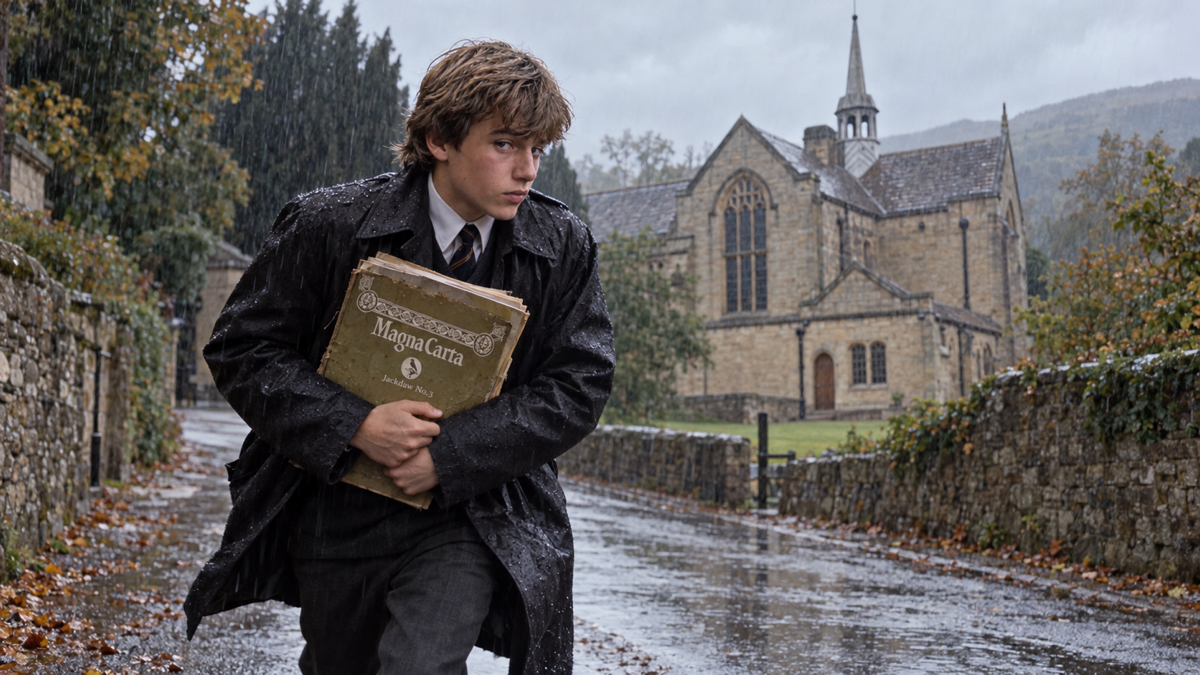
The coach engine grumbled at the kerb—a bored beast waiting to swallow boys whole and haul them back across the Pennines. In his regulation tweed jacket, black trousers and shoes, Robbie slung his trunk and tuck box into the luggage bay, satchel over one shoulder.
Cece hadn’t come. He told himself it was fine. Expected, even. A goodbye would’ve complicated it, especially with the girls hanging around the bus. Kizzy was there. Momo too. Mum gave up waiting, saying she had a long journey ahead and a new boyfriend in Warwickshire to navigate.
Robbie climbed aboard. The air reeked of Brut, sweat, and leftover Wotsits. Boys aged 14 to 18 jeered greetings, elbowed ribs, clutched copies of Shoot!, Fiesta (lifted from an older brother’s bedroom), or Cosmo (stolen from a sister’s). Robbie took a window seat near the back. Jamie Stevens flopped down beside him.
“You look smug,” Jamie said.
Robbie smiled, fingers on the buckle of his satchel, where the Form Photo was safely tucked away.
Then came the banging on the coach’s side—a muffled voice. The driver swore and opened the door a crack.
“Quick!” someone shouted. “Let me through!”
And then—Cece.
Running.
Out of breath, auburn hair was wild around her face, the kickers were muddy, and the Eastfield scarf was loose in her hands. She pushed past Jamie, grabbed Robbie’s shoulders, and kissed him. Just like that. On the mouth. Long enough for the bus to honk again.
When she pulled back, she wrapped the scarf around his neck and whispered, “Don’t lose this. I’ve had it since kindergarten.”
Then she turned and ran.
Jamie whistled. “Bloody hell.”
Robbie sat down again, eyes wide, throat tight. The scarf smelled of lavender and faint shampoo. He felt untouchable.
Robbie drifted into thought as he stared from the window.
‘We didn’t know who we were. Easter 1978 was thirty days of tuneless rehearsal—somewhere between a school disco and a conservatoire of emotional mistakes.
We’d read the theory. The Hite Report. Manwatching. Tender is the Night. I thought desire had footnotes. I thought girls had diagrams.
The boys? We saw ourselves as players—clumsy, hopeful, sometimes bold. We’d been handed the darts and told, go find music. And the girls, those who were in on the game, didn’t deny it: they saw themselves as instruments. Mysterious. Temperamental. Capable of noise or harmony. The question was—who could play them properly?
And what did that mean?
It wasn’t about sex. Not really. It was about recognition. The hope that someone might not just touch you but understand you. Make you sing. Even once. Even by accident.
Some girls knew their tuning. They had expectations. Standards. Others were still figuring it out—what they wanted, what they didn’t. Some expected boys to play, to perform, to give more than they’d ever return. Because, culturally, we told them they were the prize. Be wanted, not wanting. That was the rule.
So it was selfish, sometimes. Not in a cruel way. In a protective way. Give too much, and you risk being remade in someone else’s song. Hold back, and you can stay intact.
That’s why the under-the-stands snogs and telly-too-loud sofa fumblings mattered. They were trial runs. Experiments. Not just in biology but in identity.
What do I want?
What will I allow?
Where do I say no?
And maybe that’s all it was. A month-long tuning session. The orchestra pit before the overture. Kisses that fizzled. Touches that felt wrong. Laughter that became more memorable than the kiss that followed.
We weren’t lovers. We were learners. And now and then, someone played the right note. Just one. That was enough to keep going.
The emotional architecture of adolescent intimacy was built not through declarations or diagrams but through nudges, silences, and hesitations.
It wasn’t just about being seen. It was about learning and yearning. Two simple motivators tangled in a thousand tiny choices. That Easter, each of us was figuring out not just who we fancied but how far we were willing—or able—to go. Timing and permission mattered, too.
Some were ready. Some weren’t. Some thought they were and found out otherwise. You couldn’t tell from the outside. It wasn’t about age so much as readiness. And even then, readiness wasn’t constant. It shifted, moment by moment, breath by breath.
There were no scripts. No consent talks. We didn’t say, Can I kiss you? We said it with closeness. With eyes. With a pause that lasted a second too long. A brush of the arm. A laugh that lingered. Boundaries weren’t declared. They were negotiated—awkwardly, instinctively, with a tilt of the head or the withdrawal of a hand.
Sometimes, that boundary said, yes, a little further. Sometimes, it said, no, not now. And when it worked—when two people were in the same place, at the same pace—it felt like music. Not a crescendo. A chord. A harmony.
Other times, we fumbled. Someone reached too far or too soon. Not out of malice. Out of momentum. Out of hope. Out of fear that the moment might vanish unless claimed.
That’s why the back of the rugby stands mattered. That’s why sitting rooms with the telly turned up loud gave just enough space to try and fail in private. The world didn’t yet know what to do with us. And so we carved out these secret rehearsal rooms. These soft areas of maybe.
Each girl and each boy had their own map. Some were still sketching the outline. Others had already marked where not to go. But the point was—we had to draw them ourselves. Not having them handed down by older siblings, parents, or books that made it all sound tidy.
We didn’t need instructions. We needed a room. Time. Patience. Maybe a little luck. And someone who didn’t make you feel stupid for stopping.’
He was staring out the window as they headed out along the A66 at the rolling hills, rolling boulders (sheep to the uninitiated) and dry stone walls, composing love poetry in his head, when the sound of boys laughing loudly dragged him back reluctantly to earth with all the grace of a crash landing.
“Alright, Casanova,” someone shouted, holding up the Form Photo. “What’s that all about?”
“None of your business,” Robbie replied, trying to retrieve it.
But the smell of defeat drew attention.
Someone, it might have been his ‘friend’ Paul Peters, or maybe Jack Carr—had rifled Robbie’s satchel, looking for cigarettes or smut. They’d already laughed at his copy of The Hite Report on the inbound trip, and most boys by now had their own copy – if they’d dared buy it from Thornes (as dangerous as buying condoms from a chemist where your face was known). This time, someone pulled out the card-backed Eastfield High Form Photo.
“What’s this, then?” Mike McAdam crowed. “Ooooh, it’s a picture of the girls. All the girls.”
Laughter.
Then silence. The kind that curdles.
“Hang on—this one’s my sister,” said Mike McAdam.
“That’s Tracey,” someone added.
“She’s said some interesting things about you,” Mike said. “Apparently, you two have gone all the way, or as near as dam”.
More names. More voices.
“And that’s Donna. And—wait—did you mark this? These numbers—what the hell?”
Jamie leaned in sympathetically. “You idiot.”
Robbie reached out to grab the Form Photo back, but it had already moved down the row. Whispers became accusations.
“You were rating them?”
“It’s a bloody scorecard!”
Robbie tried to explain. “No—yes. But not like that. Talk to them, one point; make them laugh, two…”
“What, you think you’re James Bond with darts?”
Then: “That’s my kid sister, you little prick.”
Mike McAdam.
Robbie didn’t turn. He braced.
The punch landed behind his ear, a blur of sound and sting.
The bus screeched to a halt.
“OUT!” the driver bellowed. “I’m not having another bloody incident. Off. Now.”
Protests. Mike had A-levels. Robbie took the blame.
“I started it. I’ll go. Easier to hitch solo.”
He was shoved to the door, satchel clutched, Cece’s scarf still looped around his neck. The Form Photo tore in someone’s grip.
He stepped onto the A66’s hard shoulder. The wind slapped his face. The coach revved off. Red brake lights smeared into the grey drizzle.
He stood alone.
The scarf—Cece’s—fluttered slightly.
He had to choose: thumb a lift to Sedbergh, return to posh prison, or turn around.
Back to Gosforth. Back to Kizzy. Tracey. The wreckage.
Back to face it.

Leave a Reply