
Diary: M forgot his time fagging. I was ‘Head of Fags’, responsible for distributing the tasks handed to me by the House Prefects. It was far too late to correct. If complaints followed, the machine would quietly reassign tasks, reshuffle boys, and absorb the error. My tone would have been officious rather than personal—traffic-warden-like. I separated the role from the boy. I had come to loathe authority by then. At prep school, I’d already been a prefect, and I wanted no more of it here at Sedbergh. These roles were imposed from above, and I could already see the trajectory ahead: house prefect, then school prefect, the Birchenall route. I was planning my exit long before it arrived. Time Fagging required a junior boy to go along the Sixth Form ‘Cubes’, knocking on specific doors to ensure the occupant was up – the equivalent of the Victorian tapper. A dopey soul, M, like the character Dillon from the Magic Roundabout, always looked half asleep. He was tall, startlingly blonde and lanky – he looked down like a street lamppost on everyone.
M himself sits oddly in my memory—an acquaintance rather than a friend. We shared little in the way of form, games, or activities. Once, on a Sunday Exeat, he came with me to my father’s, and later I spent a day out with his parents at Morecambe Bay. Years later, he was expelled for refusing to take a caning when he wouldn’t open his tuck box for the Housemaster. I don’t blame him. I’d have done the same. Perhaps that retrospective knowledge colours him with a muted respect now.
Do last terms fagging for two weeks.
Breakfast. Our house refectory, or dining room, was brightly lit by a huge south-facing bay window, with a head table where, if present, staff sat with the prefects. There were then a dozen tables, each seating eight or more boys, I’m guessing. There were around 60 boys per house, 12 per year group, 3rd, 4th, 5th, Lower 6th, Upper 6th. A window with a head table where, if present, staff sat with the prefects. There were then a dozen tables, each sitting eight boys or more, I’m guessing. There were around 60 boys per house, 12 per year group 3rd, 4th, 5th, Lower 6th, Upper 6th.
Pack bags. This makes no sense. I’d unpack my trunk of clothes. I’d stack my tuck box somewhere. Perhaps collections of clothes came with bags: a rugby kit in a bag for a hanger, school clothes in another, sheets in another, and so on. All items had embroidered labels stitched into them by Mum.
Do Birchenall’s shoes.
P and I had a pair of shoes each to clean every morning; we did a shoe each. I’d like to think we had the sense to take turns doing this, though early on we may both have been under the awning of the rear House yard, picking out dirt and giving each shoe, brogues if I recall, a rub and polish. That was it. Birchenall, possibly the Head of House, didn’t believe in ‘fagging’ duties and gave us nothing more than this token task. Other prefects were far more demanding of their ‘fag’.
Classes: Steven and Shaw are new in my Form.
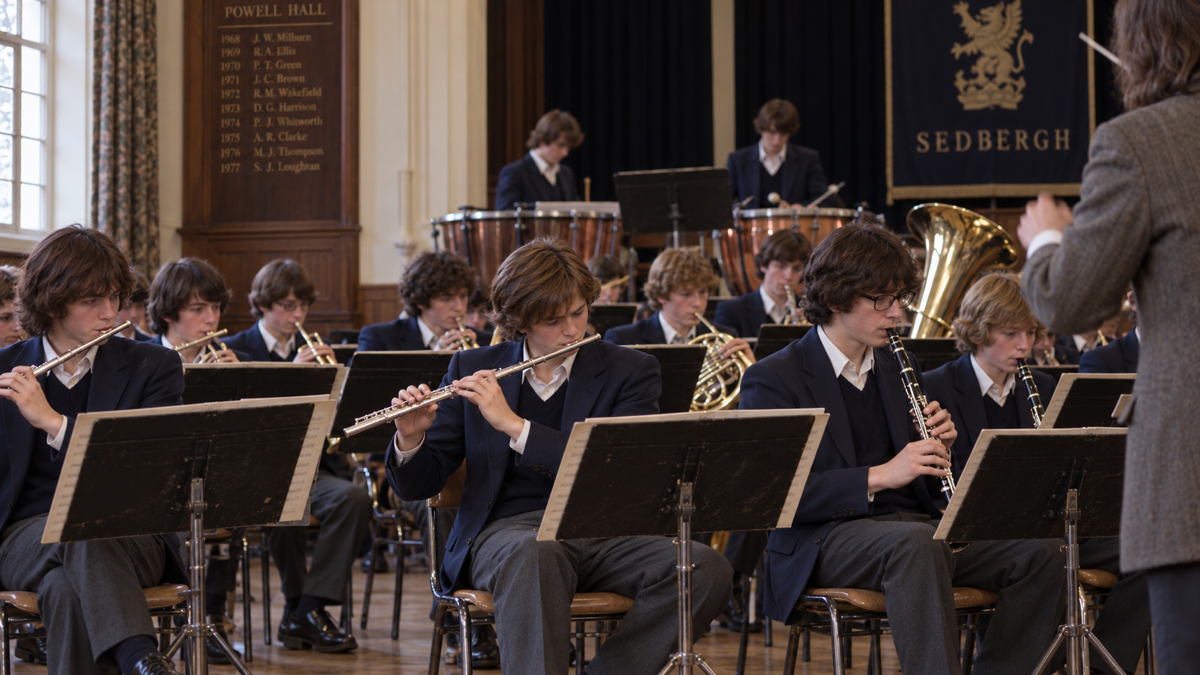
I was indoctrinated to know and call boys by their surname. I recall neither. I’d see boys from other houses in classes and activities we had in common. There were friends and acquaintances from home and from my old prep school, Mowden, whom I may not see at all except in passing during morning assembly or at Chapel. We rarely had the opportunity to interact. Overlap came in common activities: swimming, choral society, orchestra, brass band and the project centre.
We quickly learnt which boys were new to the boarding school experience and those who were completely new to it.
Chemistry: Copper experiment. I didn’t pay much attention to chemistry lessons. The language of it lost me early on and I never caught up. I fell behind and couldn’t see how or when I might catch up. I should have asked for help. I didn’t. That decision—silent, practical—sorted me more firmly into the future I thought I recognised.
English II: New books: Silas Marner and A Midsummer Night’s Dream. I guess, like the O’ Levels we’d be taking, Eng I was Grammar and Eng II was comprehension. I sat somewhere in the middle, next to a window. Neither a teacher’s pet nor one of the bad lads. I was always eager to read and have a ‘good part’, not least because just reading along was so boring. Wanting “a good part” meant wanting to read aloud. The actor in me was already stirring.
Physics: Go over exams. The teacher was excellent. Clear, precise and practical. I quietly did well. Guiltily. I think even then, those with an interest in the arts and those with an interest in sciences were different.
Break: A chocolate spread sandwich with hot chocolate.
Latin: Side track. The elderly, booby-dangling former climber, organ player and confirmed bachelor, the Rev. A.T I. Boggis, taught Latin in the most traditional of form rooms with high ceilings and individual wooden desks replete with inkwells and engraved names. He was of a different era and spoke of using Latin as a lingua franca around the monasteries of Europe. I assume his ‘side track’ was a story of his former prowess and escapades, which had nothing to do with conjugating verbs.
Maths: locus. Mr Hedges was excellent, he gave you time and helped you figure it out. I didn’t mean to do well at maths but I did. I got it, most of the time.
Lunch. Back at the House. Lunch was served through the kitchen hatch. I can’t recall whether it was brought into the dining room or served to each table for us to take potluck. It was standard school fare. Edible, hearty, meat-based and adequate. We sat largely by year group, rarely straying. How older boys ended up at our tables—or we at theirs—I can’t now recall. The architecture I remember, the social choreography less so.
Games. I’m fit, having recovered from my broken leg. Must have been the amount of swimming I’ve been doing. Very hard. Stiff.
I don’t recall who had declared me fit to play rugby. After a serious broken leg, I had thought I was excused from rugby for the season and would only swim. It would appear that four months of regular hard swimming had put enough muscle on my leg to declare me ‘fighting fit’. Someone had reported me fit for rugby. Most likely, my mother, unwittingly, had told the Housemaster how much swimming I’d been doing and that the orthopaedic surgeon had cleared me fit. Four months of hard swimming had rebuilt my leg too well. My recovery was no longer mine to manage.
My only desire was to swim. Instead, I was now being picked for House Rugby. Despite being a leading light in prep-school rugger, always in the pack, I kept a low, useless profile so as not to be picked for school rugger training. At Sedbergh, rugger was not just hearty; it was brutal, vicious. A violent fight. No wonder there were injuries.
To recover from a broken limb, swimming did a very good job – too good a job.
School sport was a five to six day a week affair: train weekdays with a match at the weekend. I’m thinking 2:00pm – 3:30pm or 4:00pm. We had further afternoon school lessons all days except Wednesday.
Running and training on my feet would have used very different muscle groups. Didn’t I know it. Part of the Sedbergh life meant road and fell running. And squash or even Fives. Some tennis.
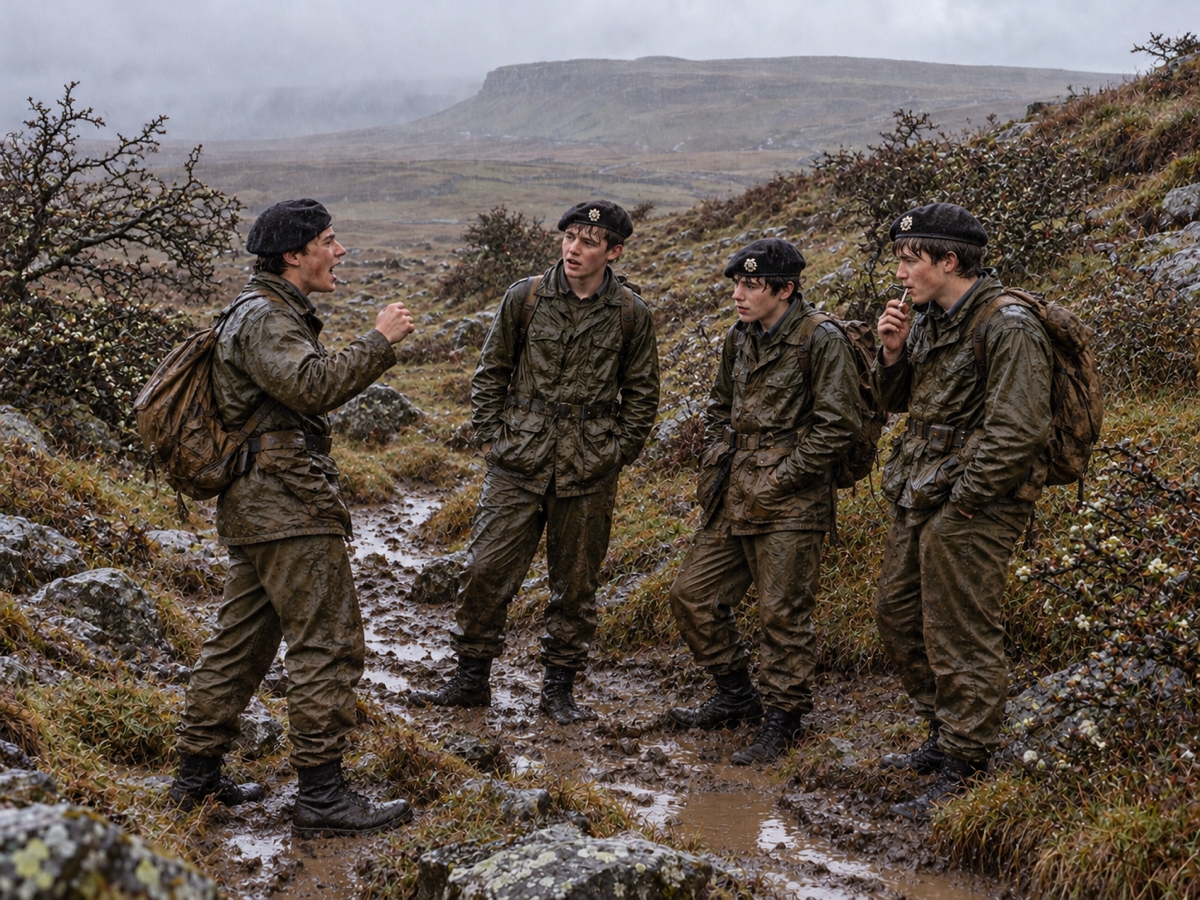
We were taught to brutalise opponents early—boot first, literally. No quarter. Studs scratched rough on the tarmac to cut and scare. Hands inside shorts, clinging to belts. Feet on exposed limbs in rucks. Torn fingernails, black eyes, swollen lips, cauliflower ears, sprains, and concussions. Played in rain, frost, wind, and snow. North Yorkshire Moors weather. Relentless. Swimming was control; rugby was surrender.
Afternoon Classes: Read Theseus. Go over Chan 7 French. Dixon Wise men. I think these are all evening classes. I can recall nothing about them.
Supper.
Evening prep: (Supervised ‘homework’) ran from 7:00pm to 8:30pm ? Or to 7:45pm, I don’t recall. This was done in silence across the House with all boys at their desks or in their studies.
Write Five-Year diary. Held in my common room locker. Later, pilfered and excerpts read out. This may explain why I stopped writing in it for much of the rest of January and February, and why I picked it up again once I was home for the school holidays. Just a few more cryptic postings of what lessons I had, and why prep is completed, and I give up from the unchanging monotony of it. No wonder I was soon hatching schemes to leave.
Once again, the same limited contacts, with pecking order and ‘watch your nip’ additional boundary markers to stay in your year group regardless of age. With a September birthday myself, plenty of the boys in the year above were only a little older than me, by a month or two. Some developmentally, by biological age, are younger-looking.
Evening Break: Chocolate spread sandwich with hot chocolate.
All eating and meals was done back at our House. For us Winder boys rhis meant the longest schlep from the school buildings last the Chape, along Lipton Lane, past the Sanatorium and Squash Courts to our house. We had access to a communal space next to the kitchens to boil kettles and make toast. Bread and butter was supplied. Milk and tea bags too. We got our stuff from our own tuck boxes. So I’m into chocolate spread (like Nutella), and Hot Chocolate.
We had a break after prep, before being sent up to bed. Our junior year first with only 3rd formers in one or more dormitories.
Bed: I don’t recall when we were sent to bed. By year group. Change into PJs, communal washroom, junior boys in an open dormitory, everyone from 4th form in cubicles: imagine a ward with 12 beds against the wall on either side. Now out each bed in a wooden stall, like a stable block. Put a chest of drawers and a bedside chair with each metal-framed bed. That was it. Some hooks. Cube sides 6ft high? You could climb up and look over.
Second Prompts
Packing remains oddly blurred.
The labels were there—J F Vernon, perhaps with Winder, or earlier still Vernon Mi. They tethered me to home, though I barely noticed them then. Soon enough I began packing illicit home clothes—flared jeans, a T-shirt, maybe a jumper, later cowboy boots—escape clothing, unlikely but symbolic.
Birchenall himself stood apart from other prefects. Imagine Dave Bautista with permed red hair: a thoughtful prop-forward in the senior XV, wearing a red colours jacket. He gave us almost nothing to do—just the shoes. I knew how to clean shoes; I’d done my own for five years at Mowden. I did the job properly but without excess.
Names mattered. At home, first names returned easily. In school, surnames dominated—especially for juniors and seniors, and all manner of nicknames. Among peers, first names sometimes surfaced, but the institutional habit persisted.
Physics brought success and guilt.
I did well, quietly. Guiltily. I saw myself as a poet, artist, performer—not a physics or engineering type. The success felt like a trespass across imagined boundaries.
The walk back to Winder House was long. I might have limped, and that could be noticed. We wore grey raincoats and carried briefcases. Only prefects were allowed umbrellas. Inside, autonomy returned in small ways: kettles, toast, tuck boxes.
Latin was taught by the Rev. A. T. I. Boggis—elderly, eccentric, long past his prime. He wasn’t a role model. These schools didn’t retire old teachers or abandon old traditions. His digressions were part of that fossilised inheritance.
Maths was different.
Mr Hedges had real authority, the kind that came with patience. Like John Keating in Dead Poets Society, he came to your desk, took the time, helped you understand. Straight As followed in Maths and Additional Maths at O Level.
At lunch, puberty revealed its uneven cruelties. Some boys could grow beards in days; others—like me—barely needed to shave. Some shot up early; others lingered childlike, voices unbroken well into their teens.
Rugby was institutional violence.
At night, the body paid its dues. Dormitories allowed a kind of contained conversation; cubicles magnified hierarchy. Older boys dominated. Most retreated into pornography or pornographic thought and then slept.
After lights out, whispers travelled only to adjacent beds. Stories circulated—of sex, of siblings, of experimentation. It has taken fifty years to recognise the plausibility of some of them. Boys separated for most of the year in single-sex schools were desperate to know, to try, to understand. “Sex-starved” wasn’t metaphorical; it felt physical.
I fell asleep easily but woke early, restless. Against house rules, I could be up and out by 4:30 am. Occasionally, I’d find another boy already awake, sitting on the grass tennis court, catching the early light.


Leave a Reply