
Memory matters. Memory fascinates me.

The project I am undertaking is part memoir, part historical enquiry, part psychological excavation. And I’ve barely started. I kept a diary from age 13. I aim to transcribe every entry over the next decade. I ought to complete all entries for 1975 to 1978 by the end of this year. It could take a couple of years to get through 1980 to 1982 because on several occasions I moved away from the line limitations (seven lines per day) of a Collins Five Year diary to fill entire archlever files and A4 notebooks.
The diary is the primary source. Memory is the unstable witness.
The older self is the historian, educator and storyteller. The younger self is the original observer.
At its heart, the project asks:
What can a few daily crumbs of memory tell us about a life, an education, and the person a boy was becoming?
As this project unfolds, I find myself becoming as interested in memory as in the events themselves. What am I recovering? What is genuinely remembered? What has been reconstructed? What is my truth, and how does it differ from someone else’s? Though nothing here will be tested in a court of law, I’m aware that events can always be viewed from more than one perspective.
What is surprising is that I am not merely recovering facts. I am recovering networks of associations.
For example, a 1977 diary entry might contain in its lines the cryptic words:
Cold Pool. Hungarian. Dur.
At first glance, they appear meaningless.
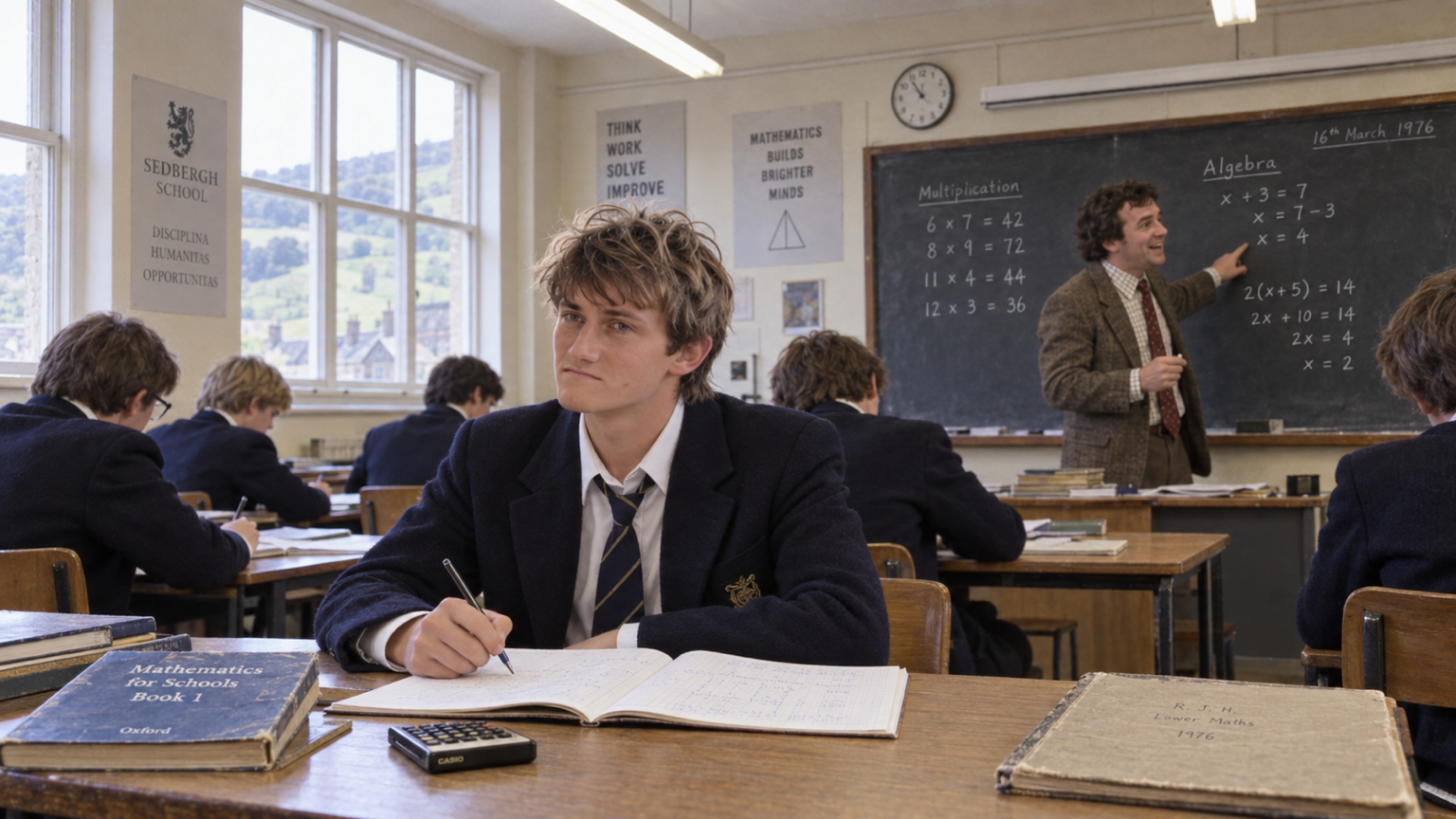
The Cold Pool wasn’t outdoors – it was the school swimming pool at Sedbergh. “Hungarian” sounds more like House supper – goulash, which had me thinking of grissle and the contents of the slop bowl. While “Dur” leaves me boggled. If it is ‘Dur’ at all. My handwriting, always inked from a fountain pen, was somewhat splotchy in my early teens.


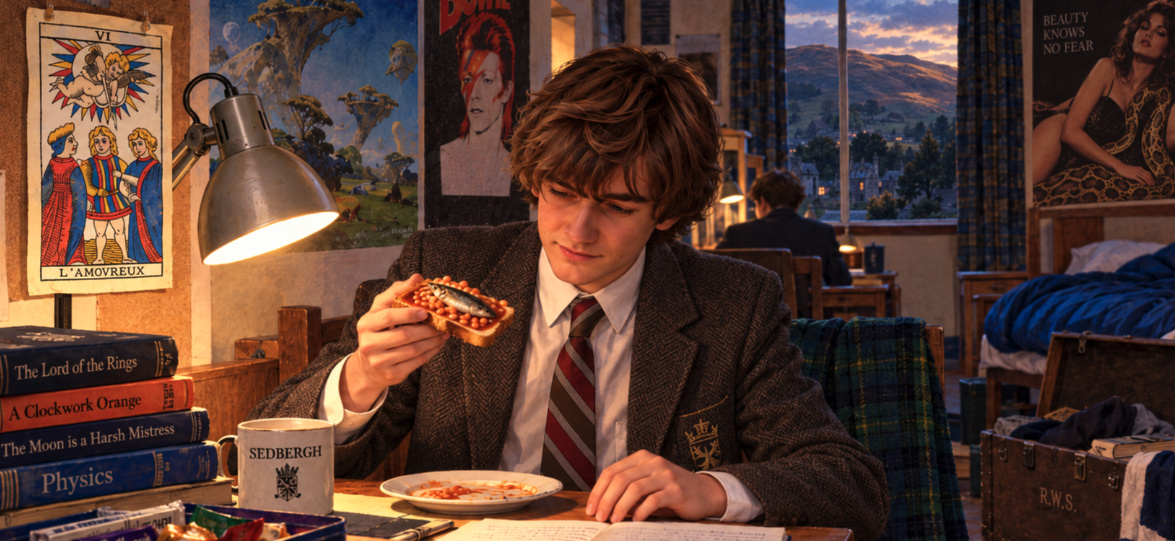
What continually surprises me is how tiny cues can release an entire scene. A single phrase, such as Sandwich Spread, Roger Dean, Tartan Rug, Tuck Box or Cube, or Fagging can bring back a room, a smell, a social hierarchy, a feeling in my stomach, even the weather.
Neuroscience suggests that autobiographical memories are distributed across networks of sensory, emotional, spatial and social associations. Remembering is less like retrieving a recording and more like rebuilding a scene from fragments.
The diary acts as a retrieval cue. A diver’s guide rope in murky water.
What makes this project unusual is that I possess something many people do not: my contemporaneous records written every day. Most adults trying to recall age fourteen have a handful of photographs and family stories. I have thousands of prompts written by the fourteen-year-old himself. Rarely a day missed. Not one from 1976 to 1980!
The most evocative entries are often not the dramatic ones but the trivial:
Rain all day.
Had sausages.
Went swimming.
These details were never intended to be literature. They were markers. Yet fifty years later, they become coordinates from which an entire vanished world can be reconstructed.
One of the most revealing discoveries concerns what psychologists call the Peak-End Rule. Associated with Daniel Kahneman, it suggests that we tend to remember the peaks, transitions and endings of experiences rather than the continuous experience itself.
When I think of school, I can readily recover:
- breaking my leg,
- my first day back,
- humiliations,
- fights,
- remarkable teachers,
- spectacular pranks,
- girls.
The hundreds of ordinary Tuesdays between them are far harder to visualise.
Without the diary I might remember only:
I swam in the Cold Pool.
But the diary adds:
French test. Cold Pool. Hungarian.
Suddenly, a sequence emerges.
The classroom before the swim. Changing into trunks. The smell of chlorine. Walking back to House. Supper.
The peak remains the strongest memory, but the diary supplies the scaffolding around it.
As a historian, I find this fascinating.
Primary sources are the gold dust of historical research. Here I possess thousands of them. Most are brief. The earliest entries occupy just seven lines of a Collins Five-Year Diary. By 1978, I had overflowed onto a further seven lines. Later came A4 notebooks, ring binders, French Exchange journals and six months of Alpine ‘Seasonier’ diary entries.
The question I increasingly ask myself is whether longer entries reveal more than shorter ones.
Perhaps they do.
Or perhaps they merely reveal different things.
The short entries have a particular power. Because space was limited, I recorded only what floated to the surface.
Physics. Muck about.
Cold Pool.
Hungarian.
That was enough.
Had I attempted a page every evening analysing friendships, ambitions, loneliness, family tensions and adolescent confusion, I suspect I would have abandoned the practice within weeks. The Five-Year Diary survived because it was sustainable.
Unlike Pepys, I never wrote “and so to bed”, although I was usually sitting in bed when I wrote the entry.
The result is that much of life appears exactly as it was experienced: routine.
A conventional autobiography compresses years into a sentence:
The next few years passed uneventfully.
My diaries refuse to do that.
They reveal that “uneventfully” consisted of:
- lessons,
- tests,
- swimming,
- meals,
- prep,
- weather,
- boredom,
- friendships,
- minor victories,
- narrow escapes.
I often think of life as a pinball machine. Memoirs focus on the moments when the ball strikes the bumpers.
Ping.
A broken leg.
Ping.
A first kiss.
Ping.
University.
Marriage.
Children.
Career.
Yet much of life is spent avoiding the bumpers altogether, drifting quietly through the machine.
Another image comes to mind: the old buzz-wire game. A bent wire, a metal loop, a battery and a buzzer. The challenge is to move from one end to the other without touching the wire.
Can you get through the day without being buzzed?
Can you avoid punishment?
Embarrassment?
Failure?
Trouble?
Most days were not triumphs or disasters. Most days involved a cold swim and supper in the House. The diary preserves precisely that texture of ordinary existence.
Neuroscientists distinguish between semantic memory and episodic memory.
Semantic memory consists of facts I know.
Episodic memory consists of moments I can re-experience.
I know, semantically, that Sedbergh possessed a Cold Pool.
But a diary entry can suddenly convert that knowledge into experience.
The echo of the changing rooms.
The cold tiles.
The colour of the water.
The walk back to House.
The cue unlocks the scene.
Not all memories are equally reliable.
Some are family folklore. I can visualise being pushed into a door and needing stitches. I can picture a childhood accident involving a school tie and another set of stitches. Yet I am not certain whether I remember the events themselves or have absorbed them from repeated retelling.
Likewise, I sometimes discover how self-centred adolescent memory can be. I remember the room, the lesson and my own emotions. I do not necessarily remember who was standing beside me.
Yet I might remember a girl’s name because I was thinking about her.
The Diary exposes such peculiarities.
It also reveals how memory depends upon cues.
For me, these include:
- Roger Dean posters,
- A 3d bus ticket,
- Mars bars,
- Heinz Sandwich Spread,
- salmon paste,
- McEwan’s lager,
- banana Angel Delight,
- tuck boxes,
- trunks,
- buses,
- teachers’ nicknames.
Historically insignificant.
Neurologically invaluable.
The diary often preserves the cue but not the story.
The fourteen-year-old Jonathan wrote the minimum necessary because he already knew the context. Fifty years later, I am attempting to reverse-engineer that context from a handful of breadcrumbs.
The process resembles archaeology.
The great peak memories are castles and cathedrals.
The diary entries are pottery shards, post holes and soil stains.
Old books, photographs, record sleeves, crucifixes, Tarot cards, television clips and songs become artefacts recovered from the same excavation.
Individually, they seem insignificant.
Together they reveal the shape of an entire vanished landscape.
Perhaps the most intriguing aspect of the project lies in the tension between the boy who wrote the diary and the man who now reads it.
The boy records.
The man interprets.
The boy had no idea where his life was going.
The man knows what happened next.
Sometimes they agree.
Sometimes they do not.
History asks:
What happened?
Memoir asks:
What did it feel like?
The Diary allows a third question:
What did I think was happening at the time?
That question can be surprisingly uncomfortable.
A teacher I disliked may have been doing his best.
A parent I judged harshly may have carried burdens I never understood.
Some things normalised in the 1970s now appear worse than I realised.
The diaries do not merely recover memories. They challenge narratives I have lived with for decades.
That discomfort is not a flaw in the project.
It is evidence that it is reaching somewhere real.
Because memory is not reproductive, it is reconstructive.
We do not replay the past.
We rebuild it.
The value of memory lies not solely in whether events happened exactly as remembered, but in what those memories reveal about the person remembering them.
The diaries have power not because they are objective.
They have power because they are immediate.
A fourteen-year-old boarding-school boy was not writing for publication. He was not constructing a public image or settling old scores. He was jotting down enough to remember the day.
And somehow, in those few words, entire worlds survived.
Fifty years later, I am still following the guide rope back through the murk, hoping to discover not only what happened, but who I was, and perhaps how I became the person I am.


Leave a Reply