Are you a lifelong learner?

Lifelong Learning in a Changing World: Curiosity, Technology and the Pursuit of Understanding
Yes, absolutely. In fact, I have come to believe that lifelong learning is not merely desirable but essential—not just for career development, but for remaining engaged with life itself.
Looking back, I can see that curiosity has been one of the few constants in a life that has otherwise changed direction many times. As a child I was forever asking why. Adults sometimes found it exasperating. I wasn’t being difficult, seeking attention or trying to be clever; I genuinely wanted to know. Why did things work the way they did? Why was the world here? How did people fit into it? Once I learned to read, books became a way of pursuing answers. Human anatomy, geography, gardening, science, space exploration—it scarcely mattered what the subject was. What fascinated me was the possibility that understanding existed if only I looked hard enough.
At one point my parents took me to a child psychologist because I was thought to be hyperactive. His conclusion was rather different: I was bright, easily bored and needed to be kept mentally and physically occupied. Swimming became one outlet. Reading became another. Yet even then I was up early, sticking my nose into everything and asking questions.
That sense of wonder never really left me. Life amazed me. The world amazed me. I wanted to know why it was here, how it worked, where I fitted in—and where we fitted in.
Over the years I have had a variety of jobs and careers. I have worked in advertising, magazine sales, television and video production, online communications, e-learning, coaching, local government, history and education. For by far the longest period I worked as a producer, director and writer in television and corporate communications. Most of these careers required learning almost from scratch. Fortunately, learning on the job suited me. I joined professional bodies, attended workshops and conferences, listened to people who knew more than I did and tried things for myself.
Technology repeatedly forced me to learn. I learned to type on a manual typewriter, then moved to an Amstrad computer in the mid-1980s, followed by a Mac Classic and a succession of Macs ever since. I learned spreadsheets, scheduling software, scriptwriting tools, websites, blogging, social media, video editing and online publishing. I still have my old CompuServe email address, now absorbed into AOL. I was keeping diaries until the early 1990s and blogging almost daily by 1999. More recently I have found myself studying artificial intelligence through the Open University.
Every technological revolution made something else obsolete. Yet I never viewed that as a threat. Learning was simply the price of remaining involved in the world. You can either adapt and remain engaged or gradually become disconnected from how things work.
Formal education has also remained important throughout my life. Oxford gave me the opportunity to study alongside some exceptionally intelligent people. Much later I found myself studying with the Open University, gaining a Master’s degree in Open and Distance Education and then continuing with additional modules. Before that there had been the School of Communication Arts, which transformed the way I approached creative problem-solving. The Open University changed me in a different way. Reflective writing taught me to think through my own evolving understanding of a subject. It taught me that learning is not simply acquiring information but examining how your thinking changes over time.
What postgraduate study gave me was something experience alone could not: space to think, confidence in methods of enquiry and the discipline to develop ideas properly.
Language learning taught me another lesson. I struggled with French at school. Yet years later I found myself living and working in France, translating, conducting interviews and dreaming in French. The breakthrough did not come from textbooks. It came from immersion. Living in Val d’Isère taught me that language is far more than words on a page. We communicate through gesture, expression, tone and context. Even now I continue using Lingvist, not because I cannot communicate, but because language is a muscle that needs exercise. I want to expand my vocabulary, keep it alive and stay in tune.
For a time I even thought of my French-speaking self as a different person. Dreaming in another language changes the way you see both yourself and others.
Learning has rarely been passive for me. Painting murals taught me about scale, collaboration and perspective. Directing a Channel 4 short film taught me that conflict lies at the heart of storytelling and that powerful stories can be told simply. Acting in Shakespeare showed me that art is fundamentally a team activity. Twenty-five years of blogging taught me that small observations accumulated day after day eventually become something enormous. A paragraph today, another tomorrow, and before long you have built a substantial body of thought and memory.
Perhaps the greatest surprise has been how much I have learned through teaching. As a mentor, trainer, learning technologist and swimming coach, I have repeatedly discovered that teaching deepens understanding. Ideas evolve when you explain them to others. Weaknesses are exposed. Assumptions are challenged. You discover gaps in your knowledge that were previously invisible.
As a swimming coach I am reminded constantly that no two individuals learn in quite the same way. Even within a squad of ten-year-olds, every swimmer is different. What works brilliantly for one may fail completely for another. Teaching is not the opposite of learning. It is part of the same process. Rather than a straight line, I think of it as a spiral. You revisit ideas repeatedly, each time at a deeper level.
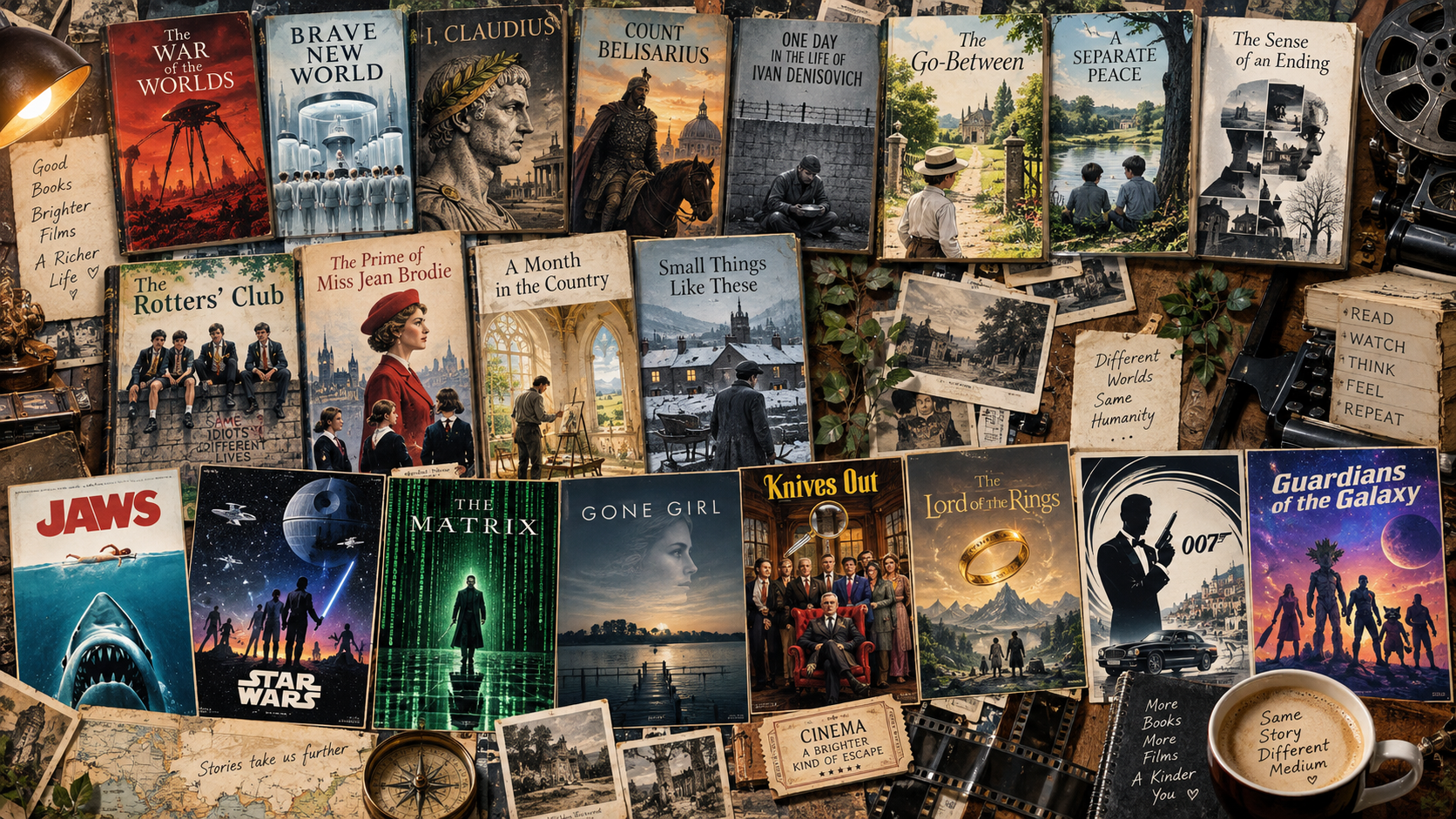
Curiosity remains central. I still read authors as different as Robert Heinlein, Karl Ove Knausgård, J. G. Ballard and Vladimir Nabokov because each offers a different way of seeing the world. Love stories, horror, memoir, history, science fiction, adventure—I enjoy both literary masterpieces and well-written pulp. Variety matters.
Some of the subjects that now fascinate me would have surprised my younger self. Philosophy, politics, football and town planning have all become important interests in my sixties. Often one book leads to another, which leads to an article, then a course, then a practical project. Recently that process brought me back to the Open University to study artificial intelligence. I trust the Open University. I know I am not being sold a product; I am being invited to think.
Life itself has also been a teacher. My parents’ divorce taught me that ultimately you are on your own. Boarding school taught me self-reliance. Raising children taught me sacrifice. Marriage, coaching and local government have taught me that most of us share the same basic hopes, fears, compulsions and vulnerabilities. We are here briefly. We grow older. Much of what seems important turns out to be temporary. Enjoying the ride matters more than we often realise.
One of the greatest joys of learning has been learning alongside younger people. Students, colleagues and swimmers constantly introduce me to ideas, technologies and perspectives I would otherwise miss. Young people tend to possess an optimism that is both refreshing and infectious. Remaining intellectually young has less to do with age than attitude. It requires an open ear, an open mind and the willingness to follow a passing comment into a website, then into a deeper enquiry, then into books, then perhaps into a course and finally into practical application.
I do not think the opposite of lifelong learning is ignorance. Learning can be extraordinarily specialised. An artist who spends fifty years painting the sea is still a lifelong learner. The important thing is not breadth but engagement.
Perhaps the most significant lesson I have learned concerns educational technology itself. Forty years ago I was convinced technology would solve everything. We would learn from cassette tapes while asleep. Then through computers. Then online. Then through games and simulations. Then through mobile devices and AI.
What I have gradually realised is that we are coming full circle.
Technology is immensely useful. It can support learning, extend access and provide remarkable opportunities. But genuine learning still requires engagement, effort, interaction, reflection and struggle. It requires an enquiring mind willing to encounter failure as well as success. The best educational technologies support these processes; they do not replace them.
So am I a lifelong learner?
Yes. But not because I have accumulated qualifications, attended courses or embraced new technologies. I am a lifelong learner because I remain fascinated by the same question that fascinated me as a child:
How does the world work, and how do people find their place within it?
Everything else—books, courses, careers, languages, coaching, technology and writing—has simply been another way of exploring that question. And I suspect it will continue to be so for the rest of my life.


Leave a Reply