
Dream: I tried to recall these dreams while semi-conscious, but did a poor job of it.
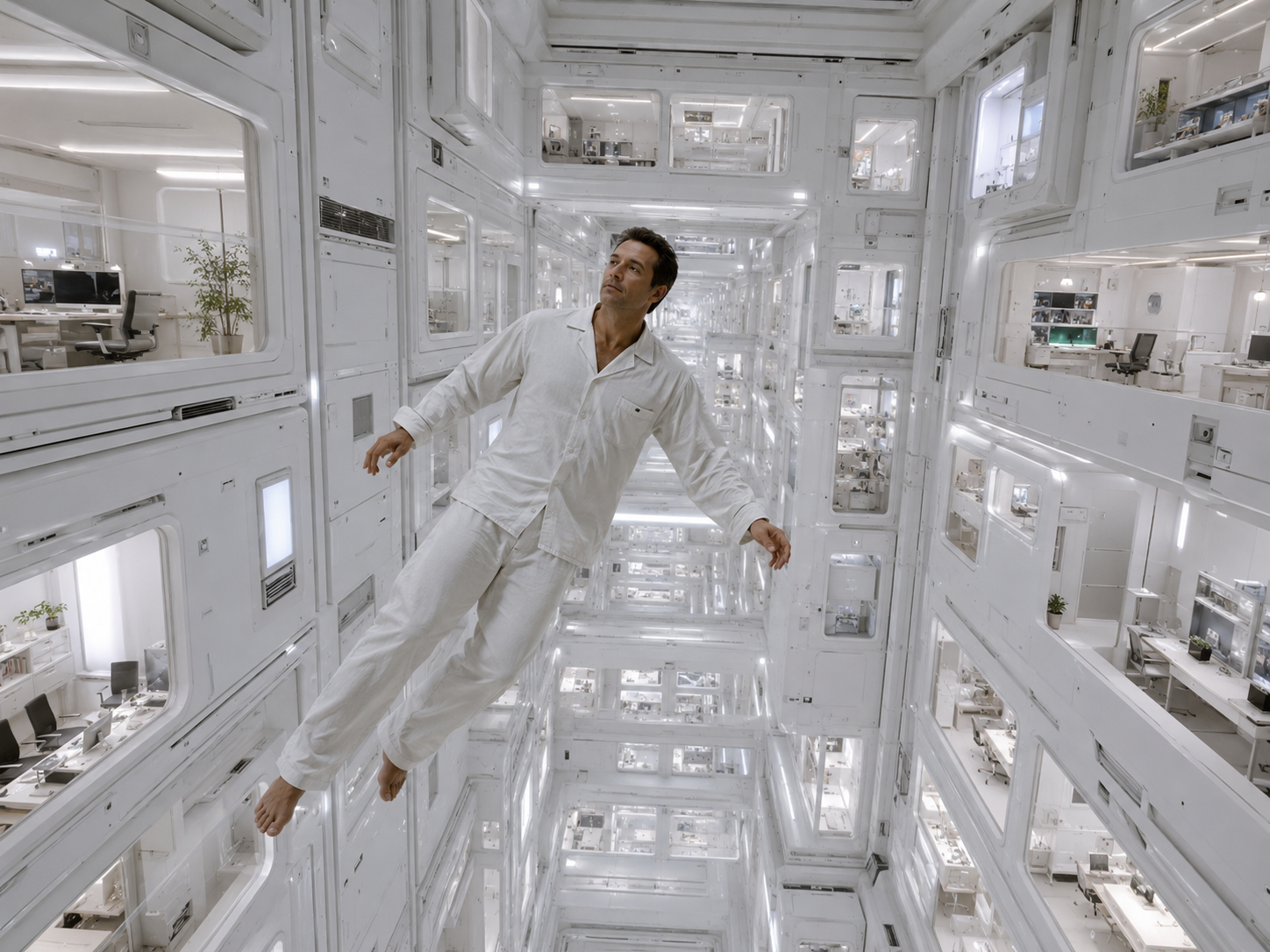
I am falling through a building. Not exactly the lift shaft as such, but each floor is open plan, and I can see what is going on. It was more akin to passing through a low- or no-gravity environment in that respect. What I can’t recall is the work I did or my colleagues. It was bright, white and breezy with white cotton drapes and coverings.
Then I’m in a different kind of office space. I keep being reminded of the layout of the remains of Housestead Roman Camp – and yet this was a functional, open-plan space. And once again, something work-related. It was bright with white cotton coverings.
Finally, I am passing through a city environment, London or Paris or a combination of the two, on foot and public transport – the underground system in particular. Although I am with my children who look about eight and ten years old, they speak and behave as adults. My son, in particular, who may have been pulling a trolley, appears most in charge of taking us wherever we are going.
My Approach to Jungian Dream Analysis
My approach to dream analysis is Jungian in method but is conducted through a carefully structured dialogue with AI. I begin by recording the dream as fully as I can, including fragments, uncertain details, atmosphere, setting, sequence, people, objects, bodily sensations and the emotional residue left on waking. I then prompt the AI not to decode the dream through fixed symbolic meanings, but to use Jung’s spiralling method: returning repeatedly to the same images from different angles until my own associations begin to disclose a pattern.
The core prompt
The core prompt asks the AI to use context-specific questions to help me elicit a personal and unique interpretation of the dream. Rather than offering immediate conclusions, it asks about emotional charge, biographical connections, recurring settings, relationships, transitions, omissions and contrasts between waking life and dream experience. Each round of questions forms another circle around the material. One image may be approached through memory, another through work, family, childhood, place, bodily sensation or present circumstances. The aim is not to force coherence, but to allow connections to emerge gradually.
I then feed my responses back into the process, marking them clearly so that the AI can distinguish my associations from its questions. These answers may include precise memories, corrections, unexpected links, emotional reactions, present-day parallels and newly recovered details from the dream itself. The AI uses this material to refine the next series of questions and to build a provisional interpretation. That interpretation remains open rather than definitive: it is tested against my experience, revised where necessary and deepened through further spiralling.
The value of AI in this process
The value of AI in this process is not that it interprets the dream for me. Its role is closer to that of a disciplined interlocutor: it remembers the emerging pattern, notices repetitions and contradictions, asks questions I might not have asked myself, and keeps the inquiry moving without imposing a universal dream dictionary. The meaning remains mine because the decisive material comes from my own memories, associations and emotional responses. AI provides the structure, continuity and range of questioning; I provide the individual key.
The first dream: the institution that never ends
The advertising agency is not merely a remembered workplace. It appears as a structure of consciousness: rank, codes, conformity, competition and the continuous performance of belonging.
Its resemblance to boarding school is especially revealing because the agency repeats the school’s social architecture while removing its most tolerable feature: the knowledge that the term will end. Boarding school, however oppressive, had boundaries. The agency presents the same system as adult permanence. The adolescent institution has become an indefinite career.
That may explain the particular horror concealed within the otherwise ordinary workplace. You had escaped one hierarchy only to discover that adult professional life could reproduce it indefinitely.
The presence of women complicates the image. At university, you had known women largely as intellectual and social equals. In the agency, you encountered an older, gendered hierarchy: men directing, women serving, and relationships formed within unequal professional roles. The agency therefore represents not only personal nonconformity but an entire social order that you could neither fully accept nor comfortably inhabit.
You were not merely a poor fit because you disliked commercialism. You were a poor fit because the organisation asked you to participate in a model of human value based upon rank, fluency in unwritten codes and adaptation to institutional power.
By contrast, the television production team offered something psychologically different. It was an équipe. Rank existed, but rank was functional rather than existential. The director, producer, camera operator, sound recordist, editor and production assistant had differentiated roles because the production required them. Authority served the work.
That distinction is fundamental:
- In the agency, the individual exists to sustain the hierarchy.
- In the production team, the hierarchy exists to sustain the collective act of creation.
The dream may therefore be contrasting two forms of organisation: the status institution and the creative organism.
Drifting away rather than resigning
Your phrase “drift away” is psychologically precise. It describes a recurring method of departure that avoids confrontation, spectacle and explicit rupture.
You have often left organisations either voluntarily or through redundancy, but in either case you have preferred to reduce the drama. There is no theatrical rebellion, no leap from the window, no denunciation of the institution. Instead, you become progressively less attached until you are elsewhere.
The dream magnifies this habitual withdrawal into a liberating physical image. You do not fall from the building. You flare away down a zero-gravity corridor.
This is not defeat. Nor is it expulsion. It is a withdrawal of psychic investment.
The institution loses its gravity.
That is perhaps the deepest significance of the zero-gravity image. Gravity ordinarily determines orientation: up, down, danger, impact. The agency has its equivalent gravitational system—rank, approval, promotion, salary, professional identity. Once those values cease to hold you, the institution cannot keep you in place.
You move according to the direction of your own initial impulse.
The bright descent: freedom with available choices
The descent is not into darkness, chaos or oblivion. You pass multiple spaces and feel that you could pull yourself into any one of them.
This changes the image from one of falling to one of radical optionality.
You are not trapped in a predetermined chute. Nor are you being transported to a single unavoidable fate. The corridor contains openings. Each remains available, but none compels you.
This corresponds closely to your actual preference for freelance and self-directed work. You did not crave the burdens that the agency offered as rewards: status, authority, approval or a prescribed professional identity. You valued the capacity to enter and leave projects, to contribute distinct skills, and to preserve autonomy.
The dream therefore may not be showing your liberation from responsibilities you once desired. It may be affirming a lifelong refusal to confuse institutional elevation with meaningful achievement.
Yet there is also a possible shadow here. The ability to enter any space may coexist with the habit of entering none permanently. Freedom from institutional gravity can become a genuine vocation, but it can also make lasting attachment difficult. The dream does not condemn this. It places the question before you.
At what point does freedom become mobility, and at what point does mobility become evasion?
The white chamber: history under cover
The second dream now seems less like heaven and more like an archaeological chamber.
The white linen is freshly laundered, but it covers something older: perhaps a house, perhaps an excavated Roman fort. This creates a striking conjunction between purity and antiquity, domesticity and archaeology, marriage and burial.
A house covered in sheets is neither fully inhabited nor abandoned. It is preserved in stasis. The objects remain present, but their ordinary uses are suspended. Similarly, an excavated Roman structure covered for protection has been revealed but not yet interpreted or opened to ordinary life.
Your feeling that you might be “researching something that was yet to reveal itself” is therefore central. The solitude is not loneliness. It is the solitude of the scholar, archaeologist or witness.
You are content because no one is ranking you. Nothing is demanding immediate performance. The hidden structure is allowed to disclose itself gradually.
This may reflect your particular relationship to memory. You do not merely revisit the past nostalgically. You excavate it: diaries, places, careers, dreams, childhood institutions, family histories. You uncover fragments, preserve them, compare them and seek the larger structure they imply.
The white covering may therefore represent a protective layer placed over the psychic past. Something has been uncovered, but it is not yet ready to be handled casually.
The association with a wedding adds another possibility. Wedding linen suggests commencement, preparation and a house about to be inhabited. Archaeological covering suggests preservation of what is ancient. The chamber may consequently unite what has been lived with what is yet to begin.
It is both ruin and bridal room.
The underground city: not a labyrinth but an infrastructure
Your clarification removes an earlier interpretive temptation. You are not lost. The underground is not a menacing labyrinth. It is a functioning modern system: bright, efficient and well used.
That matters because underground imagery is often too quickly equated with confusion or the unconscious as darkness. Here the underground is organised consciousness beneath the visible city. It is the infrastructure connecting otherwise separate places.
You know how to navigate it. The difference is that your son knows the destination better.
London and Paris are also not merely symbolic opposites. Both are places where you and your son have lived and worked. Both represent international cultural and professional life. Both are cities in which creativity can become occupation, career and public achievement.
The dream therefore places you within a domain that is familiar but no longer entirely yours. You understand the system; your son understands where it now leads.
This is not humiliation. It is succession.
The son as guide: creativity successfully commercialised
Your description of your son’s defining quality—“creativity commercialised successfully”—creates a powerful link back to the advertising agency.
The first dream presents commercial creativity in a form you rejected: hierarchical, socially coded, coercive and artificial.
Your son appears to embody another possibility: creativity that has entered the marketplace without being extinguished by it.
He may therefore be carrying a reconciliation you were unable or unwilling to achieve earlier in life. He has found a way to inhabit the very territory from which you drifted, but without necessarily submitting to its old form.
In Jungian terms, this does not mean that your son is merely a projection. He remains your actual son, whose achievements evoke genuine pride. But he may also carry a prospective function within the dream: an image of a creative adaptation that belongs partly to the future and partly to an unrealised aspect of yourself.
He leads you back towards your youth in London’s West End and television production, but not in order to repeat it. He returns you to the original source of vocational vitality: teamwork, production, cultural life, performance and shared creation.
This is not regression into youth. It is a return to retrieve something left there.
The daughter as intermediary
Your daughter occupies a subtle but important position. She is neither wholly guiding nor wholly following. She has ideas about the destination and the route.
She seems to mediate between you and your son, or between familiarity and novelty. Your son knows the destination; you are willing to be led; your daughter participates in interpreting how the journey should unfold.
The three of you therefore form not a conventional hierarchy but a small mobile collective.
This resembles the television équipe more than either the advertising agency or boarding school. Each person contributes a different function:
- your son carries destination and forward movement;
- your daughter contributes orientation, interpretation and alternative possibilities;
- you bring experience, recognition and receptive presence.
The dream may be reorganising the family not as dependants orbiting a father, but as adults forming a creative and emotional ensemble.
Your phrase “quite proud, happy to be led” suggests that this reversal does not diminish you. On the contrary, it relieves you of an outgrown burden: the expectation that the parent must always know the route.
The destination: celebration rather than achievement
Your spontaneous completions repeatedly emphasise celebration, witness and shared experience.
You are not going into town to secure a position. You are going to celebrate your son.
You are not attending a show in order to perform. You hope to witness something memorable achieved by both children.
You are not the creator of the production. You occupy a privileged place as the father of the creator.
This is a major alteration in psychic position. The first dream concerns a young man struggling to belong to an institution. The final dream concerns an older man whose presence has value without requiring institutional validation.
Your role is not passive. Witnessing is psychologically significant. A child’s achievement becomes fully relational when it is seen, recognised and celebrated by the parent.
The dream may therefore be loosening the association between value and authorship. You need not have created the show to participate meaningfully in it.
There is, incidentally, a revealing slip in your completion: “as the son of the show’s creator.” You presumably meant the father of the show’s creator. Yet the reversal is psychologically resonant. It momentarily places you as the son of your son’s creativity.
This need not be interpreted literally. But it may express a renewal in which the younger generation becomes generative: your son’s work gives birth to a new position for you. You become younger in relation to his creative world—curious, impressed and willing to be introduced.
The possible home
The qualities you associate with a new home—space, quiet, garden and access to town—bring together several apparent opposites:
- solitude and connection;
- nature and culture;
- withdrawal and accessibility;
- private reflection and public life.
This resembles the whole dream’s desired psychological arrangement. You do not want to return to an institution, but neither do you want isolation. You want enough distance to preserve autonomy and enough connection to remain involved.
The desired home is therefore not only architectural. It is a model of psychic life.
You want room to think, write, research and remain yourself, while retaining access to family, culture, travel, production and celebration.
A fuller provisional interpretation
The dreams appear to revisit an early adult question: How can creativity enter the world without being captured by hierarchy?
The young graduate initially encounters a false answer. The advertising agency offers career, status, gendered hierarchy and institutional permanence. You recognise that you cannot live there.
You withdraw by nullifying its gravity rather than fighting it. You move through a field of possible spaces, preserving your autonomy.
You then arrive in a covered, luminous chamber where the past is being excavated and protected. This resembles your current work of memory, historical reconstruction and self-examination. You are alone, but productively so. Something long buried is being prepared for revelation.
Finally, you re-enter the modern city. You are no longer the young man seeking a place in its institutions. Nor are you the solitary researcher beneath the white sheets. You are accompanied by your adult children, who know aspects of the contemporary creative world more intimately than you do.
Your son leads not away from your life, but back towards one of its most vital beginnings: television production, teamwork and London’s cultural world. Yet he leads you there under changed conditions. You are no longer seeking employment, rank or permission. You are going as witness, father, guest and participant in the celebration

Leave a Reply