
Fifty Years On: Tuesday, 27 July 1976
(Appleby Castle, Age 14)
I had a bath and then went into Appleby to buy batteries for an old dictaphone I’d been offered. It was a cassette model, a piece of redundant office equipment that had found its way into my possession. I walked down the drive, out through the main gates by the lodge, down the hill and into Appleby. That was all it took. One minute the Castle, the next Bondgate and St Lawrence’s Church.
I bought the wrong sort of batteries from what was probably a general store or DIY shop. Appleby had one of everything. No more. I remember the familiar feeling that it wasn’t somewhere for the latest fashions or records.
Back at the Castle I played around with the dictaphone and then chucked the idea, along with the machine itself. The batteries went into the kitchen drawer. The dictaphone was deposited amongst the equipment in the Management Training Centre part of the Castle, or left with my father’s PA, who had her own office off the main corridor in the North West Wing.
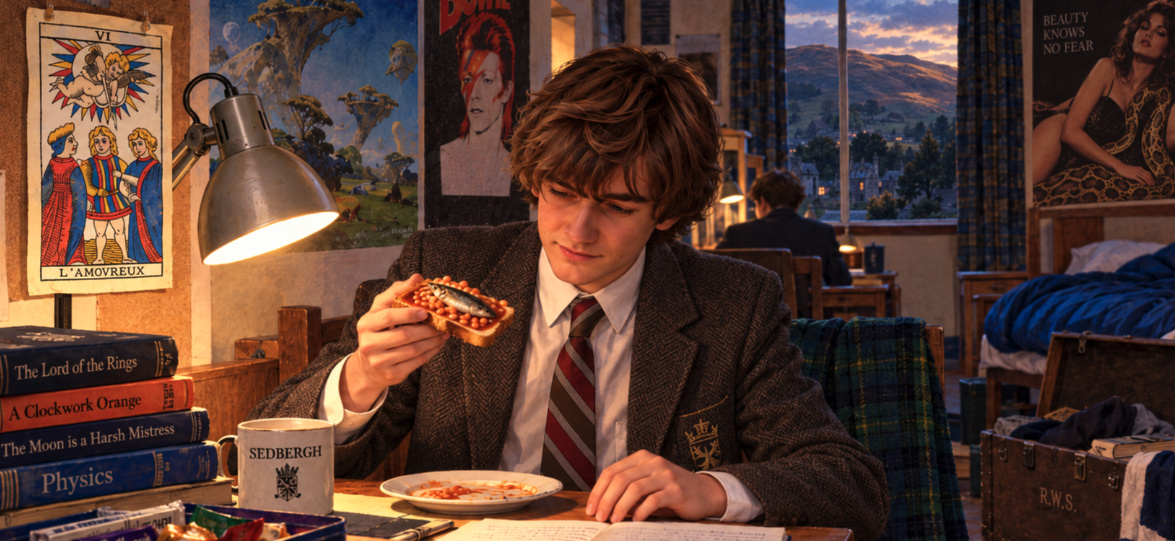
The problem wasn’t really the batteries. It was the whole idea of speaking instead of writing. I could only imagine using a dictaphone the way my lawyer-businessman father did, in a clipped and precise language. I wanted to gush. I wanted words that would cascade in a torrent over rocks and through gullies. I wanted to capture what I thought in whatever form it arrived, spontaneously. Handwriting and typing felt closer to thought than speaking into a machine.
Looking back, perhaps it was a small turning point. The diary survived. The dictaphone did not. The diaries even survived the arrival of computers. Somewhere I still have floppy disks, CDs and hard drives containing stories, fragments, attempts at novels, a screenplay or a television series. They may still be recoverable, but for now they are less accessible to me than the words I wrote in an exercise book fifty years ago.
My big sister went to a party in the evening with friends in town. I don’t suppose she came back that night.
We had globe artichokes from the kitchen garden again. The Victorian kitchen garden was thriving and well stocked, maintained by the elderly head gardener who lived in the South Lodge. I think his wife may also have been the housekeeper. The gardens were around half an acre of allotments and produced more than enough for the Castle.
I adored artichokes, though having them every day for several days in a row rather split the magic. They were steamed and eaten with olive oil and butter. You tore the leaves off with your fingers and nibbled the flesh away with your teeth. Although it was a vegetable, it always made me think of eating a chicken leg.
We left Dad’s meal in the oven.
Dad rang from Darlington to say he wouldn’t be back. That wasn’t unusual. He was spontaneous like that and very much his own man. Single at the time, I think. If he was visiting businesses he might stay overnight. From time to time we would learn he had been spending time with a female doctor, a female barrister or a female dentist’s assistant. He had a way with the ladies and was a good-looking, wealthy man in his forties.
He had also told us never to bank on him. We took him at his word. He might remember a birthday or not. He might come home or not. He might be able to give us a lift to Newcastle, Manchester or London, or not. It depended on how his diary and his week unfolded. We occupied ourselves for days, sometimes weeks, without seeing him.
His unpredictability felt normal. He minded his own business and we minded ours. It wasn’t exactly parental responsibility, but it was the arrangement we knew.
Leaving his meal in the oven wasn’t especially dramatic. We assumed he would be home. If the oven stayed on, the food would dry out. I hope somebody remembered to turn it off. Perhaps Mabel did so before crossing the courtyard to her cottage beside the Keep.
In many ways Appleby could feel like a boarding school in the holidays. The scale of the place contributed to that feeling. Staff came and went throughout the day. There was the gatekeeper and falconer in the Main Gate Lodge, the head gardener and housekeeper in the South Lodge, and at times a handyman in a flat above the stable block. If my father was hosting board members or guests, we were expected to be on our best behaviour. One family occupied one small part of a vast building while a small supporting cast drifted in and out around it.
Having spent years at boarding school, I was used to the distances between everything.
I went up to the children’s flat, as we called it, to listen to my older sister’s records. It occupied the top floor of the Southeast, or Barons, Tower. It had two bedrooms, a large sitting room, a kitchenette with a fridge and hob, and its own bathroom. A door at the end of the corridor separated it from the rest of the Castle. No adults allowed was the rule! I never saw Dad cross the threshold, and when our first stepmother did so, it was only because she was in a rage with us, my father and the world.
The sitting room in the children’s apartment looked west across the courtyard to the Keep. Other windows on a corner turret faced north-east, south-east and south along the River Eden towards the fells. It was like being on the bridge of a vast ship steering through a thousand years of history! (now there’s an idea to get my teeth into).
You could reach it either along the corridor above the Great Hall, passing old servants’ rooms, or by climbing the stairs through my father’s rooms in the tower.
Her taste in music was four years ahead of mine. Pink Floyd, Yes, Led Zeppelin and Deep Purple. Her David Cassidy days were long over. Part of the attraction was discovering music; part of it was simple economics. Why buy a record she already owned when I could borrow it and make a cassette of my favourite tracks?
Dad rang from Darlington. My sister went to her party. The artichokes kept appearing from the kitchen garden. The dictaphone experiment ended almost as soon as it began.
I went to bed about 12-ish. We may have been watching the Olympics. The children’s apartment never had its own television, which was probably just as well.
The last thing I did before going to sleep was write my diary. Then I probably read a few paragraphs of whatever pulp fiction or science fiction novel I happened to be working through before putting the book down. I only went to bed when I was ready to fall asleep.


Leave a Reply