Fifty years ago: Saturday, 11th September 1976

(Sedbergh, Age 14¾)
I’m writing this in bed in my cube at the end of the day, and I’m exhausted. Going back to boarding school after the long summer holiday always drains me. Returning to this posh prison for boys does that. I’m sitting here in my underpants because my trunk never made it – ditto forty-four other boys. The luggage bus broke down somewhere between Scotch Corner and Brough.
Going back to Sedbergh meant the usual chartered coach from Melton Park in Gosforth, picking boys up through Chester-le-Street before heading south on the A1 to Scotch Corner and then west over the Pennines, through Brough and on to Sedbergh. The bus held around forty boys, ages thirteen to eighteen: nervous new boys, fourth formers trying to look older, swaggering sixth formers, and perhaps even a seventh-term Oxbridge candidate already half out in the adult world and behaving like a teacher, not one of the inmates. We belonged to different houses, but for those hours, we were all part of the same migration back into captivity.
This year, there was a second bus purely for trunks and tuck boxes — forty of each, easily. I could see why. It made more sense than cramming them underneath us, though a lorry would probably have done the job better. Or a skip beat of all.
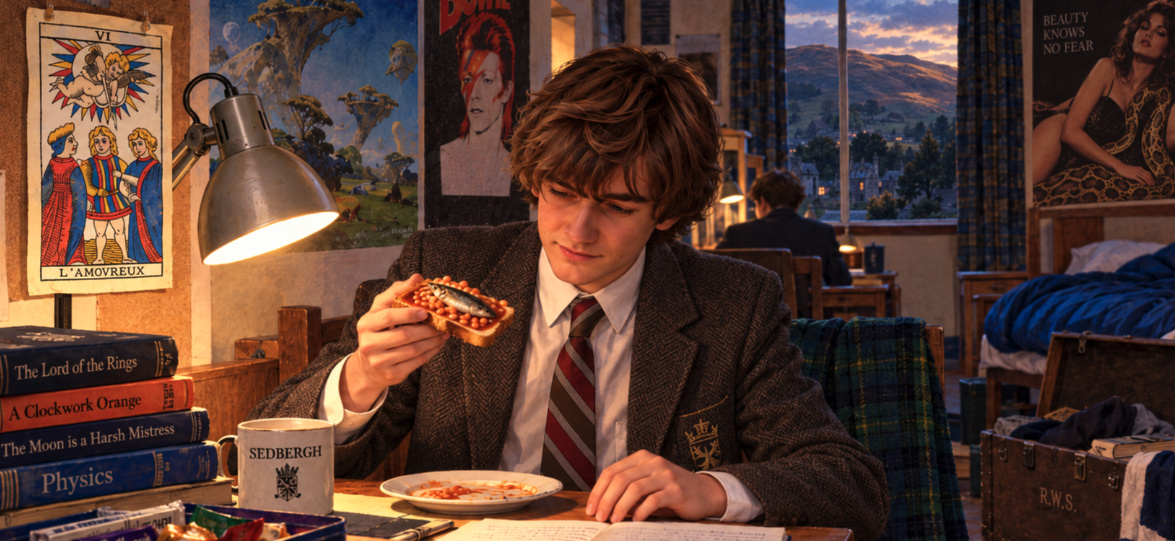
When we arrived, the House felt oddly untouched. Clean. Ordered. Empty in spirit, even with boys beginning to fill it again. Everything was exactly where it should be, waiting for us to rebuild the usual kingdom of teenage boys: dirty rugby gear draped over radiators, damp towels, hidden food, photographs of girls, record sleeves, dirty mugs, girls torn from dirty magazines, noise and hunger. Dirt and the smell of it. We were a rugby-playing House in a rugby-playing school. Mud got everywhere under your skin, and if you let it, into your mind.
The first evening back sounded different, not too. Louder, but in a good way. Conversations during House supper bounced everywhere — excited voices, exaggerated stories, oohs and aahs over places visited, things attempted, girls kissed, fights survived, records bought. For a few brief days the bullies were silent – biding their time I suppose. No shouting, no cruelty yet, none of the sudden eruptions of anger or humiliation that could ripple through a House once term kicked off for real. The first House bell would do that.
We sat with friends, tolerated enemies, and mostly ignored brothers if they happened to be there too. Then came the inevitable wait to see who would first attack the slop bowl — the disgusting communal mixture of leftovers that was treated as a professional sport. I declined. Looking at it was enough to make me feel sick. If boys were feeling flush and the red plastic slop bowl looked particularly disgusting, £5 could be raised to witness a boy consume every bit of it – a challenge only ever achieved by a lad from South Africa. Land of brutality?
There was an official pecking order: year group, age, and even your House number carried a kind of status. But in reality, things were more fluid. Clever younger boys learned how to avoid trouble. Bullies from any year drifted upwards and clustered together with the other detritus of public school life. Some prefects had natural authority. Others had only the rule book. A few couldn’t give a monkey’s.
Later, I went into town to ring my girlfriend, Julie-Anne. Normally, you needed a pass to leave the House, but on the first night back, the prefects relaxed the rules. I stuffed my pockets with 2p pieces and queued outside the phone box with the others.
Having a girl to ring gave you standing.
Julie-Anne wasn’t up. Nine o’clock seemed absurdly early for a Saturday night, but she had Church the next morning — choir and communion. She came to the phone to offer a sleepy goodbye, and she said she’d see me at half term. But we don’t have a half-term! I tried to say, but she’s already put the phone down. I’d not be back until Christmas. Them’s the rules.
With a few coins left, I rang my grandparents. They’d each given me £1 pocket money. I’d not been gone for 24 hours. In a month, I’d start getting stamped addressed envelopes from them.
Back in House, I had a bath. If you closed your eyes and slipped beneath the water, it almost felt like home again — except home didn’t have six freestanding baths lined up in a communal tiled washroom, with boys showering and talking all around you. At fourteen, all elbows and knees, hairless and skinny like some half-grown pelican chick, it was impossible not to notice how different the sixth formers looked: broader shoulders, muscles from rugby and chest expanders, and the unmistakable signs of becoming men.
I had nothing to change into except a dressing gown and a new pair of slippers Mum had handed me in a Fenwick’s shopping bag as I boarded the school coach. The dressing gown had been left at school over the summer; there were mouse droppings in one pocket. My pyjamas were somewhere in the missing trunk, so I wore underpants and socks beneath the gown; otherwise, I felt naked. I kept nudity for the fells in summer – I loved to sunbathe with nothing on.
Outside, the North Yorkshire wind and rain had arrived properly. I kept imagining my trunk abandoned beside a dry-stone wall off the A66, slowly getting soaked through.
I sat in the common room with Tim, drinking my Scottish & Newcastle cans of McEwans Export. I gave a can of Ex: to Simon. Then Thumper and Balmy arrived, and before long, I was handing out cans to everyone like I was running a free bar. The beer had travelled over from Newcastle in a shopping bag. I’d told Mum it contained books. I’d quietly sipped on one on the bus. Grandpa has a board of them. He’d worked in the brewery trade his entire life, and part of his pension was a regular supply of cans – but he didn’t drink! So my brother and I picked them up from the carrier bag at the start of each term.
The unwritten rule on the first night back was that the prefects lay off until the following day. If someone saw the beers, they ignored them; Headers asked for one. He’d be confiscating them within a week. And now he knew where to look. Except that a term’s supply would be gone on the first night.
We talked about Corps Camp — the compulsory week on Dartmoor at the start of the holidays, playing soldiers in the rain. It never really occurred to us to question it. Cadet Corps was simply part of the machinery our parents had signed us into: weekly Corps during term, Corps Days, camps, rifle ranges, military hierarchy. Necessary. Or presented as necessary. Like attendance at the School Chapel and Confirmation.
On the train south from Oxenholme to Exeter, we’d treated every station stop as a challenge, leaping off to buy drinks or snacks before the train pulled away again. Simon had misjudged it entirely, been left behind somewhere en route, and eventually arrived late at Exeter after his father — a senior Army officer — arranged for him to be collected by staff car. We discussed whether things had felt different once live rounds were issued. Did anyone else get to fire a machine gun?
Heading for bed via the washrooms I spotted Trombo who i knew from Mowden among the new boys. He was in a new dorm for his first year. A year below me, he’d been swimming captain and a music scholar, trombone player. Seeing him reminded me of a version of myself I was already trying to leave behind. At prep school, I had played directly into the system: Prefect, head chorister, swimming captain, eager and compliant high achiever. At Sedbergh, I wanted distance from all that. No choir. Less music. Some swimming, but on my terms. No rugby unless forced into it. No authority over anyone else. Mind my own business. Do my own thing. Try to become my own person instead of the school’s idea of one.
Fifty years on, that may be the strongest memory of all: not rebellion yet, that could wait for the Fifth Form, but quiet disengagement—a determined refusal to belong.



Leave a Reply