
Fifty Years Ago: Sunday, 12th September 1976
Winder House, Sedbergh. Age 14:11
Read ‘mag’ (probably short for ‘porn mag’). And was I reading it? Yes. The letters pages were the best.
I still cannot help wondering whether writing simply magazine was deliberate. It might have been New Scientist. Equally, it might have been Men Only or Mayfair. We had actually done a collection and subscribed to both, and the magazines then did the rounds of the cubicles. I could write about sexual matters in the Diary, but often did not. I was certainly thinking about them.
Late breakfast.
Probably just the more leisurely Sunday arrangement.
We had got back to Sedbergh the evening before, probably between half past four and five. Perhaps because of the heavy rain, we had left our trunks and tuck boxes down in the Grinner, the all-school common room, café-cum-store, rather than drag everything straight up to Winder.
There would have been supper, roll-call, unpacking the essentials and seeing people again. There was also the possibility of getting into the first fight of term, or avoiding one. There were rivalries everywhere. Less so in my own year, perhaps, but certainly amongst the boys above us there were some who detested each other. It was not a pleasant atmosphere when there was a bully or two, with their cronies, lurking about looking for an opportunity to put someone in his place or make him feel small.
I was not small. I kept myself out of their sights.
By then I must have felt there was no real choice about Sedbergh. It was as if we had been born into this particular path and there was no escaping it. I would stay through to A’ levels because that was what happened.
There was a pecking order amongst public schools and everyone in the Northumberland set knew it. “What school are you at?” was enough. Eton was at the top, a few others were somewhere alongside it, then came the also-rans. Sedbergh was a minor public school, known for rugby and sheep. It was not Eton, Harrow or Winchester.
At the time I looked the part well enough: neat haircut, blazer, the perfect specimen of a public-school junior. By the end of term my hair would have grown enough to make me look as though I could join the Bee Gees.
Wrote to Julie-Anne in prep.
Sunday prep meant no music or games in the common rooms or studies, although whether we actually worked was largely up to us.
Writing to Julie-Anne showed I was thinking about her. She was my girlfriend, I suppose, although because she was away for much of the year she could sometimes be more like a pen pal. She was certainly a romantic interest. She was also proof that somebody liked me.
I wanted girls to like me. I could not give a flying fish what boys made of me, provided they left me alone to do my own thing and be my own person. I liked to think I was cerebral — not necessarily academic so much as a thinker. I was not especially quiet, but I liked my own company. Boys could be right twats, and collectively their behaviour, attitudes and opinions could be worse.
Julie-Anne and I wrote to each other a lot. A dozen or so of her letters and postcards from that period still survive: news from home, trips, school friends, things about her older sister. My letters to her could be newsy, funny, romantic and intimate, probably all at once.
Eddie and I had briefly been rivals for her affections the year before. I had outmanoeuvred him.
Helped by the fact that Julie-Anne preferred me.
It had all ended amicably. Eddie did not seem to go to the discos or parties I went to. Perhaps his parents kept him in.
Letters were private, but you knew which older boys fancied themselves as Lotharios: the Spivs, with centre partings, checking themselves in mirrors or seeing whether they looked tough in their blazers. Who exactly they were preening themselves for was another matter. Each other, perhaps. I recognised the type and knew it did not include me.
Chapel. New hymn books.
The Canon had apparently had to justify the expense because the old ones did not contain enough modern hymns. I would have preferred a hymn book with the score in it. I was not in the Sedbergh choir, but I had already spent five years in a Chapel choir and knew every hymn they chose anyway.
It was a competence I had never sought. At Mowden I had to be in the choir, sing every morning, sing on Sundays and go to rehearsals. I had eventually become Head Chorister.
There was no chance of my joining the Sedbergh choir. I was an atheist by then and, besides, I would have gone from being Head Chorister back to being a junior. The choir took too much time: communion, confirmations, anniversaries and all the rest.
Christianity came a poor third at Sedbergh to rugby and exam results, though we had it every day in assembly, every evening in the House and again on Sunday. Attendance was compulsory unless you were Jewish.
My atheism was not especially dramatic. I was widely read and liked evidence: in history, geography, arguments, anything I hoped to win. The facts mattered.
Cressbrook Boys were in Chapel.
Cressbrook was Sedbergh’s new prep school, but to me it already meant one of Mowden’s rivals: rugby, cricket and, notoriously, swimming, when visiting teams were expected to race in our unheated outdoor pool.
Now Cressbrook seemed to have superseded Mowden as the feeder school for Sedbergh.
Mowden had always sent boys everywhere: Eton, Winchester, Gordonstoun, Fettes, Giggleswick, Rugby, Harrow, Haileybury, Stowe and plenty more.
The Cressbrook boys in Chapel just looked like squirts.
We were cruel about these distinctions. Everyone was ranked by year, physical development and whether he was a boarder or a day boy. There were still fags. Younger choirboys who sang soprano and looked about twelve were squirts almost by definition. Day boys were disparagingly called peasants or yokels and reckoned to be soft because they could come and go as they pleased. At the other end were rugger buggers, the thuggish rugby-playing types.
There were military types too, boys already aligned with the Army or Navy, with officer-material haircuts and manners, who took the Cadet Corps seriously. There were actors — James Wilby notably. There were boys who spent much of their time in the School Armoury, and others who gathered backstage to “do the lights”. And there were what I think of as ghosts: boys who kept quietly to themselves, often academic, though not necessarily so.
Cliques and types everywhere.
I was fifteen days short of fifteen.
Run for a wheelbarrow.
The wheelbarrows came from our Housemaster’s garage. It was not much of a competition; it simply had to be done and you took your turn.
Plenty of boys were delivered directly to the back of the House by their parents. Only a relatively small number of us arrived by coach. I know there was one from Newcastle. There may have been others, though I do not remember them.
I liked the sense that we were more independent. We could travel without having to hold our mother’s hand or have our father at the wheel.
Ricky and older Harrison helped. Harrison was one of Ricky’s contemporaries, and by then my brother and I inhabited different social worlds even though we were in the same House.
Between us we collected our trunks and tuck boxes from the Grinner/library car park, pushed them up Loftus Hill, onto Winder Drive and along to Winder House.
It was always a right pelava.
The trunks contained school clothes, games kit, towels and the things needed for the dormitory, including the rug for my bed.
Mine was tartan, blue check with a green stripe, with my name label stitched into it: Jonathan F Vernon: Winder House.
It was extraordinarily robust. The rug still exists.
The tuck box held non-perishable food and drink: spreads, hot chocolate and sweets. These were consumed, not shared.
Get straight on with unpacking.
Clothes had allocated slots on shelves along the upper corridors amongst the dormitories and cubicles.
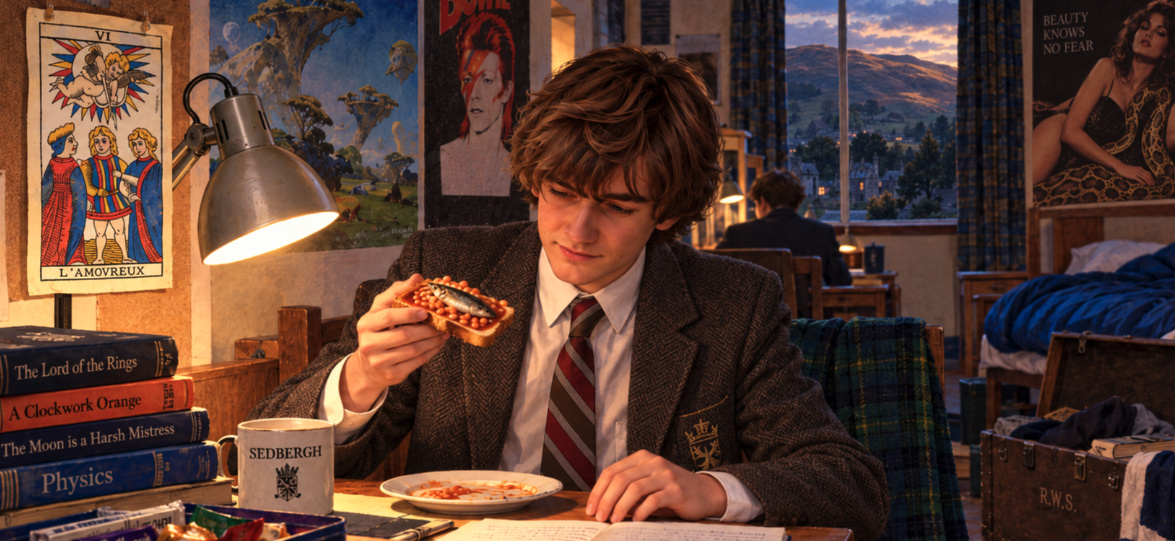
I wrote, “In the study, posters up”, though I think I was still in the Fourth Form common room rather than having a private study. Each of us had an allocated desk and could put something up around it.
That mattered. It was a small piece of territory in a communal existence.
Mine might have been Roger Dean science fantasy, Bowie or a Pre-Raphaelite.

Other boys had their own choices: Raquel Welch in a bikini, the famous Tennis Girl with the ball and no knickers, and later Nastassja Kinski nude with a snake, which was my favourite. There might be a black-and-gold JPS Formula One car. There were surprisingly few footballers.
Music ranged almost anywhere: Genesis, ABBA, Boston, Heart, Barbara Dickson, The Carpenters, Middle of the Road.
My tastes were still developing.
Do a run.
I think this was independent, probably down by the river and out towards Dent. If I had headed up Winder I suspect I would have written that.
Every day of the week already had its set activities. There was only marginally more freedom at weekends.
I enjoyed cross-country much more alone than competitively.
Play squash with Eddie.
The squash courts were on Winder Drive, close to the House, in the same plain building that is still there. There were two or three courts. Looking back through the Diary, I am impressed by how often I played. Probably twice a week, usually against boys from Winder, mostly from my year or the year above.
It was recreational.
By then I could probably have said that I mostly swam and played squash, while enjoying cross-country running on my own.
Draw the L’Amoureux tarot card.
I drew it in pencil first and then painted it in watercolour. I had a thing about Tarot and telling people their fortunes. I owned a pack and a book explaining the cards, and I had used them on Julie-Anne, her sister, even her mother, as well as my own sisters and anybody else prepared to be indulged.
I did the layout properly, by the book, but then bent the interpretations to suit my mischievous or devious designs. I kept the interpretation book well hidden, otherwise it would have become obvious quite how far I was wandering from the script.
Tarot made this easy. The interpretations dealt in generalities. People could find meaning in them if they wanted to.
If they knew I was making some of it up, they did not seem to care.
It was entertaining.
I liked the element of chance. I liked the way people wanted to believe the cards meant something. It put me at the centre of the conversation and gave me permission to say what the sitter wanted to hear or, better still, what they did not want to hear.
And L’Amoureux was one of the most important cards in the pack if you were reading for a girl.
Because of course they were going to fall in love with you.
Julie-Anne and I were lovers.
What else could the cards possibly say?
Post Julie-Anne’s letter.
The drawing itself no longer survives. I think I pinned it to the wall by my desk.
And I sleep in a sleeping bag.
It was blue. I had owned it for several years and had taken it to Pioneer Camp at Mowden. It smelt of me and home. At home it would be washed and hung out on the washing line.
Sleeping in it at Sedbergh made the bed feel less like a school bed and more like being away on an adventure.
It was not cold enough yet for what would come later in the term. In a few months there would be feet of snow, and ice thick enough on a hillside lake to skate on. The dormitories could become so cold that the condensation froze on the inside of the windows.
For now, I climbed into the blue sleeping bag.



Leave a Reply