
Fifty Years Ago; Monday, 13th September 1976
(Winder House, Sedbergh School. Age 14:11)
I woke up a few times. There were fifteen other boys sleeping in the same space and it took a while to adjust to that again.
Breakfast was good — cooked, which meant bacon and egg with toast. Then I packed for school. The classroom block was about a third of a mile from Winder, so I had to remember the right textbook and exercise book for every class coming up. Forget something and it was a considerable hike back.
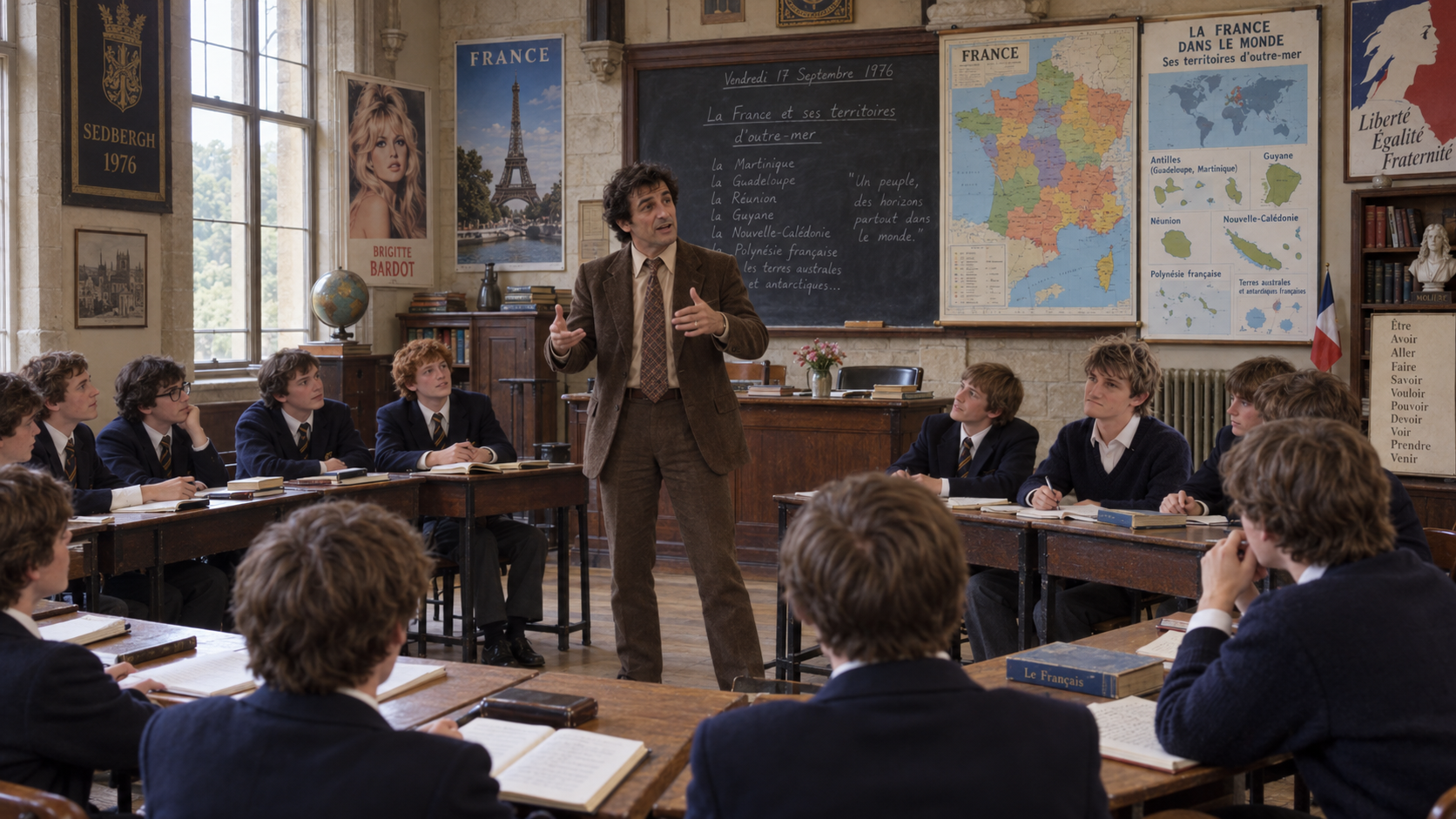
I met a new master, Mr James. “Very posh.” He was a bit of a dandy, like one of my mother’s boyfriends — not camp, but affected. Ridiculous, but a curiosity. He was never boring and perhaps that was partly because he was unpredictable.
I thought he was supposed to teach us English, though it may have been History or even General Studies. Some classes felt like fillers anyway. Mr James would bang on about tabletop war games and even had one set up at the back of the classroom. I never joined in. He couldn’t get me interested, perhaps partly because I found him such an oddball.
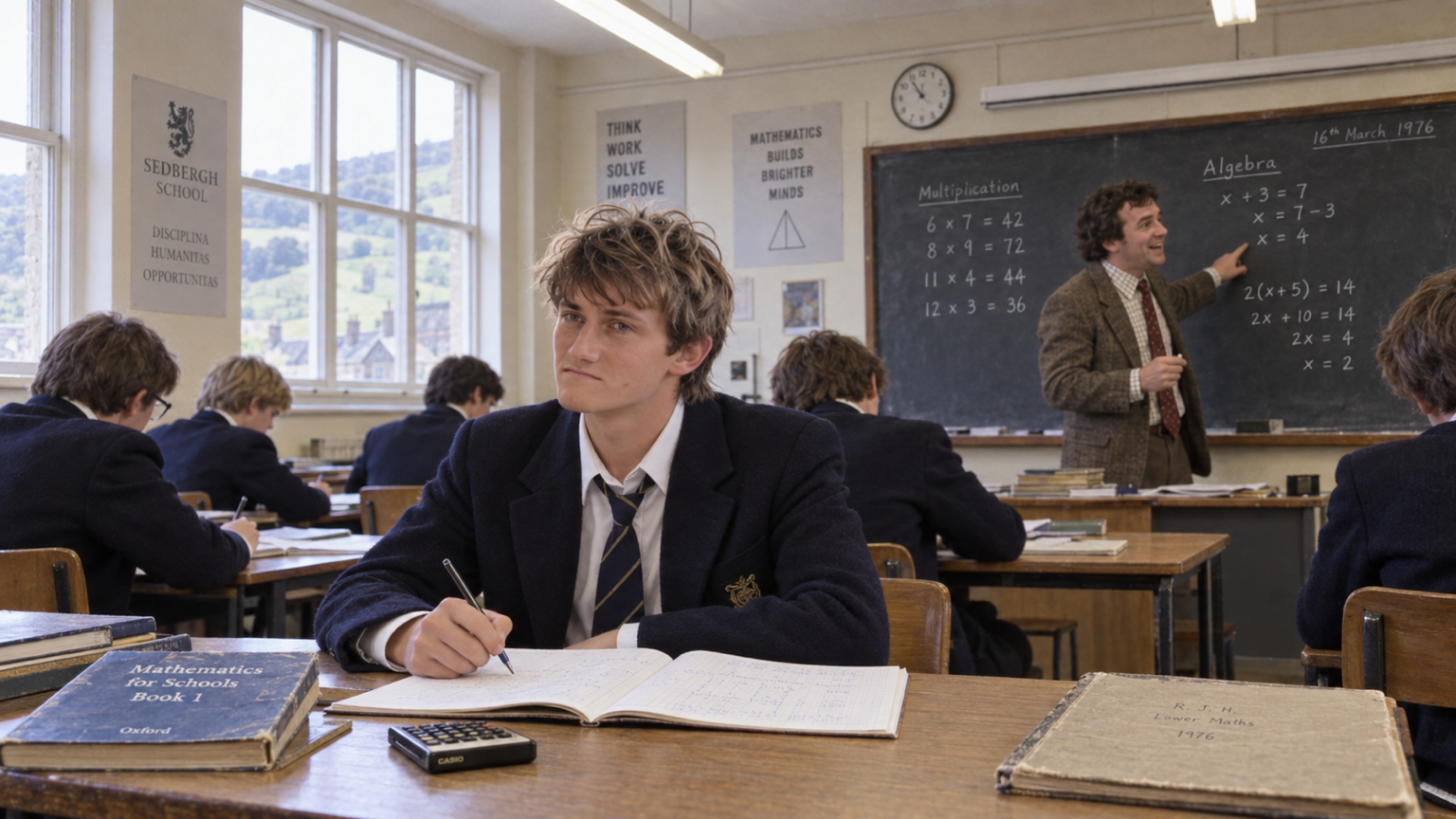
Then Maths.
I was in the Lower set.
I felt insulted that Mr Wood had put me there. He took all Junior Maths, so as far as I was concerned he had done the putting. Something seemed wrong. At Mowden, Mr Scott had been a terrific Maths teacher and I had always got excellent results.
Perhaps I needed a kick up the old proverbial, but I cannot now attach the decision to any particular bad examination result. I do remember questioning my competence at Maths, though that may belong to the O-levels in 1978 rather than here.
What bothered me wasn’t simply being placed low academically. I’d been put in with the thickies. That was exactly the word we used, along with much worse.
Sedbergh was a place where being bright had to be negotiated carefully. Rugby dominated the school. Academic ability did not automatically confer status, and there was always a danger in being found out as clever. Even so, I thought I was one of the clever boys, or at least capable of being one when I chose.
What really worried me was that being in the Lower set meant being taught basic stuff beneath what I could do.
Basic work!
Times tables? I had quadratic equations and a Casio pocket calculator to think about. Slide rules and cosine tables were already disappearing. Geography and History had shown me that I could pull one out of the hat if I wanted to. I liked proving people wrong.
Two Years later I get straight As in Maths and Additional Maths at O-level, but I didn’t know that sitting in the Lower set in September 1976. My diary tells that journey.
Physics was with Mr Fells and we started a friction experiment.
How could anyone make Physics dull?
There was no such thing as a dull subject, only a boring teacher, and Sedbergh had a few of those. Some seemed as if they had taught the same lessons in the same way for years and were simply getting through the day before going off to do what really interested them.
Fell running and caving came to mind. We were under the Howgill Fells, after all. The crude joke was that it was fell running or sheep shagging.
Perhaps I was competent enough at Physics to be left to myself. I wasn’t a bright spark or a retard. I could muddle through. Perhaps Mr Fells simply didn’t like me. Boys noticed favouritism, just as we noticed when somebody was being picked on.
After three years of being taught by him, Sedbergh came to race against the RGS only two months after I’d changed schools. Mr Fells didn’t know who I was.
English was Richard III.
I loved Shakespeare with a passion despite the school’s determination to deaden my interest. Macbeth, Henry V, Romeo and Juliet, A Midsummer Night’s Dream, The Tempest — Shakespeare wasn’t the problem.
I’d already seen Zeffirelli’s Romeo and Juliet on television and Polanski’s Macbeth at the cinema. I knew Shakespeare could live outside a classroom.
At Sedbergh it was more likely to be: open where we left off. Someone read Richard, someone Buckingham, someone whatever part came next, and we worked our way round until enough of the text had been covered. It seemed less about discovering Shakespeare than making sure we got through him.
Games was swimming, and I went with enthusiasm.
A year after arriving at Sedbergh we finally had something resembling a swimming coach. Mr Stuart was a Geography teacher who had swum for Scotland, or perhaps in the Scottish Nationals. Until then we’d had PE teachers or random masters supervising swims. I’d spent a year getting wet without any coaching.
Mr Stuart at least introduced pace, sets, all four strokes, turns and transitions out of dives and turns. It was recognisably swimming training.
I’d lost speed, fitness, technique, racing opportunities and competitive confidence during that first year. Swimming was almost a joke sport at Sedbergh. It sat beneath rugby, cricket and fell running, perhaps closer to athletics, which appeared for part of the summer. Water polo had a kind of fun-house rivalry, but serious competitive swimming hardly fitted the school’s idea of sport.
The idea that I could suddenly build back everything I’d lost was probably faintly absurd.
Sedbergh seemed less interested in developing whatever you arrived with than in knocking you into shape so that you fitted its way of doing things. Had I wanted seriously to remain a competitive swimmer, I should never have gone there.
Chemistry was with “Chaps”. An older boy had explained the nickname: one shoulder always seemed dropped, supposedly like a batsman presenting the bat in cricket.
He was one of several masters who had been Sedbergh boys themselves, gone away to university and teacher training, then returned to teach there. Boggis, the Latin teacher and organist, was another.
Even at fourteen I found that shockingly narrow. Sedbergh was evidently an acquired taste. Like being a monk. Some of them seemed barely to have escaped before coming back.
No wonder so much of the place appeared stuck in the 1950s, with attitudes, behaviour and customs suited to post-war Britain.
Divinity was boring — a waste of time.
That wasn’t because I couldn’t do it. Earlier in the year I’d scored 19 out of 20 and been top of the class. I was fervently and academically an atheist and argued against its fallacies whenever the opportunity arose. As far as I could see there was no evidence, not even valid history. Mythology, more like, and historically religion had been used to subjugate men and women.
There was no escaping it either. Morning Assembly was in Powell Hall from Monday to Saturday. Sunday meant Chapel. Every evening there was another assembly in the House for a hymn, a reading and roll call.
I could argue against Divinity and still come top in it.
Biology was boring too. That was almost worse. How could anyone render Biology dull?
Then there was Mrs Bodge.
We had no female teachers. She was a teacher’s wife.
Mr Bodger was presumably the clue: he was a teacher. That was how we saw women attached to the school — someone’s wife, rather than necessarily someone with qualifications or a professional identity of her own. I still don’t remember exactly what Mrs Bodge was doing that day, though her presence was unusual enough to record.
Women occupied the edges of this overwhelmingly male world. Teachers’ wives ran the bookstore and the grubber. Local girls worked in the kitchens.
Nice if you could spot one.
In the evening there were hard preps. There was a lot of work and it required concentration.
Even so, I made time to practise Pitman shorthand.
It was another tool. An advantage. I already had my Smith-Corona typewriter and now shorthand offered another way of getting things down quickly. Not particularly for secrets, journalism or employment. It was the possibility of capturing something that would otherwise be missed.
Almost a superpower.
I wouldn’t miss a thing.


Leave a Reply