
Thursday, 16 September 1976
(Winder House, Sedbergh School. Age 14:11)
On the way along Winder Drive, one of the hard nuts showed everyone how to scratch the metal studs of our rugby boots against the tarmac so they would “do more damage” in the scrum. Read on for that afternoon in the mud … It began in bed. Already at school, of course. We never left. If our dreams could have been policed, I’m sure Sedbergh would have found a way to do so.
Cube: I slept inside a sleeping bag in my bed. The mattress as thin as wet pizza on a I used it only in the early morning, when it was colder. Sometimes I left it unzipped over the bed like a quilt; otherwise, I zipped it up and put it in the bottom drawer, ready to pull out. The wooden cubicle around the bed meant I could just lean out and get into the pine chest of drawers without properly getting up.
This was Cumbria. Overnight temperatures were already dropping below 10°C. By the end of September there could be snow on the tops of the Lake District mountains, with the freezing level down to 800 metres or lower. By the end of October there would be frost on the rugby fields. So the sleeping bag wasn’t exactly excessive.
German: very dull, as usual. It was all too Germanic. Regiment. It felt as though you built meaning out of Lego bricks. I was only doing German because it meant I didn’t have to do any more Latin, and I didn’t really want to do either.
French wasn’t going much better. I got preps and very low marks. I was beginning to give up on French as a lost cause. I felt like the boy who was tone-deaf and still expected to sing in the choir.
English was very strict. My prep had more red biro on it than my original in blue ink.
Spelling was one problem. I didn’t spell so much as guess. I saw words almost like hieroglyphs, as sets of patterns. It seemed to have no internal logic because it wasn’t maths or physics. English lacked logic. Give me two words — where and were — and I might mentally toss a coin. Veil, vale, Vail, veal? Which one? Then cough, bough, bow. It went on.
Yet the derivation of words fascinated me. I loved a good dictionary. I could trace a word backwards lovingly as though it gave me a direct line to an ancestor five hundred years ago. I loved the spoken word too — its tone, drama, timbre, dialect and accents.
Grammar: this was another matter. I still don’t know what it means. Which may explain my struggles with Latin, French and German.
Punctuation: Too few commas. Or too many. A full colon for a list. Semicolon; you’ve got me there. When exactly did you start a new paragraph? I understood capital letters, although capital and capitol were still waiting to catch me.
Vocabulary: I loved. I made lists of words I fancied and then dropped them into my writing like name-dropping. I’d started doing that at Mowden and kept it up. Later I had a sheet from Henry IV, Part I with words such as analogous, elation, salacious, poignant, syllogism, introspection, egotist, parlando, and conciliatingly. I would have been doing the same thing now with Richard III.
I could cover a page without a sentence break. Verbose. Verbal diarrhoea. Circumlocutious. The teacher himself used big words and expected me to look them up, which was encouragement enough. I was nothing if not enthusiastic.
The trouble was that enthusiasm didn’t necessarily produce comprehensible English.
The teacher’s red biro made me think of Dad, who was equally finicky about the written and spoken word, and I resented it. Dad couldn’t see the wood for the trees. Anything I wrote to him— especially to be judged not by what I was saying or trying to say but by whether I’d split an infinitive, spelt something incorrectly, or used can instead of may, or should instead of shall. I still didn’t know what he meant by some of it.
Never split an infinitive.
Never say, “Can I go to the toilet?” It had to be, “May I go to the lavatory?“
God forbid you said anything northern either. A hard a in Newcastle, Bath or grass wouldn’t do. They all had to be pronounced as in arse. If you said “you know”, “kind of”, “umm” or “urhhh”, he could glaze over while you were still speaking.
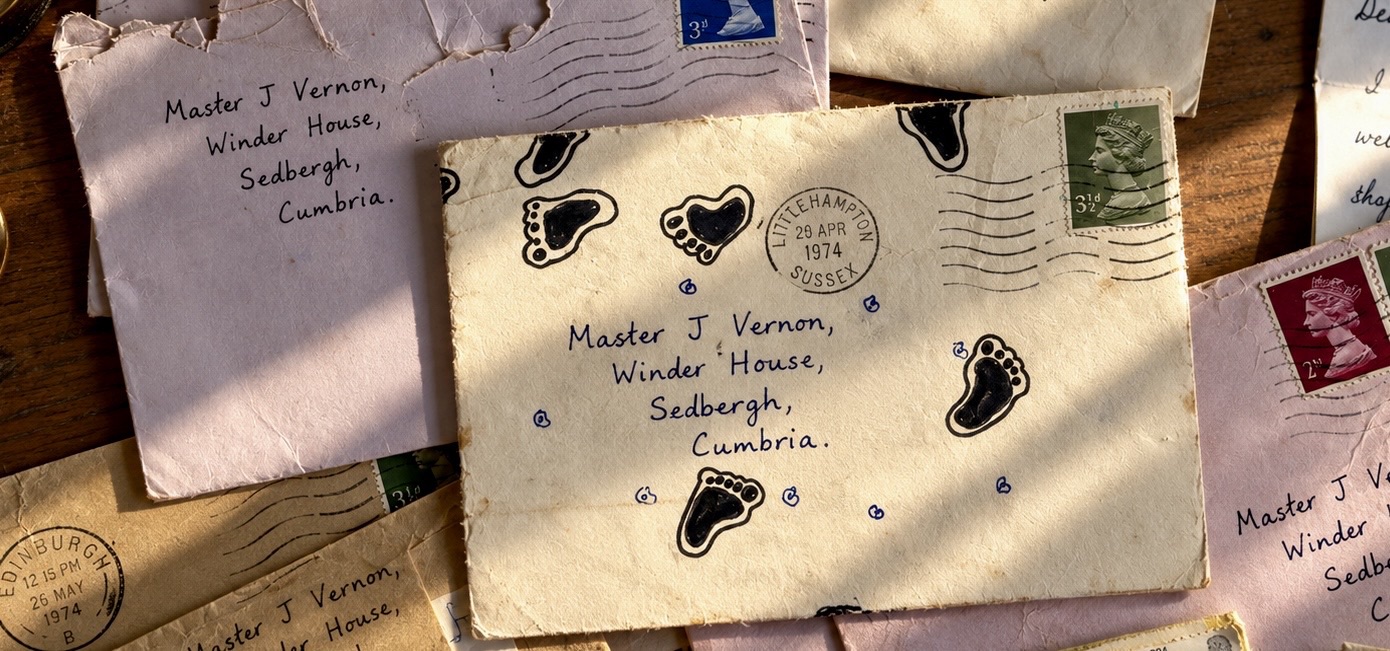
No wonder we might prefer not to write to him, or keep it brief. No wonder sometimes we preferred not to speak. If we actually needed something, we always went through his secretary—personal assistant—or his girlfriend or wife, our next stepmother, if there happened to be one.
Back to English: We were reading Richard the Third, Act I, Scene 2, the wooing-over-the-coffin scene. Lady Anne was grieving Prince Edward and cursing Richard for murdering her family while Richard, Duke of Gloucester, proceeded to manipulate and woo her.
Archie White did Lady Anne.
Archie and I knew each other from Mowden. Acquaintances more than friends. He’d been the year below me for our entire school careers. Seeing him launch into Lady Anne reminded me of the plays we’d put on at Newton Hall Village Hall. My own dramatic career there had included a tree, the back end of a cow, a lady at court — my only ever female role — and the station master in The Ghost Train.
Archie, blonde, Scandinavian and rather “white” in looks, got girls’ parts and lashed into them with relish.
He went completely over the top with Lady Anne. Voice, gestures, the lot. More Dick Emery doing Mandy — the glamorous, man-crazy woman who managed to interpret every normal interaction as a sexual advance:
“Ooh, you are awful… but I like you!“
Either that or it went completely Monty Python.
We applauded him.
The teacher gave him four Maps.
That was about right. Derailing the class was at the forefront of our minds almost every time we stepped into one. Not with every teacher. The wise and experienced ones knew how to keep on top of us. A classroom of boys was a box of fireworks. You didn’t light a match. You kept it cool, or on a slow simmer.
Maps: Four Maps was a serious punishment because it was deliberately laborious: a map carefully drawn in pencil on plain A4 paper, with all the required physical and human features added, labelled and coloured. Except I loved Maps.
I’d done the Japanese archipelago for one of mine in July. Islands in different colours; cities marked; rivers named; blue crayon etched into the sea around the coastline. I liked getting the pencils out and doing them properly. Older boys would even pay you to do their Maps for them.
The mistake was signing them like works of art.
So Archie was punished for arsing around by being told to do something that, for me, could almost have been recreational.
Harrison, another Mowden boy, got Richard. Somehow he had a knack for getting the plum role. Did he look thespian? Pull strings? Raise an eyebrow? Was the Raiseglish teacher in his House? My favouritism radar was ever alert.
Geography: map reading.
Handy for adventures.
I loved a map, a compass and the route ahead. We’d already done all this at Mowden, including Pioneer Camp when I was twelve: tent on our backs, walk to the given location, camp for the night and return by a marked route to the main campsite.
There were two pleasures to navigation. One was solving the problem: knowing where you were, taking a bearing and getting somewhere. The other was simply being out, off the leash. You had a destination you were supposed to reach, but you might also find other destinations worth detouring to.
At Sedbergh there was orienteering in Cadet Corps and hiking across the fells. There would be plenty of that.
There was also the possibility of escape.
Colditz: It had been on television, with Allied prisoners of war endlessly trying to get out of supposedly escape-proof Colditz Castle. For boys who’d been locked up in a posh prison since the age of eight, these stories rang true rather too easily. Teachers became the German officers, prefects the guards. A particularly stern order from a Prefect might even be met with a derogatory “Heil Hitler!” — which could presumably earn you another couple of Maps.
There were more attractive escape objectives too.
We could imagine navigating our way to the girls’ school at Casterton and pitching a tent, or simply finding a pub. Teachers were not idiots. The routes they gave us stayed miles away from such temptations – not that a mile or three would be out of a boy with a taste for beer, posh totty or both.
The frustration in Geography was that, for the umpteenth time, I was sitting in a classroom being introduced to something as though I’d never encountered it before, when I felt I could almost teach it myself. I’d already used maps and compasses. I’d already navigated across country.
I hankered after a challenge.
At some point, repetition simply became boring.
Physics: We made notes on friction, and there were good demonstrations. Abbott’s Basic Physics. I can’t pull the demonstration back now, but the lesson stayed with me.
Lunch back at House.
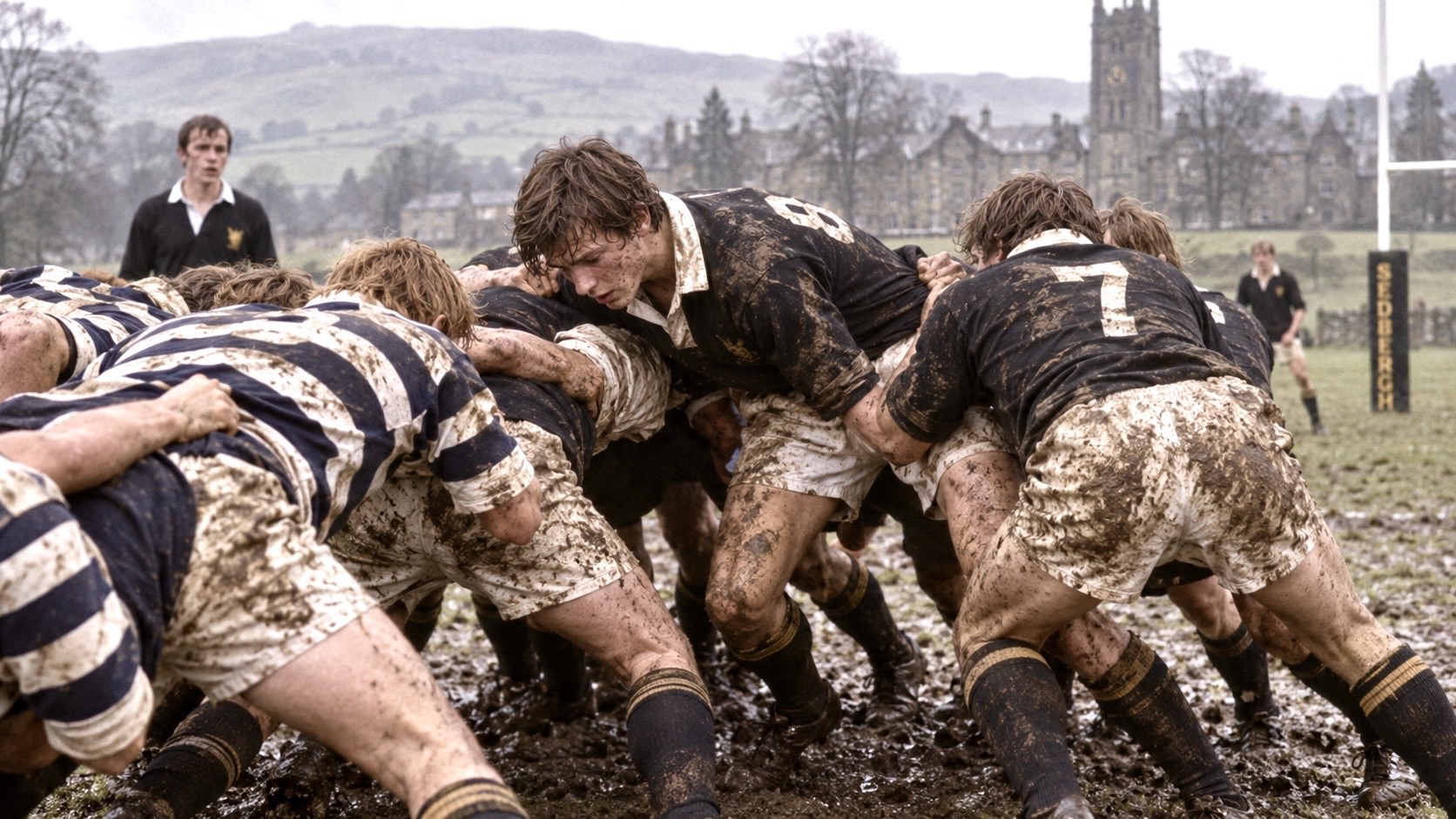
Games: I was in the House rugby team and obliged to play. No excuse; I obliged and went off to find my boots and jockstrap. They were practically pristine and unused. My jockstrap size had increased since Prep school. Some things had changed.
A jockstrap always made me think of gladiators. Possibly because I imagined them fighting in little else: sandals, jockstrap, sword and shield.
I’d hardly been a stranger to rugby. By then I’d played it for at least six years. At Mowden I’d sometimes played for the Colts and the First Team and had gained my colours in a side that won every game it played. I’d always been in the scrum and at some point had played almost every position in it.
This House game was probably for the under-16s, so there weren’t older boys showing us what to do. They were my year.
On the way along Winder Drive, one of the hard nuts showed everyone how to scratch the metal studs of our boots against the tarmac so they would “do more damage” in the scrum.
I joined in.
The intended thuggery was intoxicating.
It wasn’t merely fantasy either. Where else did Sedbergh’s reputation come from?
The basic tactic was to “scare the other side shitless” in the first maul. Once they’d been softened up, they’d be a pushover. If someone was directing operations, it was probably the scrum-half or fly-half.
I was Second Row — or possibly I’d insisted on Number 8 — but essentially I was supposed to be one of the “bulldozers”.
I played slowly. I had height and strength. There wasn’t much finesse about being in the scrum. Mostly brute force.
All I got out of the game was a hurt back.
Then I went swimming afterwards, even if it was only half an hour.
That was partly making a point. I was supposed to be a competitive swimmer, so I shouldn’t have missed swimming training. But “the House” was supposed to take priority over everything. House rugby therefore outranked the thing I was actually good at.
English prep: I had to find the “muse” in War and Peace.
It sounded suspiciously like the English teacher getting to the end of the lesson, hearing the bell, and suddenly realising he hadn’t set us any prep.
Find out who the muse was in War and Peace.
Right.
How many boys would simply give up?
How many boys in my year had read War and Peace? Did the House library even have a copy?
But give me the right incentive, and I would run with something. If I was in the mood, I could create whole realms of enthusiasm and obsession around a topic or task.
I went into town to telephone Mum, with a pocketful of coins ready for the public phone box. Mum was well into BBC period drama and would know the book or get hold of it, whether it was Tolstoy or Robert Graves. She’d probably tried to get me to read War and Peace before, although I wasn’t yet ready for it. I was more Solzhenitsyn or Arthur C. Clarke.
But Mum would have a good idea where I ought to be looking.
Then I went quickly to the House library, expecting a race for the available copy.
There wasn’t.
I was surprised to find War and Peace there at all. I doubt some boys in my year had even been into the library yet. The last thing you could call my year group at Winder was academic.
So I got the book and began a marathon read through the night.
I decided the answer was Natasha Rostova: brought up as a high-society noblewoman by a French governess, yet suddenly breaking into an authentic Russian folk dance. She hadn’t learnt it. Somehow it was simply in her. Her vitality captured something larger than herself — the spirit of Russia.
The passage I found was:
“Where, how, and when had this young countess, brought up by an emigre French governess, sucked in with the Russian air she breathed that spirit… yet the spirit and the movements were those inimitable and unteachable Russian ones…“
Her over-the-top exuberance interested me. Someone stepping out of line. Someone alive.
In the television adaptation, I associated all this with Prince Andrei and Pierre Bezukhov—Anthony Hopkins as Pierre—sulking and moping about until someoneelse’ss vitality dragged them toward joy and purpose again.
I could have done with one of those.
A bright spark in my life.
Someone who danced for joy.
Joy, exuberance, stepping out of line — anything but conformist and middle of the road. No wonder Sedbergh and I were going to be at loggerheads. Sedbergh was an anachronism in a backwater.
Sedbergh wasn’t merely middle of the road. It seemed to be standing in the middle of a road in the early 1950s. Possibly even the 1850s, given its Christianity and Cadet Corps.
If I’d described the place as being like a military academy, I suspected they would have taken it as praise rather than criticism.
And so to bed, tired and weary.
And thoughts of my own Natthoughtscing. A Russian princess.
To sleep, perchance to Dream…
… ay, there’s the rub!
For in that sleep of death what dreams may come,
When we have shuffled off this mortal coil,
Must give us pause.

Leave a Reply