Monday, 20 September 1976
(Winder House, Sedbergh School — age 14 years 11 months)

Come Break I was hoping to get a letter from Julie-Anne, but didn’t. A letter from her would have been have been such a treat, a lift to the day, recognition that someone “out there” was thinking of me.
I had a girlfriend; not many boys did. Julie-Anne and I had been ‘together’ since the beginning of the year, though we hardly saw each other — perhaps only a few times each holiday. I enjoyed her company and she was lovely. What more could a young lad hope for?
Her letters took me into her world. They came on proper letter-writing paper with a matching envelope, usually four sides over two A5 sheets. Her handwriting was clear and particular, still the writing of a girl rather than somebody with the established confidence of a young adult. The letters were friendly, informative, open and tender. She wrote about school, friends, music, family and what she had been doing, though not about her feelings for me.
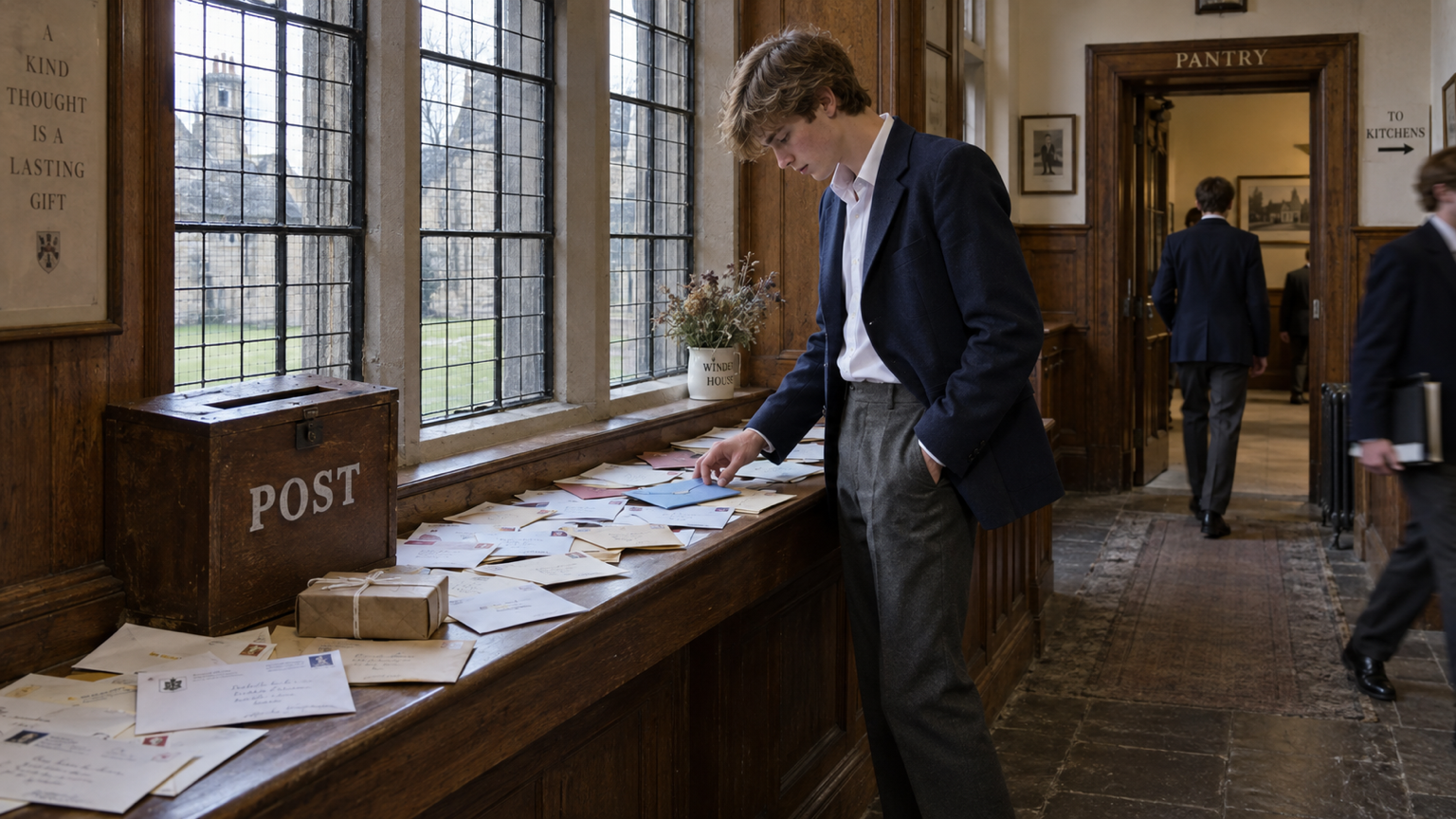
The post arrived after we had gone up to School and was put on a wide shelf by a wooden post box, beneath a window beside the pantry, opposite the doors s to the dining room. I could recognise one of her envelopes from the handwriting, paper and postmark before I picked it up. Other boys noticed that I received letters from a girl, but thankfully I was left alone. There were boundaries. Mucking about with someone else’s post was one of them.
A letter from Julie-Anne was pure romance. It was like a flirtatious glance across a room or a touch of the hand. It countered the entirely masculine world I was condemned to exist in all day, for weeks on end.
Her life was normal. She went to school and lived at home.
My being sent away to boarding school was my normal – and ‘normal’ for almost everyone I knew, but I knew perfectly well that most boys and girls were not sent away. This was a privilege. It was supposed to be a good thing. Yet I could already see that it distorted reality.
Julie-Anne could often treated going to school as inconsequential as a trip to the shops. A morning of lessons, perhaps games in the afternoon — then home mid afternoon. Homework could be done when she pleased, taking as little time or as long as seemed fitting. Get it done after school and have the evening free. Do something first and leave it until later. Bank it for the weekend. Or finish everything during the week and have the entire weekend for family and friends. Or just don’t do your homework! It’s not as if you have a house prefect or the house master leaning over your shoulder.
She had a weekend. Not simply Saturday and Sunday afternoon.
I could be dismissive of that ordinary world too. Gosforth could seem humdrum. Families where their Mum and Dad were still together could look terribly conventional. And there was the fact that my mother seemed either to be related to everyone or to have been at school with them, which wasn’t far from the truth: her mother, five siblings and all their offspring gave us cousins and second cousins everywhere, and Central High and university had added generations of people she knew around Gosforth and Newcastle.
At Sedbergh no day was your own.
Today the lessons were ‘good’. Not great, not dire. Passable. That or they were exactly the same as ever and it was my mood that was up.
I expected to get a bad French test back, but I didn’t get French.
I seemed designed to do badly at French. Whatever I did failed to improve my lot, which made any effort to do less than badly feel futile. It wasn’t the French master. Quite the opposite: he was generally enthusiastic and hopeful.
The difficulty lay somewhere else. I heard what I wrote. I saw words as images rather than fragments to be broken up and reconnected in some ordered way to make language. French grammar could feel like guesswork.
Yet give me a shot at reading aloud and I could do that. I liked acting and improvising, and I could put on a convincing French accent. My spoken French might sound far better than my understanding deserved.
In English I read Buckingham in Richard III.
I said the words but barely understood their meaning. I would rather have had Richard himself. He was like a pantomime baddy, a juicy part to read.
With Shakespeare’s history plays I loved the crossover between English, history and performance and visualising the play on stage. At home we watched Shakespeare on television, and films shown on television too: Olivier, Gielgud, Timothy West, Judi Dench, and Romeo and Juliet. Even when I couldn’t decipher much of the language, I loved the way the words rolled off the tongue, the drama and the history.
Buckingham was Richard’s strategist, political fixer and PR agent. He helped make Richard appear devout — “And look you get a prayer-book in your hand” — and helped him ignore custom and breach sanctuary. Then Richard betrayed him and had him executed, so Buckingham got his comeuppance.
After lunch we had Games.
There had been one of the compulsory House Rugby call-ups. Rather than trying to select a side and then finding someone unavailable or claiming an excuse, everyone eligible had to turn up. So we appeared by the side f a muddy pitch in our kit like a motley bunch of miscreants, quite a few of us trying to dodge the draft, hanging around waiting to discover who was required.
I resented it.
As far as I understood it, the deal when I came to Sedbergh was that I would swim. That was my sport. I hoped that was the conversation my mother had had too. But the School had its own requirements: rugger, House games, running, cricket, Cadet Corps and Chapel.
It was part of a larger mould. We were being turned into the appropriate sort of upstanding young men who would go to university or the Army, run Daddy’s farm or firm, go into the City, or become lawyers, doctors or priests. If I had wanted what that world offered, perhaps it would have been fine. Too often my impression of the boys and staff was so low that I couldn’t see why I would want to belong to it.
I was against the violence in Sedbergh rugby as well: state-condoned bullying, becoming a “rugger bugger”, turning into a hearty Berghian. It wasn’t my image of myself. If I was forced to play rugby instead of swimming, my deliberately lacklustre performance was conscious.
There were too many of us this time, so was released.
I was able to change and went off to swim instead, with my books to hand for afternoon classes.
I was a creature of the pool. Too much of my young life had already been spent being denied the swimming training I craved. Swimming suited me partly because, even in a squad, it was a solitary sport. How you trained was down to you.
The new swimming coach understood that world better than most. He was a working-class Scot who had swum for Scotland at the Commonwealth Games and had a Geography degree which allowed him to teach. But he was new to Sedbergh, a fish out of water himself, learning the ropes and expected to toe the line. If the Houses wanted their swimmers for rugby, there was only so much he could do.
On Mondays, Tuesdays, Thursdays and Fridays we had late afternoon classes, roughly from half past four until six, two forty-five-minute lessons. The pool was just down the lane from the main School block, so taking my books meant I didn’t have to hike all the way back out along Winder Lane to the House and then return again after swimming. And I got more time in the water.
We should have had lockers at School. Why did no one ever think of that?
If you forgot a textbook, you could try working from a friend’s until the teacher spotted you. Having to go and fetch your own book then became part of the punishment. Some Houses were near the classrooms. Winder was the furthest away.
I did a hard swim.
I’m gradually recovering the shape of those sessions: perhaps ninety minutes to two hours and four or five kilometres, aerobic work mixed with skills, technique and timed swims. The squad might nominally have numbered sixteen, but if twelve of us were actually in the water we were doing well. Everyone had his House to fight over rugby. Sometimes there might have been only four swimmers.
Even with others alongside me, swimming could feel private. Every part of my body was working to keep me afloat, balanced and moving through the water. It was one of the fragments of the Sedbergh day that felt mine.
There was still the usual adolescent nonsense. I made the joke too often that there was only one muscle you didn’t use in swimming, prompting somebody to suggest that if you got a stiffy you could use it as a rudder, and someone else to correct him: daggerboard. Then we tucked ourselves politely into our Speedos and got on with the swim.
Privacy existed in fragments: in bed, a bath to some degree even if taken in a communal washroom, on the lavatory, walking on the fells or beside the river or a brook, in Art, during a long run or long swim, or rehearsing alone on a musical instrument rather than sitting in orchestra or brass band practice.
And, of course, writing the Diary.
Otherwise, from the moment I woke until the moment I went to bed, my time had to be accounted for.
After swimming I changed quickly and went back up to School.
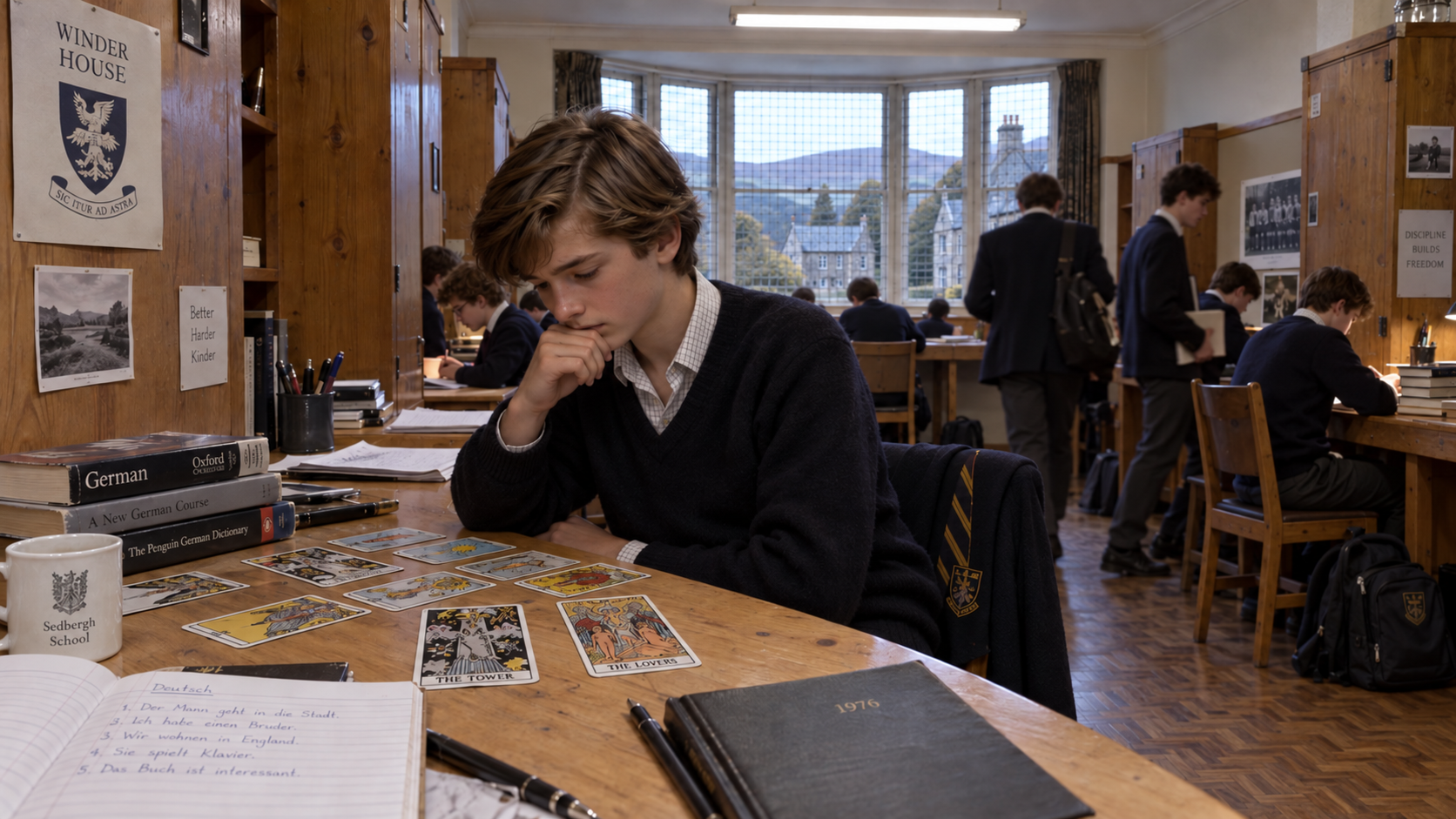
I’d done my German preps, so the work was ready to hand in.
In Geography I finished what we were doing in the lesson and then got on with revision. That was the rhythm of much of school: cover a topic, take notes, perhaps do project work or submit a short essay, revise, take a test, get the result, move on.
Tests were a constant part of the week.
If you did badly, that was your fault. The likelihood of anyone having time to help you understand what you had failed to grasp was practically nil.
The subjects I pursued beyond that conveyor belt were the things I read about for myself: geography, the environment and climate, French geography and history, and novels.
Maths was revision.
Then I did Chemistry in the Chemistry laboratory.
Later I went to Choral Society. I only did Choral Society because I hoped to spy a girl. Teachers wives and daughters sang.
There were other girls there, though they tended to be older. Choral Society separated us by voice as much as gender, so approaching anyone was hardly straightforward.
I saw Mary.
Contact had already been made, just about. A few garbled words. Perhaps a note on a piece of paper. I’m no longer certain whether that had happened yet. Somewhere in the weeks or months ahead there was certainly a folded note and a school coat pocket, but that belongs to its own day when I reach it.
For now, I saw Mary at Choral Society and was all an expectant flutter of indecision.
That was exactly what it felt like.
I wasn’t really expecting anything to happen. Most of my dreams and imaginings about girls were just that — unrequited and unpursued. I could overthink how to approach Mary and what to say until I became hopelessly frozen.
There was the public eye too. Any girl who appeared anywhere on the Sedbergh stage came under constant scrutiny. I was entirely inside the boys’ perspective then. Mary must have had plenty of suitors.
If a boy approached a girl, other boys noticed. What was she like? What did she say? What did you say? Were you going to see her again?
There also seemed to be a rule that the boy had to make the first move. Had that been drummed into us? Was it still considered unladylike for a girl to do the asking? Either way, the onus seemed to be on us.
Julie-Anne and Mary occupied different compartments in my mind. I understood the principle of being faithful and of not cheating on a girl. But being away at School was almost another life, another strand.
And what was I actually doing with Mary?
Nothing.
It was all wishful thinking from afar.
Yet simply seeing a girl could set everything going: the softness of her skin and complexion, the shape of her smile, the cut of her hair, her breasts and hips and the way she moved; how she dressed; if I was close enough, how she smelled; the sound of her speaking voice and, here, her singing voice.
That feeling itself mattered. I could endure it, indulge it, write it down. Perhaps use it in a story one day. It was a sensation that could end in several ways: indulge it and leave well alone, indulge it and act, bury it, run away from it, ignore it.
On this evening I did none of those things decisively.
I simply remained there, all an expectant flutter of indecision.

Leave a Reply