
Using AI, spiralling questions and personal association to uncover a warning about alcohol, momentum and the need to regain perspective.
I have developed a way of using AI to explore dreams that is deliberately slow, meticulous and Jungian. I am not interested in asking an AI what a dream “means” and receiving an instant catalogue of symbols: river equals unconscious, road equals life journey, tree equals growth, and so on. That would be precisely the sort of standardised decoding Jung warned against.
Instead, I use AI in the role of a questioning psychoanalyst. Its job is not initially to interpret anything. Its job is to interrogate the dream carefully, repeatedly and from different angles, while I supply the associations.
This follows the principle described in Jung’s Man and His Symbols: the dream is not a standardised cryptogram whose symbols can be translated using a glossary. Its imagery belongs first to the individual dreamer. In the introduction John Freeman describes the characteristic Jungian method as “spiralling”: returning repeatedly to the same subject from slightly different positions until its separate details begin to form a whole.
That is exactly what I try to reproduce.
Beginning without interpretation
I start by recording the dream as accurately as I can, preferably immediately after waking. I then give the AI a very specific instruction: do not interpret it yet; do not make assumptions about what anything represents; do not assign conventional meanings to people, objects, places or events.
Instead, I ask for a manageable set of precise questions grounded only in what I actually dreamed.
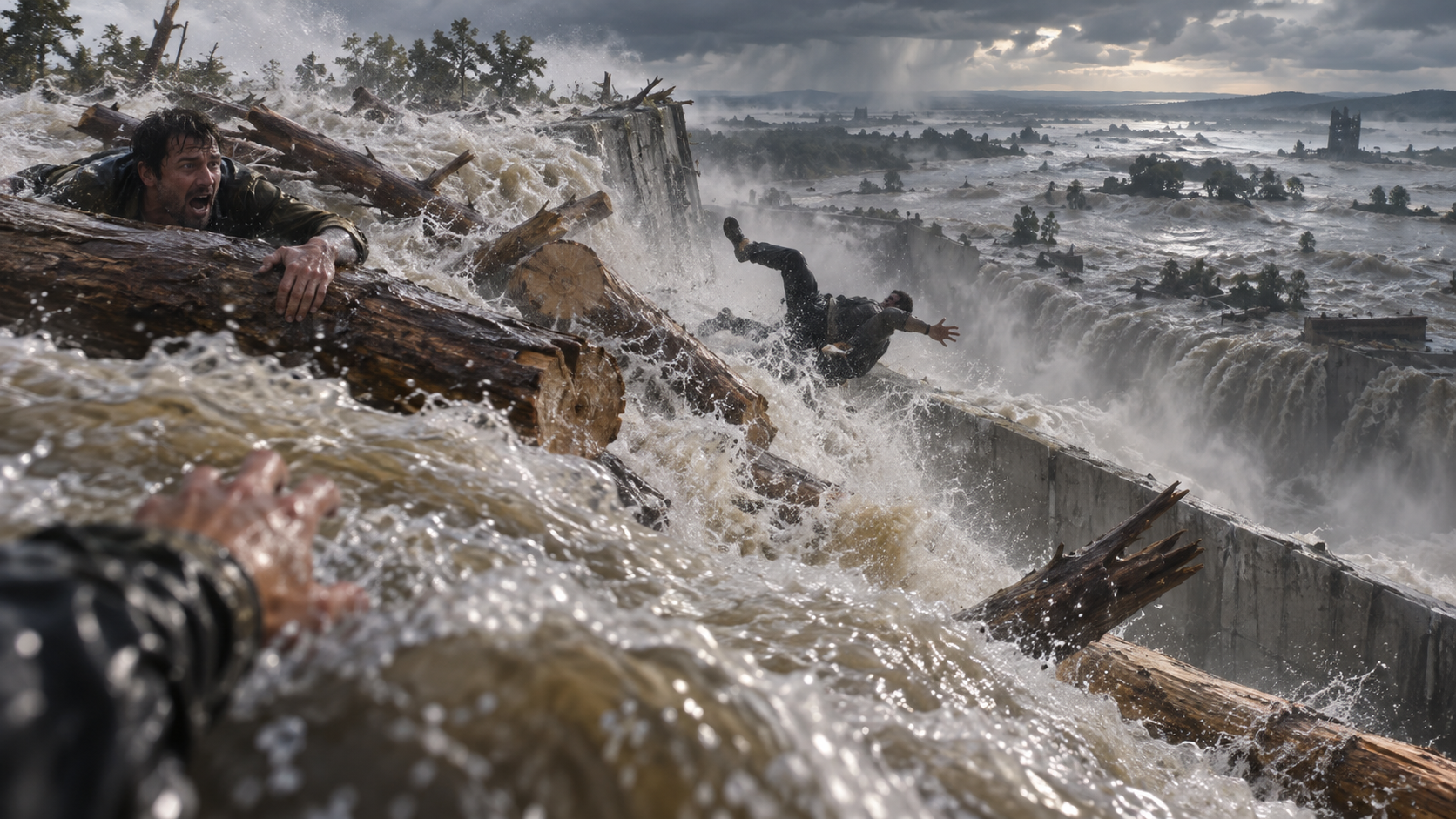
The dream: In this dream I found myself on foot at a busy city junction. There was an extraordinary black stick-and-rope swing hanging somehow from above, apparently installed as part of the pedestrian infrastructure. I grabbed it and swung high over almost the whole junction, landing on a small traffic island. There was only one slip road left to cross, but it was flooded. I stepped into the water, was suddenly swept away, and found myself hurtling towards an enormous raging river from which escape appeared impossible.
It would have been very easy to jump immediately to “water means the unconscious” or “the crossing represents a transition”. Instead, the first questions were much more mundane.
What did the junction resemble?
How did I feel standing there?
Where was I going?
Why did I describe the crossing so precisely?
Why was all the street furniture black?
Did the impossible rope hanging out of the sky strike me as impossible?
What did the swing remind me of?
Why did I choose to use it?
What did it feel like bodily?
Those questions began recovering material that had not been present in my original account of the dream.
The junction reminded me of a real journey only a month earlier in Rouen: leaving the tranquil, mostly pedestrianised old city and crossing the busy Boulevard des Belges and Quai du Havre on my way towards the Musée Flaubert.
I had not been lost in the dream. I had a destination.
That distinction mattered. I described the feeling as having “a sense of purpose, a direction in mind, and an outcome”.
The swing was equally revealing. It did not feel sinister or magical. It looked like official council equipment: sturdy, practical and deliberately designed for pedestrians. Its hand grips were at exactly the right height for me. It seemed intended for people like me: able-bodied, adventurous, prepared to take a degree of risk.
And above all, it was irresistible.
Swinging above the traffic “like Tarzan” was exhilarating.
Already the dream was becoming more complicated than any simple warning about reckless shortcuts, because the shortcut worked brilliantly. It was ingenious, effective and enormous fun.

The second spiral
I then feed my answers back into the AI, marking them clearly as my own responses, and use another standard instruction:
Using my answers marked J>, continue the Jungian spiralling inquiry. Do not yet summarise or interpret the dream. Ask the next set of context-specific questions arising directly from my replies, including any contradictions, omissions, emotional changes or especially vivid details.
That last part is important.
The AI is no longer merely questioning the original dream. It is questioning my answers about the dream.
So it noticed, for example, that my emotional state changed sharply after landing on the traffic island.
I had felt exhilaration and satisfaction. Then I saw floodwater crossing the remaining slip road.
It asked when that trepidation first appeared, what the water looked like, whether I could see the road surface, how deep I believed it was, whether retreat occurred to me and why I continued.
My answers became more revealing.
At my side the water was only ankle-deep. I could still see the tarmac. Towards the centre it became faster and murkier, carrying debris.
I judged that it would probably rise no higher than my knees.
I had experience crossing fords and floodwater.
It looked manageable.
Most strikingly, when asked whether I had considered retreat, I answered:
“There was no turning back. I didn’t even check.”
That demanded another question.
Was there literally no way back?
No. I had simply committed myself to continuing.
Asked about waiting, I realised that this had been part of the dream from the beginning. I had taken the swing partly because I did not want to wait for the pedestrian lights.
What did waiting mean to me?
“Missing the opportunity, not responding to the urge, a desire for challenge and novelty.”
The questioning was now uncovering a psychological attitude rather than attaching symbolic definitions to objects.
The third spiral
The next round followed the moment when confidence collapsed.
I entered the flood thinking:
“I knew what I was doing and would not have a problem.”
Then something changed.
The water rose suddenly. Recent news stories about glacier collapses and sudden torrents in ravines may have supplied some of the imagery. But within the dream itself the crucial fact was the rapid escalation.
I was no longer wading.
I was being washed downstream.
The flooded road became a torrent. The urban landscape almost disappeared. It became more like a canyon.
The AI asked what I did physically. Given that I have spent much of my life swimming, one might have expected me to swim my way out of it.
But that was not my experience of the dream.
“I simply had to go with it. Go with the flow.”
Then came several huge sawn tree trunks. Men were clinging to them. My first instinct was that perhaps I could grab one too.

Almost immediately I saw that this would achieve nothing.
The logs were being hurled around like matchsticks and the men like rag dolls.
Again, the questioning concentrated not on what a tree “symbolised”, but on my actual psychological reaction.
The men showed me that what looked like a possible means of rescue was not one.
The water then swept them over a retaining wall perhaps twelve feet high towards an even larger river below. Beyond it was a gargantuan flood carrying such force that serious injury or death seemed inevitable.
By then my thought was simply:
“I’m in serious trouble.”
And ultimately:
“There was no way out of it, except to wake up.”
Only then do I permit interpretation
After three rounds of questions I finally ask the AI to draw the material together.
By then it has a substantial body of personal associations to work with.
The resulting interpretation therefore does not begin with “water means this” or “the rope means that”.
It begins with the emotional architecture of the dream.
I start purposeful, competent and orientated.
I see an opportunity.
I take it.
It is exhilarating.
It succeeds.
I encounter what appears to be one final manageable obstacle.
I assess it using previous experience.
I decide I can cope.
I do not check whether retreat is possible.
Then the scale of the situation changes completely.
The sequence becomes:
purpose → opportunity → exhilaration → achievement → caution → confidence → surprise → loss of control → diminishing choices → mortal danger.
The dream repeatedly overturns my estimate of scale.
The traffic looks difficult but is easily overcome.
The flood looks modest but becomes overwhelming.
The large logs become matchsticks.
Capable men become rag dolls.
A retaining wall capable of separating road from river becomes irrelevant.
Finally, the whole engineered urban environment gives way before something elemental and uncontrollable.
That produced a provisional Jungian idea: perhaps the dream was compensating for a strongly agentic part of my personality — the part that values movement, opportunity, novelty, challenge and the confidence to act.
Importantly, the dream did not condemn those qualities.
The swing proves that.
Sometimes taking the opportunity is exactly right.
The deeper tension seemed to be that the same confidence which successfully negotiates one obstacle may not accurately assess the scale of the next.
That was already a useful reading.
But it was not yet the most important one.
The association that completed the dream
Only after all of this did something click.
Eleven months earlier I had stopped drinking alcohol.
Suddenly the flood had an intensely personal association.
It felt to me like a warning against believing that I could casually step back into alcohol and remain in control.
That did not mean “water equals alcohol”.
That would still be the symbolic shorthand I had been trying to avoid.
What convinced me was the structure.
The dangerous thing begins by looking manageable.
I have experience with it.
I think I know what I am doing.
I take the first steps confidently.
Then momentum begins to replace choice.
The opportunities to get out diminish.
What initially looked modest turns out to belong to something enormously more powerful.
The phrase that had emerged much earlier now became particularly uncomfortable:
“There was no turning back. I didn’t even check.”
Not because one drink literally makes recovery impossible, but because the dream gave me an extraordinarily vivid image of allowing momentum itself to make the decision.
The insight came from me, not from the AI.
That distinction is fundamental to the process.
Had the AI declared at the beginning that a raging flood represented addiction, I might reasonably have dismissed it as generic dream symbolism.
Instead we had spent a long time examining Rouen, pedestrian crossings, black street furniture, the design of the swing, bodily exhilaration, the depth of floodwater, my experience of fords, my attitude towards waiting, the logs, the strangers and the retaining wall.
Only after all that did I recognise the connection.
That is why the conclusion felt earned.
Re-entering the dream
There was one further stage.
Rather than leaving myself perpetually hurtling towards catastrophe, I mentally re-entered the dream.
This time I reached the flooded road and did something that had never occurred to the original dream-self.
I did not step into it.
I stepped away from the road entirely and climbed a slope behind me so that I could get a wider view of what was happening before deciding whether to continue.
That felt important.
I had not become frightened of adventure.
I had not abandoned my destination.
I had not rejected the exhilarating swing.
I had simply introduced something missing from the original sequence:
perspective before action.
At road level the flood looked manageable.
From higher ground I might be able to see the whole system — what was coming downstream, where the water originated, how it related to the much larger river beyond.
The original psychological position had been:
I think I can manage this.
The revised one became:
Before deciding whether I can manage this, I need to understand what I am actually dealing with.
For me, that is where this particular analysis reaches a satisfying conclusion.
The answer is not timidity.
It is not “never take risks”.
It is not even simply “never drink”.
The dream preserves the adventurous part of me. The swing is still wonderful. Curiosity, novelty, movement, confidence and the willingness to seize opportunity remain sources of vitality.
But the dream has also given me an image of a force with which those qualities alone are insufficient.
Its warning, as I now understand it, is more precise:
Do not mistake familiarity with something for mastery over it. Do not assume that because the first step looks manageable you control what follows. When something has the capacity to acquire its own momentum, step aside first. Gain altitude. See the whole system. Preserve the freedom to choose before momentum chooses for you.
That is why I find this AI-assisted Jungian process valuable.
The AI has not told me what my dream means.
It has done something much more useful: it has kept asking sufficiently precise questions for long enough that I eventually recognised what the dream meant to me.
This version puts the method itself at the centre while allowing the alcohol insight to emerge late, as it did in the actual analysis, which makes the conclusion much stronger.

Leave a Reply