
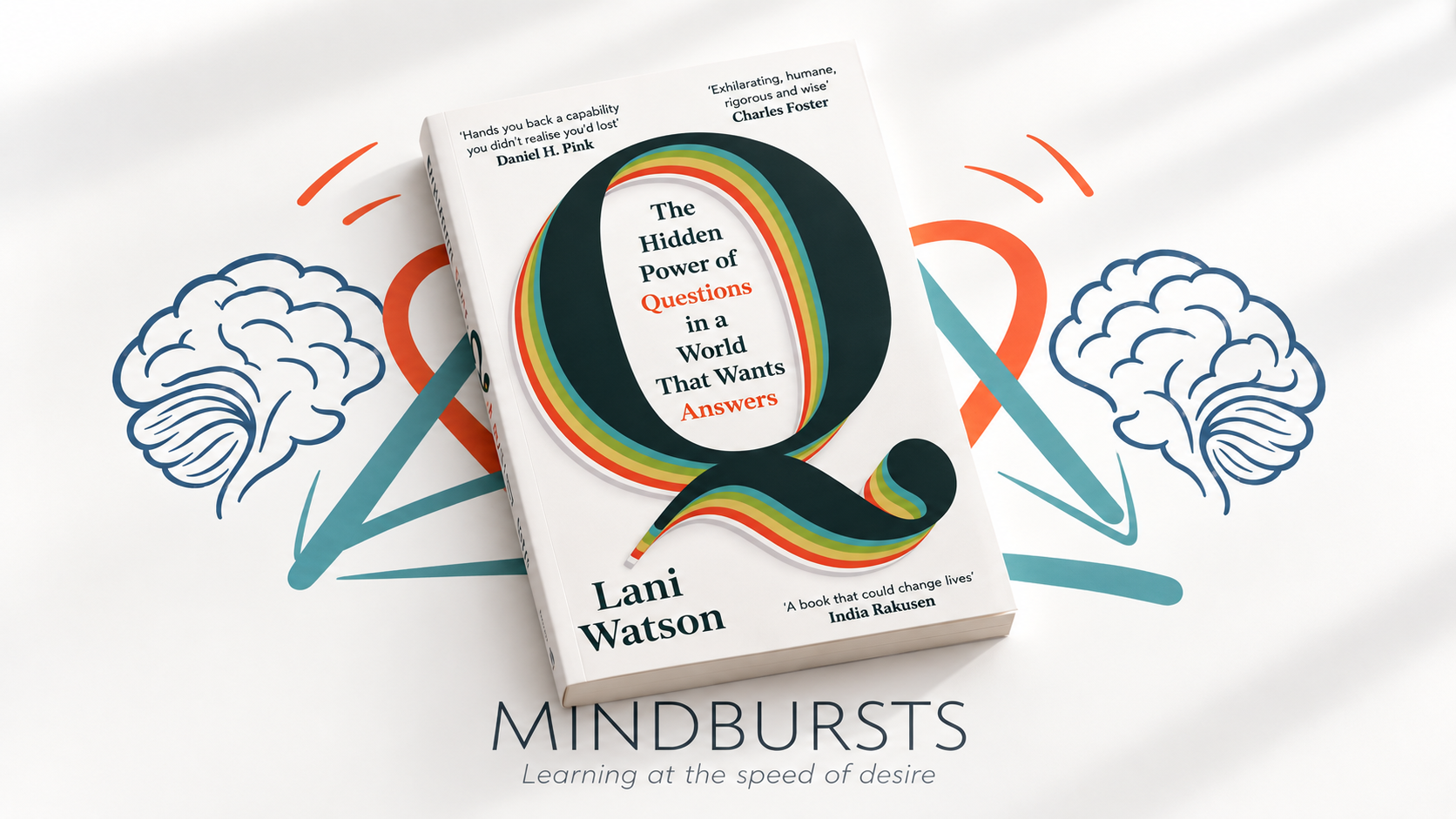
I have recently been reading Lani Watson’s Q: The Hidden Power of Questions in a World That Wants Answers, after hearing her discuss her thinking on BBC Radio 4’s Start the Week. It has given me a way of articulating something I had already begun to discover through using artificial intelligence.
The important thing may not be the answers.
It may be the questions.
That sounds obvious. As an educator I ought, perhaps, to have known it all along. And of course I did, in one sense. But there is a difference between knowing that questions are important and recognising just how much intellectual agency resides in being able to formulate, pursue and refine them.
I can see it in my own experience as a learner.
As a teenager, a student in my twenties and, indeed, throughout my life, I have not always been a satisfied student. Even now, completing an Institute of Swimming Level III coaching course, I sometimes find myself wanting to go further than the material immediately in front of me. I want to ask why. I want to test an assumption, make a connection, pursue an exception or take something apart to see how it works.
The ability to ask a question gives the learner agency.
And this is where my experience of AI has begun to collide with my experience of education.
There seem to be two very common reactions to artificial intelligence.
One is to treat it as a miraculous oracle. Ask it anything and it will give you the answer.
The other is to regard it as inherently threatening: another machine taking over something human beings ought to do for themselves, another technology consuming resources, destroying jobs or diminishing thought.
There are people close to me who are deeply suspicious of AI without really having used it. My wife, her sister and plenty of others fall somewhere within that broad constituency.
But I increasingly think both reactions miss something important.
My wife illustrated this rather beautifully as I tried to explain what I had been learning from Q and how it connected with my experience of AI.
“That’s the first time you’ve said something that makes sense to me,” she said.
I shall take that as progress.
What made sense was that I was no longer talking about AI as something that supplied answers. I was talking about AI as something that helped me ask questions.
That distinction has become fundamental to the way I use it.
Take my diaries.
I have diaries from the 1970s consisting, in some cases, of tiny entries written by a teenage boy fifty years ago. The words are there, but much of the world surrounding them has disappeared from immediate consciousness.
An entry might contain a person’s name, an unexplained remark, a lesson, a swimming time, an argument, a record bought in Newcastle or a cryptic sentence that made complete sense to me in 1976 and almost none to me fifty years later. I used shorthand too which baffles me now.
I could simply give the diary to an AI and say: “Turn this into a memoir.”
That would be quick.
It would also be almost entirely the wrong thing to do.
The AI would inevitably bridge gaps. It might make plausible assumptions. It could create a smooth piece of autobiographical prose in which things I genuinely remembered and things the machine merely inferred became indistinguishable.
Instead, over about six months, I have developed a multi-stage process based upon answering probing questions asked by the AI.
We begin with the evidence: my original diary entry.
The first stage preserves it. The language of the teenage boy matters. His peculiar vocabulary matters. His omissions matter. Even his awkwardness matters.
Then the questioning begins.
AI generates questions from the specific context of that particular entry and from what it already knows about the people, places and recurring threads within the wider diary.
I answer them.
My answers produce another set of questions.
Those answers produce further questions.
The enquiry spirals.
A question about a name may recover a face. The face may remind me of a classroom. The classroom may recover where people sat. That may remind me of the teacher, which may suddenly explain a cryptic phrase in the diary. Another question might reveal that something I had initially remembered with certainty cannot actually have happened quite as I thought.
Nothing requires me to accept the machine’s premise. I can say no. I can correct it. I can say that I cannot remember.
Indeed, “I don’t know” is often an important answer.
Several hours later, a diary entry consisting originally of a few hurried lines can have expanded into a rich piece of remembered life.
But AI has not remembered it.
I have.
The machine has helped me interrogate my own memory. I have composed and refined four detailed prompts for each stage – each building on the one before and what I write.
Far from doing the work for me, AI has enabled me to do the work more efficiently and thoroughly.
The same principle has emerged from a different project: analysing dreams.
I am interested in Jung’s analytical tradition, but I have very little interest in asking an AI, “What does my dream mean?”
To me, that would be no more valuable than having a Tarot card interpreted.
A river in my dream is not necessarily the same river as somebody else’s river. A house, tree, road, flood, railway station or unknown woman does not arrive carrying some universally fixed meaning.
The circumstances belong to me.
The associations belong to me.
The anxieties, memories and preoccupations surrounding the dream at that particular point in my life belong to me.
So once again the useful role for AI is not interpretation but interrogation.
I describe the dream.
AI asks questions.
I answer.
It asks more precise questions based upon those answers.
We circle back to an earlier image from a different direction. Something that initially appeared incidental acquires significance. A contradiction emerges. An association I had not consciously made becomes visible.
The questions spiral gradually inward.
Eventually something happens which I think is essential to the whole process.
I decide that I am satisfied.
Not the AI.
Me.
There is no electronic pronouncement declaring that the correct interpretation has now been reached. I reach a point at which the explanation coheres sufficiently with my experience for me to say: that is enough.
That is human agency.
And once I began seeing AI in this way, the educational implications became difficult to ignore.
Much of the anxiety about students using artificial intelligence assumes a very particular interaction:
Here is my assignment.
Give me the answer.
If that is how AI is used, the concern is understandable. The learner has outsourced precisely the intellectual activity the assignment was supposed to develop.
But reverse the relationship.
Do not ask AI to answer the student’s question.
Ask it to question the student.
Start with what the learner knows.
Not what somebody of their age ought to know. Not what the syllabus assumes they know. Find out what this particular person actually understands about the problem in front of them.
It might be almost nothing.
That is fine.
Ask a question from there.
Their response supplies evidence about their understanding. Use that evidence to formulate the next question. If they know more than expected, move faster and deeper. If there is a misconception, explore it rather than simply correcting it. If an unexpected interest appears, follow it for a while.
The enquiry becomes adaptive.
A student who began by saying, “I don’t understand this,” may discover that they understand rather more than they thought. More importantly, they begin asking questions of their own.
Why does that happen?
What would happen if this changed?
Does that always apply?
How do we know?
What evidence is there?
Is there another explanation?
Now something educationally interesting is happening.
The student is no longer waiting for knowledge to be delivered.
They are pursuing it.
This does not remove the teacher. Nor does it mean that factual answers cease to matter. There are times when someone simply needs to know the capital of a country, how to calculate something, what a technical term means or how a swimming turn should legally be executed.
But answers are not the whole of education.
An answer can close an enquiry.
A good question can open one.
And perhaps one of the remarkable possibilities of AI is that we now have access to a tool capable of sustaining that questioning process almost indefinitely.
A teacher with thirty students cannot conduct an hour-long individual Socratic dialogue with every pupil during every lesson.
AI potentially can.
That raises its own problems. Its questions can contain faulty assumptions. It can misunderstand the learner. It can be repetitive, superficial or simply wrong. Teachers and learners therefore still need judgement, evidence and the capacity to challenge it.
But those limitations reinforce rather than weaken my central point.
The student must remain intellectually active.
We may therefore be concentrating on the wrong question when we ask whether AI will give students the answers.
Perhaps we should be asking:
Can AI help students become better questioners?
My own experience suggests that it can.
Six months into my intensive use of artificial intelligence, I increasingly find myself doing something rather different from what I expected at the beginning.
I am not asking it to think instead of me.
I am asking it to keep me thinking.
And that may turn out to be one of its most humanly useful capabilities.


Leave a Reply