
Saturday, 2nd October 1976
(Winder House, Sedbergh School. Age 15).
I realised we had to write something for Divinity. Perhaps this was after thinking we had been given a light prep, or perhaps Harris had let us write something during the lesson, which was like him.
Harrison, in Sedgwick, Kitson, in Lupton, and I had all written much the same thing. Not the same essay, but the same arguments: three of the strongest counterpoints I had made against John Young in The Case Against Christ. Normally it was difficult if someone stole your thunder or claimed your idea as their own. This felt different. It was a relief to discover like minds.
We were all atheists, and there were more of us out there, a kind of quiet revolution against the way Sedbergh did things. Most lessons were: this is what you have to learn, these are the facts and the points you need to use in essays and exams. Harris at least allowed us to argue.
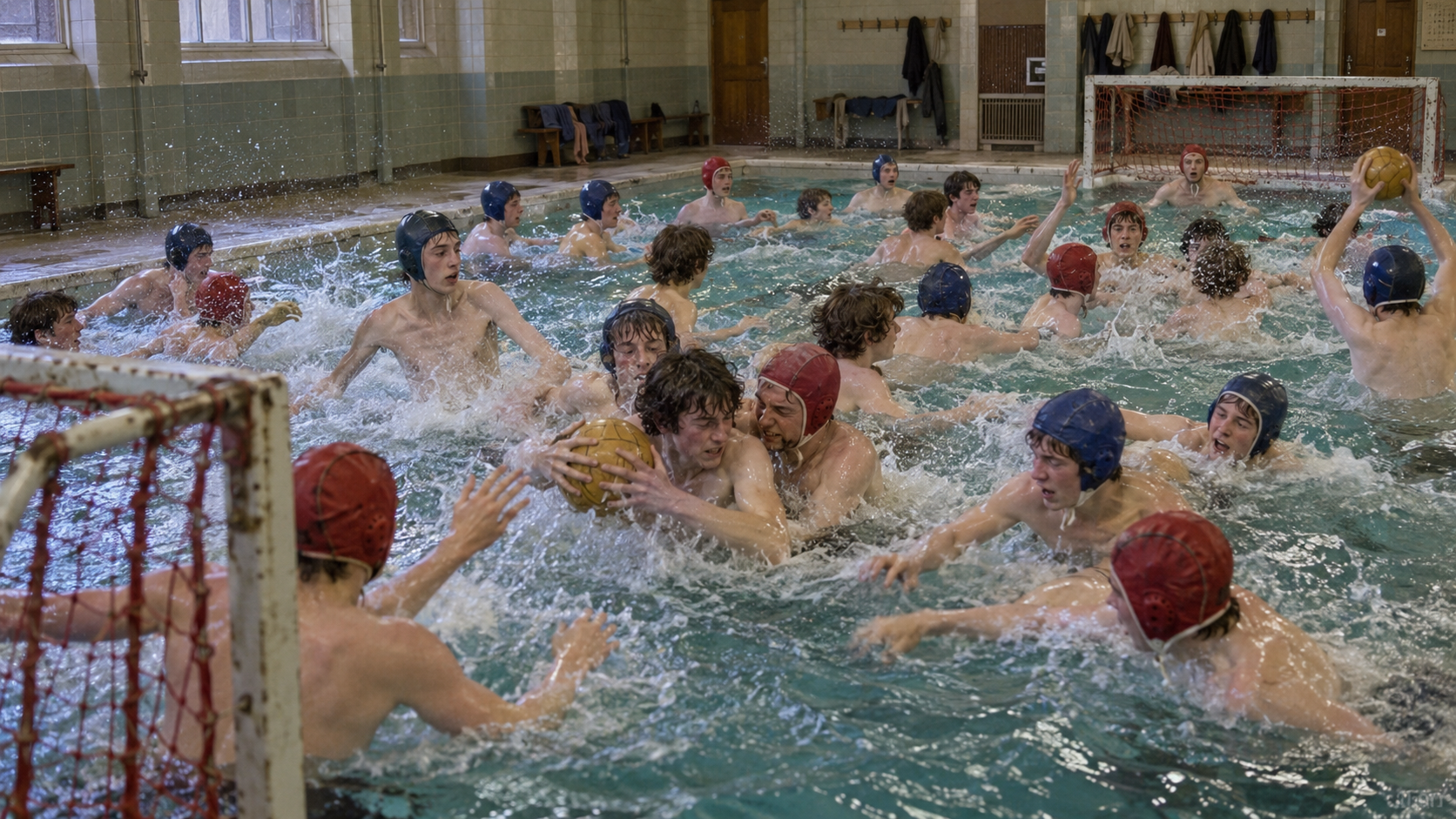
Water polo: Far too many people were there.
Half of Powell House seemed to have free access to the pool. There was never a lifeguard and rarely a teacher supervising us. The result was an overcrowded free-for-all: anarchic scrapping, hogging the ball, catching and throwing with two hands, flinging it at the walls. Too many boys didn’t know the rules.
I had about half an hour in the water. I was going to do swimming time trials, but that plainly wasn’t going to happen. Then I was off for Rugger.
I resented that. I was often made to play simply to make up the numbers so we would not be a man down. Swimming mattered much more to me, but I was being made to live the life the institution wanted for me. Still, in for a penny, in for a pound. If I had to be there, I got stuck in. There was something rewarding about a tiring, brutal game of rugby and afterwards taking a bath muddy and bruised.
Swimming, Rugger, squash. I spent the afternoon in and out of kit and showers, back and forth to Winder House at the end of Winder Lane.
Grubber: Nothing particular happened. It was simply somewhere I went, an event and a place that broke up the day.
Then I played seven games of squash with M C Pendall!

We were closely matched. You started thinking three games would be enough, then pushed it to five, and if it was still close made it the best of seven. Someone won 4–3. I didn’t even record who.
I didn’t get going until after the first game. After that I was warmed up and in the flow. Being able simply to keep going was a privilege of a kind: no one had booked the court after us, there was nothing to pay, so we could extend the game because we wanted to. Immersed in it, there was an element of escaping the place altogether.
The squash was the best thing about the day.
In the evening I went to the Powell Hall event. I didn’t have to go. I had a season ticket, though, so felt obliged. Otherwise I could simply have stayed in Winder, watched television or read a book.
Going meant changing again, this time into Sunday best: white shirt and Sedbergh tie, tweed jacket, dark grey or charcoal trousers and polished black shoes.
The concert was ‘Bassey O the Barn Band’, a visiting Manchester brass band. They were good — competent brass band playing — but a bit dull.
The whole concert series seemed rather pretentious: usually classical or folk music, the sort of culture the school thought we ought to appreciate. I wanted Bowie, Roxy Music, Marc Bolan or Pink Floyd.
By now, only a month into the new academic year, Sedbergh had me playing along. No girls. Nowhere to go. Nothing resembling a home life. It was all school, its regime and its practices, twenty-four hours a day, seven days a week.
Divinity, water polo, Rugger, the Grubber, squash, Powell Hall.
I had succumbed to its culture and its people.


Leave a Reply