
Returning to life drawing has made me realise that the interesting question is not simply how I drew at seventeen, but how I looked.
At seventeen, portrait drawing had a different set of tasks from life drawing now. I was doing A-level project work. I was getting my hand in. I had to look where I needed to look, keep it professional, and deliver an impressive likeness. The gaze had a job to do.
With a portrait, I began with the eyes, mouth and nose. A likeness is subtle, but also surprisingly exact. The position of the eyes matters, as do the shape of the eyelids and eyebrows, the size and depth of the eye sockets. Get those relationships wrong and it might resemble somebody, but not the person sitting in front of you.
I had been taught not to erase my way towards a drawing. I would make a fair stab at a line in faint pencil and gradually correct it, almost like tuning a guitar. The first mark did not have to be perfect, but it had to be tentative enough to remain part of the working-out.
My mother liked that visible working-out. She was an exceptional teacher. As children, art had always been play with her and, importantly, a way of having her attention. She encouraged at every turn. “Tell me about it,” was one of her characteristic questions: she never judged or made assumptions about what she was looking at.
Nor did she ever put her own mark onto our drawings.

She drew herself, so we could watch how she worked, but she did not reach over and correct ours.
By seventeen I knew some of the tricks of looking. I would blur my vision to get shape and form. I measured with a pencil held at the end of my extended arm. Measure it out. What you think you see and how you see it are not necessarily the same as what is actually in front of your eyes.
That lesson came back to me immediately in life drawing today.

Foreshortening in particular still exposes the difference between expectation and observation. The answer is to draw against what is around the figure, or imagine a grid, and lay it out objectively. An arm coming towards you is not the arm your brain insists an arm ought to be.
There is pleasure when it works: the precise angle of a wrist, fingers that suddenly sit correctly, the actual shape of the hips, a shoulder that falls where it should. They are small victories of seeing.
And then something happened today that turned the whole exercise into something stranger.
I first came to life drawing at Charleston Farm in 2016. I was there on my birthday, 27 September 2016.
Ten years later, after an absence of eighteen months or perhaps longer, I was back.
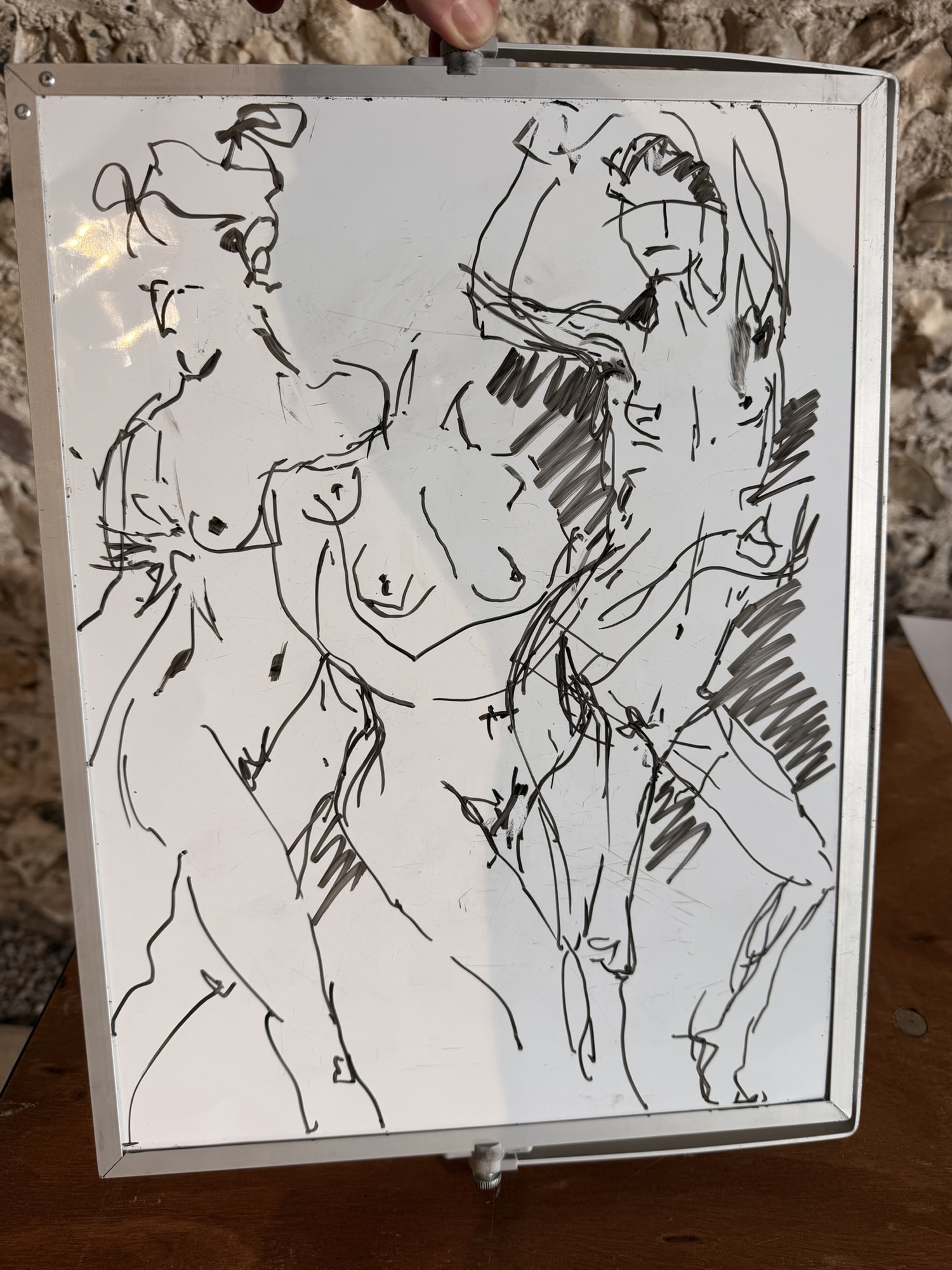
I settled into the session with a few fast drawings. Nothing remarkable at first. Get the hand moving. Find the weight of the figure. Stop trying too hard.

Then came a sense of déjà vu.
It was not simply the pose. It was the way I was treating it. Something in the angle of the body, perhaps, but also something in my own response: the line I was choosing, the way I was simplifying the form, the way my hand seemed already to know what it wanted to do.
The model was Naomi.
That name stirred something.
Later I checked my photographs.
There she was.
I had been drawing Naomi at Charleston in 2016.
So now I have the drawings I made of her then, and the drawings I made of her today.
The same model.
The same place.
The same act of looking.
Ten years apart.
That gives me something almost experimental to work with. I do not have to rely entirely on memory or on the stories I tell myself about how my drawing has changed. There is evidence.

What did I see in Naomi in 2016?
What did I see today?
What has changed in my hand?
What has changed in my eye?
And what, perhaps more remarkably, has not changed at all?
There is something wonderfully unsettling about recognising not merely a person but a way of seeing.
The drawing becomes a record twice over: Naomi’s body at a particular moment and my own visual habits at a particular age.
Perhaps that is what I am really recovering now.
Not a lost skill.
Continuity.
Portraiture demanded more time.
It was not a street-artist trick. A likeness arrived hesitantly. I needed time with the face. I might suggest a second or third sitting, although after about forty-five minutes most sitters understandably wanted to be done. Given the opportunity, I could take two or three hours over a portrait.
I rarely started again. I started instead with the softest sharp pencil and the lightest possible marks, aiming to get it right from the beginning. A 4B or 6B, sharpened with a knife. No hard pencils and no pencil sharpeners. Mum liked the bevelled edge made by cutting the wood away with a blade.
There would be a putty rubber somewhere, but not as an undo button. It could remove an offensive smidge or a mark that contributed nothing, but it was also a drawing tool in its own right.
Mum taught me something else that mattered: knowing when to stop.
Sometimes a portrait might take three hours. Sometimes I knew after less than two that it was done. And occasionally I could make a drawing in minutes and feel satisfied because somehow it had caught the essence of the person.
Debbie’s portrait one I keep returning to: October 1978
I picture her sitting opposite me in a chair. Perhaps she had homework with her and could get on with it while I worked, returning her gaze when I asked. I would have been opposite her, perhaps sitting on a stool, perhaps standing, with cartridge paper clipped to an A3 drawing board.
The light needed to be consistent. Daylight or artificial light was fine; what mattered was that it did not keep shifting.
We could talk while I worked, until I reached the face properly. Then I would need stillness, particularly for the eyes and lips.
There was a discipline involved in looking at someone that closely. It was almost a test to remain dry and professional about it, however coquettish the circumstances might become.
I wanted the portrait to establish that I really was an artist. This was not some ploy to persuade an attractive girl to sit still and follow my instructions. It was A-level work. I wanted something worth submitting in my portfolio.
That mattered particularly with Debbie. She may have been an Upper Sixth science student, but in Art I was effectively in her year: we were both heading towards examinations the following June.
Usually I was making a head-and-shoulders portrait anyway. My eyes were not wandering across a body. They were travelling between eyes, cheekbones, nose, lips, hairline, jaw and paper.
Yet beauty undoubtedly affected the drawing.
I idealised.
Eyes tended to get too large. Not quite a Thunderbirds face, but larger than a human skull really permits, something Mum was quick to point out. I might improve the sitter slightly, but only slightly. Ultimately it still had to resemble the face they would recognise in a photograph.
With Debbie, admiration was certainly part of it.
And perhaps that is where portrait drawing becomes more complicated than observational technique.
There is an extraordinary sense of ownership in a finished portrait. The sitter may want it, but they cannot necessarily have it. I have that hour, or two hours, or three hours with them sitting in front of me forever.
When the likeness finally appears there is a little piece of magic involved. The sitter looks and recognises herself.
That’s me.
Delight.
Today, drawing a professional life model, the relationship is very different. There is a considerable disconnect. I have a task: find the main form, get the proportions right, work out the weight and angles.
If our eyes happen to meet, politeness almost interrupts the process. I barely acknowledge it because it breaks my concentration. I happened to be looking at her eyes because I was drawing them. A moment later I might be looking directly at her belly button and triangulating its position against her chest.
There is nothing especially intimate about either act. They are coordinates.
That professional detachment must have existed in me at seventeen too. Perhaps I was actively cultivating it.
Look where you need to look.
Do the job.
And yet a portrait of someone you care about cannot be entirely detached.
Would I stare at someone for that long if I felt nothing towards them?
Debbie’s portrait may have been affection personified: attention translated into graphite.
There is a curious triangle between sitter, artist and drawing. As the portrait develops, the image begins to compete with the person. I look from one to the other, checking distance, shape, tone and proportion until the marks begin to become somebody.
I wanted it to look like her, not simply to have a haircut like hers.
At seventeen drawing was one of the things I knew I was good at. There were a handful of things in which I felt better than most, perhaps all, of my contemporaries: observational drawing, swimming fast over fifty metres, singing.
Art therefore carried competence, achievement and identity.
But it was also meditation.
Hours could disappear into looking.
That has returned immediately in life drawing. Today there were only seven or eight of us, mostly people in their sixties, seventies and perhaps eighties. We took plenty of breaks and the longest pose was forty-five minutes, yet time flew.
The concentration is peculiar. It is intense without necessarily being exhausting because there is almost nowhere else for the mind to go.
Look.
Measure.
Compare.
Make a mark.
Look again.
Perhaps that is what seventeen-year-old me would recognise most readily.
Pencil held at arm’s length.
One eye shut.
Measuring an angle.
Discovering once again that what I think is there and what is actually there are two different things.
And now there is another continuity I had not expected.
Naomi in 2016.
Naomi in 2026.
And somewhere much further back, Debbie in 1978.
Different women, different circumstances, different kinds of looking.
But the same problem remains.
How do I turn prolonged attention into a mark on paper?
And how much of the person I was survives in the way I make that mark?


Leave a Reply