
Saturday 16th October 1976
(Winder House, Sedbergh School. Age 15)
I was worried about the German and History tests. My school life seemed to be spent worrying about tests. I suppose you got used to it, though I dreaded getting an awful mark — anything less than about 60 per cent.
My marks could be all over the place: Latin 11/50, History 20/20, Chemistry 13/20, English 17/20, Art A+, Biology A-, French 17/32, Maths 93%, Additional Maths 2/100.
Flippant, distracted, inconsistent — depending on the subject.
German was OK, not as good as usual, but I got 10/15.
We had German in the language block off Powell Hall, a traditional Victorian classroom with high arched, almost chapel-like windows. Austere. Painted custard yellow. Posters and maps of West and East Germany on the walls.
I didn’t believe in German either, though in a different way from not believing in God. I wasn’t going to take it at O-level, so all this studying seemed futile.
And when in life, talking to somebody in another language, were you having a 10/15 conversation?
I remember getting on just fine with a French family on a corridor of the ski flats in La Plagne and watch apparently excellent students of French become tongue-tied, while I, with less vocabulary and poor grammar, got on like a house on fire. Communication wasn’t a percentage. Facial expression and body language mattered. Wanting to communicate mattered.
At Sedbergh, though, everything could be marked and ranked.
J. F. Vernon. 15.3. 63%. 2/17. Could try harder.
It was like keeping a cricket score and about as useful.
He has a flippant attitude to the subject and prefers storytelling to learning the names and dates of the English monarchs since 1066.
History was a cinch, and nearly everyone got full marks. We were doing the Jacobite Rebellion: date of Culloden, King on the throne, that sort of thing. The weather in Scotland that summer. Whether they stopped halfway through the battle for neeps and haggis.
The day before I’d been wrestling with my Culloden essay and John Prebble’s Culloden, the hardback I’d bought after visiting the battlefield.
That was History.
You didn’t meet the people in a castle or on a battlefield, but you sensed their presence. I liked what people did, why they did it and what happened afterwards. I didn’t particularly like having History converted into a memory test.
I hadn’t revised for Confirmation.
Had I not quit yet? Or had I quietly bowed out?
Confirmation was Rev. Harris’s gig. His classes were in the Music School, an Edwardian house, with tea and biscuits and discussions about what any of it meant. Harris was bald, usually in a dark suit, V-necked sweater and dog collar.
More importantly, he listened.
I’d told him I didn’t believe in God. He was the only member of staff who gave me long enough to say what I thought without biting my head off or brushing me aside.
I had to be unequivocal about it if I wanted to shut the door on Confirmation once and for all.
No belief, no Confirmation.
Doubt and he’d have me still wriggling in his web.
Though if Harris was a spider, he was a benevolent one.
I liked him. I respected him. I thought he was sadly deluded about the existence of God. Intelligent life on another planet somewhere in the galaxy seemed more likely.
Confirmation wasn’t a subject. It was a matter of belief, and I didn’t believe. I could do extremely well at Divinity, argue about Christianity, read The Case Against Christ, discuss Christ’s historical authenticity or Hinduism. None of that required God to exist.
Religion was something school did. Confirmation wanted something different from me.
So there was German, which I wasn’t taking at O-level, and Confirmation, which required a belief I didn’t possess, while History, which I genuinely cared about, became a test almost everybody could get full marks in.
I did about three days of diary work during the break.
The entries for the 13th, 14th and 15th hadn’t been written on the day. Catching up meant things disappeared. Unimportant things, like what time I got up in the morning.
That’s no bad thing.
Even three days afterwards I was already deciding what survived.
Dad took us out — my older brother and me.
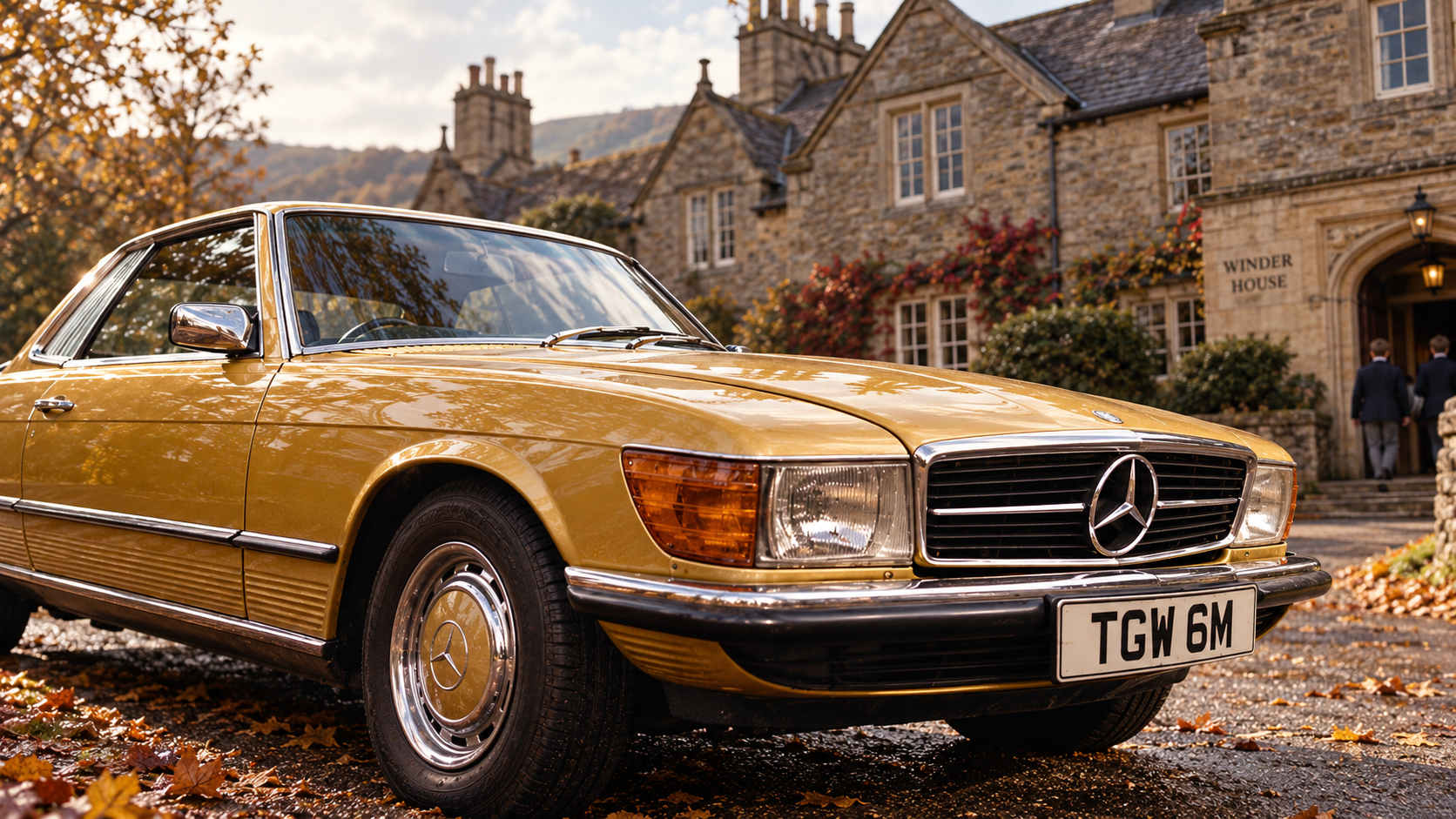
He arrived in the Mercedes SC two-seater sports car, hardly the car of somebody with four children, but he’d quit being a family man when he left his family in 1970. There was nominally room in the back, but whoever got it had a tight squeeze. Usually there was really only room for one. The rear window panels had louvres.
He took us back to Appleby Castle.
I didn’t think of Appleby as home. Home was Gosforth with Mum. Appleby was Dad’s home, or at least where he lived.
Sometimes Dad had board members, clients or owners of companies he’d acquired staying at Appleby, and we kids were expected to help host them.
Not this weekend.
We could let our hair down.
Some of us had more hair than others.
My older sister Jane had turned nineteen only a few days earlier. She’d always seemed like an adult belonging to another world, even when she was twelve and I was eight.
Her fiancé was there. I thought he was a bit of a dropout.
He reminded me of Brian the snail from The Magic Roundabout: lank dark hair all the way down his back, lolloping about, mumbling rather than talking. Flares, lots of faded denim, looking as though it were still 1972 instead of 1976.
It wasn’t really the clothes or hair that bothered me.
It was the lack of purpose.
He seemed vacuous.
I could resent Sedbergh endlessly for telling me what to do and still expect somebody to be doing something.
From Appleby I rang Julie-Anne, but she was out.
Her mother or older sister answered. I could never tell them apart on the telephone.
It was only a catch-up call.
If we’d had a formal dinner there would probably have been two or three wines. I may have had lager beforehand.
Smoking was different. Dad was fiercely anti-smoking. He’d have been furious.
So I smoked outside.
On the roof.
Never indoors.
I must have had a few cigarettes with me.
The ending sounds lonely now. Julie-Anne was out. I drank, watched television and went outside to smoke.
Usually Dad took us back to Sedbergh in the early evening. We had to be back for evening roll call before eight. The theory was that if boarders spent too much time at home we’d become homesick.
After five years of boarding, that seemed a peculiar theory.
I resented that sort of intransigence at school — rules enforced because somebody had decided the rule itself was good for us.
Dad’s authority was different.
I accepted his authority because I wanted to please him.
I wanted to be like him.
So I could drink with him and then hide on the roof to smoke because he’d have been furious if he’d known.
Unless this was one of the occasions when we stayed longer at Appleby, sometime that evening the Mercedes took us back towards Sedbergh, one of us squeezed into the back, and we were back inside Winder for roll call.

Leave a Reply