
Wednesday, 20th October 1976
(Winder House, Sedbergh School. Age 15)
I got up early to revise Biology and French.
Waking up at six, or even earlier in the summer, wasn’t something I had to force. The moment I opened my eyes, my brain jumped into action, and I wanted to be up and at it.
At Sedbergh, where I was a boarder in Winder House, everything was governed by endless bells, rigid timetables, compulsory runs and non-stop institutional noise. These quiet hours before breakfast were entirely my own.
While the rest of the dormitory was still asleep, I might sit in bed, sometimes by daylight streaming through the window, sometimes by torchlight. Or I would get up and sit at my desk. In summer, I sometimes sat on the bank by the grass tennis court. I would actively test myself, making notes, underlining key points and tackling French, Geography or Physics.
It was one of the few moments when I could do precisely what I wanted without anyone telling me what to do. I could concentrate without interruptions from other boys or masters. I liked getting ahead of things before breakfast and having some control over my preparations for the day.
I didn’t get a Geography test, luckily, as I hadn’t revised, but I had book notes.
We were working our way through The New Africa by Gladys Hickman. The aim was to understand how physical and cultural aspects governed the development of a country in this vast continent. An encyclopaedia would have been needed to cover the whole of Africa, so the book used exemplar studies instead.
We looked at things such as the Zambian Copperbelt or cocoa growing in Ghana. The book was divided into regional studies covering Central Africa, Eastern Africa, Western Africa, Northern Africa and Southern Africa.
It was the sort of Geography I enjoyed, looking at how physical conditions and human activities were related, rather than simply learning the names of places.
Biology: I got 15¾ out of 30, which wasn’t so good. There were too many ‘nearly right but wrong’ answers.
We were working our way through the Nuffield Biology textbooks, Texts I, II and III, which we were expected to complete by the end of the Fourth Year. We were probably well into Text II.
One topic I might have struggled with was Size and Surface in Living Things, particularly the different measurements of animals: length, area, height, girth, volume, wingspan and weight.
I could evidently get close to the right answer without getting it right. The quarter marks made very little difference when the total was only just over half.
French test: OK, but I thought I had done badly.
I never had the confidence to feel that what I had written down was correct. My English spelling was bad enough. In French, I mostly guessed.
Swimming was life-saving with Mr Stuart, who was involved with swimming at Sedbergh.
We practised the sort of exercises required for the Bronze Medallion: rescues, towing another swimmer and swimming in clothes. I had already gained my Bronze Medallion in 1974, while I was still at Mowden Hall, my previous boarding school, so this was familiar territory.
Games: I played Fourth League, right, against Hart House. We won, but it was sloppy.
Fourth League was the bottom league of House rugby. The match was against another of Sedbergh’s boarding houses, Hart House.
The standard wasn’t particularly good. There was poor handling, disorganised play, a lack of commitment and opposition that wasn’t especially impressive. All of it contributed to a sloppy game, even though we won.
I couldn’t recall anything particular about my own contribution.
Rugby was part of the compulsory sporting life at Sedbergh. I did plenty of it, but swimming was becoming increasingly important to me. If I had to play rugger, having swimming as well was better than just rugger.
I made two maps for Mr Mildrew and Mr Wood.
Mr Wood taught me Maths. The maps were impositions for separate misdemeanours, perhaps forgetting books or being late.
I always did maps of Japan.

I’d developed a way of fulfilling these punishments by producing maps rather than copying out meaningless lines. Japan was my regular choice, whatever the offence or the master who had imposed the punishment.
English imposition!
That one particularly offended me, or at least I thought it unfair.
I couldn’t remember what I had done. Perhaps it was unfinished work, or no work at all. Perhaps I had argued about who was going to read a part in class, or refused to do something I was expected to do.
I hoped the punishment involved writing an essay, something related to the work, rather than simply copying things out.
The maps and the English imposition were separate punishments from different masters for different offences. If I was in a mood with the world, though, a certain amount of stroppiness might have been influencing everything.
Swim for school.
This was a competitive swimming fixture, although I couldn’t remember who we were swimming against. It might have been the Royal Grammar School in Newcastle, Giggleswick or Ampleforth. I couldn’t imagine many schools sending a swimming team all the way across to Sedbergh.
I couldn’t remember my performance or the other swimmers.
It had been a busy day, with early revision, lessons, tests, life-saving, rugby, swimming and three impositions to deal with.
I liked a busy day and a full day.
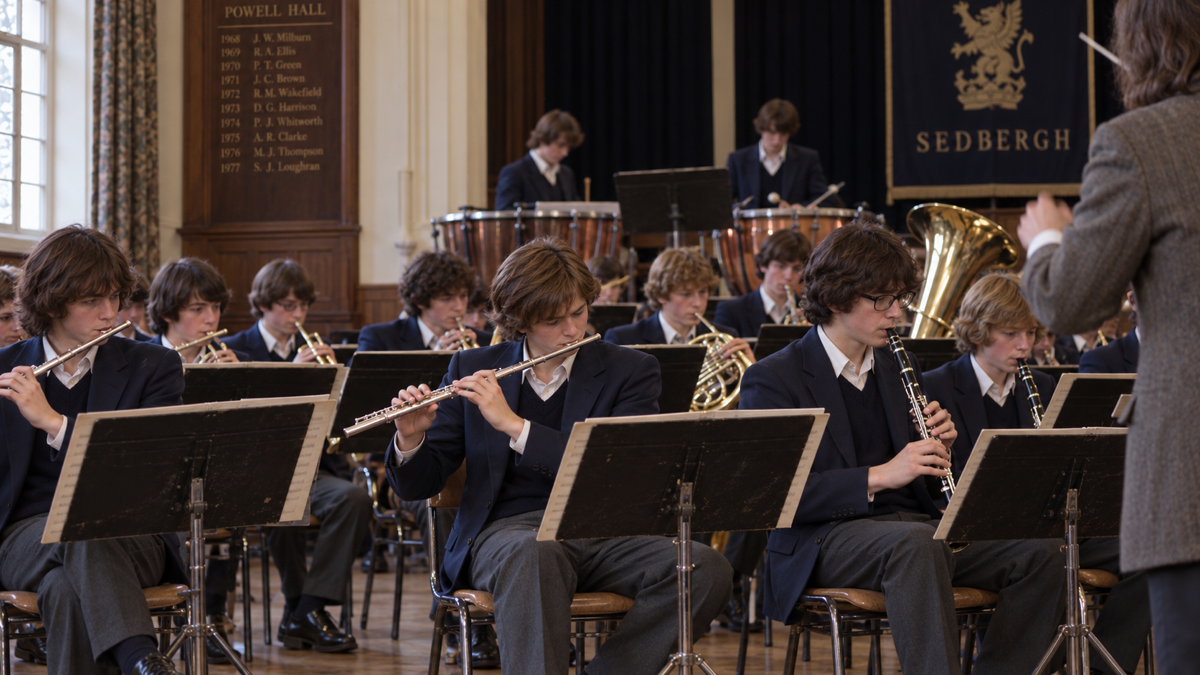
Band practice.
I couldn’t remember what we were rehearsing or whether we were working towards a particular concert or performance.
My energy and concentration were excellent. Music was something different to do.
A change was as good as a rest.
There were all the ordinary things I hadn’t bothered to mention: meals, the boys in my class and whoever happened to be sitting at the dining room table.
I had filled the day with one thing after another.

Leave a Reply