
Friday, 22nd October 1976
(Winder House, Sedbergh School, Cumbria. Age: 15 years)
It was raining as usual. This is Cumbria after all. Constant rain is normal.
My vest was still damp from yesterday’s CCF Field Day. We’d spent hours out in the relentless pouring rain on Baugh Fell. I had returned to Winder House with my clothes soaked through. Dirty clothes went into the laundry basket, while my corps boots were stuffed with newspaper to dry them out. They would later need cleaning and polishing.
Drying clothes meant finding a radiator or putting things on a hanger and hanging them from the side of my cubicle.
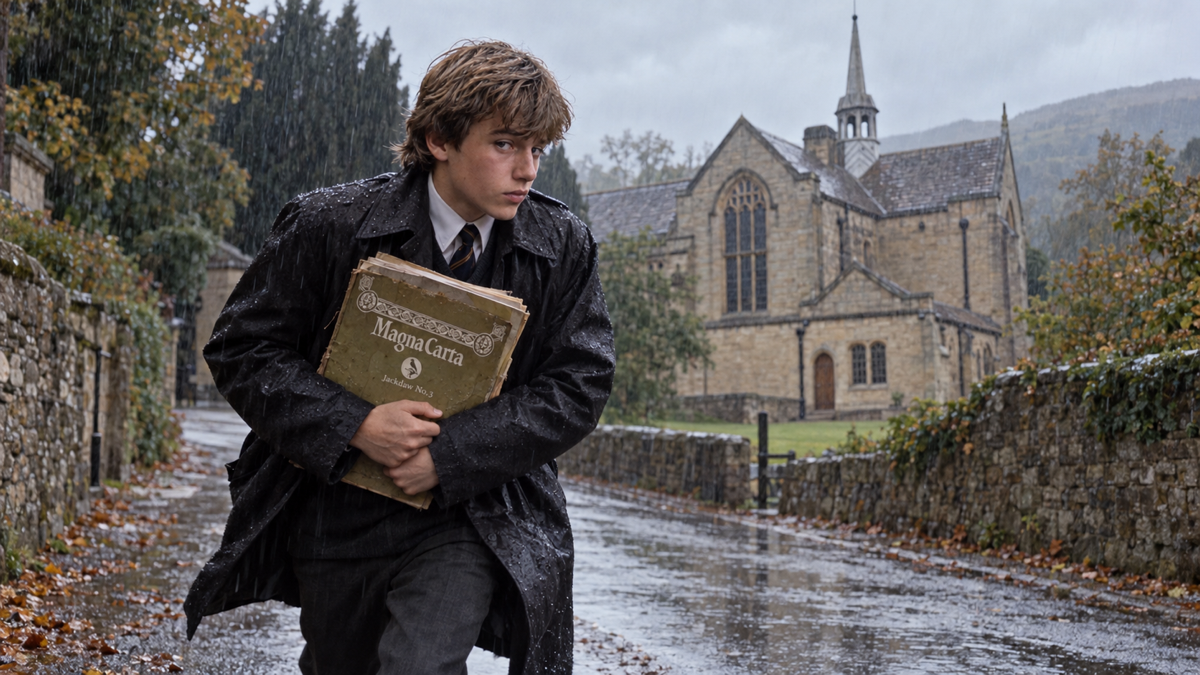
For getting about school in the rain, we wore long, waterproof black Macintoshes, or ‘macks’, which came down to our knees. Only prefects, or perhaps sixth formers, were allowed umbrellas. Our feet just got wet.
Prefects had other privileges, such as being allowed to visit friends in other houses. These privileges were nothing like enough, adequate or tempting. I’d already been a prefect at Mowden Hall and had come to detest it. There was nothing about the privileges at Sedbergh that made me want to repeat the experience.
Lessons today I describe as ‘useful’ – like on a Monday.
Chemistry could be useful when we did experiments, such as testing the solubility of copper sulphate, or had tests. English meant literature, reading ghost stories, a classic novel or Shakespeare. Geography involved classwork, taking notes, maps and diagrams. Maths was useful when we had class tests and got feedback on our prep.
History: I forgot my Jackdaw Folder on Magna Carta for a history lesson so I ran back to Winder.
I’d bought the folder from the School Book Shop. It contained copies of original documents, charts, declarations and a map, that sort of thing. (All our school books were bought from the shop and returned. We also got our regular stationery there: exercise books, pads of paper, arch lever files, ink and rulers).
We were doing classical schoolboy history: Alfred burning his cakes, 1066, Magna Carta, Bannockburn and Agincourt. It was the established Victorian ‘establishment’ version of English history, with dates to learn. There wasn’t any freedom to challenge what we were taught. None!
Forgetting a book and having to run back to Winder happened often enough. I could get there and back in fifteen minutes. Usually it came with a couple of maps for being late.
Divinity: I asked ‘Boring’ about my late Divinity Prep.
‘Boring’ was Rev: Harris. He was anything but boring. Maybe that’s the point.
Divinity was a challenger. The Bible was true regardless of any facts regarding god, Jesus or the troubled history of religion. No debate.
I didn’t know what an ‘academic interest’ in religion meant. I just liked a good argument. With religion, I couldn’t tally mere ‘belief’ with actual ‘facts’. Jesus did not walk on water, he did not turn water into wine or feed 10,000.
I had arrived at these objections through my own reasoning. I wanted facts, evidence, something that could be demonstrated, rather than statements I was expected to believe.
I returned Solar System to the school library. It was probably a book published in the 1950s or 1960s, with black-and-white illustrations. I was interested in astronomy and our place in the Solar System. Facts. Truths. Evidence. Discoveries.
I already had Patrick Moore’s The Amateur Astronomer. The next book i took out was on English medieval history.
Second Orchestra: OK. We did new, more exciting music.
The Second Orchestra was the junior orchestra, including boys from Cressbrook House, the prep school at Sedbergh. The music was easy stuff, classical favourites such as Beethoven’s ‘Ode to Joy’ from his Ninth Symphony, Grieg’s ‘In the Hall of the Mountain King’ from Peer Gynt, the theme from ‘Jupiter’ from Holst’s The Planets, and ‘Greensleeves’.
There was some latitude to embellish the flute part. I transcribed or added trills to improve it. I ornamented the music as I played, sometimes taking a passage up or down an octave.
Nobody commented on what I was doing. Knowing me, I was probably deliberately seeing what I could get away with.
I was still keenly thinking about the RAF.
Becoming a fighter pilot had been a whim of mine since the beginning of the academic year. I was thinking of futuristic jets. My ambitions were fantastical and verging on science fiction.
There was family history behind it. My grandfather and great-uncle had both been pilots during the First World War.
My grandfather had started telling me stories about being a fighter pilot officer cadet and had shown me his photographs. I remembered sitting with him at his house, by the gas fire, while he sat in his chair. There were photographs of officer cadets in Hastings, and of planes and instructors at Crail in Scotland.
He had been part of that early world of military aviation, when aircraft were still relatively new. I was thinking of the RAF and the futuristic jets of my own time, and beyond.
I was still keen on the idea of becoming a fighter pilot.

Leave a Reply