
Friday, 5th November 1976
Winder House, Sedbergh School. Age 15.
I was up early to revise Physics and start writing out a German test essay, a translation. First thing on waking was when I felt most alert, so that was when I wanted to revise and felt most capable of it. Physics with Abbott needed concentration, and I made the most of the time before lessons.
History: I took a magnifying glass in to read an ‘ancient diary’ facsimile.
This was part of the Jackdaw pack on the Plague and the Fire of London.

There were copies of ‘original documents’ that we were using to piece together the chronology of events. I knew they were fakes Yet I valued the idea of going back to the first-hand evidence rather than simply being told what had happened.
Of course, I felt an affinity with Samuel Pepys, who kept a diary. Cryptic notes, a witness to history, not literature, just a record.
On 2 September 1666, he recorded being woken in the middle of the night, seeing the fire in the distance and going back to sleep, thinking little of it.
Then there was John Evelyn, who painted a vivid, terrifying picture of the whole city in dreadful flames near the waterside, the sky fiery, like the top of a burning oven.
He described the choking smoke, the destruction of stone buildings, including Old St Paul’s Cathedral, and the plight of tens of thousands of newly homeless people camping out in the fields around Highgate and Islington.
It was extraordinary to be able to read these accounts of people who had been there, piecing together what happened from their diaries and other surviving evidence.
English: with the Mighty Mercer. He got us talking about mixed metaphors.
There were examples like, “We need to get all our ducks in a row so we can hit the ground running,” or, “Don’t count your chickens until the cat’s out of the bag.”
We had to make some up:
“Let’s hit two birds with one turd.”
“You’ve made your bed, now go clean the stain.
“A bird in your hand is worth two with a bush.”
The danger was that you remembered these rather than good examples of figurative language.
My absolute favourite was Macbeth, when he compared life to a brief candle. These were lines I was so captivated by that I learnt them by heart.
Tomorrow, and tomorrow, and tomorrow,
Creeps in this petty pace from day to day,
To the last syllable of recorded time;
And all our yesterdays have lighted fools
The way to dusty death. Out, out, brief candle!
Life’s but a walking shadow, a poor player,
That struts and frets his hour upon the stage,
And then is heard no more. It is a tale
Told by an idiot, full of sound and fury,
Signifying nothing.
Macbeth, Act V, Scene 5.
There was a bleak authenticity to it, though I was no nihilist. I often wanted to leave that last word open, as a question mark, or even replace it with the word ‘something’.
Then there was Jane Austen in Pride and Prejudice, where Regency etiquette and ballroom dancing were like strategic games or intricate battlefields. Every movement, choice of partner and conversational misstep could have long-term consequences.
I liked Elizabeth Bennet’s teasing of Mr Darcy about the obligation to make conversation while dancing:
“It is your turn to say something now, Mr. Darcy. I talked about the dance, and you ought to make some kind of remark on the size of the room, or the number of couples.”
He smiled and assured her that whatever she wished him to say should be said.
“Very well. That reply will do for the present. Now by and by I may comfort you by telling you that the ball-room is uncommonly hot, and then we may move on to some other generalities.”
And Thomas Hardy in Tess of the d’Urbervilles, who described the agricultural fields and rolling hills of Wessex almost as a living organism, with its own breathing, wounds and seasons, reflecting Tess’s personal trials and emotional cycles.
“The green trough of the versatile Frome” was like “a vast mammalian bosom”, with “its milk-ducts, its veins of silver water, and its breathing atmosphere of steam.”
Hardy and T. S. Eliot came through school English, Austen through Mum and possibly a BBC dramatisation. I knew I had read Robert Graves because of I, Claudius on television. It had been on over half-term, and we were huge fans of it.
I didn’t go swimming. Just orchestra. Orchestra was compulsory and trumped everything else. We were working towards the end-of-term concert, and there was no getting out of it.
I wrote my diary. I borrowed a ‘Rollerball Pentel’ from Hogg. He was being friendly, and had this new pen, and I was interested in having a go. This was it. I was writing with it now. It was easier than a normal ink pen and produced fine, spidery lines. For creating tight, legible text on the thin lines of a diary, it did well. I didn’t like Biros, which for me were like trying to ice skate in overly large boots. I preferred a fine nib on a fountain pen, which required cartridges or bottled ink. Pencils had to be sharpened all the time, and the text would fade and smudge. With felt tips, the letters were too broad. The Pentel did the job.
Coffee. A large mug of instant coffee, Nescafé granules and full-fat milk. No sugar.
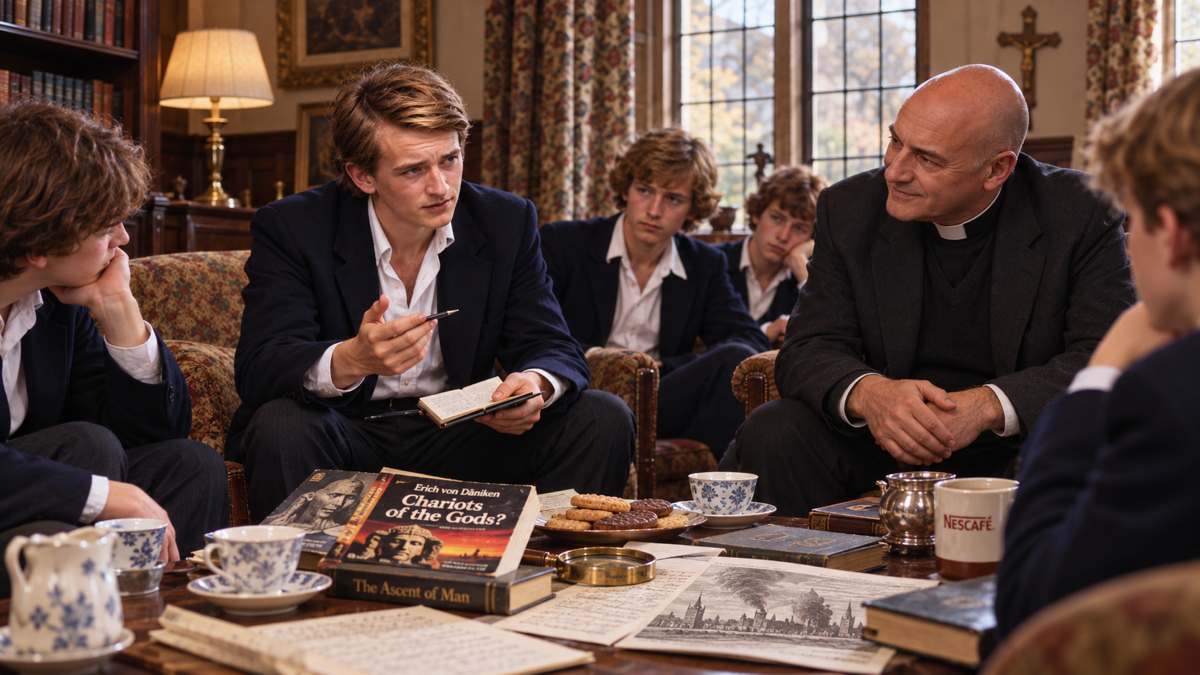
Confirmation Class: a good discussion that verged on verbal pugilism about who made the Earth, man, Mary Hedge’s bush and worms.
We had been having these discussions with the Reverend Harris in the Edwardian sitting room of the Music School, with tea and biscuits. He had a dark suit, a V-neck sweater, a dog collar and a pensive scowl, but he listened to what we had to say.
I took an evidence-based approach and was adamant that the world was not God’s creation.
My argument was the difference between made-up stories and science.
I had evolution, geology and astronomy to draw upon. I was reading widely: The Ascent of Man, Chariots of the Gods?, Asimov’s Empire and Foundation books, The Weather Machine, The Kama Sutra and The ABC of Space.
Some of these Mum had bought, or bought for me, including The Ascent of Man and The ABC of Space. Others, such as Asimov and The Kama Sutra, I had bought myself. Chariots of the Gods? was borrowed from Mum, and that was what I was reading now.
They weren’t all science, of course, and I knew Chariots of the Gods? was nonsense. But I was interested in explanations of how the world worked, where we had come from, and what people believed.
Humans invented stuff from a position of fearful ignorance to fill their mental void. What human need were these stories establishing? Hadn’t they been debunked already?
There were creation stories from every religion. I knew a few: Native American beliefs, Hindu mythology, Greek and Roman gods, Norse gods and the beliefs of Australian Aboriginal peoples.
Why should the Christian creation story be any more believable than these?
I even used the core premise of Chariots of the Gods?, the Ancient Astronaut hypothesis. Von Däniken proposed that visitors from other worlds had been mistaken for gods and had influenced ancient civilisations. It was nonsense, just like the Bible and the Koran, made up to suit the end game of an individual, group or gender.
I couldn’t see why these stories should be taken as explanations of the world when there was evidence to be found through science.
And what about the way religion was used to exploit people?
There was colonial exploitation, missionary subjugation, slavery and the subjugation of girls and women. The Puritans seemed determined to suck the joy out of life. There were religions and rituals that used drugs to evoke spirits, and religions that persecuted people for believing something different.
There was Henry VIII’s hypocritical use of religion to get rid of unwanted wives, and the Spanish Inquisition. “Beware, the Spanish Inquisition!” was practically a schoolboy mantra, thanks to Monty Python.
The very persecution of those with different religious beliefs was a human failing, not a God-directed act.
I couldn’t understand why anyone should accept all this without questioning it.
A great deal of my thinking came from reading, but there was also what my grandfather had told me about surviving the trenches at Passchendaele.
It began after Sunday lunch, when he would come into the playroom and sit in the rocking chair. He preferred this to sitting with Mum and the grandmothers. I’d be on his lap. He might talk about being ‘fighting fit’ at twenty, and we’d marvel at his biceps!
Then he would recount some horrible experience.
There was a recurring nightmare about being sent out to relieve a machine-gun post, only to find both gunners dead or dying.
One had been ‘split through his shoulder to his belly’, as though he’d been hit with an axe. Grandpa put it down to shrapnel. The other had his ‘guts spilling out’.
Grandpa was the corporal. He said reassuring words to the injured men, but he had his gun and another to get set up, a burst to check the gun and a rota to establish for the three days he would be out there.
Meanwhile, the dying man asked, “Kack, prop my legs up.”
He wanted sandbags pressed under his feet so that he could keep his legs in place to hold his guts from spilling out.
Grandpa described how he died calling for his mother.
Then, quite matter-of-factly, Grandpa described how he ‘waited for him to stiffen up’, as rigor mortis made it easier to move a body. He rolled the body into a shell hole and covered it with whatever he could find.
Such was life and death on the Western Front.
I’d always think that if Grandpa hadn’t made it, Mum wouldn’t have been born, and if she hadn’t been born, I wouldn’t exist either.
What was I supposed to make of God in all this?
On the one hand, Grandpa said things like, “I said my prayers a few times and he must have been listening.”
But he never again went to church. He’d go along to a wedding or funeral, but otherwise his attendance dropped to zero.
God couldn’t exist, he said. The soldiers on both sides were supposed to have ‘God on their side’. It just didn’t add up.
Whatever belief he had possessed, he had lost it.
Mum was different. She was content to leave me godless, but justified ‘Christian beliefs’ as a code of conduct. I wasn’t going to argue with her, not the way I did at school, but there were holes in the Ten Commandments and hypocrisy at every turn in how the Bible had been written, transmitted, justified and translated.
Besides, I always associated Sundays with Sunday school, eating Play-Doh and being sick.
At Sedbergh, though, Confirmation had become something quite different.
There was Ian Garden, strongly in favour of religion, who wanted to pray for guidance.
Was he expecting some magic? A miracle? For God to strike me down? Or even, with the classic sense of superiority, to ask God to forgive me!
I said I wouldn’t pray. I’d go to the library and gather more evidence.
Reverend Harris, in his usual way, was like a referee in a prize boxing match, only stepping in if there was a knockout blow.
To say these sessions were different was an understatement.
What had started as tea with a priest had become heavy-duty debate between combative teenagers with a strong sense of belief or disbelief.
I hated that someone who believed in God could be adamant they were right because ‘it was written’ or because ‘God told them so’.
I knew where the written word came from. It was mankind. With the emphasis on ‘man’.
And if God’s word to them was absolute, why wasn’t it trumped by the words of Zeus or Odin?
I had been questioning scripture since Mowden Hall, and the more I read, the less convincing the whole business became.
Too many of the other boys were simply going along with it because Confirmation was something their mothers wanted them to do. And there were gifts and cash rewards for being confirmed.
Some were already totting up the booty.
I wasn’t going to accept something as true because I was expected to believe it, because somebody in authority said it was true, or because there might be money at the end of it.
I wanted evidence.
And this was 5 November. Guy Fawkes Night.
A date like 1066, engraved on our British souls.
Yet it never got a mention. For six years now, I’d missed Bonfire Night because I was away at boarding school, where it was never marked.
Boys and fire, and fireworks!
Never a good combination.
Leave a Reply