
Sunday, 7th November 1976
(Winder House, Sedbergh School, Cumbria. Age 15.)
I wore illegal trousers. They were dark grey, but more like Oxford Bags. Some boys wore illegal trousers the other way, with narrow drainpipe legs. Neither of us was following a particular trend. We were trying to be individuals.
Most boys were more likely to wear flares or bell-bottoms, in a Led Zeppelin, Pink Floyd or Eagles kind of way. I never saw anyone dressed as a Teddy Boy.
Nobody noticed mine! I had to point them out. I’d thought they might be a talking point with one of the Casterton girls, a way of finding a fellow low-level rebel. I knew girls did all kinds of adventurous, non-regulation things with their school skirts: extra pleats, shortening them, changing the length, or changing the colour or material.
I read the Telegraph colour supplement. It was an autumn fashion issue, with an article about the search for SS kidnap victims thirty years on from the last war.
I liked the colour supplements. The models, fashion, entertainment, photography, all of it. Rarely politics, though, or business, come to think of it. They offered plenty to look at and read about beyond Sedbergh.
The Second World War interested me. My paternal grandfather had served with the Desert Rats, though that was about all I knew of his war. He’d died when I was very young, so there was little I could remember of him.
Chapel.
I read the Chick Rag Mag with Seb Hoffman, whose older brother was at Nottingham University. It was filled with student-written satire, parodies, irreverent jokes, cartoons and lighthearted commentary targeting university life, local figures and pop culture.
It intrigued us. University life was beyond school. The irreverence appealed. Here were students making fun of their own institutions and the people around them. We were still at Sedbergh, where there were rules about everything, even the width of our trousers.
I went swimming but said I wouldn’t stay for training. It was my mood. The gloomy winter, the slow, dark drag towards Christmas. I didn’t feel like doing everything I was supposed to do.
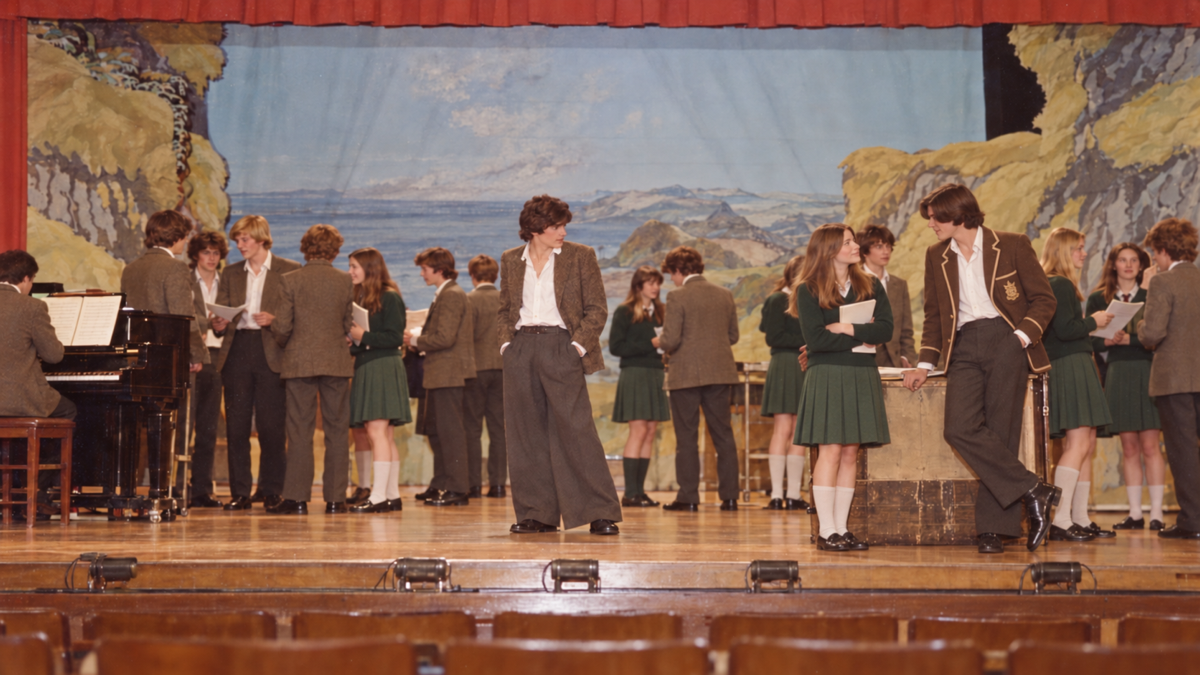
There was a rehearsal for The Pirates of Penzance with the girls from Casterton in Powell Hall.
We’d been rehearsing since September, mostly singing and trying to get things right. At earlier rehearsals the girls hadn’t always been there, which had been disappointing. Now they were, but I didn’t really talk to any of them.
We were in groups, with the boys generally apart from the girls. You could catch someone’s eye, but then what? The girls were on the prowl too! Well, one or two were. Most appeared painfully shy. Those with brothers at Sedbergh had more confidence. I supposed they were familiar with the place.
I’d hoped my trousers might help. A girl who’d shortened her skirt or done something equally rebellious with her uniform might appreciate someone who’d broken the rules himself. But nobody noticed until I pointed them out.
Not in the mood? No one moved me.
I was sad about this; usually seeing a girl thrilled me. But it was as basic as what a girl looked like. The idea of putting personality before looks hadn’t crossed my mind.
My day-to-day experience of girls was poor. I still felt they were fundamentally different, not just on the obvious physical side of things, but in their interests, outlook and what they were good at.
I’d come through boarding prep school, where ‘being girly’ or ‘doing things like a girl’ was derogatory. ‘Running like a girl’, for example. I didn’t. Or ‘throwing like a girl’. I did, apparently.
It wasn’t much of a preparation for getting to know girls.
Julie-Anne had the looks! We’d been seeing each other since the previous Christmas, though being away at school meant much of our relationship was conducted through letters and telephone calls, with occasional meetings during the holidays.
But I couldn’t help looking at other girls, especially when Casterton came to Sedbergh.
Only one would rate as a Jane Birkin, Joanna Lumley, Fiona Fullerton, Jacqueline Bisset or Jane Seymour.
‘Posh totty’ was the sobriquet. Model looks, well-spoken, smart, alluring, independent, unique. They were the women I admired whenever they appeared in a film or television series.
I was beginning to find myself attracted to more unusual looks, too. Not simply the perfectly pretty face, but someone distinctive, with personality and magnetic charm suggested by the way she looked. The jolie-laide, perhaps, although what was I to know until I got to know someone?
The one girl at the rehearsal who caught my eye was a kind of Mary Hopkin, with mousy brown hair.
And she was always talking to Mike McAdam.
They were so engaged with each other. Flirtatious, I’d have called it. She seemed interested in him, and he certainly seemed interested in her.
He wasn’t even in the play!
He said he was doing ‘lights’, but I never saw him up there. The lighting master wasn’t even there, so who was to say whether Mike was supposed to be doing anything?
I’m sure he hadn’t a clue about lighting and had no desire to learn. He had the advantage of being able to wander about while the rest of us had to rehearse. Someone should have called him out.
Perhaps I’d do lights myself next time a production came along.
There was something frustrating about all this business of fancying girls. You saw someone you liked and she seemed to act like a beacon, calling you in. But did other boys see the same thing? Did they all go for the same girl, like Mike McAdam?
Should you speak to her friend, hoping you’d get the chance to talk to her? That felt sneaky.
And how could it possibly work out if all the boys fancied the same girl and all the girls fancied the same boy? There was someone for everybody, surely?
Mum had sensed that I’d made a list of what the perfect girlfriend would be like. My idealised ‘proper’ girlfriend. She said I’d be lonely if I took that approach. You had to get to know someone first. That’s what counted.
I couldn’t help thinking that hadn’t worked out for Mum and Dad!
They hadn’t got to know each other well enough for long enough. But they’d been ‘courting’, as they called it in the 1950s.
I couldn’t see how any of this was supposed to work. You fancied someone because of how she looked, but you were supposed to get to know her before deciding whether you liked her. And how were you supposed to do that when you hardly ever had the chance to talk to girls?
I then went to water polo.
I just did the training and left when the game started. Training was more about developing skills, whereas the game made you go into battle mode. It was like rugby in water, played competitively.
I wasn’t in the mood for battle. I’d already avoided staying for swimming training earlier in the day. I wanted to step back from things.

On TV tonight was the film Caravan to Vaccarès. Quite good.
I talked about it with Branston, Jamie and Smalls.
The American was played by David Birney. He was too cliché handsome for me, literally like a toy Action Man. I didn’t particularly admire him. Clint Eastwood had character; David Birney did not.
It was about a suave American, Neil Bowman, a bit of an Action Man, who met Lila, the rather gorgeous ‘posh-totty’ played by Charlotte Rampling. In the film she’s a British photographer. It mostly takes place in France.
The pair were hired to escort a Hungarian scientist to New York by a dodgy French landowner, the suitably villainous Michael Lonsdale as Duc de Croyter. They faced a gang of kidnappers who were after the scientist.
I’d have liked to take the role and play it differently. Or have a life that saw me living in France, meeting a girl like Charlotte Rampling!
I liked her otherworldliness.
There was mixed interest in Charlotte Rampling among the others. Branston, Jamie and Smalls had different ‘tastes’, whatever that meant. A more womanly figure, a polite way of putting it.
Two of them couldn’t understand my fixation on Jane Birkin. They preferred Raquel Welch and Farrah Fawcett.
We didn’t discuss films particularly critically. It was about the action, the manly men, the girlie girls and the baddies.
What happened? What did we get glimpses of? What was hinted at? How did the camera cut away or fade through to the next morning?
There was plenty to discuss.
And there was Charlotte Rampling.
Leave a Reply