Friday, 19th November 1976
(Winder House, Sedbergh School, Cumbria. Age 15).

I received a letter from Mum saying Gran had been snooping and had opened and read one of my letters.
Who knew what I’d written about? Wanting to leave Sedbergh? Not being allowed to swim much? Seeing girls from Casterton? What I was drawing or painting?
Gran lived a modest, sheltered life and was hugely proud of her grandchildren, whom she saw too rarely. She wrote to us and provided self-addressed envelopes and stamps to encourage us to write back. She spoke to her sisters regularly, and they compared notes about what their respective grandchildren were up to.
There wasn’t much I could do about her reading my letters.
Mum also said that Ricky and I were going skiing with Dad at Christmas.
I thought we’d already known, so this was confirmation.
It was the established practice that two of us four children went skiing with Dad in rotation, either at Christmas or Easter. My brother and older sister had been out the previous Easter. This time it was Ricky and me.
We were going to La Plagne, in the French Alps, for three weeks, from 18th December until early January.
In History, we were doing a project on the Agricultural Revolution.
We had been using Jackdaw No. 15: The Agricultural Revolution, compiled by John Addy. It was a folder of facsimiles, historical documents and illustrations, including Jethro Tull’s seed drill and horse-drawn hoe.
I tried drawing the seed drill and made a complete bish of it.
It was rubbish.
Mum, who was an artist, would have understood why. You couldn’t just copy something properly from a two-dimensional print. You needed to see it for real. But there weren’t any wooden seed drills lying about. You’d have to visit an agricultural museum.
I didn’t like the Jackdaw folders. We’d used them for other History topics, but they always felt like borrowing someone else’s research, someone else’s ideas of what was interesting about an era.
I would have preferred to ask my own questions and do my own research.
I’d have liked to go to an agricultural museum, look at different History books and develop my own point of view, rather than work through a collection of material someone else had decided was important.
Instead, I drew a load of rubbish.
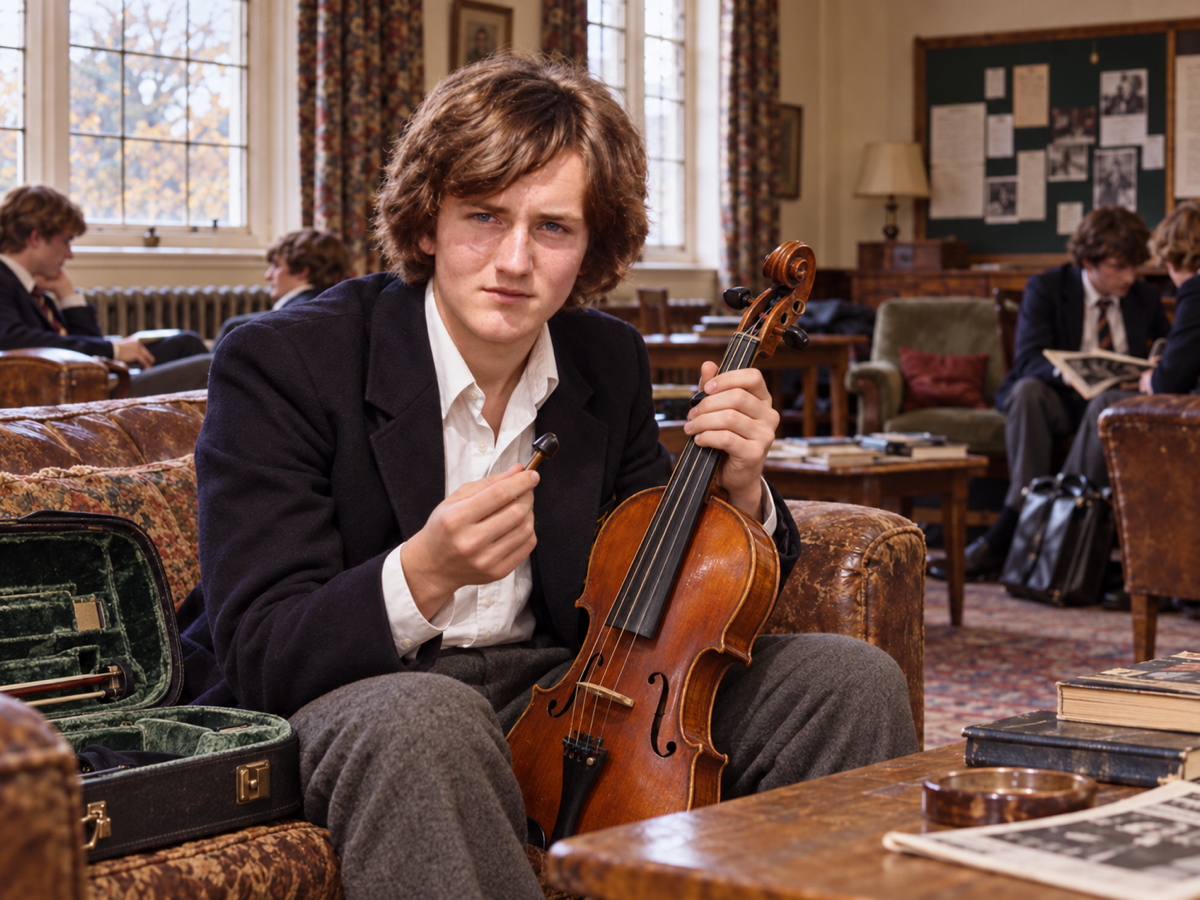
At some point, I got hold of Colin Park’s viola.
Colin, or Colly Wobbles as we called him, was another boy at Winder House. I turned one of the tuning keys, and it slipped out.
I should never have been near it, let alone adjusting his tuning.
I hoped I hadn’t succumbed to the tribalistic nastiness of the likes of Mike McAdam and started joining in the bating of Colin.
Colin was constantly set upon.
To dodge the attention of the bullies, you could show you were with them rather than against them. It was a dreadful form of survival.
I knew what it was like to be on the receiving end.
Someone had got hold of my flute mouthpiece and used it to imitate the Clangers talking to one another. I’d lost it.
I imagined Colin would have reacted much as I had. Like me, he wouldn’t hold back. That was what made bating him, or bating me, such sport.
And I used the term advisedly, because that was how we commonly spoke about it.
To bate meant to torment.
Not bears or badgers, but fellow students.
Bullying by another name.
And sometimes feeble teachers who couldn’t control a class of fifteen fifteen-year-old boys with their blood up.
I only did German prep.
That might have been written exercises, vocabulary or translation. I couldn’t remember what the particular assignment involved.
I also finished Divinity.
We’d recently been studying Naboth’s Vineyard, the story of King Ahab, Jezebel and Naboth, whose vineyard the king wanted.
I’d been given an assignment to write a newspaper report about the affair. I’d bought a copy of The Sun to see how a sensational newspaper handled its stories.
Something along the lines of JEZEBEL’S DIRTY DEEDS!
I wasn’t sure whether the Right Reverend Harris, our Divinity teacher, would appreciate my approach.
At the same time, I was hatching a plan to back out of Confirmation.
I couldn’t live with the hypocrisy.
I didn’t believe in God in any of his forms, and I thought Christianity and other religions were mostly terrible forces on humankind.
We’d been discussing these things in Confirmation classes, where Reverend Harris allowed us to question what we were being taught. I’d already been arguing about religious explanations for the origins of the world.
I wasn’t going to pretend I believed something simply because I was expected to.
History again.
Supposedly project work.
More of the Agricultural Revolution and those Jackdaw documents, I supposed. I still preferred the idea of finding things out for myself.
I wrote letters.
I wrote spontaneously. I just made a start, filled the page or pages, stuck the letter in an envelope and started on the next one.
One was to Julie-Anne, back in Gosforth.
We’d been writing to each other throughout the term. She’d even enclosed a Glacier Mint in one of her letters in October.
I wrote to see if we could be friends.
Things had been awkward at half-term. I’d written in my diary that she was boring, though I’d never have said that to her face.
Nor was what I wrote necessarily what I meant.
I was frustrated by a kind of stalemate or stagnation in our friendship.
At fifteen, I didn’t know how to move things on other than moaning about it.
We were both equally placid.
Would we both grow into something more exciting?
We understood romance from television, books and films. But romance seemed to require drama, and our lives lacked it.
Coffee and a pastry at Gregg’s on Gosforth High Street and a film at the ABC Haymarket was about as exciting as it got.
Did she even have a bike? Or a bathing costume?
How did she spend her days?
She didn’t play a musical instrument, do art, perform or take part in any sport that I knew of.
I had a term for a particular type at Sedbergh. Had the school been co-educational, perhaps Julie-Anne would have been one of the ghosts — someone who travelled through their school years going unnoticed.
That was where I differed from her.
I wanted to do things. Swimming, music, painting, performing, going out. I wanted things to happen.
But I didn’t know how to make anything happen between us.
I also tried to get leave to go out with Paul Muirhead.
Paul was another boy at Sedbergh. He might already have been to Appleby with me for an exeat, staying with my family. If so, perhaps this was his turn to reciprocate.
You could go out with a friend and their family if you had permission from the Housemaster.
Nobody I knew could get home during one of these outings. You weren’t going to have a day out in Norway or Cyprus, or even get back to Newcastle.
I thought Paul came from Manchester or Liverpool.
A day out might mean a trip around the South Lakes, a pub meal, a walk or a film.
It was a chance to get away from school.
The Housemaster gave permission. He might have checked with Paul’s parents that it was all right.
I couldn’t remember whether we eventually went, but at least I had tried to arrange it.


Leave a Reply