What’s the best beach you’ve ever been to?

If I had to choose one beach above all others, it would be Beadnell Bay, on the Northumberland coast. Not a beach on the Mediterranean or Pacific Coast, not an island beach from a sailing trip across the Atlantic. But Beadnell.
It is spectacular in so many ways: the view to the horizon, the historic harbour, the rhythm of the tides, shifting sands and variable weather. Even in August, swimming there will take your breath away.
Beadnell is the best beach I’ve ever been to because it’s been part of my life for more than sixty years. My earliest memories were born in Beadnell.
I grew up in Gosforth, Newcastle upon Tyne, but much of my early childhood was spent at Beadnell. My family had Rose Cottage, a holiday home in the village. My mother had been coming to Beadnell since she was a girl, and my great-uncle had helped establish the sailing club. There were second cousins, family friends, fishermen and an entire community of Gosforth families who decamped to the coast every summer.
For several generations, Beadnell was where we went.
As children we visited at Easter, during half-term, for long weekends and throughout the summer holidays. From about four until I was nine or ten, I spent more time on Beadnell beach as I did at home; it was home.
Those were the days when children were allowed to disappear for hours. I would head off barefoot in shorts, through the dunes and marram grass, exploring the beach, rock pools and harbour. I knew the tracks through the dunes, the best places to find crabs, the rocks exposed by the falling tide and the places where the water collected in deep pools.

I collected fossils and shells, investigated sea creatures, dug elaborate systems of channels and reservoirs in the sand, and attempted to control the incoming tide with engineering projects that invariably failed. I remember finding a lumpsucker fish in a rock pool and claiming a particular rock as my own. My brother and I created a ‘rock museum’. I flew kites, fished from the harbour and went out in boats. I even remember charging about dressed as Batman.
There were sweets from the caravan shop, excursions to the Black Cat Café, and afternoons when time seemed to stretch indefinitely.
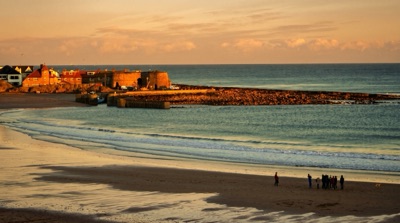
The beach itself is magnificent. An enormous sweep of pale sand, backed by dunes, opening towards the North Sea. To the south, the distant outline of Dunstanburgh Castle rises above the coast. At the northern end are the old lime kilns, the harbour and Beadnell Point.
At low tide, the beach seems limitless. At high tide, particularly during spring tides, the sea slap against the dunes, transforming the landscape and forcing you to take a longer route.
As a child, I learnt to read the beach through these changes. The tides, the wind, the clouds, the shifting sand and the behaviour of the waves were all part of an informal education.
There was a particular smell, too. Salt, seaweed, wet sand and the warm, dry scent of marram grass. The sound of the wind in the dunes, the clacking of halyards against masts, the cries of seabirds and, in the distance, the foghorn. The taste of a 99 ice cream with ‘monkeys blood’.
I can summon these things instantly.
Our family circumstances changed, and Dad sold Rose Cottage after our parents separated. That was a profound loss. Beadnell had represented a particular kind of childhood freedom and security, and its disappearance coincided with other upheavals, including being sent away to boarding school.
But I kept returning.
As a teenager, Beadnell became something different. It was no longer simply a place where I played. It became somewhere I could exercise independence, meet friends, sail, swim, camp and, inevitably, fall in love.
In the summer of 1978, when I was sixteen, I returned with a tent, sleeping bag and rucksack. I had met a German girl, who was staying in the village, and I was thoroughly smitten.
We walked along the beach, swam in the freezing sea, talked, laughed and kissed. I played tunes on my penny whistle. One evening, at low tide, we sat together on the very rock I had claimed as my own when I was a small boy.
I find that extraordinary now.
The same rock, the same beach, the same North Sea. But an entirely different version of myself.
The small boy who had spent hours investigating rock pools had become a teenager trying to understand love, attraction and the complexities of human relationships.
That is what makes a place like Beadnell so remarkable. It is not simply a landscape. It is a succession of landscapes, each belonging to a different period of your life, all occupying the same physical space.
I have returned many times since, sometimes alone, sometimes with my wife and children.
Taking my own children to the places where I played was particularly moving. I could show them the rock pools, the dunes, the harbour and the paths I remembered. They could enjoy the beach for themselves, while I was simultaneously inhabiting several decades of memories.
There is something most peculiar about revisiting a childhood landscape; not just the scale of it shrinking away, but immediately spotting details that held a fascination at six or seven. Others seem completely unchanged. You recognise a bend in a path, a storm drain, shrimps in the sand, the shape of a rock and suddenly find yourself transported back fifty years.
And when I have returned alone, I have experienced something different again.
Without the distractions of family or friends, I can simply walk. Listen to the waves. Watch the clouds moving across the vastness of the Northumberland sky. Look towards Dunstanburgh Castle and consider how many generations have walked that coastline before me.
The tide comes in and goes out, the dunes shift, the wind blows, and the gulls call.
Beadnell has changed, of course. The fishing community that was still active in my childhood in the 1960s has diminished, while holiday accommodation, water sports and tourism have expanded. The village has changed a bit; the beach and bay not one bit.
But the essential geography remains. The great arc of sand. The dunes. The rocks. The cold, restless sea. The distant castle.
I have walked that beach as a small boy, a teenager, a young man, a husband, a father and, more recently, a man in his sixties.
Each time, I have brought a different life to it.
Perhaps that is why I cannot nominate some exotic tropical paradise as the best beach I have ever visited. Such places, even if they offer better weather, warmer water, Moules marinière, or surfing, they can rarely offer more spectacular scenery, and they certainly cannot compete with sixty years of experience.
Beadnell Bay is where I learnt about tides and rocks, boats and weather, freedom and friendship. It is where I discovered something of the natural world, experienced the exhilaration of independence and navigated the bewildering emotions of adolescence.
It is also somewhere I can revisit the people and circumstances of my childhood, many of which have long since disappeared.
There are beaches I have admired, beaches I have enjoyed and beaches where I have spent wonderful holidays.
But Beadnell is the only beach where I could bottle my life. Scatter my ashes from the highest dune.
Leave a Reply