
Wednesday, 24th November 1976
(Winder House, Sedbergh School, Cumbria. Age 15).
Geography: We started limestone — the first time we’d done something different from weather!
At last! We had spent so long studying the weather, making observations, drawing charts and forecasts, that it was a relief to move on to something else.
Limestone was all around us in the Yorkshire Dales. We had been on trips to the caves around Ingleborough and hikes across the limestone pavements. It was great to have something we were studying practically on our doorstep.
Our Geography teacher, Mr Twentyman Pritchard, looked like one of Chris Bonington’s mountaineering mates, as if he had just come off a mountain. He wore the almost obligatory Geography teacher’s outfit of a beige or tweed-like suit, a beige or Lincoln green jumper, a tie and a checked shirt. His hair grew over his ears, and he had a rather disbelieving look about him.
He was most at home in a cave. His enthusiasm for stalactites and stalagmites was infectious.
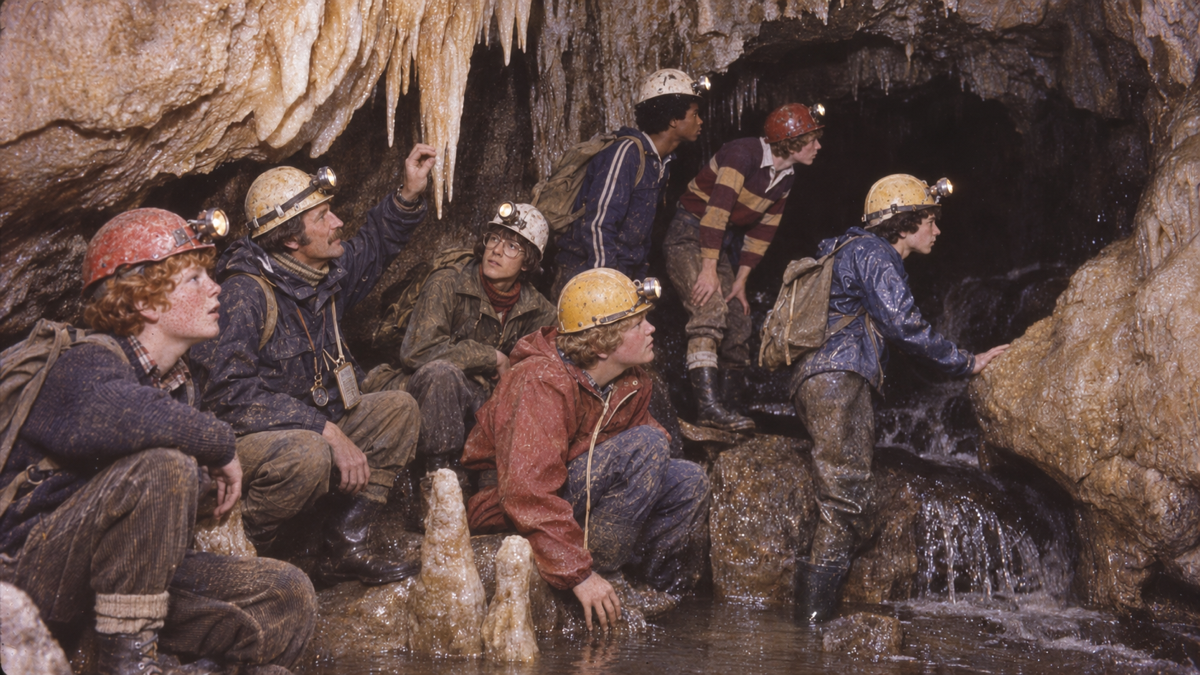
I remembered a trip into the caves around Ingleborough with six of us from the House. There was a sense of jeopardy about being underground, even claustrophobia, with the sound of tumbling water and that particular smell of a cave. It was quite different from sitting in a classroom drawing weather charts.
I loved the mixture of erosion effects, diagrams and drawings. There was something fascinating about the way water dissolved rock, gradually creating underground passages, caves and all these extraordinary formations.
Anything that fed my curiosity could get me enthusiastic. It didn’t matter what the subject was. Geography was much more interesting when there was something to investigate, draw or go and see for ourselves.
Biology: I got one map for doing my work on file paper rather than in a notebook.
This kept happening!
Mr Milo Grey, our Biology teacher, wanted our notes in a book, but I preferred working on loose sheets of paper and keeping them together in a file. Some teachers wanted everything in an exercise book so they could collect it from time to time and check the quality of our note-taking. Which was understandable.
But I thought my approach was better. I’d argue that my notes and diagrams were better organised and more useful than if I’d written everything straight into a notebook.
I’d already got a map from Mrs Rogers for exactly the same thing. It was breaking the rules, but my argument was that I should have the ability, or the choice, to learn and record what I’d learned in the way that best suited me, without constantly thinking I had someone looking over my shoulder.
I wasn’t trying to make a point about authority. I only thought my approach was better.
The irony was that when my notes were occasionally seen, I think they were sometimes held up as examples of what was expected. Which was almost worse! I could be punished for not doing the work in the prescribed way and then potentially pilloried by the other boys for being too keen.
Anyway, I got one map to draw as an imposition. Hardly much of a punishment. Just one map was a tap on the back of the hand compared with some of the punishments we’d had.
It certainly didn’t stop me. I kept doing it.
PE: I only managed 25 press-ups. Mr Stuart expected at least 50 from me!
He knew what I could usually do. He was involved with our swimming, so he knew I was capable of more. I had been swimming regularly, as well as playing rugby and doing all the other compulsory physical activities.
I wondered whether I had been unwell. I was prone to colds at this time of year, and only managing 25 press-ups was well below what Mr Stuart knew I could do.
Anyway, we moved on.
Chemistry: We made notes on sodium chloride.
Lunch.
Rugby: Fourth League. Good game!
We were playing for Winder House in the Fourth League, where the teams were made up of a mixture of reasonable, rubbish and reluctant rugby players.
Every House had to produce its teams, so there were boys who enjoyed rugby and were reasonably good at it, and others who would rather have been doing almost anything else.
I had played plenty of rugby before coming to Sedbergh, but swimming was much more important to me now. I wasn’t one of the particularly enthusiastic rugby players.
Fourth League rugby could be quite relaxed. There was sometimes an unspoken understanding between the two sides: we won’t hurt you if you don’t hurt us.
Against some Houses, though, it could be violent, and you could end up playing against boys who seemed determined to flatten anyone who came near them. There were also games somewhere in between, where we enjoyed the challenge and the competitiveness, particularly when we were playing against classmates.
This was one of those games.
The teams were well matched, which made it enjoyable. We were winning by two tries until the last five minutes, when the opposition caught up.
It ended in a draw.
We were pleased to have had a competitive game. There wasn’t much point in dislocating a shoulder or getting concussed by being overly keen to stop a try in the last five minutes!
At least we’d had a decent game.
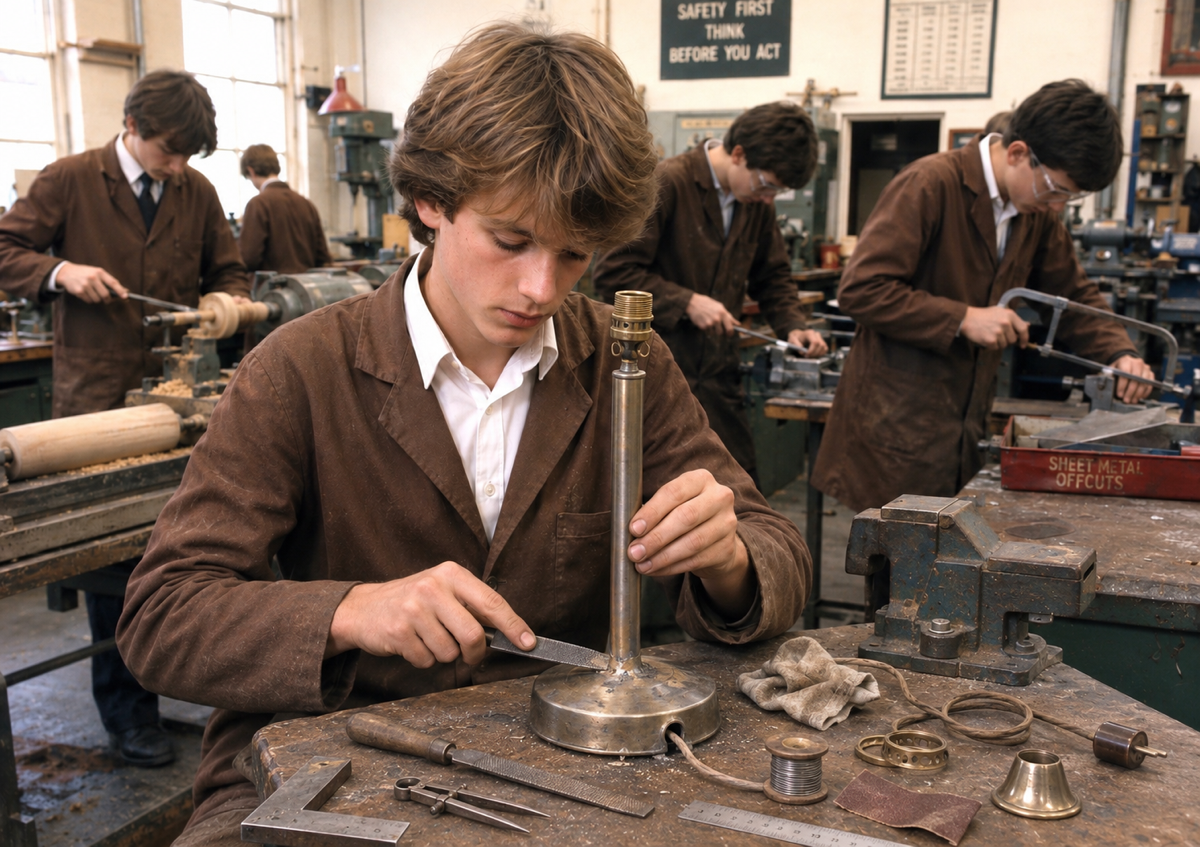
Projects: I worked on my lamp stand and watched a film on electric engines and hovercraft.
The lamp stand was still a botched job.
I’d made a start on it without truly knowing what the plan was and then tried to make it work. By now it was a question of damage limitation, fixing what I’d got wrong so I could finish the assignment and move on.
I had been struggling with it earlier in the month. There wasn’t much point in starting all over again.
Projects weren’t quite like ordinary schoolwork. You could be rubbish at something or you could be brilliant, but only you and the teacher really cared. It wasn’t as though everyone else was interested in how well you had made your lamp stand.
And it was just a lamp stand, or a tea-tray, after all.
We also watched a film about electric engines and hovercraft. The hovercraft were interesting enough, but the film wasn’t any better than watching Blue Peter or Tomorrow’s World on television. In fact, it was rather dull by comparison.
What I liked about those programmes was the unadulterated enthusiasm of the presenters, who weren’t necessarily experts themselves. They seemed genuinely interested in whatever invention or experiment they were demonstrating.
The film didn’t have much of that.
German: We talked about getting an Austrian penpal and a French exchange.
I was interested in either possibility.
There had been a children’s television programme about children from different countries exchanging places or visiting one another. It was quite old-fashioned, with a voice-over narration accompanying filmed footage, but the idea was interesting.
I thought it might have been an internationally produced series, involving lots of different countries. Having a narrator would have been the easiest way of making it work for audiences in different languages.
It was the sort of programme where the son of a builder in Bradford might go on an exchange with the son of an oyster farmer in Rochefort, or the son of a café owner in Bodrum might swap places with the son of a teacher in Denmark.
Or perhaps the daughter of a librarian in Dresden might exchange with the daughter of a tea-picker in Kenya.
That kind of thing.
An exchange with an alien from Epsilon Five whose parents repaired spaceships would have been even more interesting!
Still, the idea of corresponding with someone in another country and finding out about their life appealed to me.
An Austrian penfriend would be quite something, particularly as I was learning German.
I was already accustomed to writing letters to friends outside Sedbergh, so having someone to correspond with in Austria would be another possibility.
The French exchange was more complicated.
How would an exchange work when Sedbergh was an all-boys boarding school and the lycée in France was co-educational?
I imagined staying with a French family, attending lessons at their school and having a French pupil come and stay with us in return. All of that sounded interesting.
But the practicalities were another matter.
How could we have someone staying at Sedbergh who had never been to a boarding school? Where would they sleep? What would they do? How would they fit into the House?
Surely it would have to be an exchange between boarding schools.
Did the French even have boarding schools?
No band.
Band practice was cancelled.
We played water polo. Winder vs Sedgwick. We won 7-1.
.



Leave a Reply