
Friday, 26th November 1976
(Winder House, Sedbergh School, Yorkshire. Age 15).
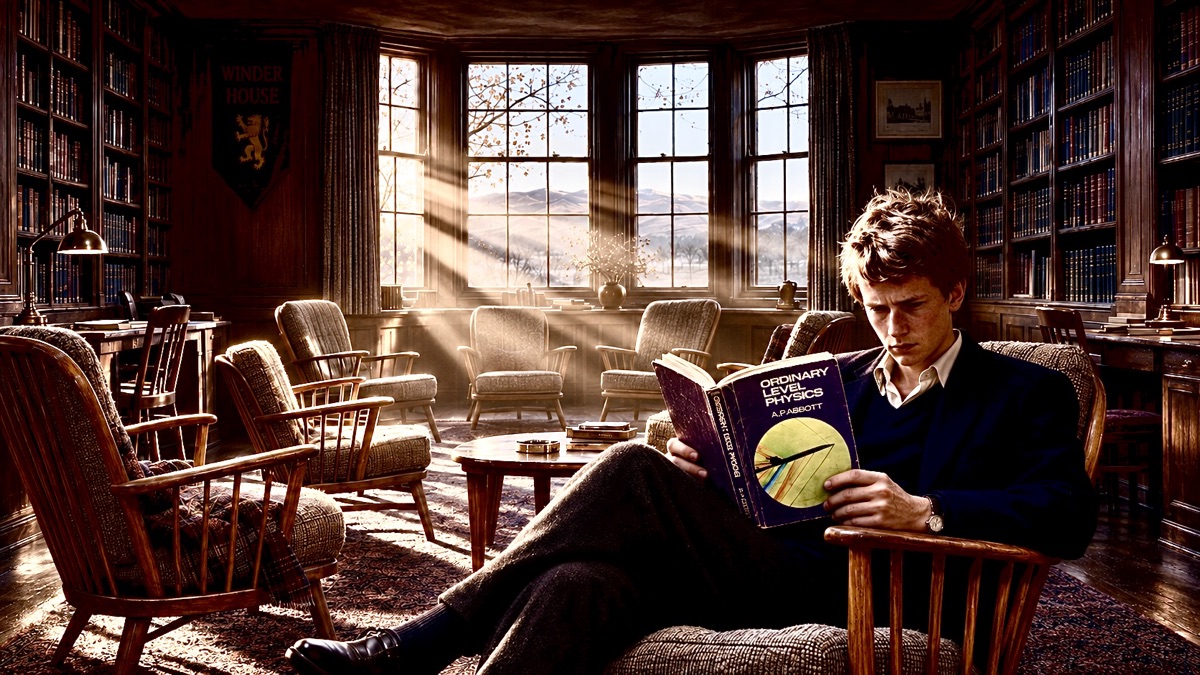
I was up early to do Physics.
I had always got up soon after drifting into consciousness. It was as if the conveyor belt of sleep had deposited me at the steps of a playground slide, and I had to climb the steps, place myself on the slide… and whee — we were off!
I woke, I got up and got on with the day.
I found the early morning very good for reading and note-taking, revision for a test, or starting or finishing an essay. The intention was to go undisturbed and get something done, ticked off, before breakfast — before most of the other boys had done anything more than get up, wash and dress.
At the end of November, in the cold, I might have stayed tucked up in bed to work. If I got up, I would most likely have headed for the House library rather than the middle common room.
Physics was one of those subjects where I was better able to tune into some things rather than others. I understood the three-dimensional and visual: pendulums, airflow, velocity and volume. Rolling steel balls down a chute, magnets opposing each other, the displacement of water and calculating volume, or the forces acting on the wing of an aeroplane — these were things I could picture and understand.
Earlier in the term, I had been working on the Ferryman’s Problem, involving relative velocity. That was the sort of thing I could get my head around if I could picture what was happening.
I wasn’t so good with electricity.
In History, I was told to read five chapters.
That was a lot for someone who could skim-read to get the gist of a thing but would plod through a text taking notes if I wanted the remotest chance of recalling any detail at all.
I selected key sentences or short sections to copy out. I couldn’t trust my attempts to précis something in case I missed the point or a key fact. When expected to discuss something I had read but couldn’t remember, I tried to wrinkle it out of my brain. Sometimes I’d recall something useful.
Then we discussed the French Revolution.
I think our History teacher was ‘Skull’, the tall, austere deputy head. He was bald and sallow-cheeked, rather like Peter Cushing, hence the nickname.
With the reading done, I think we were then open to discussion. The atmosphere was quite dry, formal and austere, like the teacher. We waited to be called upon rather than volunteering opinions. I was hesitant about expressing myself in front of him. He was a scary figure.
The French Revolution brought to mind A Tale of Two Cities. I had seen the 1935 film with Ronald Colman on film night at Mowden Hall, my old preparatory school, shown through a 16mm projector. Once a term, about a hundred boys were crammed into one space to watch a film, all in our pyjamas and dressing gowns. I had also seen it at some stage on television. These films could be evocative and moving, and made a lasting impression.
With the French Revolution, it was always the guillotine.
The terrible mechanics and efficiency of it. Imagining being in that position. Was loss of consciousness instant? What was the view from the basket like? Could you be saved at the last instant?
The film, classroom discussions and illustrations in books and encyclopaedias all fed these questions.
The overthrow of a monarchy was another subject to consider, particularly as Britain had experienced something similar.
In English, I finished a monarchy essay.
The focus was on the English Civil War, the removal of Charles I, the rule of Oliver Cromwell and the Restoration, rather than the modern era and a constitutional monarch. I had seen Cromwell, the film with Richard Harris and Alec Guinness, and had read The Children of the New Forest by Captain Frederick Marryat. My knowledge was coloured by these fictional portrayals.
There was privilege, power and the aristocracy versus ‘the people’, with the caveat of who could and could not vote. That took us into universal suffrage and women’s rights.
We had to make points, not take sides, but seek a balanced conclusion.
Then there was Orchestra.
We rehearsed on the stage in Powell Hall, playing classical favourites. I was second flute. If I didn’t play, no one noticed!
I hated it.
I had been playing the flute for years and had recently taken part in the school music competition in Powell Hall, playing alone before the judges. Being second flute in the orchestra was rather different.
I went to the library to find stuff on Martin Luther King.
I used the Almanack of World Events, which was rather like an illustrated encyclopaedia.
I thought this research was for Divinity, or perhaps Confirmation Class, if I was still attending.
King had been assassinated in 1968, only eight years earlier, but I felt more detached from contemporary or recent events than from history. This was a world I knew little about, and I felt that the lives of African Americans had little to do with me.
I didn’t follow the news. Strikes, the Prime Minister, politics, even world events beyond the moon landings — I knew very little about them.
Films, television and pop music held my attention. An exhibition might interest me, such as Tutankhamun or Pre-Raphaelite paintings, but contemporary politics was another matter.
For French prep, I had to do the passé composé and passif.
Another sticking point.
I didn’t know what these were in English, so I had no hope in a foreign language.
These building blocks of language made no sense to me. It was like dissecting a Picasso with a knife to understand how it was put together.
That was how I reasoned my problems with languages. I knew there was a disconnect. My diary was full of every spelling error possible.
I could understand the workings of a pendulum, the displacement of water or the forces on an aeroplane wing, but the rules governing the construction of a sentence were another matter.
Leave a Reply