
Monday, 29th November 1976
(Winder House, Sedbergh School, Cumbria. Age 15).
Geography
Geography: take notes. I spent too much of the lesson fooling around with my friend ‘Ebenezer Scruff’.
I couldn’t remember exactly how we had become friends, though I suspected it had something to do with our similar backgrounds. We had both been to boarding prep schools – his had been in Scotland. There was something familiar about him. We shared the same cheeky, rather know-it-all sense of humour, and once we started, we could be difficult to stop.
I think his prep school was Crawfordton House. We compared our two schools, and they had sounded remarkably alike: the grounds, the woods, the outdoor swimming pool, the gym and the science laboratories. At Mowden, the science laboratories were away from the main school, which we thought was sensible in case they blew up!
I also remembered a Scottish preparatory school rugby team coming to stay overnight at Mowden. All the beds in our dormitories were already taken, so I think they used the sick dormitory and perhaps brought in extra beds. I wasn’t certain whether this was ‘Ebenezer’s’ school, but it seemed quite possible.
I liked having someone I could bounce off. It was a sort of bromance, I suppose, even flirtatious in its way. You tuned into somebody, discovered that you shared a sense of humour, and began to see how far you could take it.
The same thing could lead to all sorts of good and bad things. Mischief, certainly, but also a joint enterprise. Two boys thinking through a problem together, an epic battle on the squash courts, pushing one another to swim faster or try a different stroke, or getting involved in a play or a band. Much depended on whom you were with.
I seemed to gravitate towards different boys in Geography, Chemistry and Biology, and it was easy to get carried away.
Mr Pritchard was particularly vulnerable. He couldn’t, or perhaps didn’t want to, impose discipline. He was easy prey.
We could completely ‘Chang-hie’ a lesson. One of our better tricks was a Chinese fire drill. At an agreed time, everybody stood up on their desks, turned through 360 degrees and sat down again. Then we were as good as gold.
Pritchard laughed it off. We’d had our hit of fun, and the lesson could continue.
It was amusing, but there was a price to pay.
I was supposed to be taking notes. If I missed something important, there was no guarantee I would ever recover it. I already had this problem with music lessons, where leaving an academic lesson to go and play my flute meant missing whatever the master had been explaining.
These weren’t just incomplete notes. They were crucial gaps.
Teachers didn’t put themselves out to help, and there were no extra classes. If you missed something, you missed it. There was no catching up unless you managed to work it out for yourself.
That was what I usually tried to do.
The trouble was that once I had lost the thread of a subject, the gaps accumulated, and I began to worry about falling behind. I enjoyed mucking around, but I didn’t enjoy the anxiety afterwards.
Pritchard could make Geography interesting. I remembered his lessons about Norway, particularly the mountains and mountaineering. But he could be diverted, and we were quite capable of taking advantage.
I would have to stop fooling around quite so much, even if it meant sacrificing some of the fun.
Physics
Physics: an accurate test result, all to three significant figures.
I liked Physics when we had something practical to do and a result to work towards. There was a problem to solve, and the challenge was to solve it correctly, preferably against the clock.
It was rather like cooking without the creativity. You followed a procedure, measured things, made your calculations and discovered whether you had got the right answer.
I liked that.
The three significant figures mattered because they showed the precision of the result. There was something particularly satisfying about the calculations agreeing with what we had measured.
Maths could be much the same. I liked a challenge, particularly when I could see the problem, work through it and reach an answer that I knew was correct.
In practical Physics, it also helped to have somebody working alongside me who wanted to get on with the experiment rather than muck around. I could enjoy the fooling about in Geography, yet become quite irritated if somebody prevented us from getting a good result in Physics.
Perhaps that was the difference. When I was enjoying what I was doing, I wanted to do it properly.
And getting an accurate result to three significant figures was rather pleasing.
English
English: an essay on the monarchy. Mark was Average. One too many essays.
I wasn’t especially pleased with that.
We had been studying the monarchy, and I had become rather interested in the question of whether Britain needed one at all.
I kept thinking about the film Cromwell, with Richard Harris as Oliver Cromwell and Alec Guinness as Charles I. I had enjoyed the film enormously and found myself siding with the Roundheads.
The Royalists were rather too effeminate to me, certainly as they appeared in the film. I liked the seriousness of the Roundheads, their sense of fairness and their determination that things needed to change.
I wasn’t attracted to Puritanism, though. That was quite another matter.
Alec Guinness seemed gave a good representation of Charles I. At least, it fitted the impression I had formed of him. I also liked The Children of the New Forest, which presented the Civil War from a rather different perspective.
We had been learning about the gradual curbing of royal power through the Tudor, Stuart and Hanoverian periods, and the subject raised all sorts of questions about authority, Parliament and whether the monarchy should continue.
I thought it was interesting to argue both sides.
In fact, I had a feeling I might have written the essay twice, or at least attempted it from two different positions. I wanted to see whether I could make the case both for and against the monarchy.
This was something I enjoyed about writing essays. You could take one position and defend it, then consider the opposite argument and see how convincing that could be.
I had done something similar in an essay about the environment, considering what might happen if one course of action were followed, then what might happen if something else were done, before looking for some sort of compromise.
I liked defending both positions and then seeking a balanced argument.
That seemed to be what the teachers wanted: not simply an opinion, but a properly argued case, with the different possibilities considered before reaching a judgement.
Perhaps I had made the monarchy essay too complicated. Or perhaps I had simply written too much.
Whatever the reason, the result was only average.
One too many essays!
Swimming
No rugby because of the weather, so swimming instead.
It had been bitterly cold, with temperatures barely getting above freezing. The ground was frozen, and rugby had been cancelled.
That always changed the atmosphere of the school.
When the weather became really cold, particularly when there was snow, it was almost like having a holiday. We could venture into the hills, and on one occasion we had even gone up to a frozen tarn to skate.
Today, however, we went swimming.
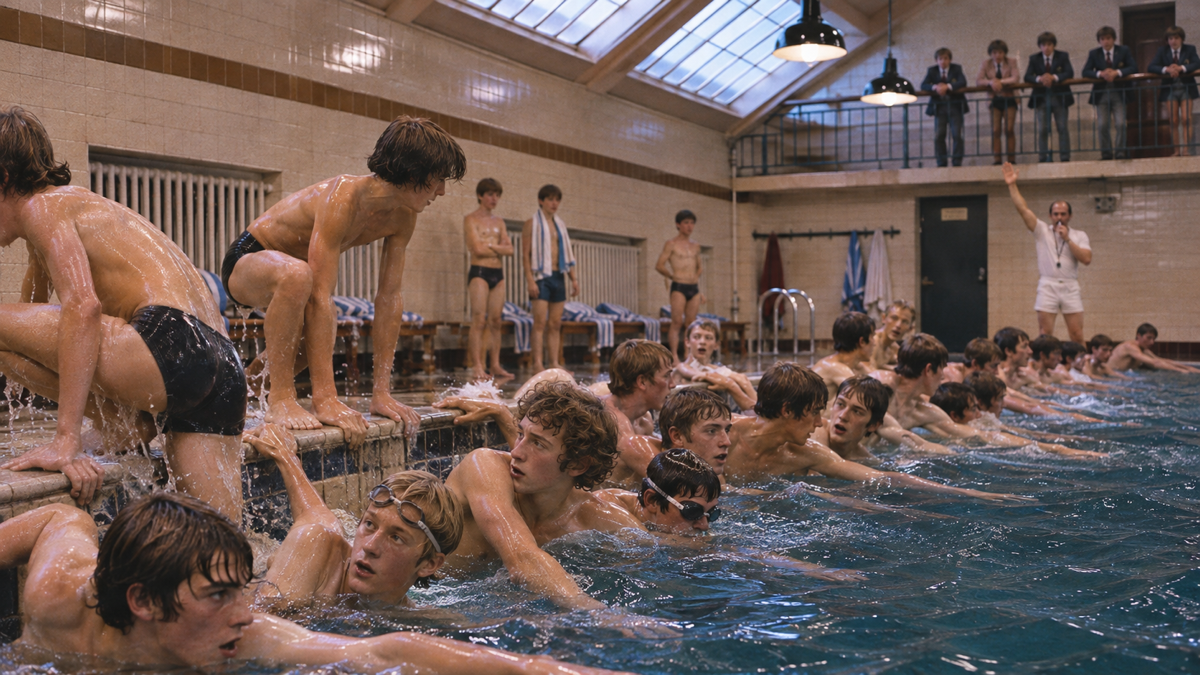
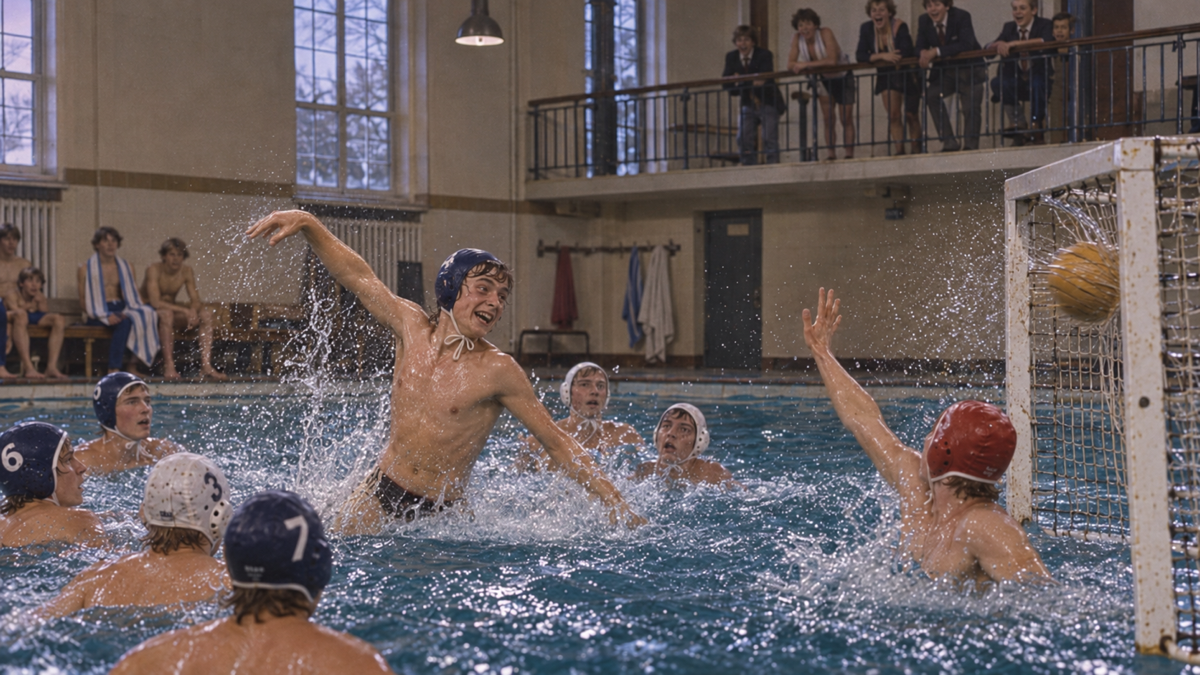
There must have been about 45 of us in the pool, which only had four lanes. There wasn’t enough room for everybody to swim lengths properly, so we did widths instead.
It was good fun.
There were races, relays and various kicking exercises, rather like the swimming lessons I remembered having at the Royal Grammar School in Newcastle when I was about seven.
Mr Tunstall had taught us there. I couldn’t remember much about his actual teaching, but I remembered doing kick sets. Lots of kicking.
This was rather different from a normal swimming session at Sedbergh.
There were so many boys in the water that we were almost shoulder to shoulder. Just as well we were only swimming widths, because some of the rugby players were dreadful swimmers!
There was quite a difference between the boys who swam regularly and those who were only there because rugby had been cancelled.
We did what we knew how to do.
We pushed off properly, held a tight streamlined position and added a couple of butterfly kicks before coming up to swim.
Some of the others simply launched themselves across the pool with their heads up and their arms flailing.
It was rather amusing to watch.
Rugby was obviously the great sport at Sedbergh, and the boys who played it were accustomed to being considered athletes. But swimming required its own skills, and I was quite happy to demonstrate that there was more to getting across a pool than thrashing about.
I enjoyed being in the water, particularly when there was the opportunity to race.
The whole session lasted about 45 minutes, and despite the crowding, it was a pleasant change from rugby.
Good fun!
Chemistry
Chemistry: Carbon, hard water and soap.
Then More pointless questions, I thought.
I wasn’t enthusiastic about Chemistry. We spent a good deal of time answering questions, and I wasn’t always convinced that I understood what we were supposed to be learning.
Carbon, hard water and soap were the topics today.
I could manage some of it, but there was a difference between learning a fact and understanding how it fitted into everything else.
When there were multiple-choice questions, there was always the possibility of making an educated guess — or simply having a go at what I called ‘multi-guess’.
It wasn’t much of a substitute for knowing the answer.
I had the same difficulty here as in other subjects. If I missed an important explanation, whether because I was fooling around or because the lesson hadn’t made much sense in the first place, I was left to work it out for myself.
I was much happier when there was something practical to do and a result that showed whether I had understood it.
I could get full marks for Chemistry practical work, yet still find the theory difficult.
Another set of pointless questions didn’t help.
Choral Society
Choral Society — Cas: Everyone was bad!
We had Choral Society in the evening, with girls from Casterton and a mixture of boys, masters and some of their wives.
It was rather different from being in Chapel Choir or singing at Mowden.
I had been a chorister, could read music and understood something about singing properly. I knew about breathing, phrasing, diction and holding a part. I could sight-read, which was an advantage when we were learning something unfamiliar.
The trouble was that Choral Society was rather amateur.
I felt a cut above many of the others, although I didn’t particularly enjoy feeling that way. What irritated me was hearing a performance being dragged down by people who couldn’t sing their parts properly.
I did my own part with conviction.
I could hear who knew what they were doing, and my ear picked out the better singers. The Maths teacher, for example, was good.
It was interesting seeing masters outside the classroom.
For them, school was over for the day. They had been home and changed, and much of the usual formality had disappeared. They were no longer simply the masters who taught us lessons, set work and imposed discipline.
Here they were singing alongside us, sometimes with their wives.
I rather liked that difference.
The Casterton girls were another matter.
There was always the possibility that being in a room with girls might make an evening more interesting, but there was next to no opportunity to talk to them.
I soon established that they were older than me anyway.
If any of the boys had joined Choral Society primarily in the hope of meeting girls, they were mistaken. Those doing O’ levels or A’ levels had other priorities, and there was precious little chance of making any sort of acquaintance during rehearsals.
We had music to learn.
I thought we were probably working towards the Christmas concert or carol service. Whatever we performed, the entire school would be there. Attendance wasn’t a matter of choice.
I might be playing my flute in the band or orchestra for one occasion and singing with Choral Society for another. They were separate activities, although both involved rehearsals and performances.
I enjoyed performing when it was done well. That was the point of rehearsing, surely: to make something sound better.
I had been used to singing with people who could hold their parts, and it was frustrating when the standard was so uneven.
There were some good singers among us, but not enough to stop me becoming irritated.
Everyone was bad!
Another Monday evening spent at Choral Society
Leave a Reply