
Fig. 1. Passion at work: Blogging practices of knowledge workers (2009)
by Lilia Efimova
Doctoral thesis published by Novay.
I’ve come to this thesis for a number of reasons:
I’ve been blogging since September 1999, sometimes obsessively so, such as the couple of Blogathons I instigated in 2002 and 2004, where participants had to post 1000 words every hour on the hour for 24 hours – words were meant to be written during the previous 60 minutes. Three of us made it to the end.
I’ve posted regularly since 1999, with several years never missing a day – that’s the diary writer in me. We created ‘circles’ in Diaryland a decade before Google used the term for those with 100, then 500, then 1000 posts.
I know of one blogger from that era who is still there, plugging away ‘Invisibledon’.
I’ve written on themes such as creative writing, parenting, swim coaching, and e-learning.
And added to this typed-up entries from diaries. There are some 2 million words ‘out there’.
My credentials, therefore, are as a participant, as a player.
Perhaps I am too close to the hubbub to see what is going on?
I blog as a means:
- To learn
- To collate
- To share
- To test and practice my knowledge (or lack of … )

Fig. 2 It helps that I’ve kept a diary since I was 13. Blogging since 1999. On WordPress since 2007.
I’m used to gathering my thoughts at the end of the day or logging them as I go along. And learnt that a few succinct sentences are often enough to bring back the day. My first blog was NOT assembled in ‘reverse chronological order’ – I posted to a set of 32 themes. It works better that way.
- One diary covers my gap year working in the Alps.
- Another diary covers a few weeks of an exchange trip to France.
- A third covers a year with the School of Communications Arts.
I personally value blogging to form a writer’s journal and as a student’s journal, particularly over the last three years during which time I have successfully completed the Open University’s Master’s in Open and Distance Education (MAODE).
- I read everything I can on blogging.
- I’ve just read this engaging PhD thesis by Lilia Efimova.
- She is Russian, works in the Netherlands and writes perfect English.
Her supervisors were:
Robert-Jan Simons
Robert de Hoog
My interest is twofold – blogging and methodology, as I am doing a postgraduate module on research (H809: Practice-based research in educational technology)
The methods used (Efimova, 2008, p. 1):
- Use of unconventional research methods
- Cross boundaries
- Define and defend choices
Blogging can support a variety of knowledge worked activities to:
- articulate and organise thoughts
- make contact with people interested in the same topics (like minds)
- Grow relations with other bloggers
- work on a publication
Caveats
- personal
- crossing boundaries, passions, and paid work, private and public.
I read ‘Uses of Blogs’ for the second time. Edited by Dr Axel Bruns and Joanna Jacobs. I had a OU Library copy so bought another through Amazon. A book on blogging that only exists in print. I far prefer eBooks. I’ve posted on that elsewhere. (Versatility, notes and highlights in one place, search and having as Lt. Col Sean Brady described it a ‘university in my pocket’).
My take on blogging – who does it, is based on Jakob Nielsen’s 2001.
I can’t find figures that suggest that this has changed in the general population, though research with undergraduates might give a split of 5/35/60. The problem is, what do you define as a blog? And can your really say that someone who posts once a year, or once a quarter is blogging at all?
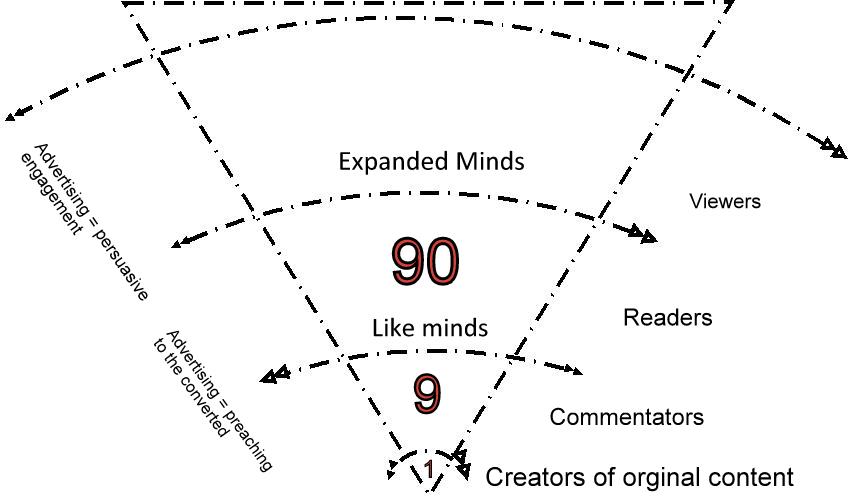
Fig. 3. For everyone 1 person who blogs, some 90 don’t, and the other 9 are half-hearted about it. (based on stats from Nielsen, 2006).
According to Nielsen (2006) most online communities show a ratio of creation, commenting and simply reading of 1% – 9% – 90%. With blogs, the rule is more like 95% – 5% – 0.1%.
Introduction
I agree with Efimova that we learn from the edge. We come into everything as an outsider. She cites ‘legitimate peripheral participation (Lave & Wenger, 1991) and moving from being an outside in a specific knowledge community to a more active position. I would like to thank John Seely Brown and Paul Duguid. (2007) Awareness, as a starting point of this process, comes through exposure to the ideas of others and lurking at the periphery (observing without active participation), learning about professional language and social norms. Efimova cites (Nonnecke & Preece, 2003). I would add Cox (1999).
As the thesis more reason to blog, or reason not to are offered. Efimova also commits to examining blogging in the workplace among Knowledge Workers. Efimova (x.p ) In 2000, we used the term ‘infomediaries’, people who dealt in information and knowledge on behalf of others.
Workers use blogs to
- develop ideas and relationships
- inspire conversations
- work on specific tasks
Early adopters are experimenting with the medium. Here, I think a full consideration of the diffusion of innovations (Rogers, 2005) would also be beneficial. Efimova offers some ideas from Gartner, though without the self-explanatory chart I provide below.
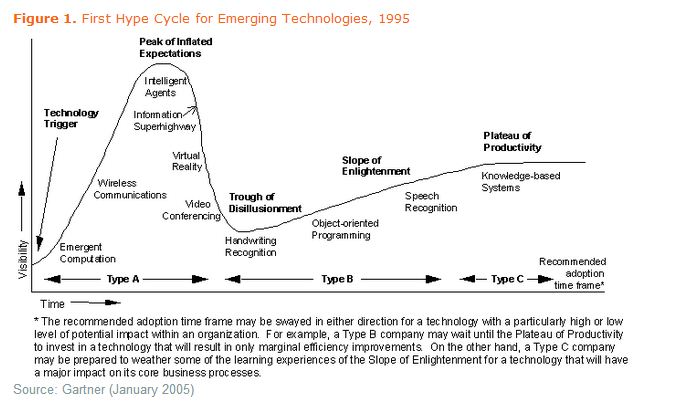
Fig. 4 . Gartner mid-2005 projection (Fenn & Linden, 2005)
I know of all three company types. Whilst a very few at A can be hugely successful, the safest approach is to come in at C – as Virgin do, time and time again, letting others make mistakes. On the other hand, for example in e-learning, if you aren’t willing to behave like a Type A you may find your clients start speaking to companies down the road. Ditto advertising and social media.
Efimova talks of the ‘peak of inflated expectations’ and the ‘trough of disillusionment’.
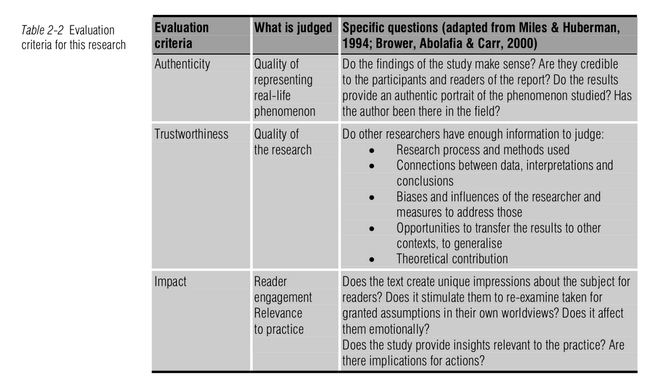
Fig. 5 Evaluation criteria for this research
This is where I need to put in a good deal more scrutiny. Whilst I don’t question the validity of the approach, I do wonder if a more ‘scientific’ approach would have produced something more revealing than observation of 34 work-related blogs, which is how this thesis plays out. We wander into the questionable arena of informal interviewing and participant observation as a central way to generate ‘ethnographic data’. This smacks of anthropology to me. Of social anthropology. But perhaps such qualitative techniques are as valid, and may be the only way to study subject if you are going to take the challenge of researching it at all.
The best answer I have read and give myself now when asked, ‘what is a blog?’ is to say ‘electronic paper’. That is how broad it has become. In 2001-2002 a handful of us in Diaryland set out and shared our standards:
- A minimum of 250 words
- Post every day for at least a year.
- Fact, not fiction (unless expressed as otherwise)
At the time, it was rare to post images, and you wouldn’t and couldn’t include video. Today, a blog might be a stream of images or streamed video. It can be multiple users, too, posting on the hour for a year in a team of six if they wish, as Andrew Sullivan (2013) does with ‘The Daily Dish’, which gets a million views a month.
Efimova uses a technique called ‘triangulation’ to help validate her research – this is the use of multiple sources and modes of evidence to make findings stronger, by showing an agreement of independent measures, or by exploring and explaining findings (Miles & Huberman, 1994; Schwartz-Shea, 2006).
i.e. Triangulation by study – studying blogging practices from three perspectives using a variety of methods.
She also used ‘data triangulation’ – including in the analysis different types of data ( e.g. text and statistics), data sources and data collection methods. So, including non-elicited data (Pargman, 2000) from public sources (e.g. weblog text) as well as recorded interviews.
I can’t fault Efimova’s (2008) introduction to Blogging
‘Since their early days, weblogs have been conceptualised as personal thinking spaces: as an outboard brain (Doctorow, 2002), a personal filing cabinet (Pollard, 2003a) or a research notebook (Halvais, 2006). In fact, the first academic publication on blogging (Mortensen & Walker, 2002) discusses uses of blogging in a research context, particularly in relation to developing ideas, and the weblog of its first author, Torrill Mortensen, has a telling title: “Thinking with my fingers”. I soon discovered that a weblog worked well that way, but also that this “thinking in public” provided an opportunity to show how ideas, my own and those of other bloggers, develop over time.
Pacquet 2002 discussed the use of blogging in research.
Fig. 6 Number of weblog posts per month
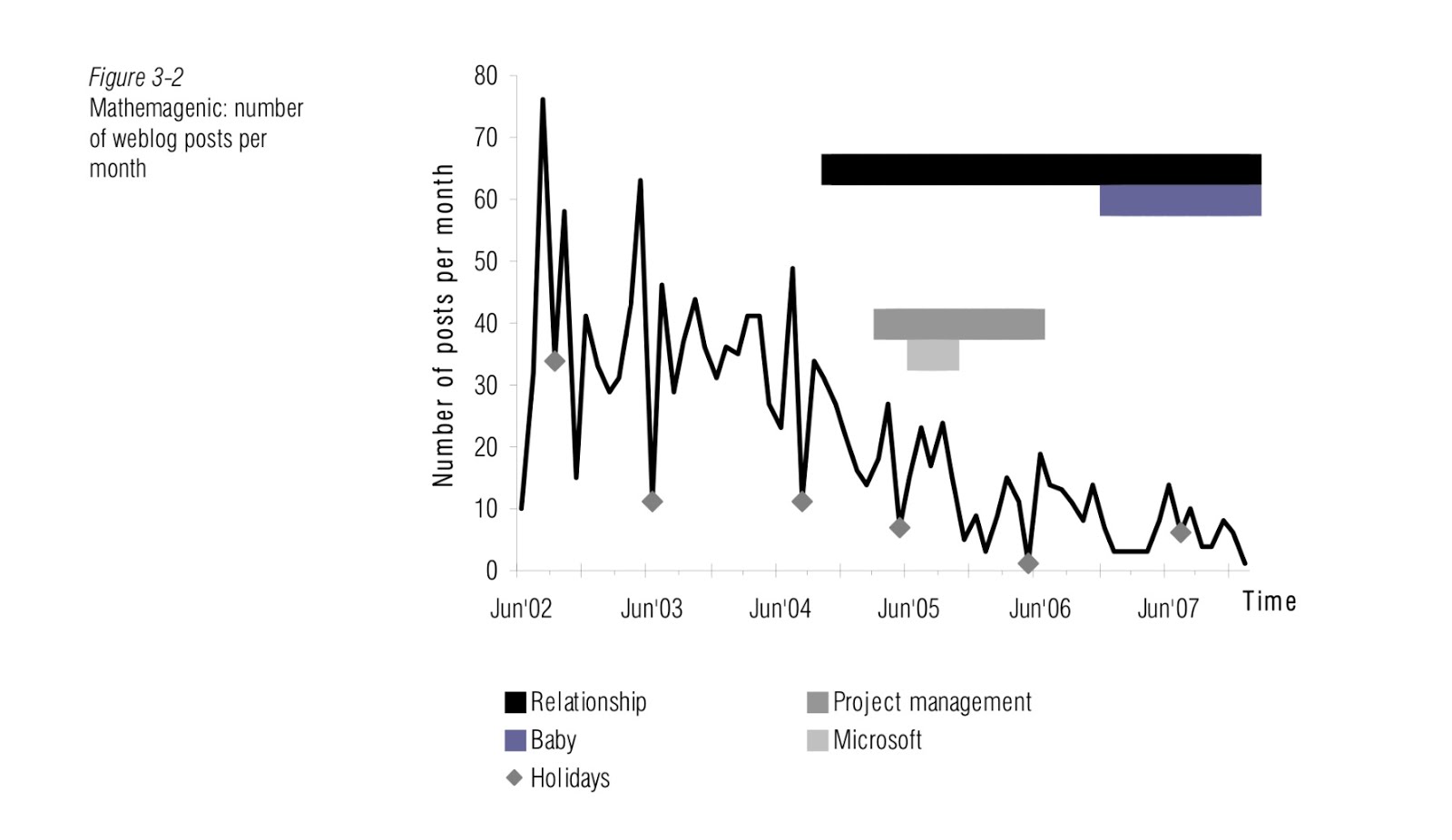
Blog analytics are mystifying. We count the undefined.
What is a blog?
What is a blog post?
A group of us asked these questions in 2000, then got on with it. We had guidelines to post at least 1000 words every day, with no post under 250 words. We did this as others flooded online, and in the race to have 100 or 500 posts, we would put up a random string of letters and post every few minutes. As it became feasible and easy to post images, was a picture worth a thousand words?
Was it still a ‘blog’ in our sense of the definition if it had no explanation behind it. And in my case, by storing by category, not date, in defiance of conventions, could what I do still be called blogging?
And if used to archive diary entries, was I now an archivist?
Looking at the fall-off in posts in Efimova’s blog, I also see that when things get more interesting, when there is more to say, we post less. From an earlier generation, I stopped keeping a diary when my fiancé and I moved in together.
Had I found what I was looking for?
Around this time, in 1998, Ellen Levy was featured in the Washington Post for keeping a ‘blog’ (not called this) for a year, writing up business meetings and how she attended them, even adding photos. She struggled to post when she was ill. Over time, knowing when we fall ill can start to explain why. And if, as we can now do, our daily life is captured automatically, is that a blog? To what degree must the blogger select, frame, write, and edit what they have to say, rather than rely on a device like your own CCTV camera hanging around your neck to do it for you?
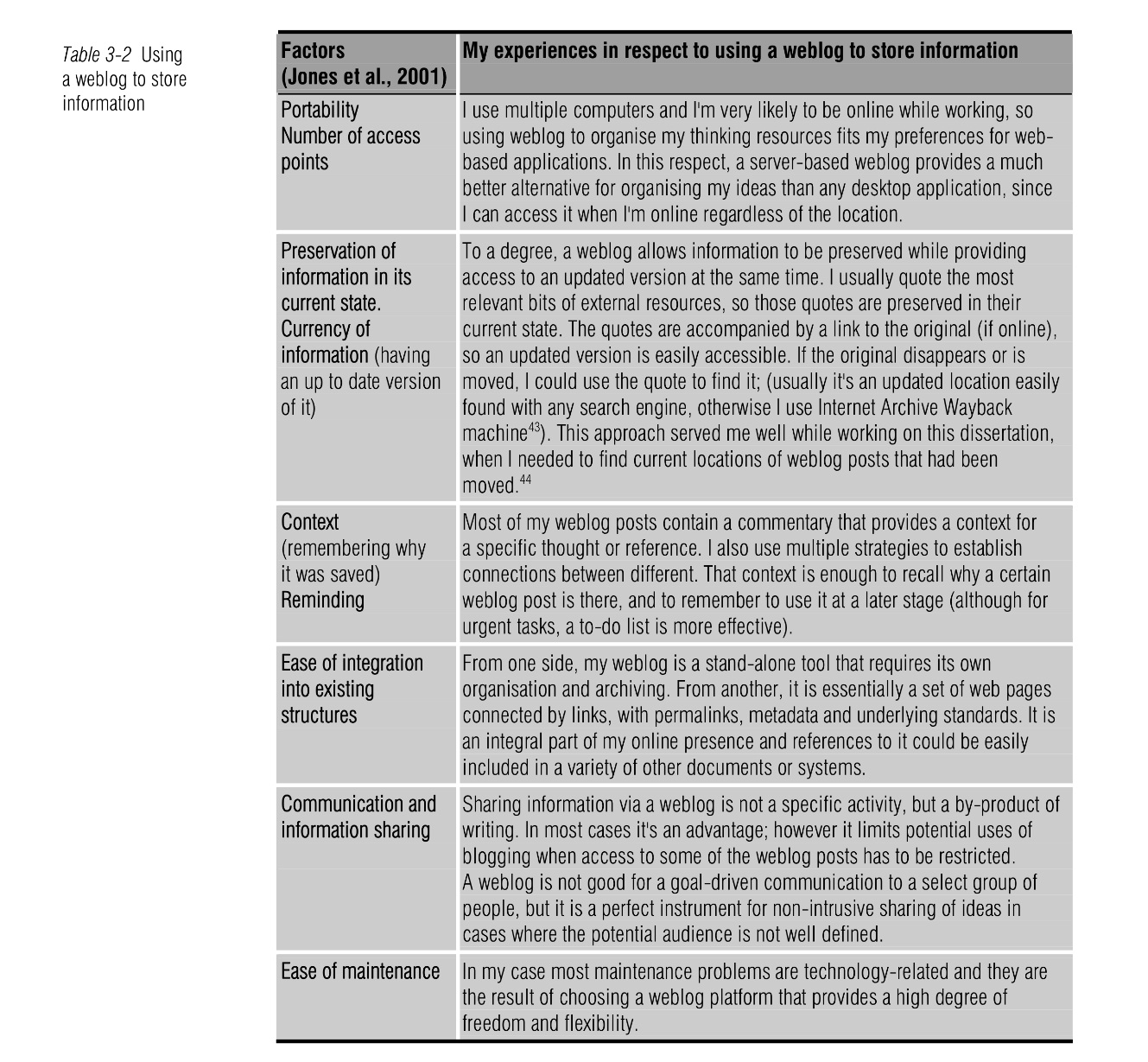
Fig. 7 Using a Weblog to store information (Efimova 2008, p. 58)
To understand the blogger’s mind, should we look at why people in the past kept a diary? Or is keeping such a record, a journal, simply one strand to something that has become extraordinarily multifarious? The 17th-century diaries of Lady Anne Clifford and Samuel Pepys, the 20th-century diaries of Anne Frank, Virginia Woolf and Anais Nin, the audio-cassettes of British MP Tony Benn …
Surely to say you want to study blogging in 2013 is akin to saying you want to study printed matter in the 17th century. The field is too diverse. In a way, we have gone from the mechanical era of print to the organic era of the blog. Even studying one facet of blogging, such as the business or corporate blog, would be like studying the ecology of a meadow to understand the interplay among different plants and creatures.
Efimova speaks of ‘sense-making’ (2009, p. 70)
‘As with writing, blogging is not simply formulating in words an idea already developed in one’s mind. It is also about connecting, developing and redefining half-baked ideas. When writing, I often go through the weblog archives to explore connections with what is already there. Reading and rereading what I wrote before shapes and changes what I’m about to write: I often find something unexpected or see patterns only in retrospect.
And others have some reason to blog … and just one reason not to.
- Somewhere to “park” emerging insights until the moment they are needed. Efimova (2009. p 75)
- Doesn’t require much effort
- Somewhere to park ideas
- Reading and engaging with others to become aware of issues and themes
- Topics accumulate, and connections grow, and things become clearer.
- A set of sense-making practices
- “Everyday grounded theory” Efimova (2009, p. 75)
- Connecting multiple fragments
- Getting into the writing flow
- Strengthened by readers’ feedback
- A channel for distribution
- Publication additional motivation to document emergent ideas
- A legitimate place to share thinking in progress
- -ve when the need is for extreme selectivity and focus. Efimova (2009. p. 80)
- To collect in one place the fragmented bits relevant to my thinking Efimova (2009, 3.5.4)
- Clusters of conversations
- Conversations unfolding
- A personal space and a community space simultaneously.
- A personal narrative is used to articulate and organise one’s own thinking. (conversation with self. p 90?) around 4.3
- An example of hypertext conversation. Efimova (2009, p. 129)
- Weblogs provide a space that helps both to develop one’s own point of view and discuss it with others.
- Bloggers present their ideas to the world, and readers learn from them. Efimova (2009, p. Getting Things Done, Staying in touch)
This would make a good topic for debate.
And if I post multiple entries about my personal life, is this content less of a blog when it is locked than when it is made available publicly or in a limited way by password?
Eight functions of corporate blogs are offered (Zerfab, 2005; Juch & Stobbe, 2005)
- Public Relations
- Internal Communications (knowledge transfer and contract negotiation)
- Market communications:
- Product blogs
- Service blogs
- Customer relationship blogs
- Crisis blogs
- CEO blogs
Fig. 9 Conversations with self. Efimova (2009)
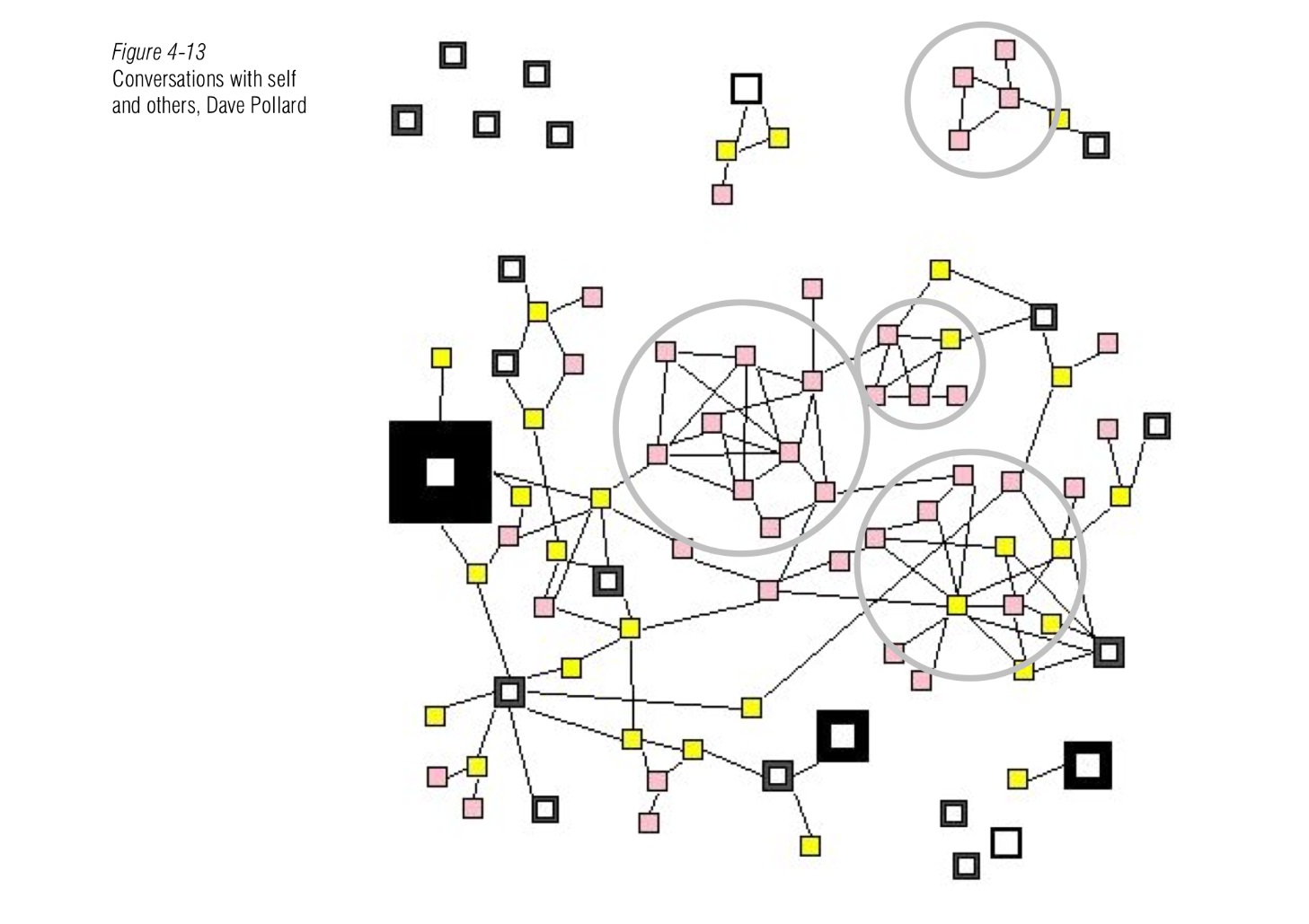
To mean something, plotting ‘conversations’ requires annotation and even animation for it to start to make sense.
It is also very difficult, even unrealistic, to isolate activity on a website from other forms of synchronous and asynchronous ‘conversation’ – the dialogue in a forum, through email, even on the phone or Skype. This is why as a metaphor I return to the notion of an ocean, in which all these digital assets, this ‘stuff’ is floating around, mixed up by the currents of search engines, micro-blogs and social networks, churned by new Apps, software and kit and made dynamic as it is remixed, shared and transformed through translation, borrowing, plagiarism or mash-ups.
In this way, an ocean of content is thrown into the cloud, where it is circulated and recycled like a virtual water cycle.
Others will see it differently; many talk of an ecosystem, of something organic going on. Would a zoologist or ecologist make more sense of it? Or a biologist, mechanical engineer or psychologist? Some of these questions, and this eclectic mix of folk, have been gathering at the University of Southampton for the last three years under the umbrella title of WebSciences – a cross-disciplinary faculty that works with computer scientists and educators, the health sector and social sciences, the creative industries, geographers and historians. It’s as if a mirror has been held up to our offline world, and by translation, as Alice through the Looking Glass, transformed the real and explicable into the surreal and the unexplainable.
The history of blogging at Microsoft, Groundup from 2000 to 7000 internal and external by 2005. What it brought and what was hoped for:
- Humanising the company.
- Visibility to its author (Efimova 2008, p. 187)
- Recognition as an expert
- Communicating about the product
- Reader expectations and visibility-related risks shape the content. Efimova 2008. p. 191)
‘Employee blogging creates tensions by crossing boundaries between work that is paid for, regulated and controlled, and personal passions that enhance it, passions that could be recognised and appreciated at work, but couldn’t be easily specified in a job description.’ Efimova 2009. p. 199)
For 11 months I worked in a business school in social media.
My efforts to support those who didn’t blog in doing so, or to encourage those who said they blogged to post more often than once a quarter or a couple of times a year, failed. If they had wanted to be journalists or politicians and had got up on a soapbox, they would have done so in their youth. They saw no individual value or purpose to it, so they wouldn’t. As academics, they have readers, and their pattern of research and writing is well established. Some do, some don’t. Some will, some won’t. And it would appear that those inclined to share their point of view online are just a fraction of the online population, and just a fraction of that population who read blogs – i.e. 1% (Nielsen, 2006)
‘On the downside, blogging requires an investment of time and effort that could be a burden. Although potentially useful, work-related information in employee weblogs is highly fragmented and difficult to navigate. Although the visibility of bloggers, their work and expertise, can have many positive effects, it may also result in undesired communications overhead, time spent dealing with high reader expectations or with taking care of negative effects.’ Efimova, 2009. p. 200)
- Lack of control of the company’s message
- Dependence on personalities
- Challenged hierarchies and communication flows
Efimova (2009, p. 201)
- To illicit passion for knowledge (Kaiser et al., 2007)
- Change the image of the company in the eyes of others (Kelleher & Miller, 2006)
It’s easy to blog, so more people should do it.
- low-threshold creation of entries
- a flexible and personally meaningful way to organise and maintain them
- opportunities to retrieve, reuse and analyse blog content
- opportunities to engage with others.
- fitted in while working on something else
- providing a way to keep abreast of others’ ideas
- capturing one’s own emergent insights
- clarifying matters for the public
- Over time, ideas on a topic accumulate, and connections between them become clearer.
- Feedback from readers turns blogging into a sense-making practice
- an idea is ‘ripe’ and ready to become part of a specific task.
Efimova (2009, p. 208)
The reality, if Nielsen (2006) has it right, is that only a tiny fraction of any population wants to go to the trouble of, or has the inclination to, post something. Better that those with something to say and a voice to say it do so, so that everyone is obliged to express themselves online. I liken it to cooking on holiday. I disagree with obliging everyone to cook on a rota. For some, it isn’t a chore; it’s a joy, and if they do it well, encourage them. With the proviso that others make their contribution in other ways – laying on the entertainment, doing the drinks … it’s what makes us human?
Conditions for a weblog ecosystem, Efimova (2009, p. 232):
- Scale and reach
- Readership
- Visibility
- Feedback
- Lowering thresholds – a tool for everyday tasks
- Making it accessible
- Crossing boundaries
Ecosystem suggests that blogs exist in something organic – they do, the Web is fluid, shifting and expanding. What value would there be in studying blogs in a way that is somehow ‘scientific’ as if blogging were a natural, evolving feature? Like trees in a jungle?
What other metaphors might contribute to such understanding, and how, if at all, can they be justified in research?
Could I look at the Web as a water cycle, as oceans with clouds, as currents and climate? Or is this shoe-horning systems we understand in part to explain one that we do not? Is it presumptuous to look for a natural, rather than a machine, model for the Web and for where blogs fit in?
FURTHER LINKS
Plant CPSquare: communities of practice in the blogosphere.
REFERENCE
Bruns, A. (2006). What’s next for blogging? In A. Bruns, A & J.Jacobs, J (eds) Uses of Blogs (pp. 247-254). New York: Peter Lang Publishing.
Brown, J, & Duguid, P 1991, ‘Organisational Learning and Communities-of-Practice: Toward a Unified View of Working, Learning, and Innovation’, Organisation Science, 1, p. 40, JSTOR Arts & Sciences IV, EBSCOhost, viewed 15 February 2013.
Cox, R, McKendree, J, Tobin, R, Lee, J, & Mayes, T n.d., (1999) ‘Vicarious learning from dialogue and discourse – A controlled comparison’, Instructional Science, 27, 6, pp. 431-458, Social Sciences Citation Index, EBSCOhost, viewed 15 February 2013.
Efimova, L. (2009). Passion at work: blogging practices of knowledge workers. Novay PhD
Research Series 2009 (www.novay.nl.dissertations)
Halvais (2006) Scholarly Blogging. Moving towards the visible college. In A. Bruns, A & J.Jacobs, J (eds) Uses of Blogs (pp. 117-126). New York: Peter Lang Publishing.
Kaiser, S, Muller-Seitz, G, Lopes, M, & Cunha, M n.d., ‘Weblog-technology as a trigger to elicit passion for knowledge’, Organisation, 14, 3, pp. 391-412, Social Sciences Citation Index, EBSCOhost, viewed 15 February 2013.
Kelleher, T, & Miller, B. (2006). ‘Organisational Blogs and the Human Voice: Relational Strategies and Relational Outcomes’, Journal of Computer-Mediated Communication, 11 (2, pp. 395-414, Communication & Mass Media Complete, EBSCOhost, viewed 15 February 2013.
Lave, J. & Wenger, E (1991). Situated learning: Legitimate peripheral participation. New York: Cambridge University Press.
Miles, M.B. & Huberman, M.A. (1994). Qualitative data analysis: An expanded sourcebook. Beverly Hills, CA: Sage Publications.
Mortensen, T & Walker, J. (2002). Blogging thoughts: personal publication as an online research tool. In A. Morrison (ed.)., Researching ICTs in Context. InterMedia report 3/2002 (pp. 249-278). Oslo.
Nielsen. J. (2006) Participation Inequality: Encouraging More Users to Contribute. (Accessed 16 February 2013 http://www.nngroup.com/articles/participation-inequality/ )
Nonnecke, B. & Preece, J. (2003). Silent participants: Getting to know lurkers better. In C.Lueg & D. Fisher (Eds.), From Usenet to CoWebs: Interacting with Social Information Spaces. Springer Verlag.
Pargman, D. (2000). Method and ethics. In Code beges community: On social and technical aspects of managing a virtual community. Department of Communications Studies, The Tema Institute, Linköping University, Sweden.
Pollard (2003) Blogging in Business – The Weblog as filing cabinet. How to save the world, 3 Mart 2003.
Seely-Brown, J.S and Duguid, P. (1991) ‘Organisational learning and communities-of-practice: toward a unified view of working, learning and innovation’, Organisational Science, 2 (1): 40-57
Brown, J.S. (2007) October 2007 webcast: (accessed 16 Feb 2013 http://stadium.open.ac.uk/stadia/preview.php?whichevent=1063&s=31 )
Schwartz-Shea, P. (2006). Judging quality. Evaluative criteria and epistemic communities. In D. Yanow & P. Schwartz-Shea (Eds.), Interpretation and Method: Empirical Research Methods and the Interpretive Turn (pp. 89-113). M.E. Sharpe.
Sullivan, A (2013). The Daily Dish (accessed 16 February 2013 http://www.guardian.co.uk/media/2013/jan/03/daily-beast-andrew-sullivan-daily-dish )
von Hippel, E. (1986). Lead users: A source of novel product concepts. Management Science, 32 (791), 805.
Weller, M (2011). The Digital Scholar: How technology is transforming scholarly practice.
Zerfaβ, A 2005, ‘Assembling a Localisation Kit’, Multilingual Computing & Technology, 16, 7, pp. 60-11, Business Source Complete, EBSCOhost, viewed 16 February 2013.
Related articles
- Why blog – 21 good reasons, 1 bad … Lilia Efimova from her PhD thesis on the subject (mymindbursts.com)
- Personal Knowledge Management and the hangout where we should all hang out. (mymindbursts.com)
- Reading – nothing quite beats it, does it? (mymindbursts.com)
- Mathemagenic blog networking study (billives.typepad.com)



Leave a Reply