Thursday 20th February 1975

‘Lessons were dull because I had hoped to skive out of them apres C.E. I missed swimming to Tonstall to play rugby. I played hard, doing more often tidying up work, forming rucks, etc.: we won after a disappointing start 24-4. We missed evening lessons and supper, so I practised flute, mostly playing things like Clementine. I read a book and something to do with Hannibal by some Elliot person. Go to sleep and dream.’
I’d come to find swimming was considered a minor sport, with school and house games, cricket, or athletics always coming first. I received amazingly little swimming training: a school swim for an hour once a week at Newburn in the winter and Easter months and the terrors of the unheated school outdoor pool in summer. Once at Sedbergh, recovering from a badly broken leg, I was excused from rugby for the season. Unfortunately, the muscle growth from a term of swimming training and some competitive club training back in Newcastle resulted in the osteopath signing me off to play rugby in the Spring Term of 1976. I deliberately played down any talent I might have gained from playing the game so often at prep school so that I could concentrate on swimming, which, during the school term, we did four or five afternoons a week.
Swimming is not just a sport, it’s a part of who I am. I love being in water. I should learn to scuba dive. I’ve written about how I was taken to a swimming pool to have swimming lessons when I was young enough to warrant having my mother with me. I was as young as 3 or 4. I only swam competitively at school, winning everything in my age group and sometimes challenging boys far older than me. As an adult, I participated in swimming marathons to raise money for charity. I was always the person they’d have to kick out of the pool when it was closing after I had been in the water for several hours. Being asthmatic, I have never coped well in cold water, which resulted in a shaming incident at Mowden last summer. Diving in for a race, I could not breathe, and having got to one end of the pool and turned back, I collapsed on the side of the pool. Instead of sympathy, I was chastised, my swimming cups taken from me. The incident has made me resentful for decades and annoyed at the teacher who took this stance. But despite this, my love for swimming has never waned. It’s a passion that has stayed with me, shaping my life and my experiences.
Can a person be forgiven for misinterpreting a situation? As an invigilator in an exam, the same teacher took issue with my mistakes, rubbing a few of them out and correcting them. This blatant cheating strikes me as either a lack of professionalism or an over-keen desire to be seen to produce successful students. Teaching in private schools in the 21st century is different from how it was in the 20th century, and indeed, 50 years ago, boarding schools were much as they had been in the Victorian era, filled with the same types.
Having been scouted while swimming at the pool with the school, I was offered a free place to join their club. My mother was willing to take me from school several times a week so that I could train, but the school said no. I wish I’d left the school. I wish I’d been told this rather than many years later when it was too late. I’d watched the Mexico Olympics and had been transfixed by Mark Spitz and his wins, so I had an eye on the most significant challenge a young swimmer can have. Young people with parents interested in their strengths and ambitions should support such interests as enablers. I love the expression I learned when training to teach swimmers with a disability: ‘play to their strengths’ – I think this attitude has many applications.
As a teacher, educator, and coach, whenever working with children, I am alert to what they say and how they behave. I listen to them and their parents. This may risk my being gullible to feigned fatigue or injury, a pushy parent sending their child to train when ill, or reticent. These behaviours and situations are for us all to negotiate, helped these days by Child Welfare Training and, in England, the oversight of Swim England, as well as the trustees and other responsible staff who make up the club’s coaching, teaching, and management team.
Rugby was the thing with successes celebrated in assembly and colours awarded – we could wear a different school tie incorporating silver into the school brand’s red and green.
In 1992, Tonstall closed and merged with a private girls’ school.
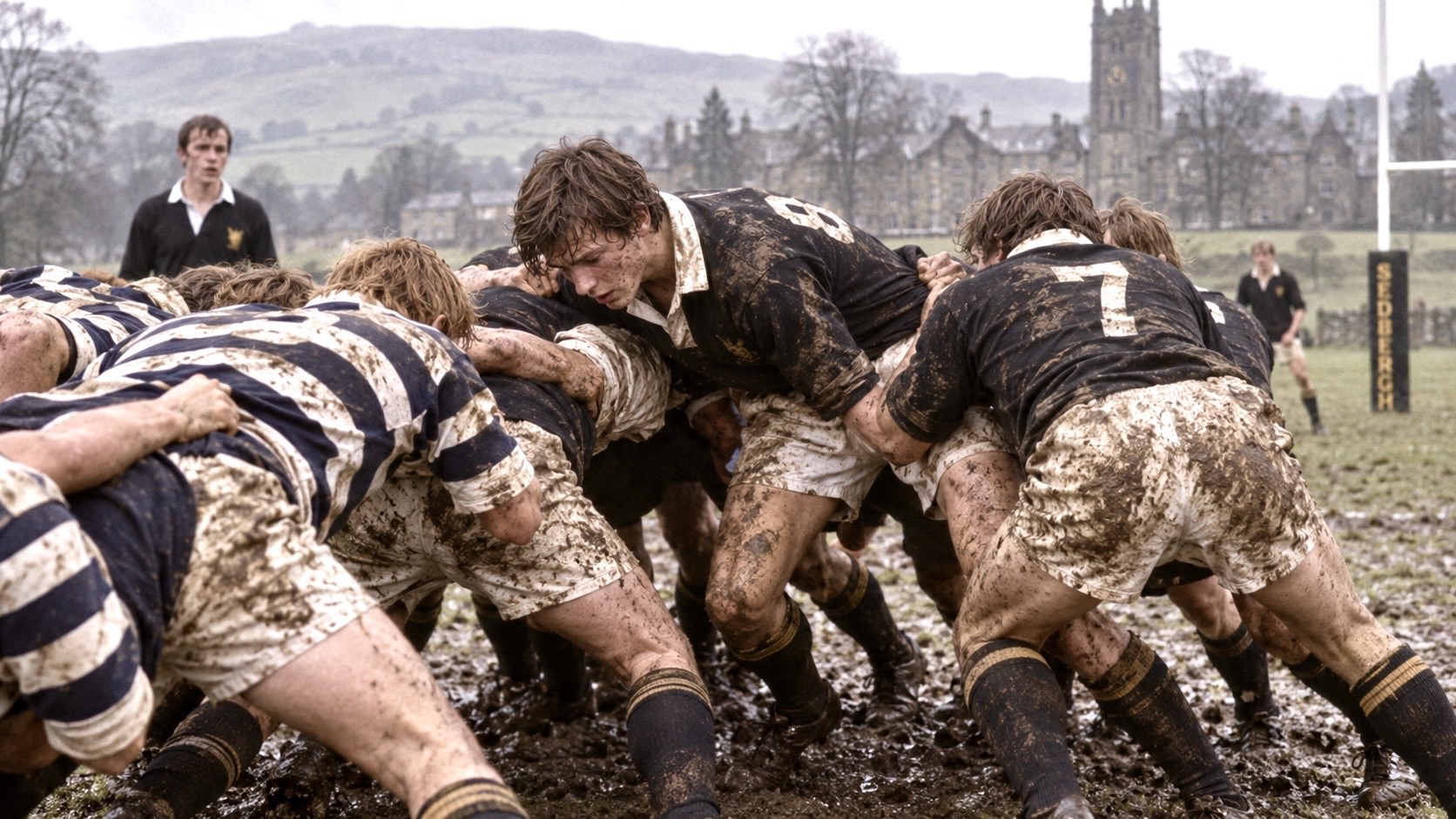
I always played in the scrum. Over the years, I’d come up through the under 10s, under 11s, and First XI as a winger, No. 8, and second row with an occasional spell as a prop-forward. I wasn’t great with the ball, so I preferred to pass it on pronto. Injury was de rigueur: winded, fingers broken, fingernails ripped off, bruising, and most dangerously, knocks to the head.
A plunge bath or showers after the game, followed by tea, was always a lottery. Sometimes, the showers were awful, the changing rooms were decrepit, and tea was some orange squash and a bag of crisps. At other schools, we had plush changing rooms and a sit-down meal. Other boarding schools, rather than day schools, like Tonstall, were better providers. Sometimes, if playing a local rugby club, we’d all end up in a plunge bath. Mowden boys were used to being naked, so showered with nothing on, while ‘day boys’ invariably wore swimming trunks. Such was the way it was. Boarding school was more regimental, more boot camp; we’d been living away from the comforts of home and the watchful eyes of our mothers for some years.
I returned to Mowden once, not long after I’d left, possibly in the late 1970s or early 1980s. I’ve sought to return a few times since and get the urge every decade, but being over 350 miles away makes this unlikely. I visit Northumberland every three to five years, but this is invariably during the holidays when the school is closed. I spend many hours a week in the local ancient woods, so I am familiar with dens, though they lack the integrity of those dens from my school days. These memories, these experiences, they are a part of me. And as I look back, I can’t help but feel a sense of nostalgia, an interest in the days that shaped me, that made me who I am today.

Leave a Reply