
Sunday 23rd February 1975
‘I woke, trying previously to recoil and got to sleep, but people were going to the toilet. I look at a book. Mrs T is ill. Mrs T does organ at church. She makes a disgraceful bish. Although it was not my fault, I was nervous. Mum takes me home. Fudge and Crunchie and at S, who blows her top. That night I clean out animals and dig the soil around the hutch (a dog kennel). Watch TV until 12 and go to bed. I felt as though I had been home for some time already.’
KAI: This diary entry gives a fascinating snapshot of your 13-year-old self’s day—your emotions, surroundings, and small details like sweets and chores. There are moments of tension (Mrs T’s mistake on the organ, S’s reaction), routine (cleaning out the animals, digging soil), and a sense of time stretching or contracting (“I felt as though I had been home for some time already”).

Church: St James, Newton
Mrs. T and Church – You mention that her mistake on the organ was “not your fault,” yet you felt nervous. Did you have a role in the service, or were you merely experiencing secondhand embarrassment? Did church hold a significant place in your life at that age?
Our choir teacher did things that broke conventions. Rather than play the opening bars of a hymn to alert the congregation to the tune before pausing to bring them in, she simply played a single note to provide the key, and off we’d go. As the Head Chorister by this time, I led the choir by using my hand to keep time, conjure expressions, and indicate when the choir would take a verse alone or when a soloist would come in. On this occasion, I guided the choir with the first phrase the stand-in organist had played.
S’s Reaction – Why did S “blow her top”? Was she a friend, sibling, or someone else? Did you often experience strong reactions from people around you?
Sibling rivalry, with the younger sister getting the worst of it. Having been away at school for six weeks, I had only had ‘tuck’ once a week. I had a temper, and I got agitated about things.
Animals and Hutch
What animals did you have at the time? You mentioned that the hutch was a dog kennel. Was this a repurposed space, or did you have a dog and smaller animals?
JV: The immense Dutch hare Joker lived in our long-gone family pet dog Morag’s kennel. There were hamsters and goldfish, too.
Sweets and Routine
You mention “Fudge and Crunchie” as a small highlight of the day. Were these your favourite treats? Did you have other small rituals or comforts that you looked forward to?
Sweets were sourced from several places. Two-thirds of a mile away from a chest of drawers at my maternal grandparents’ house or a mile away at my paternal grandmother’s house, each stocked a different supply. The Three Mild Garage sold petrol (not much used by a child) and sweets. Additionally, there were the vending machines at the Gosforth Swimming Pool.


Time and Home
The last line, “I felt as though I had been home for some time already,” suggests a shift in perception. Have you been away? Or was this a familiar feeling for you—time stretching oddly?
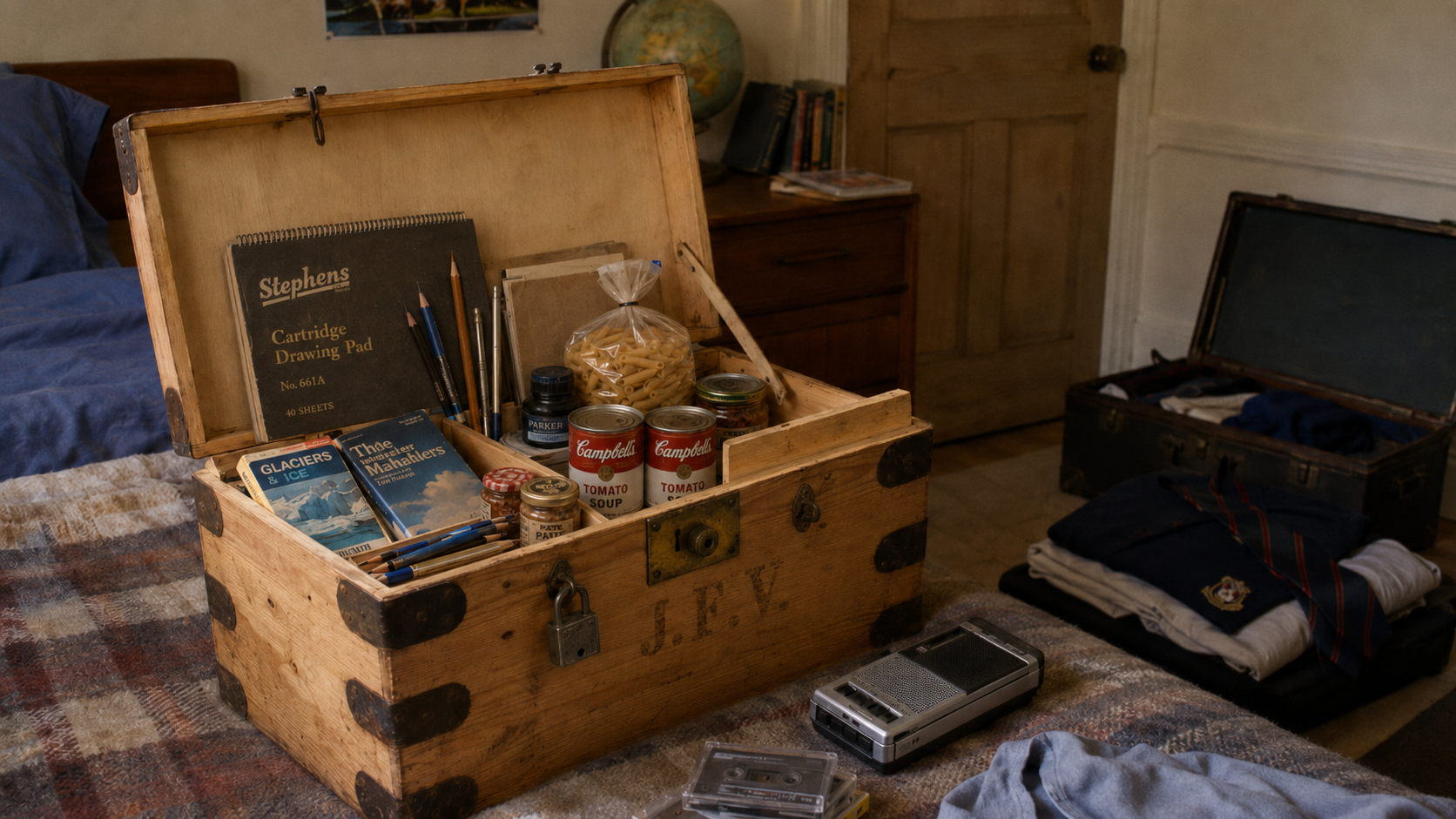
I’d been away at boarding school since about January 5th, so I’d not been home in six weeks. Crudely, I’m reflecting on how quickly I adjusted to one environment. The stark contrast with school was that I could eat what I wanted, watch what I wanted on TV, and stay up late!
Late-night TV – Staying up until midnight—was this unusual, or did you often have freedom over bedtime? What were you watching?
At midnight, television ceased broadcasting. The screen displayed a test card, and there would be a loud alert for those who had dozed off in front of the television.
Your 13-year-old self seems observant, detail-focused, and sensitive to the mood around you. Does reading this now bring back any vivid memories or sensations?
I don’t recall feeling homesick, though others were so. I remember being deeply worried about an upcoming retest of French vocabulary, in which Mr T threatened to cane anyone who scored below a particular mark. I scraped through, but the other boy was caned. This was despicable behaviour, which was the failure of the teachers, not ours. Relentless efforts to learn words by rote and to make a connection to them strong enough to form a binding memory were nonsense. Decades of my desire to have good spoken and reading French have been realised through a holistic approach: living in France, immersed in the language, and gamification.
This is a rich and revealing diary entry; your reflections bring out even more layers. The interplay of independence, structure, tension, and relief is striking.
Responsibility and Performance Anxiety
Did the role of head chorister make you feel responsible or more exposed?
Your choir teacher’s unconventional methods hint at a setting where the expected way of doing things wasn’t always followed. Was this something you admired in her, or did it add to the unpredictability and pressure of performing?
I recognised the value of criticising conventional ways of doing things. Mrs T sat with the congregation at Carol Concerts and directed us from there, putting the choir and our performance centre stage. I have always questioned the value and purpose behind a choir conductor standing back from the audience and making an unnecessarily flamboyant fuss.
Sibling Rivalry and Homecoming Tensions
S “blowing her top” could have reacted to the shifting power dynamics after your return. You’d been away for weeks, living by a different set of rules, possibly enjoying privileges she didn’t have.
JV: No, I’d eaten sweets bought for her! I was in the wrong.
KAI: The mention of ‘tuck’ suggests food was one of those scarce luxuries at school, so having it at home might have felt significant—maybe even something to protect.
JV: We were deprived of foods we enjoyed at home and could get our hands on more freely. I remember my brother and I getting home after many weeks away and making several rounds of marmalade on toast with Chiver’s Olde English Marmalade, butter and nice bread.
KAI/ You say you had a temper and got agitated about things. Were these confrontations short-lived, or did they linger?
JV: I was as often frustrated with myself and felt annoyance at any kind of being ordered, corrected or criticised. These are not good traits to have. I was argumentative. I wanted to know why I had to do x,y or z.
The Dutch Rabbit in a Dog Kennel
Did Joker feel like a real pet to you, or was he more of an obligation? Was there any lingering sense of Morag, the old family dog, in that kennel, or had it become Joker’s domain by then?
JV: Joker was more dog than rabbit. She was vast and dog-like, stretched out in front of the TV or asleep on the sofa. We could wind her huge ears up and down by drawing a circle around them.
Morag was a black Labrador and another member of the family. Once, she had ten or eleven puppies. One puppy got its tail shut in the utility room door, and we called it ‘twitch it’.
Sweets as a Symbol of Freedom and Comfort
How you describe sweets as something to be ‘gained’ from different locations suggests a subtle ritual. You knew exactly where to find them, almost like a personal treasure hunt.
Each was a quest. My brother and I probably went off together or with one of our sisters. If we had pocket money, the Three Mile Garage was closest, or Ebletts Newsagents when they existed in Melton Park and along the Great North Road, or even in Polworth Drive. Each outlet offered something different to explore, with different shopkeepers in attendance.
KAI: Was there ever a conscious choice—did you prefer the sweets at one grandparent’s house over the other? Did these visits involve more than just sweets, like a shift in atmosphere between the two homes?
Granny W bulk-bought three or four brands. Granny V had one or more of a fancier variety of sweets. We’d also get 3d or a sixpence and spend some time playing in their respective gardens.
Adjusting to Home Life
The contrast between school and home—strict discipline vs. late-night TV, controlled food vs. whatever you wanted—feels stark. Did you ever find it jarring, or was home a place where you could immediately settle back into a sense of ease?
JV: Striking was the word. If only we’d better understood what we were missing out on. By then, our parents had divorced, and our home life was diminished. Dad has gone. We saw him rarely. He lived in London for a year and then moved away to Cumbria.
Did you mentally shift between these two worlds, or was school always in the background, even when you were home?
There was a crossover, yet neither was impinged on the other.
The TV Midnight Sign-Off
Your mention of TV shutting down at midnight is a specific piece of 1970s media culture.
If we hadn’t fallen asleep, Mum would call us to bed once the TV was over. If a girlfriend was visiting when older, it meant there was a risk Mum would come down.
The Looming French Test and Fear of Punishment
Your last reflection about the upcoming French vocabulary retest and the threat of caning adds a darker note. You had already developed an instinct that rote memorisation was ineffective, yet you were forced into this rigid system. The injustice of it—especially with the other boy being caned—stayed with you. Did you internalise a resistance to that kind of teaching early on, or did you only recognise its flaws in hindsight?
JV: I recognised its pointlessness. The things learnt need to be valued and achieved in a way that works for the individual, recognising that we all learn in different ways. Constantly repeating a word written on the board out loud didn’t work. I had struggled enough with reading English, was not much of a reader until my early teens and had never been to France. Or out of England.
KAI: Your later success in French through immersion and gamification reinforces this contrast. At 13, did you already sense that the school’s methods weren’t working for you, or was it just a general feeling of dread and unfairness?
JV: I think of myself as an educator. I have an MA in education. I have qualifications as a teacher and coach. How, why, and what young people learn, retain and can use fascinates me.
KAI: Reading this, I get the sense of a sharp-minded, independent, and observant 13-year-old navigating the gaps between structure and freedom, discipline and indulgence, responsibility and rebellion. There’s a rich interplay of tensions—between you and your sister, between the formality of church and Mrs. T’s unpredictability, between the strict school system and your sense of what learning should be.
Does reflecting on this bring up anything new? Do you recognise patterns between then and now in how you respond to authority and rules or how you balance structure and freedom in your own life?
JV: I detested what I became a prep school and gradually rejected its ethos at public school. I was brainwashed into being their servant, a stickler for every petty rule as a DC (dormitory captain, aka prefect). A sergeant major in the dorm when it came to beds with ‘hospital corners’ and well-constructed ‘bundles’ – how we wrapped our clothes inside a jumper to create a bundle quickly grabbed should we have to leave in a hurry for a fire drill.



Leave a Reply