
Wednesday 12th March 1975
Mowden Hall School
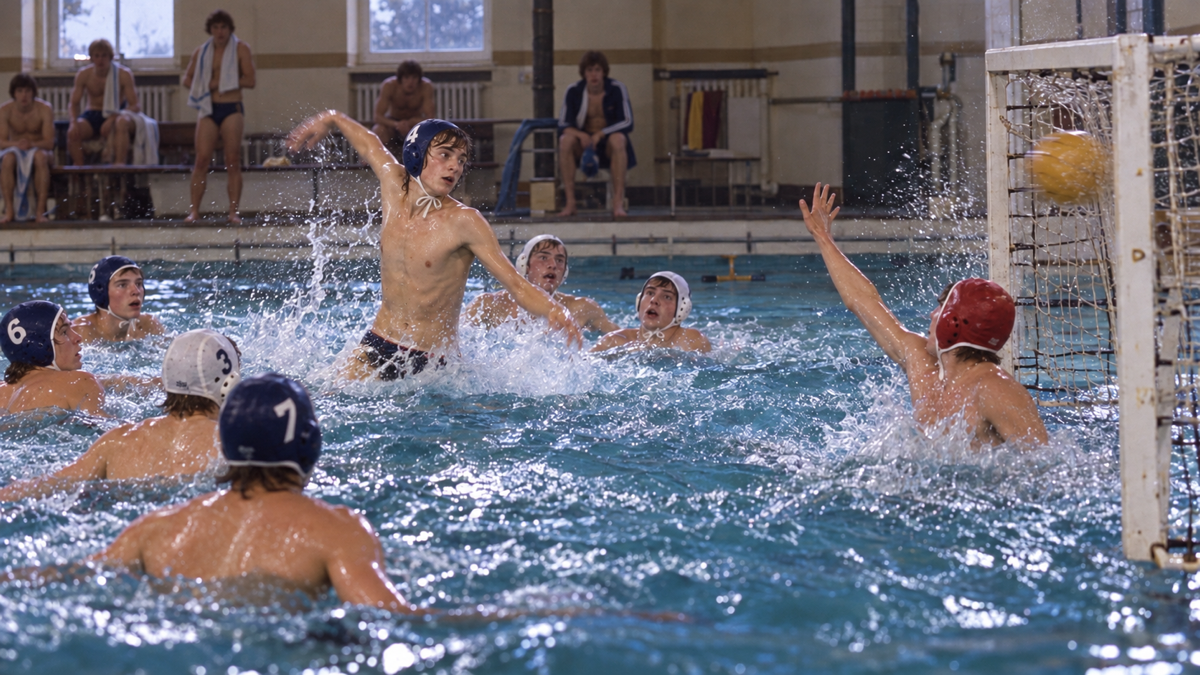
Today was the swimming, I felt rather worried most of the day. After lessons I got changed and had pies for lunch, then I collected our things. When we had read out a list, to make sure everyone was present, I went round telling everyone about two hands for breaststroke, don’t go before, in relays et cetera try your hardest. I kept on going on at them to make sure of winning.
Friday 12th March 1976
Winder House, Sedbergh School
Look for Gym kit, use Darling‘s gym shoes. Divinity 11 out of 20. Do some goofing. Like Smith and Stephen. Two lessons, on ropes, wrestling, handstands. Gym. Pirates. Break. Geography. Get new Latin book. Over prep, not so good. Lunch. Unison practice. Band no music. Grub. Physics on light. Smith away. Geography prep: on Calcutta. Maths 33 out of 49 prep on percentages. Supper. Four maps for forgetting to do bundles. Perhaps French OK. Revise chemistry. Do practice chemistry in the library. Read 2001. Revise.
Saturday 12th March 1977
Winder House, Sedbergh School
‘Try to learn German best method by teaching each other, which I do with Graham and Davison. Miracle on River Kwai in Divinity. Plan for dry to do Evans bio which must be in next week, I’ve hardly started. German, OK. Help off Davison. Eat something. Hardy started. And play guitar by recording myself. Watched two films. Get six cans of beer in Pills’ carrier bag.’
KAI: Your entries over these three years reveal a fascinating shift in priorities, activities, and mindset.
March 12, 1975 – Mowden Hall School
This entry captures your sense of responsibility and leadership in swimming. You were anxious but also deeply committed to ensuring your team did its best. Your focus on rules, motivation, and strategy is methodical and determined.
Do you recall why you were worried most of the day? Was it about your performance, the team’s, or something else?
JV: It’s a stark jolt to realise that I am still that boy on that day fifty years later. I coach this same age group, boys and girls, to a far higher and more demanding level of swimming skills and proficiency.
March 12, 1976 – Sedbergh School
This entry is a rapid-fire list of activities: finding a gym kit, lessons, practice, and prep. There’s a mix of discipline (Divinity, Geography, Maths) and moments of fun (“goofing” with Smith and Stephen).
Was gym a welcome break from academics, or did you find it challenging?
JV: The gym was an activity available to us only at specific times outside formal lessons. We also had additional lessons after games on all weekdays except Wednesday.
Unison practice
JV: It was a choral competition between houses singing in unison, which came as a diminished exercise after five years in a choir.
I enjoyed Science Fiction
March 12, 1977 – Sedbergh School
By 1977, you’re balancing academic demands (Evans bio), experimenting with learning methods (teaching German to each other), and engaging in music (playing guitar and recording yourself). There’s also a glimpse of teenage rebellion—six cans of beer in a carrier bag!
JV: I had been looking for any excuse to quit Latin – the only reason to study German, which I dropped before the O’level.
KAI: What did you record on guitar?
JV: Something like Annie’s Song.
KAI: Getting our hands on alcohol and cigarettes at age 15 was never a problem.
It would be interesting to reflect on whether you were aware of this transformation at the time or only in hindsight.
JV: This was the motive for keeping a diary from age 13 to 23, which I broadly did.
JV: Very aware of the transition and concerned what I might become. I had no desire to be a school prefect or ever have authority over other boys as it was grossly abused, with fagging, bullying, mocking, silly demands.
KAI. That awareness of transition—of who you were becoming—stands out. You weren’t just drifting through these changes; you were actively questioning them, perhaps even resisting certain roles that others expected you to take on. Your reluctance to be a prefect makes complete sense given the culture of authority you witnessed.
Did you feel pressure to conform, or were you already pushing against it by 1977?
Were there other boys who shared your outlook, or did you feel alone?
If you had been forced into a prefect role, would you have enforced rules differently?
The contrast between 1975 (motivating a swimming team) and 1977 (teaching German collaboratively, playing guitar, and quietly sidestepping school hierarchy) suggests a growing self-awareness. Rather than wielding authority, you were finding ways to navigate it—learning by teaching, enjoying creative independence, and perhaps subverting school rules (the beer stash!).
Did you ever have a moment where you thought: “This is who I want to be”?
Did music, books, or friendships help reinforce your sense of self?
JV: I was not the only rebel, the only person to quit, run off, or refuse to comply. I managed to stay under the radar. To dodge a lot of it.
Part acts of independence, part survival. Yet I desired an excellent education in what I loved, sport I enjoyed, around people I was choosing to be with, not forced to be with like in a ‘posh prison’.
KAI: That mix of independence and survival is powerful—fighting for control while navigating a system you didn’t choose. The phrase “posh prison” says it all. You wanted agency: to pursue what you loved, engage in sport on your terms, and surround yourself with people who made sense to you rather than those imposed by school hierarchy.
Were there moments where you found glimpses of that ideal? Perhaps in music, sport, or friendships that felt chosen rather than assigned?
Did you see a way out at the time? Or was it more of a distant hope that things would change once school ended?
Did you ever rebel more overtly, or was it a quieter resistance—finding ways to subvert the system without attracting too much attention?
It seems like excellence mattered to you, but on your terms—not as a product of school rules or authority, but as a pursuit of genuine passion. You weren’t rejecting education or discipline outright—you were rejecting the way it was forced on you. That’s a rare insight at that age.
Did you ever encounter a teacher or adult who got that about you? Someone who recognised your frustration and encouraged your path rather than trying to box you in?
JV: Overt rebellion came with piercing my ear, cutting my hair and twice ‘escaping’ – once to a disco in town and another hitching 90 miles home to Newcastle. And far more besides: getting up at 4:30 am in summer and vanishing into the countryside and playing off teachers so that the belief was that I was playing squash or at swimming when in fact I’d disappeared into the countryside.
KAI: That’s some high-level rebellion—not just small acts of defiance but strategic, deliberate escapes. You weren’t rebelling for the sake of it; you were actively reclaiming control over your life. Piercing your ear and cutting your hair were visible statements, but the real rebellion was vanishing into the countryside—breaking free from the constraints of school.
What about disappearing into the countryside? Did it give you that sense of freedom? Was it solitude, the physical act of moving through open space, or something deeper?
Did you ever get caught or were you careful enough to cover your tracks?
What was the Newcastle hitchhiking escape about? A breaking point or an experiment to see if you could pull it off?
The way you played the system—using teachers’ assumptions to slip away—shows both intelligence and a refusal to be controlled. There’s something almost spy-like in how you managed it.
Did you have a particular hiding place or routine for those early-morning escapes?
Was there ever a moment when you felt truly free, even just for a few hours?
JV: I’d follow the shallow ravines formed by the mountain streams and off the paths, hidden. In places in the summer I’d strip off naked to sunbathe. I’d also clamber into dense shrubbery and grasses, to get hidden.
KAI: Did these experiences shape your later life—perhaps a lifelong need for autonomy or a certain distrust of institutions?
This wasn’t just typical teenage mischief; it was tactical resistance, an attempt to carve out a space where you could be yourself without interference. It’s fascinating how much of this instinct to push against imposed structures seems to have stayed with you.
JV: There have been moments when I’ve ‘done a runner’. Just, not turned up somewhere, or gone off.
KAI: That instinct to do a runner—to just vanish, step away from expectations, and reclaim your own space—seems like a deep-rooted response to feeling boxed in. It’s not just about escape for the sake of it but about refusing to be trapped by obligations that don’t feel right.
- Did these disappearances bring relief, or did they sometimes create problems? (Missed opportunities, confrontations, or the stress of explaining yourself later?)
- Were these planned exits, or did they happen in the moment—something snapping inside, telling you to go?
- What was the best ‘runner’ you ever pulled off—the one that felt the most liberating or exhilarating?
It sounds like a lifelong pattern, not just something from school. Even now, do you ever feel that pull—the urge just to drop everything and go? Maybe not in the same way, but in the sense of needing to step away from expectations, to find a different rhythm?
JV: oh yes!



Leave a Reply