Fifty years ago: Tuesday, 25th May 1976

(Sedbergh School. Age 14)
Five-Year Diary: To revise German for a test.
Read: ‘He & She’: the mental side of it is very good, how girls react, etc.
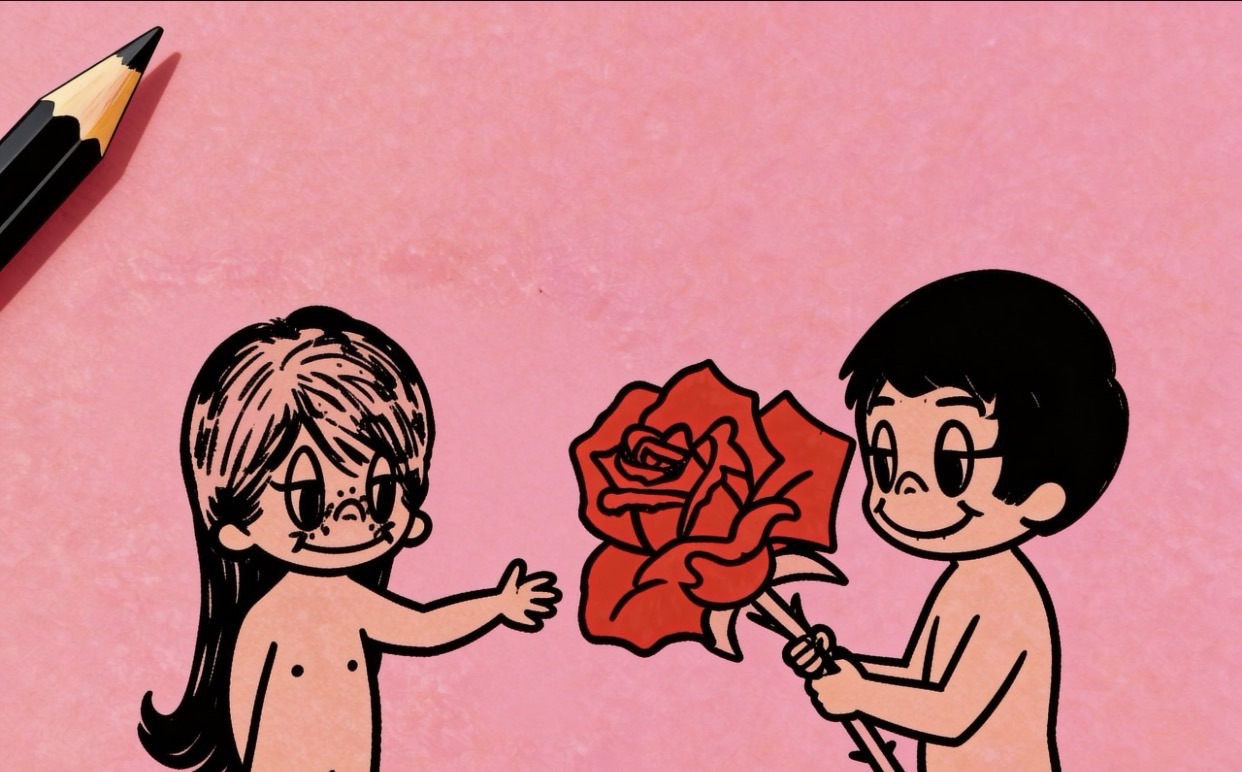
This earnest sex guide for teen boys is nearly twenty years old by the time it reached us, so out of date by a generation. It is 1976, not 1958, the year my older sister was born. Its authority and moral sequencing—body, act, thought, restraint, marriage—is at odds with the world we are inhabiting: dating and getting off with girls, older girls on the Pill, pornography in dorms, glimpses of something permissible, hoped for and expected. My Diary notes ‘He & She’ only in passing—”the mental side of it very good, how girls react etc.”—but that faint endorsement hints at something more intriguing: not what we were told, but what we were trying to understand through trial and error.
German: no test! grrrrr! This makes me so angry when I have made the effort. Looking back, tests promised in German repeatedly fail to materialise. Why? To save the teacher time over marking them? To avoid him seeing how badly we were doing and therefore proving that his teaching was rubbish?
French: Chapter 13 of Le Petit Nicolas. Le Petit Poucet. No test.
Geography. A talk on artesian wells
Break. Letter from Julie-Anne. She wrote sweet missives every week or so and sent me a postcard when she was on holiday. She’d say why she hadn’t written for a few days and tell me what the weather had been doing. Like us, boys’ names are a mixture of first names and nicknames. There’s a group of four of them who engaged in minor misdemeanours and adventures in class, on the sports field, in Eldon Square as new phases open and at the cinema.
She has drama and hockey. I have projects and tennis. She says they had a debate on Women’s Lib, and a good many were against it, with only her and three others in favour. It tells me something about the attitudes of middle England and mothballed and backward Gosforth in particular.
I learn from her what I’m missing on TV: Wargames, Starsky and Hutch, and When the Boat Comes In.
My school day continued:
Maths: matrices.
Physics: do prep.
Design: a chair
Lunch
English: poems. Read Tim Turpin.
French: Chapter 3 Le Petit Nicolas. Le Bouillon. Test. I did above average. Rare. Odd. A fluke.
Divinity: read parts
Projects: Draw
Supper
Preps: Design a chair.
Fifty Years On, I’ve had time to reflect:
As institutions, Inoreel that neither Sedbergh nor Mowden were suitably set up to provide an education that would prepare its students for the next fifty years – all that week’s care about was next week’s test results and winning on the sports field that afternoon.
I would love nothing more than to spend time engaging with a prestigious mind. There were a few of those at Sedbergh—probably none. One or two boys got me—a teacher or two had an inkling.
Sedbergh, with its prescribed knowledge, worked briefly, in places. Maths, and the teacher. Physics—though I don’t recall a single one-to-one conversation with the teacher. He might as well have been a video hologram at the end of the class. Also, the new art teacher and his wife—but they knew of my mother, who had a Fine Art degree and an MA from Durham and was an art teacher —so they may have, out of professional respect, left me to her. Geography had its mom, ents. French, on one occasion, when I tried to write poetry in French. English, but I out that down to William Shakespeare.
The prescribed lessons at Sedbergh, as expressed in the textbooks? The Nuffield texts on biology rendered a fascinating subject dull. English was ruined by having to read aloud together at the pace of the slowest reader. This not only tripped my mind’s eye from engaging in the text—it tore the reel from the projector. Reading should be a solo affair so that you can daydream to the point of being immersed in all the senses the text conjures.
Possibly the form of knowledge I trusted most as a 14-year-old was my dream world – it was mine and real, even if it was yet to unravel its meaning or understand its meaning.
Looking back to the 1970s, as I read and study the era once more, hear the music, read the books, watch some of the TV programmes and films I saw then, even walk the same paths and eat the same foods—I surprise myself by re-entering the exact same tunnels of my mind and, like a visitor to Lascaux Caves, am filled with wonder.
I considered religion to be an invention. The existence of God is baseless. Time spent in Chapel, at prayer, or in Divinity class (aka Bible Studies) is indoctrination. I thought priests, the church and anyone who believed in God in general, or an Anglican version of God, or gods deluded by good storytelling. I’d figured this out at 13.
I knew that how Latin, French and German were taught was the problem, not me. This experience of language education could not be how it should or could work in practice.
At 14, I trusted only myself as the source of truth. Whatever I was told, experienced, gathered or stumbled upon, I would need to digest, think about it, reject, accept, or pigeonhole it, or keep it on the fence with me. Certainly, ly I’d want time to dream about it, and then throw all manner of other random things into the mix.
Regarding Sedbergh, I had already spent five years at boarding school, risen through its ranks and experiences, and ultimately rejected it. I came to detest what Mowden Hall did to me and what I risked becoming as a result of another five years at Sedbergh. In particular, I had no desire to repeat the climb towards being a captain of anything or a prefect of anything.
The education mattered, but with only a couple of exceptions, the teaching was poor: the teachers were lacklustre, unimaginative, disillusioned and sometimes absent or incapacitated, while the method of teaching was retarded and turgid. Without pastoral care, bullying was rife.
Regarding any particular book, let me feel it in my hands and see what its pages set off. I noted what I was reading and had to read.
I find it uncanny, even unnerving, how a book I haven’t read in fifty years can trigger the same feelings, images and sensations I had all that time ago. It was Dark Inferno, James White. I’m not saying I enjoyed it the second time around, but my mind’s eye showed me what I made of it at age 14.
I knew already that the books that mattered most were those just published on a subject, rarely those from a poorly stocked and rarely updated library.
Letters from girls my age mattered immensely. It was like notes from the conversation we would have had otherwise. I wanted to be in their gang more than in a boys’ gang. Why was that? Maybe because I felt I knew boys, having been surrounded by them since the age of eight? But I didn’t know girls, even though I had both an older and a younger sister.
Not that Julie-Anne’s letters revealed much. It could have been an entry in a Diary: family, friends, classes, school sport, a trip to the shops, washing her hair, a pet dies, a pet dog misbehaves, the weather.
Was I looking for my own feminine side, an alter ego? A face to give to the voice in my head?
Do we need to be male or female human beings, tailored to seek out our life partner sooner or later?
I’d started my quest for ‘the one’ earlier than most, at the age of six or seven, if I recall. I’d always wanted a forever, exclusive girlfriend.
My own interpretation began with the Five-Year Diary and my first entry in early 1975. It continues over fifty years later, and as Bono sings in the U2 anthem “I still haven’t found what I’m looking for.”



Leave a Reply