The Scene: Hedgehope House Disco

A long, echoing hall with parquet floors and strings of fairy lights drooping like tired tinsel. Parents sip sherry on one side. Girls in long dresses and neat jackets hover like curious satellites. India walks in as if the music already belongs to her.
Robbie, still sore from his brace removal and unsure what kind of man he’s supposed to become, sees India—and forgets the entire purpose of the party.
India Armstrong-Jones dances like she’s not performing for anyone but with the music. It’s punk, it’s Bowie, it’s rhythm dancing with claws. Robbie drifts toward her. They move together like sparks.
The previous summer, she’d been expelled from Bedales for stealing the housemaster’s car to drive to Plymouth for a Blondie concert.
Frustrated, her mother transferred her life and education responsibility to her father, who balanced his relationships while managing his regular job in Newcastle. He thought he could enrol his daughter at Eastfield Girls School in the town, provide her with an allowance, and expect the housekeeper to keep an eye on her. She’ll spend most of her holidays with her Mother in London.
In May 1977, it was Blondie; in June 1978, she skipped school in Newcastle to attend a David Bowie concert in Norway. That’s a story for another time. I need to keep her grounded in the Northeast for a week.
She moved like she knew what she was doing. I didn’t. I followed her every mouth. Circled and gyrated to Bowie’s ‘Rebel Rebel’ and then ‘Jean Jeanie’.
“India as a rule-breaker among rule-breakers,” said Kizzy.
The dart landed on India, daughter of a prominent figure from Newcastle. Her mother, a socialite from West London, couldn’t cope with Newcastle’s stifling atmosphere and left. The children drifted between boarding school and their separate parents’ homes, causing their connections to unravel. Boarding school became either a sanctuary or a prison, reflecting their family’s disintegration while providing a link to what it represented. As teenagers, they rebelled if they found no comfort in these institutions or the people around them. After 1976, rebellion embraced punk, David Bowie, Roxy Music, Ian Dury and the Blockheads, culminating in 1978 with the Undertones’ ‘Teenage Kicks.’
India and Robbie felt adrift. India, required to spend a few weeks of each holiday with her mother in London, would have preferred to have stayed in West London with her mother.
India digs in her heels. Like Robbie, she wants out. She desires a home life and a routine that includes friends she sees during the term- whether in school or outside- and those she meets on weekends and holidays. Her plans were aided by the fact that she had been expelled from Beadales the previous summer for borrowing the headmaster’s car to get to a Blondie concert in Plymouth.
In the fresh flush of Spring 1978, Robbie was already plotting his escape from boarding school, breaking out, and newly enrolled at the Youth Theatre. A new world opened up before him, while Fen seemed even more claustrophobic than before.
A Christian Disco for teens in 1978 was doomed to fail.
The idea that teens, boys in tweed Jackets and girls in long skirts, would find any joy in a party that looked like it had been organised by the Chaplain and his wife from their respective boarding schools is ridiculous.
Robbie turned up, already getting his toes wet in rugby club discos and youth theatre improvisations. This party reminds him of the assembly hall at school.
He’s feeling hungover around the edges, unable to dress appropriately, and hints of punk and Bowie are written all over him; his hair is the first signal of trouble. A stud in his ear is a possibility. The alignment of Robbie and India is inevitable.
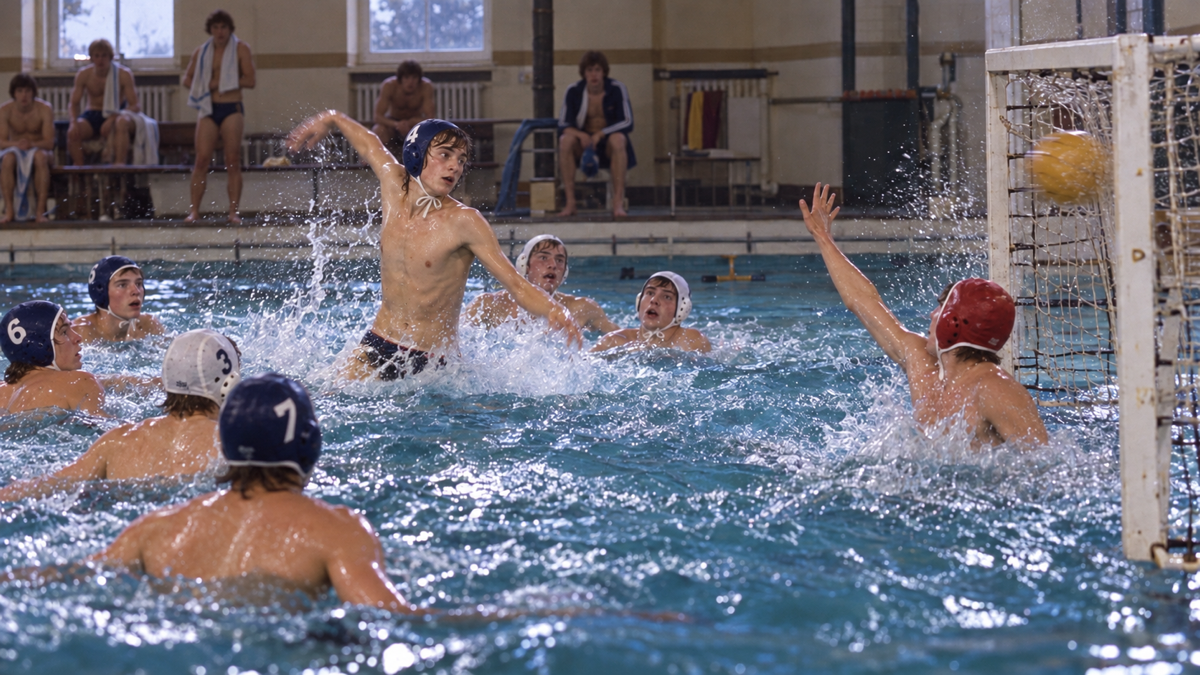
India is the only girl in trousers, and these trousers accentuate all the parts that might attract a hot-blooded male. Robbie is partly surrounded by boys who know him; he could pick them all from a picture from the Choristers at Prep School, 1974, or the School Swimming Team, 1972. The boys lingering around the edges of the dance floor are his contemporaries from his year, the year above, or the year below.
For some, Robbie, three or four years later, is a reinvention. The Head Chorister, Captain of the Swimming, is cutting his strings and asserting independence in a way they find impossible. Robbie can do this because, like in India, his parents separated and divorced. The myth has been fractured; the rules previously set by either parent are no longer applicable because both ‘live in sin’ with a girlfriend or boyfriend who stays over. The parents feel that the rules they followed are no longer relevant. The very same freedoms they are enjoying are ones that their children can, should, and might also have. And why not?
The Form Photo and the darts represent how two teens make themselves known.
How do Robbie and India realise that they are different from all the other young men and women at this event? What prevents other boys from approaching her? Are they intimidated by the girl in the red trousers? Do they recognise that wearing a tweed jacket, an open-necked shirt, and a cravat looks off-putting?
They have dressed like their father for a round of golf. India feels she is dancing with an uncle, not a boy her age. In contrast, Robbie is dressed differently. It’s a mess; he needs a costume designer to coordinate his look. The flamboyant Marc Bolan shirt with long sleeves from the Kard Bar in the Arcade in Newcastle screams Woodstock, while the denim jacket, though dated, is preferable to tweed. The cowboy boots and drainpipe black trousers help. India is surprised at his presence.
She recalls him; she remembers Robbie. Her younger brother was in his dorm. He likely won’t remember that. He looked up to Robbie. Is he still looking up to him now? A few wish they’d had the nerve to do something similar.
Seeing Robbie and India clash like Ali and Foreman would create quite a show. They weren’t entirely on their own for “Rebel Rebel” and “Jean Genie,” but once they began, their hips synced, their flow matched, and the DJ from Morpeth felt it would be more entertaining to cater to their tastes than to stick to the safe playlist provided by Mrs Trevelyan.
Robbie could have stopped there, and Kizzy would have been content.
The dance, the laughter, and the kiss- the kiss gained over a cigarette outside. She smoked; he did not, and he wasn’t going to admit that. He would play into her hands. He could see her mentally checking him off: how many boxes did he tick? For her, this one was as close as it would get to one of the boys from London. He’d do.
Mutterings of ‘disgraceful’ and even ‘disgusting’ greeted Robbie and India after a particularly raunchy, close-proximity dance. What was the tune? Some parents were having words with the DJ – no more of that.
They wondered if all the whisperings were about ‘that’s what we wanted to avoid,’ ‘You’re not going to behave like that,’ and so on, considering that for most of the boys and girls present, there was a parent, especially a mother, keeping an eye on them. Robbie could provide a list if Fenella wanted reasons why her friends were not enjoying the party and why she wasn’t enjoying it either. He might seem like a two-timing tosser, but he wanted to dance with Fen- any dance, not necessarily one like that. However, she was too busy ‘being a host,” and the mothers keeping a watchful eye were enough to put anyone off. Kick out the parents, turn the lights down low, and play the music they listened to in their studies at school. Let them let their hair down. Change out of the skirts. Find some jeans and a T-shirt.
After that, Robbie understood his trajectory. He reported back to Kizzy, checking all the boxes, but no details were necessary. They met charmingly across the dance floor, showcasing their synchronised movements.
- You must speak to her. 🗣️
- You must try to make her laugh. 🤭
- You may kiss her — but only if it feels right. 💋
This was too easy. Speaking to a girl was straightforward. You could ask for the time, inquire whether she had better suggestions for the music being played, or compliment her by highlighting a specific detail. To make her laugh, you had to listen, which was impossible on the dance floor. But once you had her trust, she’d offer all kinds of gems where you could see the funny side: her situation, her siblings, her parents, something on TV, her favourite children’s programmes, and the kiss. If it felt right? It had to feel natural, not stolen. Asked for and given, not planted. Robbie could do that; he was learning. He could hold back. He could create stolen moments. Create drama. He could respond to opportunities.
Others smoked; some of the parents smoked, but she didn’t want to have anything to do with them or be anywhere around them if she could help it. So they wandered off into the rhododendrons. The kiss felt right. But it was also ‘why bother, it’s not going anywhere; I’ll never see you again’ until it turned out to be ‘maybe she will. ‘Bored in wylam for another week, Robbie could come and find out, pass the time of day. And if they stayed in touch, and he was in London? Who knows. Relationships were fluid. She was entirely enamoured with her current boyfriend in Hammersmith.
Robbie didn’t go into details with Kizzy. She was a possible, maybe, a new beginning. Robbie thought it was all about this, like one of those maze or labyrinth games in the back of a Jackie magazine where you have to spot the thread that connects a pair of kickers with a Chopper bike or something similar.
He could see where India was leading him and follow that thread. Kizzy wanted to set many threads a-tremble. He wasn’t just after any girl; he was after ‘the’ girl, the one.


Leave a Reply