
Fifty Years Ago, Wednesday, 21st July 1976
(Appleby Castle, Age 14.9)
I weeded the courtyard and watched the Montreal Olympics in the afternoon and into the night. For the rest of the stay, I earn £5, go to Carlisle with my big sister and the kids.

At first glance it is hardly the stuff of great autobiography. Weeding. Television. A trip to Carlisle. Five pounds earned. Yet fifty years later, I find that almost every phrase opens a door into a much larger world.

The courtyard I weeded was not an ordinary courtyard. It was the great enclosed space at the heart of Appleby Castle. At one end stood the massive Norman keep, already over eight hundred years old when I was pushing a hoe through the gravel. At the other were later additions: the Norman Hall and the seventeenth-century buildings that completed the enclosure. The place had the curious quality of being both immense and intimate. One moment it felt like a private garden; the next, like the centre of a medieval town.

The keep towers above the scene. And there, absurdly, almost comically, sits the swimming pool: a neat rectangle of blue sunk into the green expanse of the lawn.
That swimming pool may have been unique.
How many fourteen-year-old boys have swum lengths in an outdoor pool situated inside the courtyard of a medieval castle?
The pool was only about fifteen metres long. There were no lane ropes, no starting blocks and certainly no pretensions to being a serious training facility. Yet for a swimmer it was irresistible. The water was heated by a wonderfully improvised solar system. Water was pumped onto the roof, circulated through black sheets of rubber and plastic exposed to the sun, and then returned slightly warmer than before. Primitive solar power, decades before environmental consciousness entered the mainstream.
As I weeded, I was surrounded by history. Yet what occupied my mind was not the thirteenth century but Montreal.
The Olympics dominated that summer.
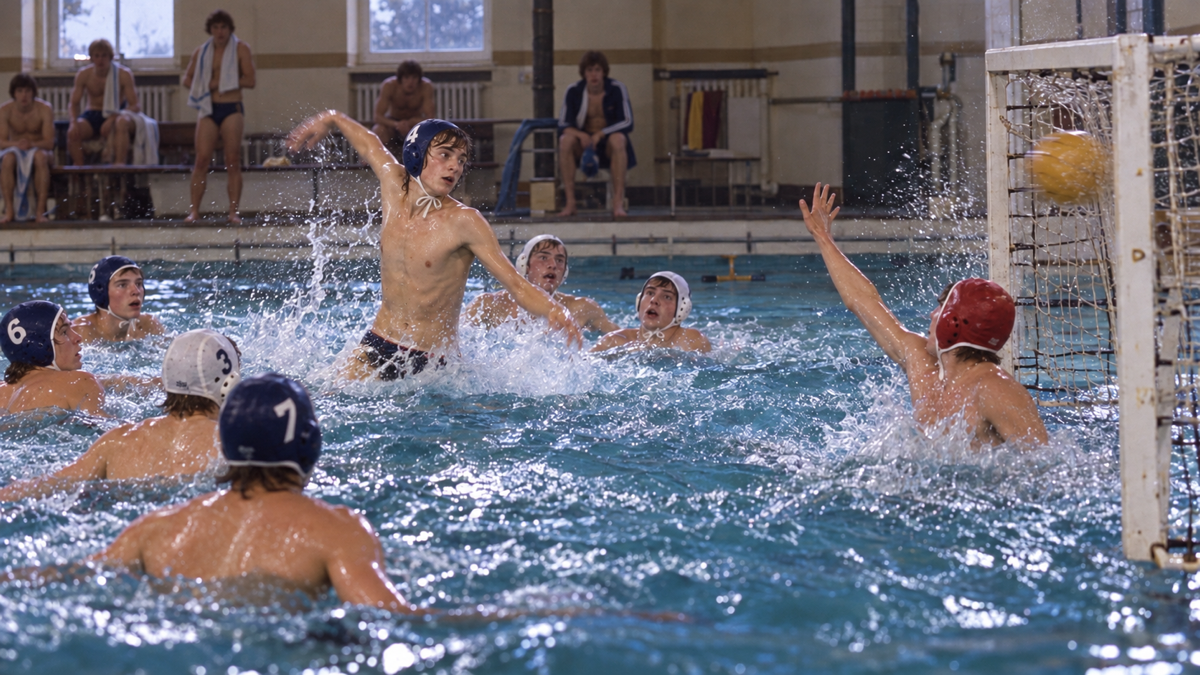
I watched the swimming first and foremost. I watched everything else too, but swimming was my sport and therefore my lens on the Games. The Americans seemed almost invincible. Their dominance was impressive but also faintly tedious. One wanted competition, uncertainty, drama.
The great revelation was Nadia Comăneci.
Even now I can see her.
Small. Graceful. Smiling. Astonishingly composed. And my age! Despite being so petite she was just six weeks younger than me! Look at me! I’m nowhere near an Olympic title!
The perfect tens became a story that transcended sport. At fourteen I lacked the vocabulary to explain why, but I understood instinctively that I was watching someone extraordinary. Around her clustered other stories: East Germany’s improbable success and the questions people asked about it; the boycott by many African nations; obscure sports such as rifle shooting suddenly appearing on television screens and briefly becoming subjects of national conversation when a woman competing in a male dominated event won.
The Olympics enlarged the world.
For a boy living part of his life in Cumbria and part in Newcastle, they offered glimpses of countries, ideologies and ambitions far beyond my own experience.
And afterwards I would go outside and swim, push off two strokes and turn! But I could imagine the roar of the crowd.
I was realistic enough to know the difference between schoolboy success and world-class performance. But excellence has a way of provoking effort. Watching people do things brilliantly makes one want to do one’s own small thing a little better.
So I swam lengths beneath the walls of a Norman castle.
When written down like that, it sounds entirely invented.
The television itself forms part of the memory. Appleby contained several televisions, each inhabiting its own social world. Dad’s television was in the sitting room of the Barons’ Tower. This was his territory after the divorce. The room was comfortable and slightly melancholy. Antiques. Oil paintings. A stand-up piano. Soft sofas. The accumulated possessions of a man rebuilding a life. The television itself was a small portable colour set. Colour television still retained some magic then. We forget how new it felt. Montreal itself seemed brighter because it arrived in colour.
There were larger televisions elsewhere.
The Great Hall contained one. It was effectively a giant common room capable of accommodating a hundred people. Most of the time it accommodated hardly anyone. There was something wonderfully surreal about sitting alone in a Norman hall, beneath a ceiling two storeys high, watching Olympic coverage on television.
Around the walls were displayed the heraldic emblems of centuries of owners. Generation after generation had left their mark. Earls, nobles, families whose names had once carried power and significance throughout the north of England.
And there I sat, a fourteen-year-old swimmer eating biscuits and watching Nadia Comăneci.
The contrast never struck me then. Children accept their surroundings as normal. There was another television in the old Chapel, by then converted into a sitting room for office staff and guests. Comfortable chairs. Coffee tables. A fireplace. A view down the steep bank towards the River Eden. One could watch the Olympics there too.
The castle itself was unlike any home I had previously known.
Part house and home.
Part business: PLC HQ, Management Training Centre, Rare Breeds Survival Trust , grounds and Castle.
During the week offices functioned. Staff came and went. Guests arrived. Historians appeared. Conference groups occupied rooms. Rare-breed enthusiasts discussed livestock. Visitors wandered through. Domestic staff worked quietly in the background.
Looking back, it resembles less a family home than a self-contained community.
In one curious respect it reminded me of school. There were always people about. Always activity. Always somebody whose role you only vaguely understood. You couldn’t wander about in your PJs or underpants!
My father’s growing rare-breed project was becoming central to all this. At fourteen I regarded it as slightly eccentric. Looking back, I can see it was where his heart truly lay.
Birds. Animals. Conservation. Preservation.
The protection of things that might otherwise disappear. Perhaps there is a parallel there with this diary.
One of the entries around this period mentions a missing swan.
We had mute swans and trumpeter swans living around the flooded moat. Usually they were pinioned to prevent them flying away. One had somehow escaped the procedure and vanished.
I remember a traditional Canadian canoe. I remember the comedy of the situation. I remember paddling in pursuit of a bird that seemed entirely indifferent to our efforts. Perhaps my older brother was with me. In truth that seems more likely than my memory of being alone. Memory often promotes us to starring roles in adventures that were really collaborative efforts.
The swan eventually solved the problem itself. It returned for food, companionship and routine.
Most creatures do.
The trip to Carlisle intrigues me even more.
Who exactly were “the kids”? The most plausible explanation is that they were my younger sisters friends Dorothy and Lois, two girls connected with the castle.
I can reconstruct the day only partially.
Carlisle station. The concourse. The walk into town. The red sandstone castle. Independent shops. The curious feeling that Carlisle was both important and remote. Not quite a city. More than a provincial town – more to it than Appleby, but it wasn’t Newcastle City centre!
A border place with its own identity.
I suspect I bought a book. Or perhaps a record. Possibly even a cassette or two. Stevie Wonder? Peter Gabriel? Anything new from David Bowie?
And then there is the diary itself.
The forgotten five year diary. The absent diary. The diary sitting uselessly in a bedside drawer back in Gosforth while I attempted to reconstruct events a week later.
The irritation remains surprisingly vivid.
I had started keeping a diary after breaking my leg in March 1975. Confined largely to home, I convinced myself that every day was identical and therefore unworthy of recording.
What nonsense.
The older I become, the more convinced I am that ordinary days matter most. The extraordinary days survive regardless.
We remember first kisses.
School prizes.
Bereavements.
Victories.
Disasters.
What vanishes are Tuesday afternoons.
Conversations over tea.
The smell of cut grass.
The programme watched after dinner.
The book half-read before bed.
The texture of ordinary life.
The diary was my attempt to rescue those things.
So when I arrived at Appleby without it, I felt I had failed.
Why I did not simply buy a notebook and continue recording events remains a mystery.
Lack of foresight, perhaps. Or simply youth.
What interests me now is that I explicitly noted the interruption.
The gap itself mattered. I was not merely recording events. I was recording the act of recording. Somewhere, even at fourteen, I had begun writing partly for a future reader.
The future reader turned out to be me.
That thought leads inevitably to Mallorca.
There are entire sections of my adolescence that disappeared because I stopped writing.
Summer 1977 is one such casualty. Without the diary I am left with fragments. A rusty nail through my foot. A game of strip poker with two sisters. My brother and I invariably losing. Nobody progressing beyond their underwear.
Long walks along dusty lanes behind apartment blocks in Paguera. A girl called Christina Or Chloe or Colette?
Even her name blurs.
What remains clear is her presence. Sun-kissed permed hair. The confidence of a girl developing physically slightly faster than the boys around her.
At fourteen I interpreted hips and breasts as evidence of adulthood.
In reality she was my age. We talked endlessly. That is what I remember. Conversation. Stories. Observations. Questions. I could always talk.
Perhaps that was my advantage over my older brother. He may have seemed older, cooler, more sophisticated. But I could tell stories and chat forever.
Did we kiss?
Fifty years later I am no longer entirely sure.
Perhaps we merely held hands. Perhaps the anticipated kiss became merged with the memory of wanting one.
Memory edits. Memory condenses. Memory invents. Yet the emotional truth remains intact.
Then there are the sensory memories. The bullfight in Palma. The restaurant called El Cordoba. Elderly women dressed entirely in black. Middle-aged men sitting in the shade. Franco’s Spain still lingering in the background.
The submarine torpedo arcade machine. Mini golf. Dropping ice cubes from the balcony and aiming for the pool below.
And above all the smells. The smell of Garnier Ambre Solaire. Ideal Bronze. Warm skin after a day in the sun. Salt drying on roads and pavements. Swimming-pool chlorine. The faint odour of drains warming in the heat. Cigarette smoke drifting from a corner bar.
These survive when facts disappear.
As I write this fifty years later, Sussex is enduring the fifth day of the second heatwave of 2026. The air feels Mediterranean. The vegetation is dry. The heat presses against the house from early morning.
And suddenly Majorca returns. Not as narrative. Not as chronology. Not even as memory in the conventional sense. It returns as atmosphere.
This may be the great lesson of diaries and memoirs.
A diary preserves facts. A memoir reconstructs meaning. Memory itself preserves sensations.None is sufficient on its own.
The diary tells me I weeded the courtyard and watched the Olympics. Memory gives me the smell of hot gravel, the sight of a swimming pool beneath a Norman keep, the glow of a colour television in a hall built centuries before television existed, and the feeling of being fourteen years old during one of the hottest summers England had known.
Together they recover a world. Not perfectly. Not completely. But just enough.
Enough, at least, for the boy who wrote the diary and the older man reading it fifty years later to recognise one another across time.

Leave a Reply