
(Gosforth, Age 13)
Five-year Diary: It’s the 20th of April, and I’m still at home. I will stay here until September 17th. The entire summer term at Sedbergh—missed.
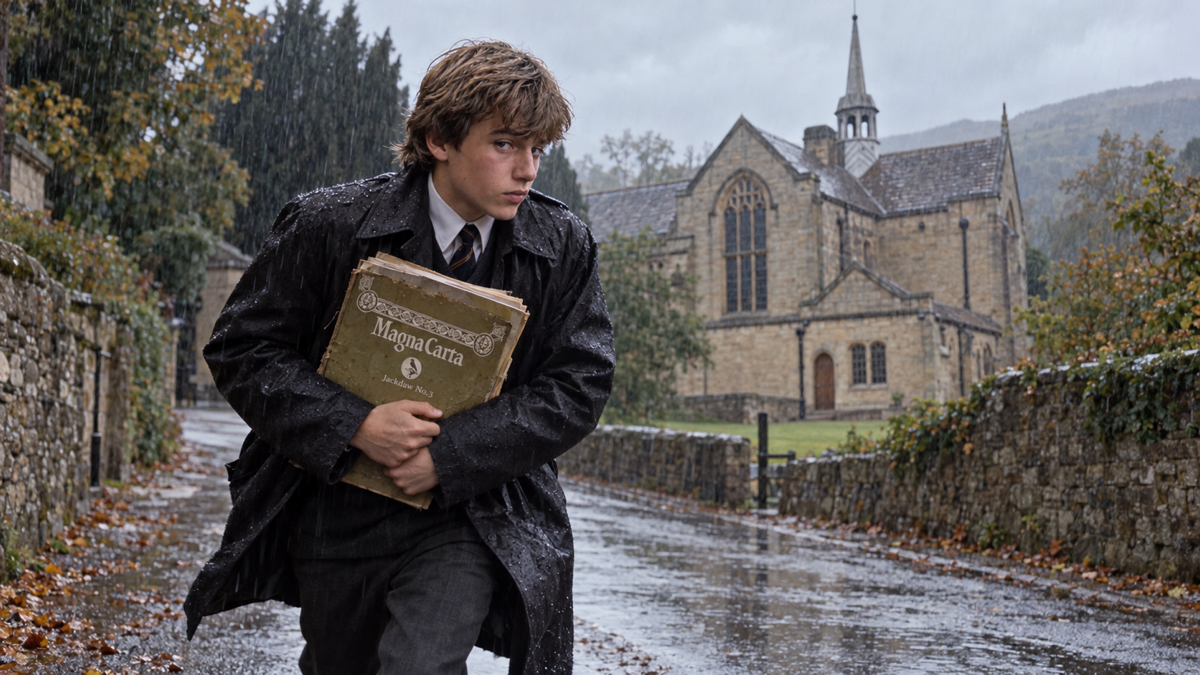
A collection of textbooks arrives, each one supplied by my Sedbergh form teachers – none of whom I had met. No note. No explanation. Just the books, as if that is the education itself. It says everything: this is what you would have done—now get on with it.
They sit there. Had Mum, or better Dad, devised a timetable, I would have liked that. Not strictly a school routine, but a bit of everything, with time for art and gardening too. What if grandpa, who had left school at age 14, got on board? He’d have enjoyed physics.
I remember the Physics book most clearly.
Something about it intrigued me—diagrams, ideas, a sense of how things worked. But even that I barely opened. The rest remained untouched, a stack of expectation with no mechanism attached.
Basic Chemistry — pub. Arnold
French Precis & Comprehension Practice — pub. U.L.P.
The Making of a Nation 1603–89 — pub. Penguin
Silas Marner (George Elliot)
The Tolpuddle Martyrs — pub. Pan/Heinemann)
The Tempest (in Winter term ’75) — O.C.P.
A Midsummer Night’s Dream ’76
Ordinary Level Physics — H.E.B.
The Approach to Latin, 2nd Part — Oxford (O.U.P.)
School Maths: Project Bk 3TC Metric — C.U.P.
Le Petit Nicolas — Longman
Latin Grammar Notes, printed 56 pages — School
Voix et Images de France — Didier
The New Africa — U.L.P.
Biology Text I: Introducing Living Things — Nuffield
Biology Text II: Life & Living Processes — Nuffield
The New English Bible — O.U.P. / C.U.P.
Rudiments & Theory of Music — ABRSM
There was no plan. No timetable. No sense of sequence. No one is saying: start here, do this, then this. Looking back now, it’s the worst kind of distance learning. There was no scaffolding at all—just absence. Did none think to tell me I’d stay back a year? I couldn’t show I’d gone through these books.
I didn’t build anything in its place.
Instead, I drifted into something else. Gardening, mostly. Armed with The Reader’s Digest Gardening Year.


I set about ambitious projects—air-layering hybrid rhododendrons, experimenting, and learning by doing. That, at least, had structure: cause and effect. You do something, and something happens. I pulled myself around the garden in a tea-tray, enjoying being at ground level as I poked around in the soil.
The weather maps fascinated me: the difference between the north east of England and the south was striking.
Fifty years on, these maps are several weeks out of date. For April, read May. For August, pick continental weather.
And cooking with Mum.
And surely some observational drawing? And a self-portrait, pencil with a watercolour wash.
But schoolwork—nothing.
I wrote in my diary that I would produce a single essay to cover the whole term I missed. A neat idea. Contained. Manageable. I would staple it in my Five-Year Diary – as if that might substitute for everything I had missed.
I never did it.
The days passed in a loose rhythm—reading, gardening, thinking, but never accumulating into anything formal. Not rebellion. Not even deliberate avoidance. Just a kind of unstructured existence in which nothing took hold.
And yet I wasn’t entirely lost. I knew I liked my own company. I liked thinking, drawing, writing, and being left alone with ideas. That part was alive.
What was missing was the bridge between that and anything resembling work.

Leave a Reply