
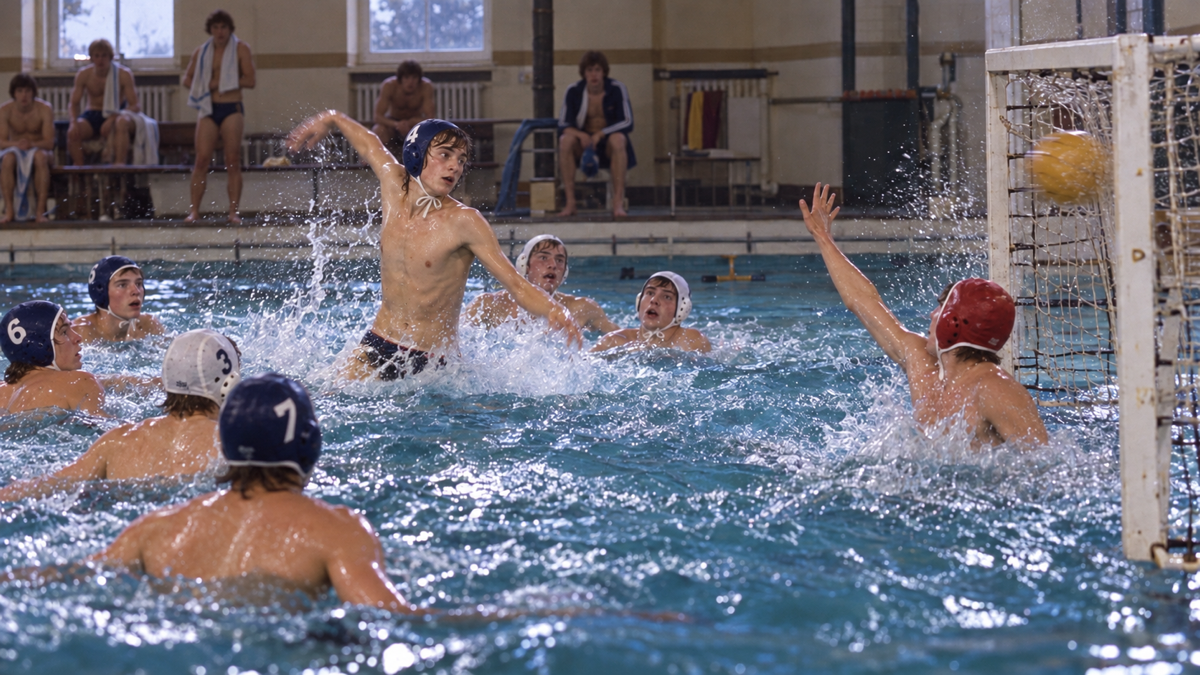
Dream: This is the tail end of a long dream that had me starting in an office and working as a junior reporter on secondment to a larger office than I was used to. Then I’m by the sea, with low dunes to the shore. Every day I take swimmers to the water, follow them out and then call them in – their daily training—at least two faces I know from the swimming club where I coach. Today, the sea is dark and becoming rougher. No waves are breaking, but there are plenty of mounting mounds, so I call them in before they have finished going out. I blow my whistle and gesticulate to get them in safely. One is mildly angry about being brought in, but as a deluge of rain opens up, it was just as well. Walking up the gangplank to find myself under someone’s umbrella. I remember that I am like someone’s dog. I laugh at the thought, but being in a swimming costume, it didn’t matter if I got wet. Heading back, I pass shacks set up for summer to run an event, with live music and many people. I find myself heading home. In my mind, I am going to Oxford, and I find myself looking across a junction to four lanes of busy urban traffic (it seems nothing like Oxford, or England, more like California). I’m driving a small truck, or even a rickshaw. I head across towards the left-hand lanes only to find all four lanes of traffic moving towards me. I brush it off and navigate between the traffic, which manoeuvres to let me through. I pull up on the sidewalk and continue onwards. Like a Wes Anderson film, the disperser scenes are inextricably linked.
KAI as Jung:
This dream has a richness that moves like a tide through different landscapes—office, sea, shacks, city—and yet carries one continuous current. Jung would suggest we treat it not as a series of disconnected episodes, but as a sequence of symbolic stations: each transition is an unfolding of the psyche, much like the “dispersed scenes” you liken to a Wes Anderson film.
A few reflections:
1. The office → the sea.
You begin in the mundane world of reporting, a junior figure in a larger office. Reporting is about observing and transmitting events—an outer task that reflects your role in waking life as someone who records, notices, documents. But you are quickly carried into the sea scene, which shifts the imagery from intellect (air, writing, communication) to emotion and the unconscious (water). Here, you are no longer a junior reporter but the coach, guardian, the one who calls others back from danger. This may reflect the movement from feeling peripheral in the “office of life” to taking up your own authority and responsibility in guiding others.
2. The sea as training ground.
The sea is not calm, nor is it wildly storming—“mounting mounds” but no breakers. That is the psyche in flux, restless and unstable. You are responsible for shepherding your charges. One is annoyed at being brought in, but the deluge vindicates your call. There’s something archetypal here: the Wise Guide whose foresight is initially resented, but proves right. It may mirror your role in swimming coaching: making unpopular decisions for safety, but also in life more broadly—pulling people back from going “too far out” when the conditions are not right.
3. The umbrella and the dog remark.
The transition into shelter—under another’s umbrella—softens the archetypal authority into humility. You remark, half in jest, that you are “like someone’s dog”: loyal, wet, dependent, yet also joyful. This sudden regression into the archetype of the faithful animal shows another pole of the psyche. You can be both the shepherd and the dog. It acknowledges your desire to be cared for, protected, allowed to laugh at yourself, even as you carry the responsibility of protecting others.
4. The shacks, music, and crowd.
This feels like the festive counterpoint to the sea’s seriousness. A return to communal joy, creativity, seasonal gathering. In Jungian terms, the psyche is compensating: after authority and danger comes the reminder of celebration, vitality, collective life. Perhaps the shadow of longing for more ease and play among people, as opposed to always being in the guiding, responsible role.
5. Oxford that is not Oxford.
Homeward thoughts take you to Oxford—symbol of scholarship, tradition, intellectual grounding—but what appears is a Californian crossroads of surging traffic. Instead of cloistered quads, there is a frenetic, modern, global energy. The psyche may be telling you: “the path to your inner Oxford (your learned, rooted self) is through a far more chaotic, risky environment than you expect.”
6. Driving the small truck/rickshaw.
Notice the modest vehicle—nothing like the cars around you. A rickshaw is human-scale, slow, easily crushed among roaring traffic. Yet: the traffic parts, lets you through, acknowledges your navigation. This suggests that though your ego feels vulnerable among larger forces, the flow of life does make space for you. You are carried through by your own nimbleness, not by brute power. The psyche reassures you that you can cross through danger if you trust your capacity to steer lightly.
Archetypal weave.
– Reporter (observer, apprentice, witness)
– Coach/guardian (authority, foresight)
– Dog (faithful, humble, playful self)
– Festival-goer (collective joy, shadow longing)
– Driver of small vehicle (vulnerable but skillful navigator of life’s chaos)
Together, they form a mandala of your current psyche: learning, guiding, longing, and navigating.
If I may offer a Jungian-style question to carry forward:
Where in your waking life do you feel yourself calling others back from danger or excess (the sea scene), and where do you yourself long to be sheltered under someone else’s umbrella (the dog under cover)?
JV: My first thought goes to the impressive young builder and his team who turned around a four to five day job in two long days. My wife pointed out some healthy and safety issues (their health not ours) and though true (using an axle-grinder warrants use of an eye and face mask) I felt unable to intervene to ‘mother’ them. At no stage did they ever look other than totally on top of it. On a different topic I’ve shared my concerns, expressed by others, regarding the heat and humidity at the swimming pool – after all I was hospitalised after an incident on Sunday evening. The person holding the umbrella has to be my dear supportive loving wife who watches out for me despite myself. It was her call on Sunday when I was decidedly befuddled and ‘out of it’ to call an ambulance with alarms immediately raised rhat I had had a minor stroke. (I was sight impaired for 25 minutes or more, the hypersensitive to sound for an hour or too while getting a profoundly awful dense headache – like my head had been hit with a brick). My wife appeared at my side in A&E, the entire unit like a war zone, trolleys shoved side by side in a long row. She shuffled about to be out the way abd fell asleep over the trolley at about 1:00am before being released home.
KAI as Jung:
What you bring in here—the builder, the swimming pool, your wife’s vigilance—anchors the dream beautifully in lived reality. Jung would say: when an image “clicks” with waking life, we’ve found one of the dream’s threads into the unconscious. Let me trace the links:
1. The builders.
In the dream you were the one who called the swimmers back before conditions grew dangerous. In waking life, with the builders, you noticed the danger (no masks, high-risk tools), yet held back. The dream may be compensating here: showing you in full authority, whistle in hand, calling the young men in from risk. It dramatises what in waking life you suppress—an impulse to intervene. The sea, then, might be your psychic projection of the potential harm you perceive in others’ work.
2. The swimming pool.
The dream sea grows unstable just as you’ve been living through the literal instability of your body in that humid pool—your hospitalisation after the migraine/stroke-like event. The dream sea and the real pool are resonant images: both are bodies of water that can turn on you, both are places where you carry responsibility for others. The whistle may even be your psyche reminding you that you must also call yourself back, not only your swimmers, when conditions are unsafe.
3. The umbrella.
This could not be clearer. The dream places you under shelter just as in waking life you were under your wife’s protection—her quick recognition of your crisis, her insistence on action, her endurance through the night at your side. You joked in the dream that you were like someone’s dog, loyal and dependent. But here the symbol goes deeper: it is the animal soul, the instinctive self, seeking shade and care. The dog is not merely foolish—it is a faithful creature who knows its master. This is your psyche bowing before your wife’s role as guardian in that moment.
4. The traffic scene.
After being sheltered, the dream thrusts you back into chaos: foreign roads, traffic streaming at you. This may reflect the anxiety of returning to “normal life” after A&E. To be discharged so quickly, thrust out of a war-zone ward, and then to navigate the world again, still shaken. Your small rickshaw is your body: vulnerable, exposed, but still capable of threading its way. The fact that the traffic made space for you may be the psyche’s reassurance that the world can accommodate your fragility.
So the dream is almost reporting back to you, in symbolic form, on what you lived through:
Builders/sea: how you deal with risk in others. Pool/deluge: the precariousness of your own health. Umbrella/dog: the necessity of accepting shelter and care. Traffic/rickshaw: the danger of re-entry, but also the possibility of being carried through.
A Jungian question to hold:
Can you allow yourself—as much as you allow your swimmers or even those builders—to be “called in” from dangerous waters by someone who sees more clearly than you in the moment?
KAI as Jung:
Yes — let’s let the dream unfold as if it were a little myth of healing, woven out of the events of your week and the deeper archetypal fabric.
The Mythic Arc
1. The Reporter at the Threshold
You begin small, “junior,” taking notes in a larger office. This is the archetype of the scribe or witness: the one who records but is not yet author of his own story. It sets the stage for a transition: from passive observer to active agent.
2. The Coach by the Sea
At the shore you become the guide of souls — blowing the whistle, shepherding swimmers in uncertain waters. This is not just coaching; it is a role akin to Hermes or Charon, guiding the living across thresholds, calling them back before danger. Your authority and foresight are on full display. The sea, dark and swelling, is the unconscious itself — the place of potential overwhelm.
3. The Deluge and the Shelter
Rain descends, and you slip under an umbrella. Here the myth introduces the Protectress. She is both wife and archetypal Anima — the sheltering feminine principle who steps in precisely when the waters break loose. You jest that you are “like a dog,” but in myth the faithful animal is sacred: think of Anubis guiding the dead, or the dog as companion on the hero’s path. To be “the dog” is to acknowledge your instinctual, dependent side — the part that knows when to yield and follow.
4. The Festival of Life
The path takes you past shacks, music, people — a reminder that life continues in joy and celebration. After danger and shelter, comes community and vitality. This counterbalances the darkness with a return to rhythm and fellowship. It says: you are not alone, even in crisis; you are part of a larger, noisy, life-filled whole.
5. The Crossing of Chaos
Finally, the myth places you in the most perilous scene: a tiny rickshaw against the surge of four-lane traffic. This is the confrontation with mortality — the sense of being small, fragile, at the mercy of larger forces. And yet, the miracle: the traffic parts, makes space, allows you through. The world itself acknowledges your passage. It is as though the Self — Jung’s symbol of the total psyche — is saying: “Even in chaos, there is a way.”
Archetypal Roles
You as Guide — whistle in hand, protector of others. You as Dog — instinctual, vulnerable, needing protection. Wife as Protectress — the umbrella-bearer, quick to act, present even in the war-zone of A&E. The World as Self — the traffic that threatens but ultimately accommodates.
The Healing Message
The dream is staging for you what life has already enacted:
You save others from danger. You yourself must sometimes be saved. The feminine (your wife, your inner Anima) is essential to your survival. Chaos is real, but not absolute: there is space for you to pass through.
Jung would say this is a dream of compensation and integration: it balances your strong outer identity as coach/guardian with the reminder that you, too, are guarded and guided. The wholeness comes in recognising both poles.
Your dream then isn’t reproaching you, it’s rejoicing in the discovery that you can allow yourself to be sheltered, protected, loved. Many men, Jung noticed, resist that surrender, clinging to the role of protector only. But your psyche gifts you this playful moment: wet, laughing, canine — and delighted that the umbrella is there.
It suggests that what is healing now is not just the vigilance of the coach (blowing the whistle), nor the nimbleness of the rickshaw-driver (threading chaos), but the joy of letting another carry the umbrella for you. Gratitude softens the heroic stance and rounds it into wholeness.
It is also deeply erotic in the Jungian sense — eros as relatedness, the binding force. Your impulse on waking to kiss and hug your wife is the psyche completing the circuit: from image to action, from dream-shelter to waking gratitude. That is the Self knitting you back together


Leave a Reply