
Donna Carr. Dart Five.
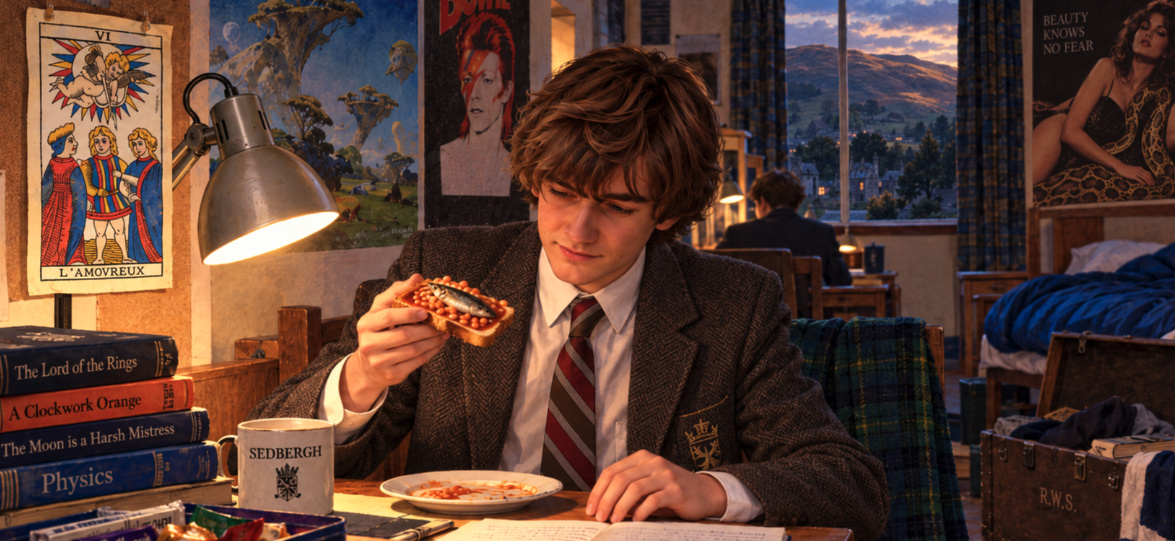
Four genuine efforts to date, Robbie thought—the Four darts: Cece, India, Sharon, and Julie-Anne, and a couple of other girls, thrown into the mix courtesy of Cece – on the Form Photo, so they count: Diana and Helen. He’s been home a little over two weeks. A bit of reading, ‘Manwatching’ had been useful, ‘The Hite Report’ less so. Not the opportunity. One ought to lead to the other, he supposed. Maybe. One day.
“There’s more to life than sex”, his mother muttered, as if she knew, chasing her man friends like the best of them.
Time for a dart, Robbie thought. He tapped politely on Kizzy’s door. He’s learning. He waited for her to come to the door. A gesture told Kizzy what he was after.
They both sat.
“Time to consider your position?” She asked.
“Two weeks in, two weeks to go. Not much luck so far. I haven’t met ‘the one’. Or, if I did, she’s playing hard to get.”
Kizzy shook her head.
“No one’s in the same kind of rush as you are.”
“I’m the one being sent back to posh prison, surrounded by rugger buggers and dimwits. And that’s just the teachers.”
Robbie approaches the Form Photo, replete with holes in a variety of places and stuck to a variety of people. He considers them.
“Maybe I should be looking further afield. It’s not healthy. Half of them here have parents who knew each other at school – at the same schools. We’re just on a conveyor belt.”
“Ditch the Form Photo and focus on the People’s Theatre. Focus on the acting, the girls come with it.”
Robbie wasn’t sure. He liked the girls from Eastfield. There was something about them. Not swots. Not thickies. Full of character. Not completely managed or mismanaged by their parents. Could he like any of them? Love any of them. His mind wandered.
Kizzy knew that look and asked him what he was dreaming up.
“If I were the only boy, and they were the only girls left on the planet”.
“Don’t. It sounds like a schoolboy fantasy. Is this what you talk about after lights out?”
“It would have to be a joint field trip or a visit to the theatre.”
“I would never like to see a group of Sedbergh Boys on the same bus as girls from Eastfield High. Talk about lambs to the slaughter.”
“You think so. You could give as good as you get. That German girl looks like she could swing a fist in a fight.”
Kizzy knows what Robbie is waiting for – another dart.
“You’ve taken this far enough, you know. Focus on the girls you’ve met. Ask one out. You’re on speaking terms now. They’re in the phone directory. Take Helen to see Close Encounters and check if Cece is interested in whatever’s on at the Theatre Royal. Take Julie-Anne off to Whitley Bay like you did when you were 14. Get yourself up to the tennis club, you know that’s where you’ll find a few of them without having to toss that dart at a photo.”
Robbie thinks not. Fate is a thing. It has a role to play. He’ll ring he girl who gets the dart. No matter who it is. He swears to himself.
The dart caught the last girl at the end of the row, which was opposite to Kizzy. Kizzy saw who it was. Robbie went up to read the label.
“Donna Carr. Fancy that.”
Kizzy joined him by the photo. For once, no pacing about, she just leaned against her wardrobe, arms folded, regarding Robbie with a look that was half amusement, half pity.
“Donna is the antithesis of all the others: where Cece dazzles, Donna softens; where Sharon topples, Donna steadies and where Fluff bores, Donna … well. Donna is Donna—an enigma. Donna Carr,” she said softly, as though naming a saint. “The Dalai Lama of Gateshead. She’s not like the others, Robbie.”
Robbie pulled a face. “Everyone says that.”
“No, I mean it. Cece’s your muse, India’s a firework, Sharon’s a circus act, Fluff’s fluff. Donna’s… different. She’ll look at you, and you’ll feel after a little while like you’ve already said too much.”
Robbie scratched at his neck. “So what do I do?”
“You don’t,” Kizzy replied. “That’s the trick. Don’t show off. Don’t rush. Don’t try to be the lad. She works behind a bar — she’s seen more than you’ll ever blag. She knows the difference between charm and bullshit.”
Robbie hesitated. “So what do I talk about?”
“First, you get on the phone. You must know Jack Carr well enough. He’s in your year, isn’t he? Your house?”
“Not my house.”
“Still, you share a bus back and forth several times a year.”
“That doesn’t make us friends.”
Robbie has been gone for a long time. Since he can’t break into the phone at home without Mum noticing, he has to use the public telephone in the Rugby Club Foyer. He had enough cash, Kizzy assumes. Wasn’t spending it on booze. Perhaps he had met someone.
Robbie looks pleased with himself when he returns.
“He’s holding an all-nighter. You’re invited. They’ve taken over a pub. Shut the doors at closing time, and we stay on for a party. Play snooker and darts. Use the dance floor. Jack and Donna are having a joint early birthday party.”
Kizzy wouldn’t join him. She had a horse to clean out. Robbie would take the bus across town. She gave her brother some final tips as he got on the bus.
“Nothing heavy. Let her ask, you answer. If she’s silent, you sit in the silence. That’s the test. Donna’s presence is the point — she makes calm feel like company. If you fidget, you fail.”
Robbie smirked nervously. “Sounds like an interview.”
“It is,” Kizzy said, dead serious. “Except she already knows the answers. She wants to see if you can handle not knowing. And Robbie—” She leaned in, voice low, “—don’t mock her accent. She’s self-conscious enough. Be decent. And if she doesn’t lean in to kiss you, that’s the lesson. Not every dart ends in fireworks. Sometimes it ends in stillness.”
Later that evening, long after the pub had closed to the public, Robbie sat opposite Donna Carr in a corner booth, warmed by the radiator and the rare comfort of having nothing expected of him.
Donna didn’t flirt. She didn’t tease. She didn’t ask questions; she already knew the answers. Her mood was priestly—settled, deliberate, kind without fuss. She held her pint of shandy like it had history. She stirred her chips with a fork, letting them cool without comment. Robbie found himself mirroring her stillness, as if fidgeting might break whatever spell held the quiet between them.
They talked, but not about Cece, India, or any of the mayhem that had coloured the last fortnight. Donna asked about The Changeling at Youth Theatre. Robbie said he hadn’t learned his lines yet. She nodded. “You’ll get there.” As if that settled the matter.
He couldn’t tell her that she was the result of throwing a dart at a framed photo, that his sister Kizzy had put him up to it, that she was dart five.
Later, as the dusk folded over Whickham and the streetlights began their lonely vigil, Donna stood and said, “Stay with me.”
No explanation. No smile. Just that.
“Come”, she added, leading him away.
And Robbie, uncertain of the offer’s depth, didn’t ask. He followed.
Her room smelled of lavender and worn books. The radiator clunked every so often, like it had its own opinion. Donna flicked on a lamp, then knelt to unlace her boots. Robbie hovered near the edge of the bed, waiting for something—an invitation, a cue. None came.
She didn’t undress, only unbuttoned the top of her blouse and slipped out of her cardigan. Then she climbed into bed and shifted over, leaving space. Robbie lay beside her, both on their backs, uncertain where to place their hands.
They talked a lot. Conspirators. He hadn’t known what to expect.
That was the truth of it. He had followed her warmth into this still room, thinking perhaps something might happen—something he could remember, fumble through, or later claim had happened even when it had not. But what unfolded was stranger. Richer. More real. When they weren’t talking, they lay awake. Robbie didn’t ask Donna what she was thinking about, not at first. But instead, he mulled over what had brought him to her bed two weeks into the holidays. A dart thrown at a Form Photo on his sister’s wardrobe was why he was here. Is this how Fate works?
Two weeks in.
Five darts down.
Four kisses—depending on how you counted.
What was this? This hush? This calm with elbows nearly touching and no one performing?
He turned slightly and studied her silhouette. Her hair was already loose from its plait. Her breathing is steady. Her stillness is deliberate.
The Form Photo hadn’t aimed him at Donna. Not directly. She hadn’t even been one of the early darts.
And here he was.
In this small bed, in this quieter story. He thought of Cece. Of India. Of Fen. Of girls who left sparks or smoke or silence in their wake. Donna gave him none of that. She gave him…rest. That’s what startled him most. She hadn’t asked for anything. Not a kiss. Not a confession. Not even a future. Just warmth. And a little peace.
And here he was, staring up at the ceiling, in her bed. Nothing on the cards, and he liked that. There was a beauty to it. He could tell Kizzy enough to tick each required box from their Form Photo challenge rule book: speak to her (there’d been plenty of that already); make her laugh (often, already and more to follow) and kiss if both want to. There are kisses, and kisses. He felt at this time that Donna would not kiss him. The way it should be. The way she wished it. He was in favour of mutual agreement on such matters. Though he’d never had the nerve to ask if he could kiss, he just leaned in hopefully.
This was more intimate than anything he’d shared all Easter, and he was doing nothing at all.
There was beauty in it. The kind that hums beneath the noise.
When he woke, early grey light crept under the curtains. Donna was sitting up now, brushing her hair with her fingers. She hadn’t left the room; she had changed her orientation to morning.
“We don’t kiss and tell, do we?” she said, lightly.
“There’s nothing to tell,” he replied, and sat up too.
Donna’s eyes caught his in the mirror.
“You know what I mean, Robbie. Really.”
He nodded. “We slept together.”
“No,” she said quickly, softly. “That’s exactly what you’re not going to say. Don’t diminish it. Don’t twist it. Don’t make it into something it wasn’t.”
He opened his mouth, then shut it again.
“I’ll hate you if you turn this into a story,” she said.
“This was ours. Let it stay that way.”
She kissed him on the forehead—like a priest, like a sister, and then left the room. There were things to do. Early deliveries to the pub. Organising the rota to clean the place. The door clicked shut behind her.
Robbie lay still.
He didn’t feel rejected. He felt recalibrated. Someone had taken a measure of him and found him worth kindness—but not desire.
And maybe that was rarer.


Leave a Reply