
Dream: The dream opens in a science-fiction world that feels less like a setting and more like a given reality—a space station that has been inhabited long enough to become ordinary. It is not a frontier or a battlefield but an orbiting micro-world, self-contained, culturally evolved, almost complacent in its success. People live there. Children grow there. It has the quality of something carefully designed and then lovingly inhabited over decades.
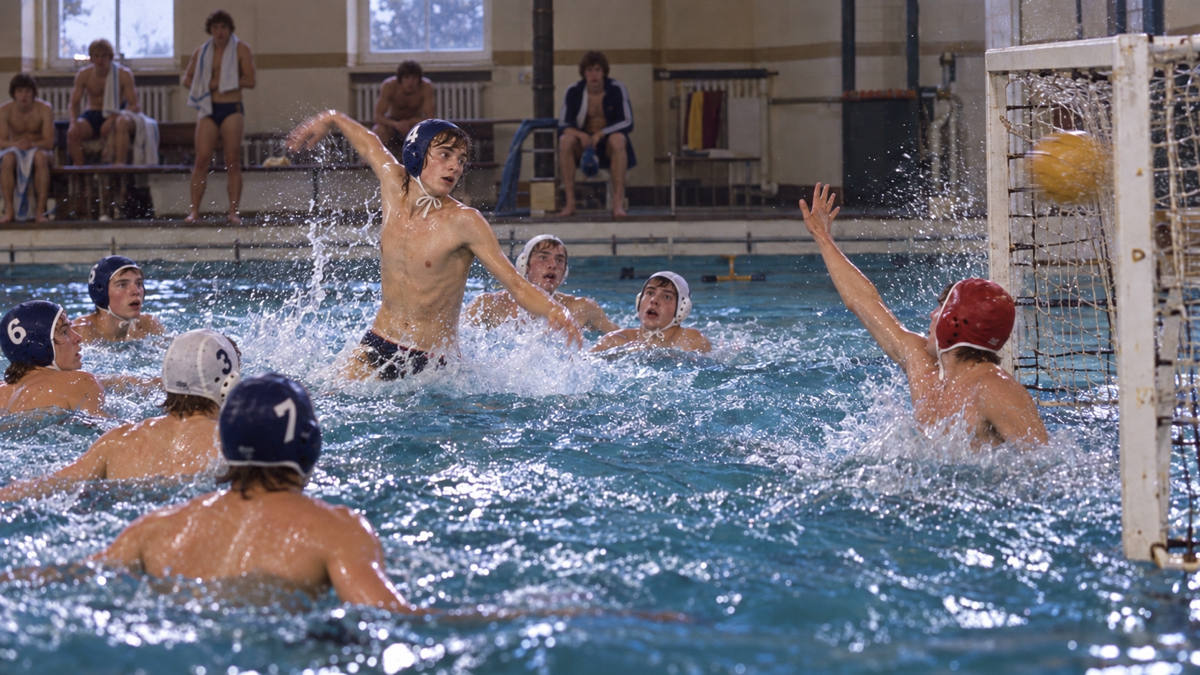
At its heart is a vast interior globe—part conference centre, part leisure complex, part cathedral of pleasure. Inside it, gravity is softened or suspended. People swim not only through water but through air. Bodies drift, rise, and arc in slow, joyous trajectories. It is playful, communal, and deeply civilised. The space carries the emotional charge of a family leisure centre transposed into the future: laughter, learning, trust in the environment. It is a place where people let go because they believe the structure will hold them.
Then the rupture.
There is no villain, no warning speech. What pierces the globe’s outer skin arrives as something like a random astronomical event—asteroids or projectiles that strike in multiple places at once. The language of the dream is ambiguous enough that they feel both natural and engineered. They puncture the exo-skeleton of the world, breaching what had been assumed to be inviolable.
What kills is not the impact but what is released.
From the punctures seeps a poisonous gas, blooming into the interior like an obscene inversion of play. It mixes with the water. It dissolves like an effervescent tablet, spreading silently, beautifully, lethally. Its colour is unstable—white, purple, yellow—and it carries the unmistakable psychic residue of First World War gas: indiscriminate, chemical, morally shocking. Men, women, children—people who trusted the environment—are overtaken before they understand what is happening.
You escape, but survival is not triumphant. It is narrow, contingent. Relief arrives first and is immediately poisoned by guilt and inevitability. Why you? Why now? The dead children imprint themselves on you, not as abstractions but as echoes of yourself, earlier, younger, equally vulnerable. Survival marks you out rather than frees you.
You are then required to return.
The gas has pooled temporarily near the top of the globe, a fragile pocket held in place by circumstance. You and three others must cross the space to reach the far end, moving under the suspended threat that at any moment the cloud could drift downward and finish the work it has begun. This passage feels tense, procedural, morally loaded. During this rescue traversal, one of the four dies—carelessly, avoidably, as if the system itself has already begun to thin, to sacrifice something essential without fully registering the loss.
Though deadly the thunderstorm of shifting chromatic colours is beguiling.
Instead of the sharp, fractured brilliance of a kaleidoscope — those hard-edged shards of coloured glass snapping into new geometries — the shifts happen through light itself.
Colour does not break; it bleeds. Soft beams of colour drift across mist and cloud, as if projected from an unseen source. Reds, blues, violets, and pale greens slide slowly over one another, never quite separating, never fully blending. The boundaries are porous. One hue thins into another the way breath thins into air on a cold morning. Nothing clicks into place; everything eases.
The mist acts as a receptive surface rather than a structure. It catches the light, holds it briefly, then lets it move on. Shapes form only temporarily — a suggestion of landscape, a hint of figures, a memory of places once known — before dissolving again. The effect is immersive rather than dazzling. You are inside the colour, not observing it.
This shifting illumination carries a quiet menace. Because there are no sharp edges, no sudden contrasts, the change is harder to resist. The world does not announce that it is altering; it simply drifts into something else. Orientation becomes uncertain not through violence, but through softness. Direction is lost because everything remains gently plausible.
Psychologically, it feels like reality losing its firmness while remaining beautiful. There is no moment you can point to and say, here it broke. Instead, coherence thins. Meaning becomes atmospheric. What was once solid becomes conditional, dependent on attention to remain intact.
The light sits in the air, brightly lit, oddly cheerful. Colour planes are clean and confident — turquoise sky, lavender mist, acid-yellow light — yet the perspective doesn’t quite agree with itself. Multiple viewpoints coexist: you feel you are seeing the storm from several positions at once.
On the far side, the nature of the dream changes.
The catastrophe does not end the mission; it initiates it. A ruling authority—never personified, never questioned—assigns a task that feels less like an order than an inevitability. The remaining three of you are charged with saving the space-station micro-world, but not directly. Instead, you are required to create and enter an alternative reality, a fully immersive historical fantasy world that you collectively imagine into being.
This secondary world is vivid, textured, and internally consistent. It has its own rules, landscapes, and temporal depth. You live inside it as fully as you lived inside the station. At the same time, you are aware—dimly—that you are also on a quest: to identify the source of the original attack and to find an antidote to the gas. Yet this investigative task feels secondary, deferred.
What matters first is that the imagined world must be kept stable.
You come to understand that your survival—and perhaps the survival of the original world—depends on your ability to hold this fantasy reality together. It is not enough to imagine it once. It must be continuously maintained through shared attention, coherence, and restraint. The work is subtle, exhausting, ethical.
At some point, not long into this alternative reality, something goes wrong.
One of the three—possibly any of you—loses the capacity to hold the world steady. There is no single act of sabotage. Instead, the world begins to shift, to fracture atmospherically, like a muffled thundersnow. Images bleed into clouds. Scenes fuse. The environment becomes unpredictable and hostile. The danger is immediate and existential: if the world destabilises further, another of you will die, or all of you will.
A critical recognition occurs here: stabilisation is now more urgent than explanation. Before you can hunt causes, before you can identify enemies or cures, the shared world must be re-secured. The task becomes bodily and collective rather than intellectual—holding, breathing, synchronising, slowing down enough to prevent collapse.
The dream ends with this pressure unresolved but clarified. The work is not to defeat an external threat but to remain conscious together inside a fragile, constructed reality, long enough for any further action to be possible.
The final feeling is not fear, but responsibility: the knowledge that worlds—whether orbital, imagined, or familial—do not fall apart only because of attacks from outside, but because the effort required to hold them together quietly exceeds what anyone wants to admit.
Here is a mythic–psychological description of the four who enter the globe.
They are not people in the ordinary sense. They are functions given bodies, the way the psyche dramatizes itself when the stakes are high.
The Companion (the one who will be lost)
This figure enters first, almost unnoticed, because their gift is presence. They are not decisive, not strategic, not especially insightful — and that is precisely their value. They keep the group human. They notice who is lagging, who is frightened, who needs a hand without asking. They speak little, but when they do it softens the air.
They carry memory rather than plan. They remind the others what is being protected — not abstract life, but lived life. In the globe they move easily among children, linger near the water, instinctively lower themselves to the level of play. They assume the world will hold, because it always has.
Their death is careless and avoidable because this function is often sacrificed unconsciously. When urgency rises, companionship is deemed expendable. The psyche does not mourn them theatrically — but their absence is felt everywhere afterward, as a subtle thinning of warmth.
The Thinker (the Clever One)
This figure enters with their eyes already mapping the structure. They see the globe as a system: pressures, seals, vulnerabilities, probabilities. They speak in conditional sentences. They are the one who understands how the exo-skeleton is pierced, even before anyone asks.
They are calm under threat because thinking gives them distance. In crisis they become sharper, more precise, more abstract. They are essential for survival — but they do not grieve well, and they are uneasy around chaos that cannot be named.
In the alternative reality, they are the stabiliser of rules. They know which laws of the world must not be violated if coherence is to hold. Their danger is rigidity: if they dominate, the world becomes brittle. They need the others to keep thought from becoming tyranny.
The Empath (the Feeling One)
This figure feels the deaths immediately and bodily. They are the one who kneels, who stays with the mourners, who cannot pass the dead children without stopping. Survival lands on them as a burden rather than a relief.
They do not argue for action; they argue for care. Their language is moral rather than technical. They sense when mistrust begins to spread faster than the gas. In the globe they move toward the injured zones instinctively, even when it is unsafe.
In the shared dream-world, they are the emotional weather system. When they are steady, the world softens and holds. When they are overwhelmed, the world darkens, grows hostile, turns against its makers. Their danger is exhaustion — carrying too much pain without relief.
The Foreseer (the Intuitive One)
This figure is least tethered to the present moment. They arrive with a sense that this has happened before — or will happen again. They do not always know why something is wrong, only that it is. They notice patterns before causes.
They are the one who understands that stabilisation must come before solution. They grasp, without explanation, that breath and rhythm matter more than strategy at certain thresholds. They are attuned to timing, to when to act and when to wait.
In the alternative reality, they are both asset and risk. They can sense shifts before they occur, but they can also be the one who destabilises the world — not out of malice, but because intuition outruns containment. They live closest to the unconscious and therefore closest to danger.
As a group
Together, the four form a complete but fragile ecology:
The Companion keeps them human, the Thinker keeps them coherent, the Empath keeps them ethical, and the Foreseer keeps them oriented
When all four are present, the world holds almost effortlessly.
When one is lost, the remaining three can still function — but at a cost. The system becomes more efficient and less forgiving. Survival is possible, but warmth must be consciously reintroduced rather than assumed.
That is why the mission is not to defeat an enemy, but to hold a world together long enough for life to continue inside it.
And that is why the psyche chose four — and why it allowed one to fall.


Leave a Reply