Winder House, Sedbergh School

Five-Year Diary: Monday, 19th January 1976. “M forgets time fagging.” That’s how the day is logged, and it sounds sharper than it felt.
I was Head of Fags. This meant I was responsible for passing on jobs from the House Prefects. I also had to ensure they happened. Time fagging involved sending a junior boy around the Sixth Form Cubes in the morning. He knocked on doors to ensure people got up. M was meant to do it. He forgot. By the time anyone noticed, it was far too late to fix. The system would absorb it. If there were complaints, someone else might be chosen next time and M quietly moved sideways into a different duty.
I remember M more by how he looked than by anything he did. He was tall, startlingly blonde, all limbs, permanently half asleep, like Dillon from The Magic Roundabout. He looked down on everyone like a streetlamp. I didn’t feel irritated with him. More neutral than that. Acquaintances rather than friends. Years later he’d be expelled for refusing to take a caning over his tuck box. I don’t blame him. I’d have gone the same way.
I was officious in the role, like a traffic warden. I separated the job from the boy. I’d come to loathe authority by then. I had experienced too much of it earlier as a prep-school prefect. These roles weren’t optional. They were handed to you. One of the reasons I already knew I wouldn’t stay. The path led inevitably to being like Birchenall, a house and school prefect, and I wanted no part of that.
Breakfast was in the Winder House refectory, brightly lit by a huge south-facing bay window. There was a head table for staff and prefects, then a dozen or so tables seating eight boys or more. About sixty boys in the house, twelve per year group from Third Form up to Upper Sixth. We tended to sit by year, rarely straying. The architecture I can picture clearly; the social detail less so. Hierarchy was there, but unspoken. You learned it by appetite and silence.
Somehow, without my really registering when or how, I’d been declared fit again. After a seriously broken leg I’d assumed I was excused rugby for the season and would just swim. Four months of hard swimming must have rebuilt the muscle too well. Someone—possibly my mother, unwittingly—had told the Housemaster I was training hard and that the orthopaedic surgeon had signed me off. Treachery by recovery. My body had improved faster than my autonomy.
Packing made little sense even as I did it. Unpacking trunks, stacking the tuck box, separating clothes into vague systems: rugby kit, school clothes, sheets. Everything labelled in my mother’s stitching. J F Vernon, maybe with Winder added. A quiet tether to home, sewn into everything. Soon enough I’d start hiding illegal home clothes. I’d pack flared jeans, a T-shirt, maybe a jumper, and cowboy boots. This was just in case escape became necessary. Not yet, perhaps, but soon.
P and I cleaned Birchenall’s shoes. One shoe each. Token fagging, really. Birchenall didn’t believe in piling on duties. Other prefects were far more demanding. We probably stood under the awning in the back yard, picking out dirt, rubbing polish in, nothing fancy. I knew how to clean shoes. I’d been doing my own since Mowden. Birchenall himself was huge—imagine Dave Bautista with permed red hair—a thoughtful prop forward in the senior fifteen. Red colours jacket. Authority without cruelty.
New boys in form: Steven and Shaw. I remember the fact, not the people. Surnames were everything. First names retreated to home and close friendships. You learned quickly who was new to boarding school life and who was simply new to Sedbergh. Overlap only came through activities: swimming, orchestra, choir, the project centre.
Chemistry passed me by. Copper experiments, heat, colour, residue—I didn’t really notice. The language lost me early and I never caught up. I should have asked for help. I didn’t. That was probably the moment I quietly sorted myself into a future without chemistry in it.
English II meant new books. Silas Marner. I sat somewhere in the middle, near a window. Neither teacher’s pet nor troublemaker. I wanted a good part. Reading aloud mattered. Just following the text in silence was intolerable. The actor in me was already awake.
Physics revision was oddly calm. The teacher was excellent—clear, practical, precise. I did well. Quietly. Guiltily. I saw myself as a poet, an artist, a performer, not a physics person. Arts and sciences felt like opposing camps, and I didn’t quite know where to put myself.
Mid-morning food punctuated the day. We walked back to Winder House. It was the longest schlep of all. We went from the school buildings past Chapel, along Lipton Lane, past the Sanatorium and the squash courts. We used the communal space by the kitchens to boil kettles and make toast. Bread, butter, milk and teabags were supplied. Everything else came from our tuck boxes. Chocolate spread sandwiches and hot chocolate. Small autonomy, fiercely guarded.
Latin with the Reverend A.T.T.I. Boggis was a side track in every sense. Elderly, bachelor, former climber, organist, from another era. High-ceilinged room, individual wooden desks with inkwells and carved names. He spoke of Latin as a lingua franca of European monasteries. Then he wandered off into stories of his own past. Not a role model. A relic of a system that couldn’t retire its teachers or its traditions.
Maths with Mr Hedges was different. He made time. He came to your desk, helped you work it out. Calm authority. I got it, most of the time, without meaning to. Straight As followed later. Being given time felt like being seen.
Lunch was the usual school fare: meat-based, hearty, adequate. Served through the hatch. The social rules held firm—stay with your year, watch your nip. I had a September birthday, so I was younger than many in the year above. Some of them were only a month or two older. However, biology told a different story. Some boys could grow beards in days; others, like me, still looked like choristers. Puberty was uneven and merciless.
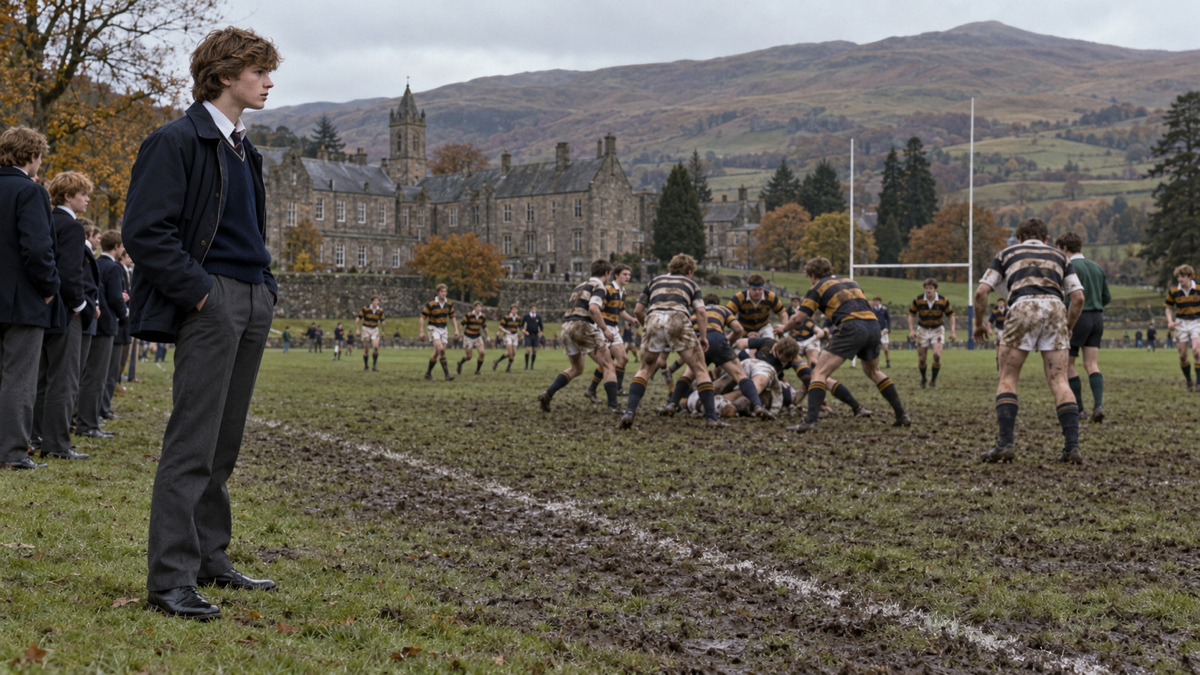
Games loomed. My only desire was to swim. Instead I was picked for house rugby. At Sedbergh rugby wasn’t just robust, it was brutal. Violent by design. The first five minutes were about fear. Studs scraped on tarmac to roughen them. Hands went where they shouldn’t in scrums. Legs were trodden on in rucks. Torn fingernails, black eyes, split lips, concussion. Played in rain, frost, snow. North Yorkshire moors weather: wet, windy, cold. Swimming was control. Rugby was surrender.
By evening my body knew it. Stiff, unfamiliar pain from muscles I hadn’t used in months. Evening classes blur together now—French, something called Theseus, perhaps. Prep ran in silence across the house, boys at desks, no talking.
Bed came by year group. Communal washroom. Junior boys stayed in open dorms. Fourth Form and above occupied cubicles. These cubicles were like wooden stalls in a stable block. Each contained a metal bed, chest of drawers, chair, and hooks. Low walls you could climb and peer over. After lights out you could whisper to the boys either side. Odd things were learned that way. Rumours, confessions, desperation. We were starved for privacy and knowledge, and curiosity filled the gaps.
I slept easily enough but woke early, restless. Against house rules I could be up by 4:30 a.m., sometimes sitting on the grass tennis court in the half-light. Silence then wasn’t oppressive. It was a pocket of my own time, before the system started the day again.

Leave a Reply