List three books that have had an impact on you. Why?

The immediate problem is that, since the age of thirteen, I’ve kept a complete list of the books I’ve read. Because I also kept a daily Diary for 15 years and a daily blog since 1999, books became part of the fabric of my life. I often review as well as read them, or at least the fo on a list (the good, the bad, the recommended, even school text books). Add e-books, and the odd obsession where I owned both the physical and digital versions of the same title, even collector’s first editions, and suddenly “three books” feels limiting – like having to chose my three favourite fingers. Looking at them I’d say my two thumbs and the index finger on my right hand – or should that be both index fingers and the thumb on my right hand?! You see how hard it is, and that is trying to choose between ten fingers, not 20,000 books!
These days I mostly buy physical books — new or increasingly second-hand when I can. I like the artefact itself: the smell of old paper, inscriptions, bookmarks left by strangers, cracked spines, marginalia. I like how light falls on the page. You can sit in the sunnwirh a book and not worry about the battery in your smartphone or ipad overheating. These are books with history. They are like a good kitchen pan – they’ve seen life! I use them. More importantly, a physical book gets me away from screens and notifications. It sees me drawn inexorably into another world. I can binge read; and read anywhere: in front of tv, on a coach full of noisy kids, at the back of class, at the table, on a ski-lift, on the deck of a yacht … (you’d don’t see astronauts reading books in space though do you?)
If I’m honest, I could probably choose a hundred books that changed me in different ways. But three that still echo across the decades would probably be these.
Brewer’s Dictionary of Phrase and Fable
First, Brewer’s Dictionary of Phrase and Fable. I’ve owned a copy for forty-six years; the current hardback us about as useful as an old leather hiking book. It needs the red Chambers English Dictionary that sat with it for twenty or thirty years. I once had a reference library (a couple of shelves) of atlases, dictionaries and volumes of mythology while I was trying, rather self-consciously, to turn myself into a “scholar”. A few degrees down the road ‘permanent student’ might be a more apt description. Brewer’s taught me that stories, language, folklore, history and symbolism are all interconnected. You open it looking for one thing and emerge an hour later somewhere entirely different.
Carl Gustav Jung’s ‘Man and His Symbols’
I should have Carl Gustav Jung’s ‘Man and His Symbols’ instead! Have I submitted this yet? I came to him around the same time, age seventeen, possibly younger. Here’s a book I have returned to, directly and indirectly, over fifty years, with some consistency. We can’t help ourselves when it comes to dreams, and I like to analyse them—ninety minutes to two hours these days, assisted by AI (ChatGPT) to complete a Jungian Dream Analysis. It used to take me at least a morning, maybe even all day, armed with books, a pen, and paper. I keep finding handwritten or typed notes on dreams I’ve had, ones I’ve remembered and analysed. And here’s the thing – I can read my write-up of a Dream I had in October 1992, and step back inside that world just as easily as imagining I’m on my favourite ski run in Val d’Isere. There must be a hundred of these dreams written up here in my blog.
Tropic of Capricorn by Henry Miller
Second, Tropic of Capricorn by Henry Miller. As a teenager I discovered books like Emmanuelle that I read with a mixture of fascination, delight and awe. Returning to it fifty years later, I was struck less by the eroticism than by how evocative and escapist the writing was. It is well written! That reading led me in due course towards Anaïs Nin and then Henry Miller, whom I studied with academic intensity for a period of my life. Miller’s voice felt alive, conversational, reckless and intellectually hungry all at once. I have a folder of my typed up inventions that twist around real events – on my ‘fifty years later’ campaign I’ll get to these in four years time. Recently I found something similar in Portnoy’s Complaint by Philip Roth — though Roth is more neurotic, funnier and far more brutally self-exposing. What interested me wasn’t simply the sexual candour, but the larger question underneath it all: how human beings (men and women) can be governed by impulse, longing and emotional immaturity while pretending to be rational adults. I also stumbled upon Pat Califia’s Macho Sluts a couple of decades ago – books that knock you off your feet.
Macbeth by William Shakespeare
My third choice is Macbeth. Nearly fifty years ago I fell in love with it through the Roman Polanski’s Macbeth film which was shot in my home county Northumberland. I fancied myself as an actor at the time and later performed in Shakespeare at university, though never Macbeth. It remains the only Shakespeare play I can quote at length.
Tomorrow, and tomorrow, and tomorrow,
Creeps in this petty pace from day to day
To the last syllable of recorded time,
And all our yesterdays have lighted fools
The way to dusty death. Out, out, brief candle!
Life’s but a walking shadow, a poor player
That struts and frets his hour upon the stage
And then is heard no more. It is a tale
Told by an idiot, full of sound and fury,
Signifying nothing.
That sense of ambition, mortality, performance, time slipping away, and the stories we tell ourselves about destiny has stayed with me ever since.
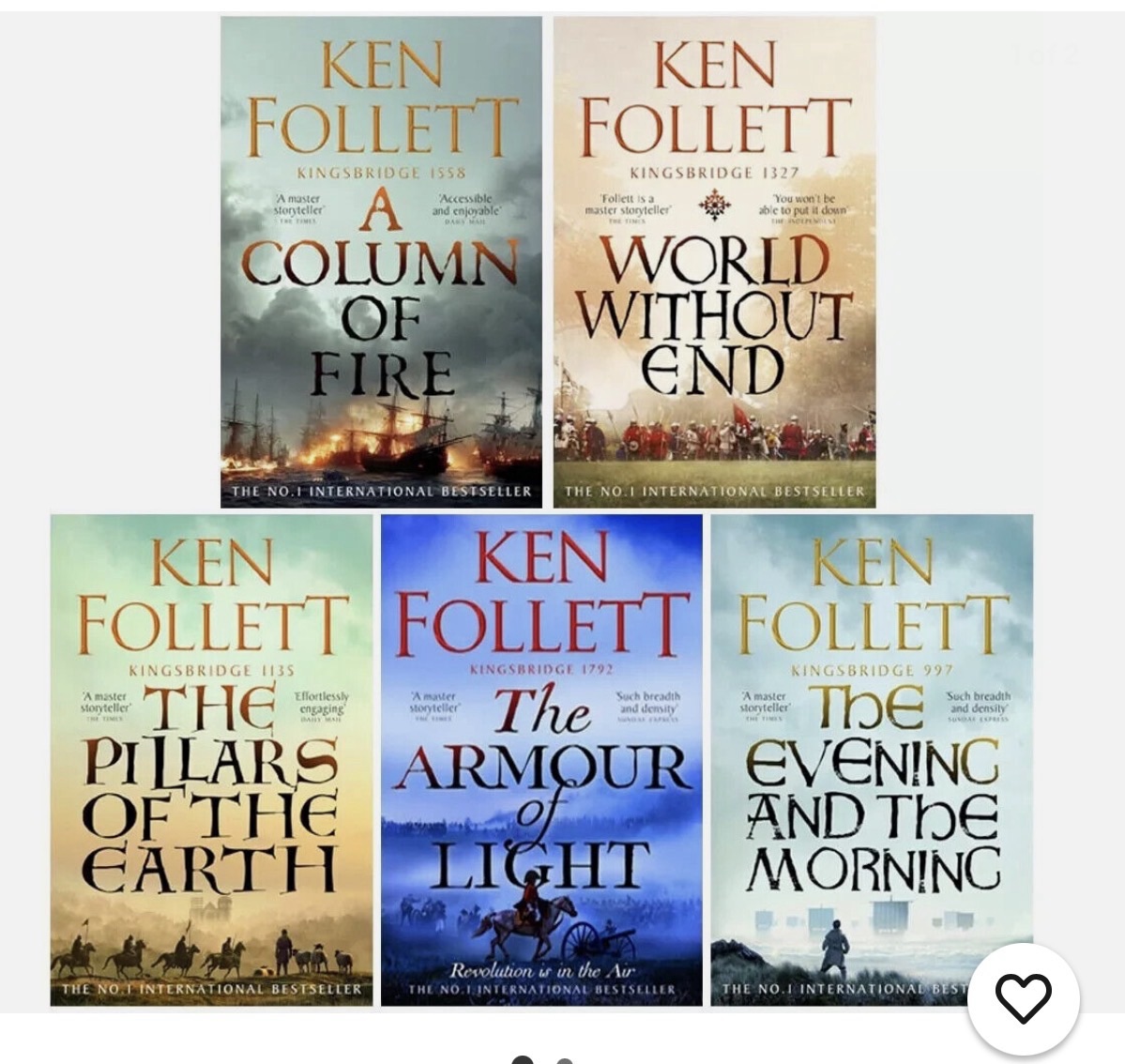
I could have chosen Ken Follett’s The Pillars of the Earth because I’ve recently devoured the entire Kingsbridge series and even signed up for his BBC Maestro course to study how he constructs a saga. Or Hilary Mantel, Salman Rushdie, H.G. Wells, David Nichols, Jonathan Coe, or a dozen wartime historians (First World War). But perhaps the books that matter most are not necessarily the “greatest” books. They are the ones that attach themselves to your identity and continue travelling alongside you for decades.
And if I could only take one book with me?
“Ay, there’s the rub”.
Hamlet. Have I mention Hamlet?
Can I belatedly ask for ‘The Complete Works of Shakespeare” to replace Brewer’s Dictionary of Phrase and Fable?

Leave a Reply