
Fifty Years Ago: Saturday, 3rd July 1976
(Sedbergh School, Age 14.9)
The day began with the usual confusion over lessons during the last weeks of term. It’s Saturday morning but I have I noted down that we are getting Thursday’s lesson timetsble.
I went to English. It was peculiar. Not many people around! Two boys thought it was Tuesday’s lesson timetable and had arrived convinced they were in the right place. so a school governed by bells, timetables and routines, had lost its place? Why couldn’t we just stick with Saturday? No wonder we managed to lose track of where we were supposed to be. We didn’t look at schedules eleven weeks into the term – we simply followed the usual routine for that day of the week.
Then came the best news of the day.
History exam result in: I came first!
I was delighted and genuinely surprised.
History never felt like work in the way other subjects did. Revision for Maths, Chemistry or Physics always seemed to involve forcing facts into my reluctant brain. History was different. I read the books because I wanted to. I followed trails of curiosity wherever they led. It felt less like studying and more like reading stories.
At the time we had been working through The Making of a Nation 1603–1689 by A. J. Patrick. We had also studied the Tolpuddle Martyrs. Yet much of my real education in history was happening elsewhere.
My father now lived at Appleby Castle.
That extraordinary place had become my own personal timeline stretching back two thousand years. History was no longer trapped inside books. I could look down into a Roman well beside the car port. I could sit in a medieval stone long-drop lavatory next to my father’s study. I could eat breakfast beneath a Norman portcullis dating from the twelfth century. I could read in a sixteenth-century chapel and sunbathe on top of a thirteenth-century round tower.
Most remarkable of all was Lady Anne Clifford’s Great Picture, which had recently returned to the castle. Through it I found myself drawn into a family story that connected Elizabeth I, James I, Charles I and Charles II. The centuries stopped being dates and became people.
Perhaps that was why I came first.
History required facts, but it also required imagination and enough English to communicate your ideas. For once I seemed to possess both.
Yet is nit be taking History next year or for O’ levels. I had chosen sciences, had to take two maths, two English and a modern language which left me with either Geography or History but not both! The only two subjects I’d come too of. So I dropped history. I’d keep up the reading regardless.
French: talk to Mr Poyo.
The nickname survives; the reason for seeing him does not.
Maths: revise.
French.
Break.
German consisted of going over points and then starting the next chapter.
Lunch.
Questions by a Professor.
This remains one of the great mysteries of the diary. The word “Professor” was not one I would have used casually. To me it meant an expert, someone at the very top of their field. Why he was there and what he was discussing I have no idea.
The next note says:
Write masses. Whatever the Professor had been talking about, it mattered enough for me to fill pages and pages of an exercise book with notes. Looking back, that seems characteristic. Even then I instinctively understood the value of recording things. The daily diary itself proves that. Something about the occasion struck me as important enough to preserve.
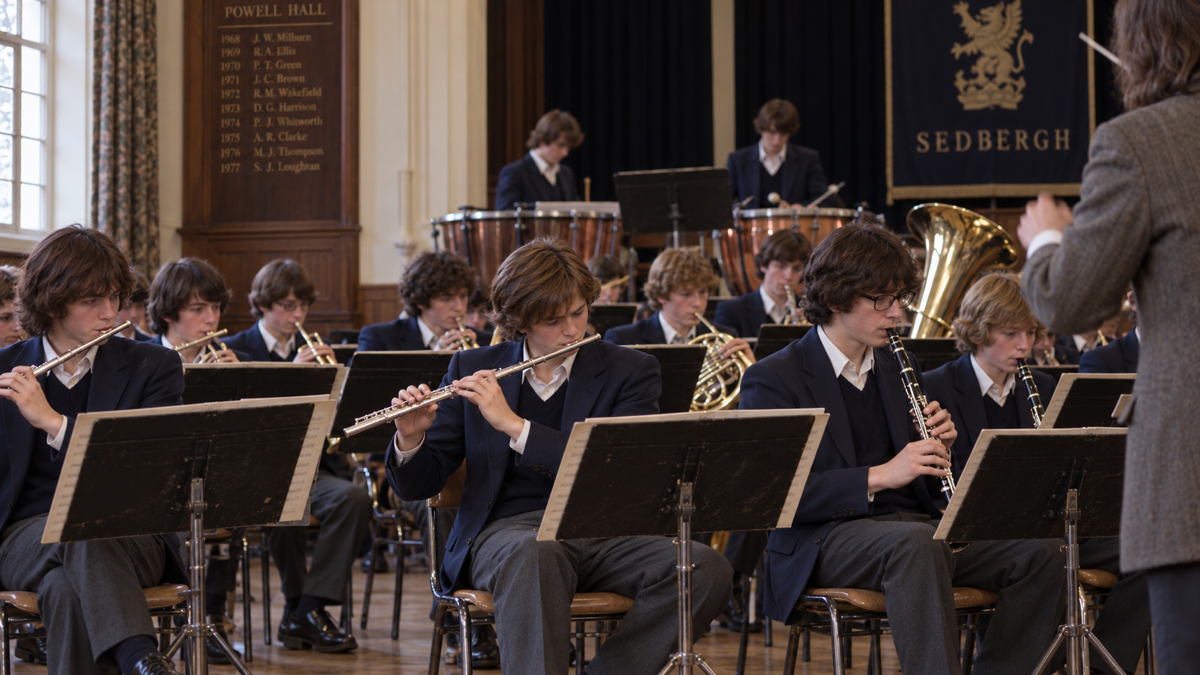
Was it an event in Powell Hall that we all attended? What was the talk about!?
Swimming followed.
Relay practice.
I swam frontcrawl. I was the fastest freestyle swimmer available, so that was where I was most useful. Relay sessions always felt different from ordinary training. Individual races depended on you alone. Relays carried a shared responsibility. One poor take-over could lose the race for everyone.
Athletics afterwards.
Throw discus.
I was willing enough but hardly gifted. Throwing events always seemed to belong to a different species of schoolboy.
Then came one of the great pleasures of the summer of 1976.
Sunbathe.
Not on a crowded field. Somewhere secluded. Somewhere hidden. If I could get away with it I would strip down to my Speedos. If I was absolutely certain nobody could see me, sometimes I would strip off altogether and enjoy the warmth all over my body in complete solitude. Your birthday suit is tangible. You know it is there when to you are named.
The weather that summer seemed endless.
Discuss.
The word is wonderfully vague. I rarely sat with a fixed group of friends. If I sought conversation it was usually with older boys, thoughtful boys, clever boys. Intelligence was not something you advertised openly at Sedbergh. Too many boys regarded academic curiosity with suspicion or contempt. The slow, the crude and the vulgar often set the tone.
Yet there were always exceptions.
A few older boys possessed a quiet confidence and seriousness that I admired. Conversations with them felt different. They ranged beyond school gossip and sport towards books, ideas, politics, universities and life beyond Sedbergh.
Don’t revise.
An unusually honest instruction.
Perhaps the History result had given me confidence. Perhaps the heatwave had simply defeated all ambition. Either way, revision was abandoned.
Get up early.
The eternal promise.
Finally:
Type out.
I owned a typewriter and had developed a theory. If I transformed my handwritten notes into typed notes, perhaps the facts would somehow stick in my head.
They didn’t.
What I was really doing was teaching myself to type.
Without realising it, I was slowly becoming a touch typist


Leave a Reply