
‘It seems to me that I follow only the most accessible thread. Three or four threads may be agitated, like telegraph wires, at the same time, and if I were to tap them all I would reveal such a mixture of innocence and duplicity, generosity and calculation, fear and courage. I cannot tell the whole truth simply because I would have to write four journals at once. I often would have to retrace my steps, because of my vice for embellishment‘. Anais Nin
(Henry & June, Journals, July 1932)
In January 1993 I believed I had a problem: I could not decide whether I was keeping a diary, a journal, a notebook, a dream record, a scrapbook, a writer’s workbook, a confessional, or a logbook.
The answer, viewed from 2026, is obvious.
It was all of those things.
What I thought was a failure to settle on a form was actually the discovery of one.
I now realise that I have never really kept a diary in the conventional sense. Even the Five-Year Diary I kept as a teenager was less a diary than a trigger mechanism for memory. Fifty years later, a cryptic line about washing my hair, swimming in the Rawthey, or writing fifty German sayings can unlock an entire day. The sparse record was not the memory; it was the key to the memory.
The journals that followed became something different again. They were laboratories.
I see now that I was trying to solve a problem that every diarist eventually encounters. Life does not arrive in neat categories. A day contains events, dreams, ideas, books, anxieties, fantasies, plans, conversations, memories and observations all at once. The desire to split them into separate volumes was admirable but ultimately futile. Human consciousness is not organised like a filing cabinet.
Anaïs Nin was right. We live several journals simultaneously.
The difference is that I eventually stopped trying to separate them.
Looking back from the age of sixty-four, after decades of handwritten journals, a daily weblog begun in 1999, an Open University study blog maintained since 2010, a swimming coaching blog stretching across more than a decade, thousands of photographs, notebooks, dream records, essays and now the reconstruction of diaries dating back to March 1975, I can see that a single thread runs through all of it.
Curiosity.
I was never really recording events.
I was recording attention.
The subjects changed. At different times I examined relationships, education, literature, dreams, technology, swimming, politics, environmental issues, family life and personal development. But the underlying impulse remained remarkably constant: to notice things, to preserve them and then to ask what they meant.
The 1993 version of me worried about embellishment and performance. I wondered whether I was writing truth or creating stories. Reading this now, I think that concern was misplaced. Memory itself is an act of composition. The moment we choose what to record, we are already shaping reality into narrative.
The question is not whether diaries are truthful.
The question is whether they are honest.
Those are different things.
A diary can contain factual inaccuracies and still reveal profound truths about the person who wrote it. Equally, it can record events with forensic precision while concealing everything important.
One of the great surprises of revisiting my teenage diaries is discovering how often the fourteen-year-old was more candid than the adult. The boy who scribbled five lines in a school diary sometimes revealed more than the man who filled ten pages of A4.
The online blogs introduced another dimension. The presence of an audience changes the nature of writing. Even when readers are supportive, the act of publication introduces performance. Yet I found that public writing and private writing served different purposes. The private journal allowed exploration. The public blog allowed communication. Both were necessary.
What I failed to foresee in 1993 was how valuable accumulation would become.
I wrote that “it all counts. It all mounts.”
That line feels prophetic now.
The notebooks I stacked in cupboards, the files saved on floppy disks, Zip drives, CDs, hard drives and cloud services have become something I never anticipated: a longitudinal study of a life. Not because the events themselves are extraordinary, but because continuity is rare. Few people possess an almost uninterrupted record stretching from adolescence into their sixties.
The journals have become a dialogue across time.
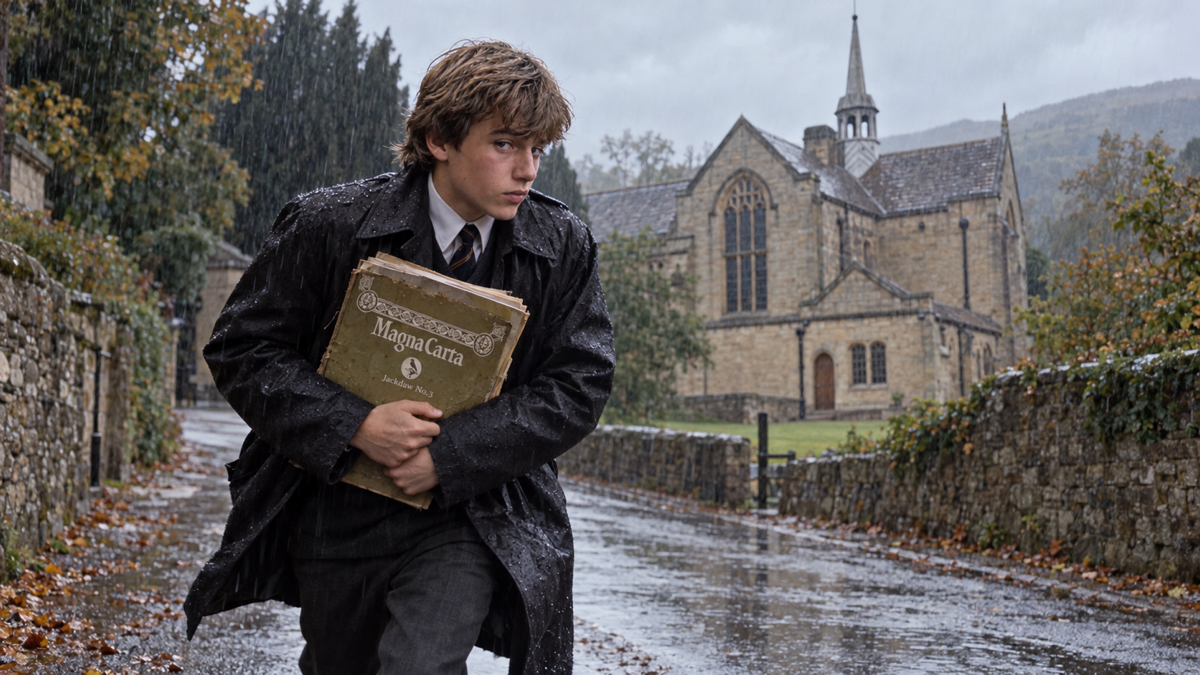
The boy at Sedbergh speaks to the undergraduate at Oxford. The young copywriter argues with the middle-aged online educator. The swimming coach compares notes with the dream recorder. The councillor consults the environmental campaigner. The sixty-four-year-old reads the words of the fourteen-year-old and discovers that many of the questions remain unchanged.
Who am I?
What happened?
What does it mean?
How should I live?
In 1993 I wondered how many journals I needed.
The answer turns out to have been one.
One journal in many forms.
One conversation conducted over half a century.
One attempt, never completed and never completable, to pay attention to a life as it unfolds.
The irony is that the thing I thought I was creating—a record of the present—has become something else entirely.
It is now a machine for travelling through time.



Leave a Reply