
Fifty Years Ago: Tuesday, 14th September 1976
(Winder House, Sedbergh School — age 14:11)
I was trying to teach myself Pitman shorthand and using it in the diary.
Mum was a Pepys fan — the diaries, the man and the era — and she’d been delighted that I was still keeping a diary after eighteen months. Grandpa had also told me about learning typing and shorthand as an office boy many decades ago – when men did alkbthe secretarial work in the office. For him it had meant self-improvement and money. He had paid for the classes himself, then earned an increment in his pay packet once he’d passed.
Typing already made sense to me, so shorthand was a natural extension. I had a beginner’s book, though not the one featuring a pretty female in a skirt, legs crossed, looking demure while taking shorthand. I had no ambition to become either a journalist or someone’s secretary. I was simply giving it a go.
The real attraction was speed: transferring memory and thoughts as quickly as I could think them. Pitman was compact, alien, clandestine and different. If I mastered it, it would be a sort of secret superpower. I practised it elsewhere too, not only in the diary.
The secrecy was useful. My diary had once been taken from my school locker and mocked when I was a junior boy, so making it harder for others to read had obvious appeal. In truth they’d in all likelihood be bored to death.
The schoolday was now reduced to bullet points; each lesson given the briefest possible verdict. That was often enough to satisfy the nightly obligation to write something. As a record of what we actually did, it was sadly inadequate.
German: boring as usual.
I disliked the mechanical building-up of a language in bits and pieces. It seemed to have little to do with how a language was really learnt. I had almost no evidence for this — a couple of skiing trips had barely exposed me to French — but I was already certain that German would be a chore.
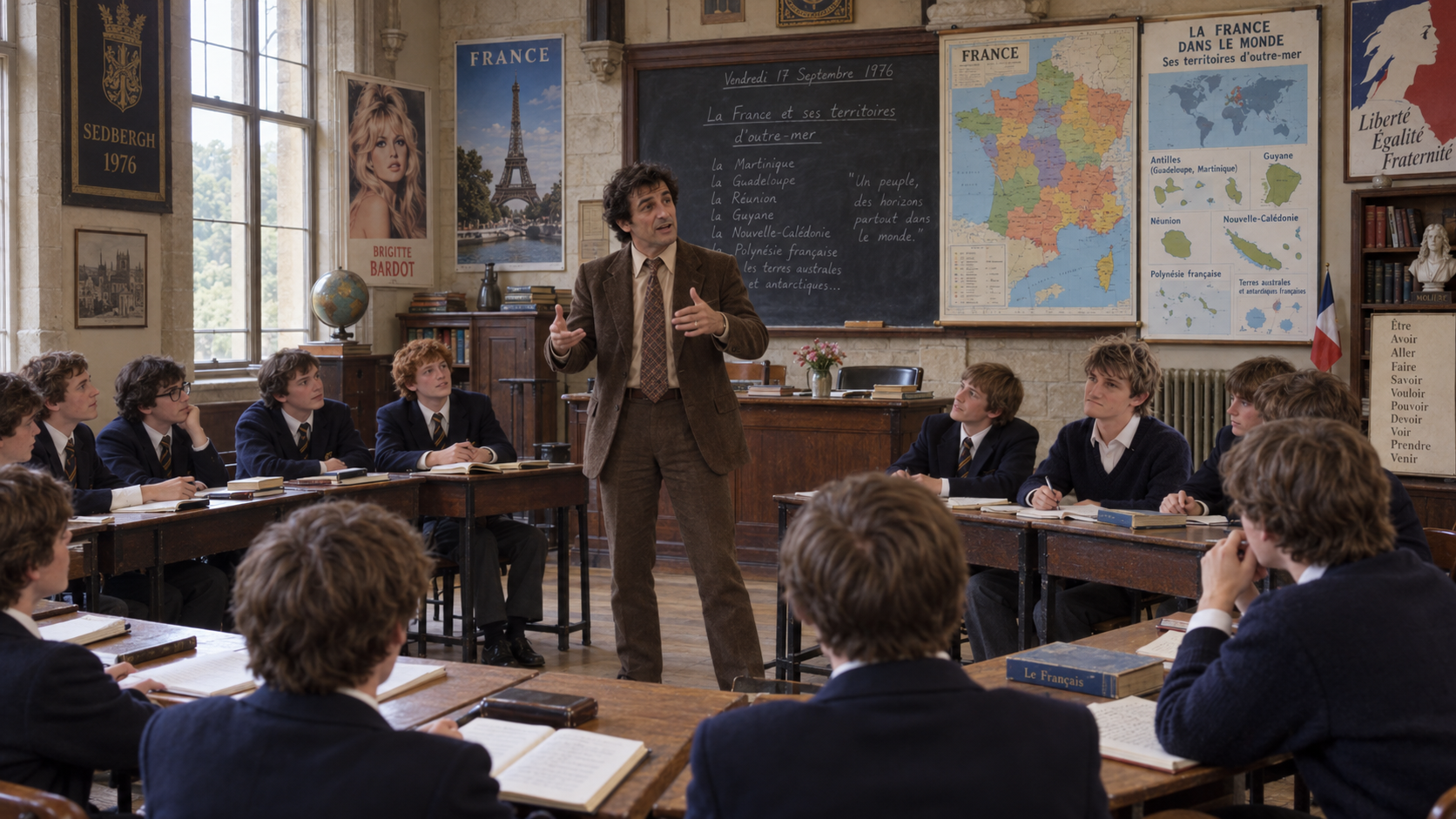
French with Mr Poyet. He was vachement grand or quite excellent. And he was actuellement French – on sabbatical, which made him different from our normal language teachers – an Englishman who’d spent some time abroad. We were learning about France rather than merely French: maps and images, geography and history. Today we looked at the French territories scattered around the world. Martinique remained in my memory because of the Caribbean.
This suited me. At this point we were not being taxed very seriously to read French, write it or speak it, which probably helped.
Unfortunately, Mr Poyet’s Frenchness also offered fourteen-year-old boys opportunities. Any weakness — misunderstanding what we said, not knowing a school rule — could be exploited. Rules could be invented. Accents could be adopted. Trouble could be created. A group of malevolent fourteen-year-olds would collectively discover what they could get away with. Chatting in the background with a Geordie accent.
Double Biology: with Mrs Rogers – good.
This was my first lesson with a woman teacher in nearly six years. She was younger than our mums but older than our big sisters. There were no women on the normal teaching staff, unless you include Pottery or music lessons.
We were unusually muted with Mrs Rogers. We were self-conscious, but we were also reluctant to test the boundaries as we did with most teachers. We held back the way we usually spoke about girls and women: less banter, no being crude. I think Mrs Rogers was only standing in.
Biology often meant a practical; otherwise just note-taking. We were working through Biology Text I: Introducing Living Things and Biology Text II: Life and Living Processes.
Lower English: Richard III. Typically we spent several weeks simply reading Shakespeare aloud around the class. It was not such a torment if you got a part. The trouble was that if I did, I would flick ahead to find my next lines and read them several times so that I was ready. Meanwhile I stopped listening to everyone else and literally missed the plot.
My enjoyment of Shakespeare could easily be killed by the way it was taught: fragmented, disjointed, licked over and then tested to see what we recollected.
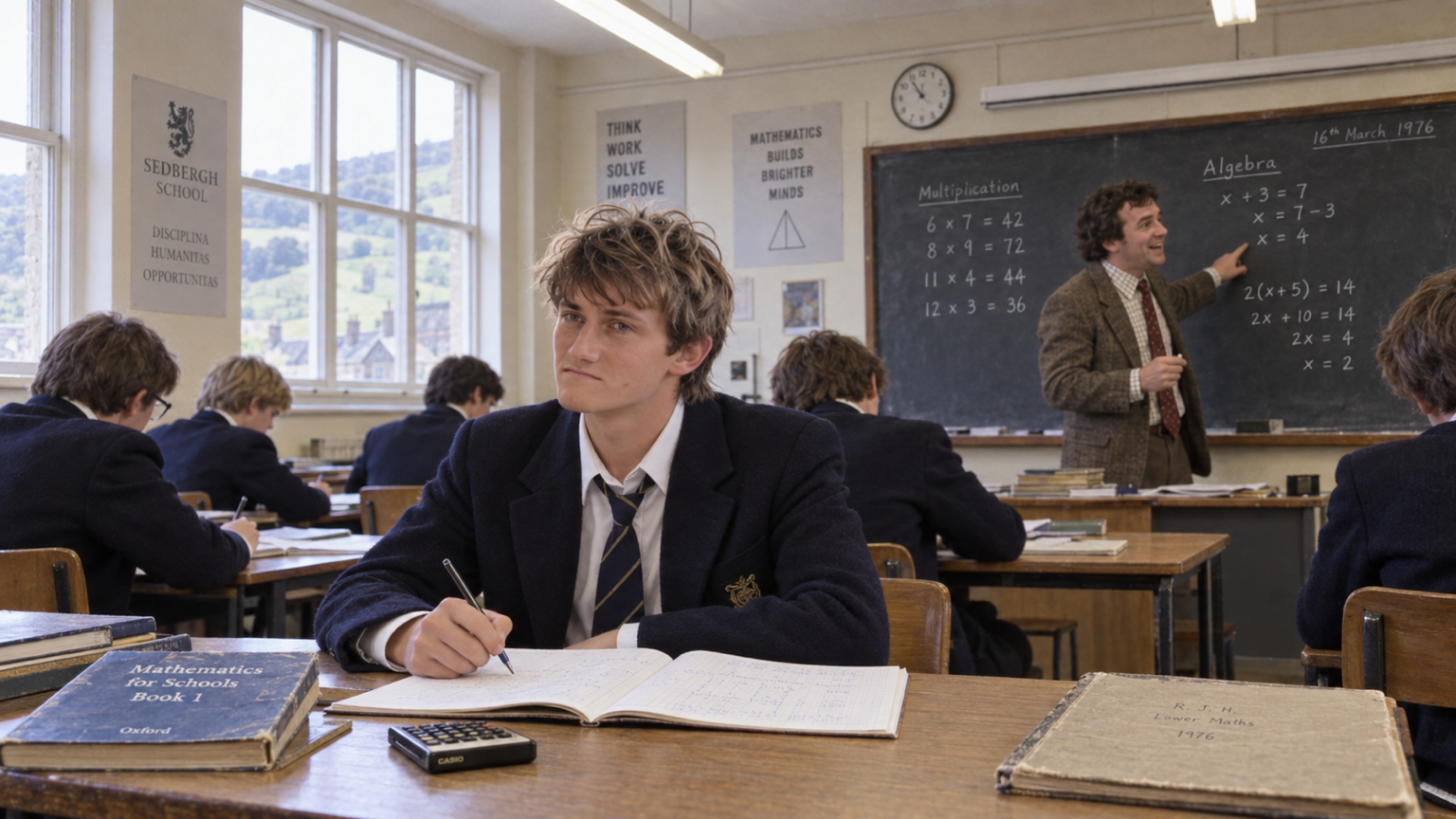
Maths: with Mr Wood.
My worries about being in the lower Maths set were already being vindicated. I had always been in the top Maths set from the age of nine. I had been an A-grade student at Common Entrance. Being put in the lower set felt as if I had been kicked out of the team.
Then I handed in prep which I had taken ages over and had got mostly wrong.
With Maths that made me more determined, not less. There was a right answer.
I liked to think that if enough time and effort were applied to something I could improve. It was the same logic as swimming or music: work hard, get better, rise through the ranks. There was something intrinsically pleasing about solving a problem, reaching an answer and knowing it was right. There were not many subjects where you could get 100%.
We were tested and placed all the time. A result might be Geography 2/11, 73% or German 9/9, 21%. Form Rank was explicit. A report home could be cruel. “He is inept at languages as he won’t out in the effort” – that kind of thing.
I already felt at ease with Art, Geography and History. Swimming too. They were mine. I wanted Maths, English, Biology and Physics to become mine in the same way. German, French and Chemistry felt as though they might always remain chores.
Then lunch.
Games: I swam – an hour or perhaps ninety minutes in the four-lane, 25-metre school pool. Sixteen swimmers would have been the maximum and there were often fewer than twelve. We were organised largely by age and speed and mostly swam front crawl, though some boys specialised.
Swimming had not always been well coached at Sedbergh, but water itself remained my domain. Here, unlike the lower Maths set, I already knew where I belonged.
Afterwards I went to the Grubber. We usually went together and met boys from other houses there. We queued to be served by three elderly, rotund and whiffy women: Marathon bars, Polo mints, Coca-Cola, Smiths crisps.
Then I played squash with Eddie. I’d known him for years because he’d been a chorister at Mowden.
Boys from Mowden could feel like siblings by then: they were simply there and there was nothing you could do about it.
Squash was easy to arrange, needed no teacher, you could choose your opponent, and there were always ways to improve. The game with Eddie was relaxed. Court availability and gaps in our timetable determined when we played.
Then prep.
French seemed easy. Biology was just reading – working through the standard text.
At the end of prep I had coffee and biscuits in “the hatch”, beside the Winder House kitchens. The House provided milk and kettled. Sometimes there was a tray of home-baked rock cakes or something similar, baked I liked to think, with tender loving care by the girls who working part-time in the kitchens. Fraternisation was discouraged and probably forbidden.
That was the day: boring, grand, good, wrong, easy. Lessons, swimming, Grubber, squash, prep, coffee and biscuits.
I was never homesick so a schoolday could quite naturally shrunk to this sequence of activities and verdicts.


Leave a Reply