
Tuesday, 19th October 1976
(Winder House, Sedbergh School. Age 15)
We were having Wednesday’s afternoon lessons today as well as tomorrow. We had no idea why!
Our timetable was usually predictable. Lessons every morning, Monday to Saturday inclusive. Three lessons before break, making two and a quarter hours, half an hour’s break, then another two lessons before lunch. Lunch around 1.00 or 1.30. Games, known as Exercise or simply Ex., at 2.30. We had another two afternoon lessons on Mondays, Tuesdays, Thursdays and Fridays, starting around 4.30 and lasting an hour and a half. The evening meal was in House at 6.30, followed by prep from 7.30 to 8.30.
So why we were having Wednesday’s afternoon lessons twice was a mystery.
German: OK but dull. Nothing exceptional.
I had to do two languages in the Third and Fourth Forms. I’d been doing Latin since I was nine and hadn’t enjoyed either the subject or the teacher, so I thought I’d give German a go. It hadn’t worked out particularly well. The teaching was dull, the exercises repetitive, the language difficult, and I wasn’t particularly interested.
I’d be dropping German at the end of the year.
Chemistry: Got the results of yesterday’s Chemistry block test. 56/60!
So far, so good. This was only my second year of Chemistry, and I seemed to be doing well enough. Mr Barrett, our Chemistry teacher, was meticulous and expected good results. He wasn’t so good with stragglers.
We learnt Chemistry through experiments in the Nuffield book on Basic Chemistry. I liked the practical approach and was keeping up with it. Somewhere along the way I was going to lose the plot, but for the moment I understood what we were doing.
Games: I played No. 3 (tight-head prop) in rugger.
I’d played just about every position in the scrum since I was nine. I’d started on the wing in Colts rugby at Mowden Hall, my prep school, and had even played hooker. As I got taller, I’d played prop or second row, eventually playing second row in the senior school team and earning my school colours.
At Sedbergh I was still being moved around the forwards. No. 8, second row, prop. I could play rugby well enough, but I was a reluctant rugby player who had never identified as a ‘hearty Berghian’.
There were plenty who did. Rugby was what mattered at Sedbergh. The backs were often athletic, almost balletic, while the forwards were variously bulky, with their Bullworkers, chest expanders and press-ups. Being good at rugger counted for a great deal.
Swimming came first for me. I’d learnt to swim when I was four or five and had been with a swimming club since I was seven. By the time I arrived at Sedbergh, I’d been swimming competitively for years.
Yet my skill as a swimmer counted for very little. School and House rugby took precedence. In the Easter term it was fell running, and in the summer cricket came before swimming. At least I was truly useless at cricket!
My mother had challenged this, and so had I, to no avail. It had been much the same at Mowden Hall, where the school had refused to accommodate the opportunity I had been offered to swim with a local club, even though Mum was prepared to provide the transport.
I was resigned to this arrangement but appalled at the way swimming was denigrated. I’d put years into it, yet rugby remained the measure of a boy’s sporting ability.
How much effort I put into rugger depended on the game and my mood. Sometimes I held back. At other times I got stuck into the scrum. I wasn’t much cop at catching an incoming ball or kicking it back. I’d once been put at fullback and was genuinely useless. I was best when the ball was put into my hands, or when I snatched it from the scrum and barged through.
So there I was, playing tight-head prop.
Tea: I had peanut butter on toast.
Bread from the House pantry and my own glass jar of peanut butter. Tea was something we prepared for ourselves, using the toaster in the pantry or one of the gas hobs along the corridors.
Projects: Glued my tea-tray.
Woodwork was one of our compulsory Projects. I’d previously made a pendant from a piece of yew, carving and polishing the wood into the shape of a heart.
Now I was making a tea-tray. I glued it together, though the handles eventually came off.
Fail.
Woodwork wasn’t really for me. I liked making things when I needed something and felt capable of making it, but my heart had to be behind the project. Compulsory woodwork didn’t have quite the same appeal.
Prep: I only finished my prep on chemical position.
By comparing which element ‘wins’ in a chemical competition, we were establishing its chemical position on the reactivity scale relative to other elements. This was a foundation used in subsequent lessons to explain metal extraction, corrosion and electrolysis.
I left the three revision preps I had to do.
I had a habit of waking early to do revision. If I didn’t finish everything during evening prep, there was always the morning.
Diary: I wrote up 5th January 1970 as a story.
This was my first attempt to write up my day. It was something I’d started when I was eight, nearly seven years earlier.
I’d called it Days & Dayze.
The title was about the bewildering experience of life itself.
On Monday, 5th January 1970, I’d decided to write about a day in my life. Why that particular day? It had chosen me.
It was early in the New Year, the beginning of a new decade. I was at home at Orchard House, Fencer Hill Park, near Newcastle, still a day pupil at Ascham House. My older brother, Rick, had been away at Mowden Hall boarding school since the previous September.
I missed him. No more scrapping, competing or doing things together in the garden. No more climbing trees, exploring the woods or going to the swimming baths together. No more shared baths.
Apparently I’d missed him so much that I would join him at Mowden myself, possibly in the summer term rather than waiting until September.
Perhaps I wanted to capture what being at home was like.
I’d written on the lined pages of an A5 pad, using an ink pen. Big, bold letters, longhand, joined up, with no paragraphs. I’d gone to some trouble to make a cover, weaving plain white plastic drinking straws with plain lollipop sticks, held together with string and glue. I’d made a glued-down dust cover using pictures cut from magazine pages.
It was a proper little book.
Mum had always encouraged me to keep my drawings and paintings. Never throw anything away. You learnt from past efforts. She kept some of her own work, and I’d applied her advice to my writing too.
It was something I’d written, something I’d extracted from my head and put on the page.
Perhaps the elaborate binding was why Days & Dayze had survived six and a half years. Perhaps I’d always planned to finish it.
I had the original pages in front of me.
I’d only managed the first fifteen minutes of consciousness before giving up. There were already multiple pages describing waking and going down to breakfast.
I wanted to document everything I sensed and thought, including the decisions I took.
I could remember my bedroom at Orchard House and the sounds of the house in the morning. Mum was in the kitchen immediately below me. I could hear the washing-up, the kettle boiling, cupboards and drawers opening and closing. She would be emptying the dishwasher from the night before, making toast, putting on the extractor fan and opening the kitchen curtains.
Along the landing, where my older brother and sister slept, everything was silent.
I was always the first of us children up.
I remembered the route from my bedroom to the breakfast room vividly, every step of the way.
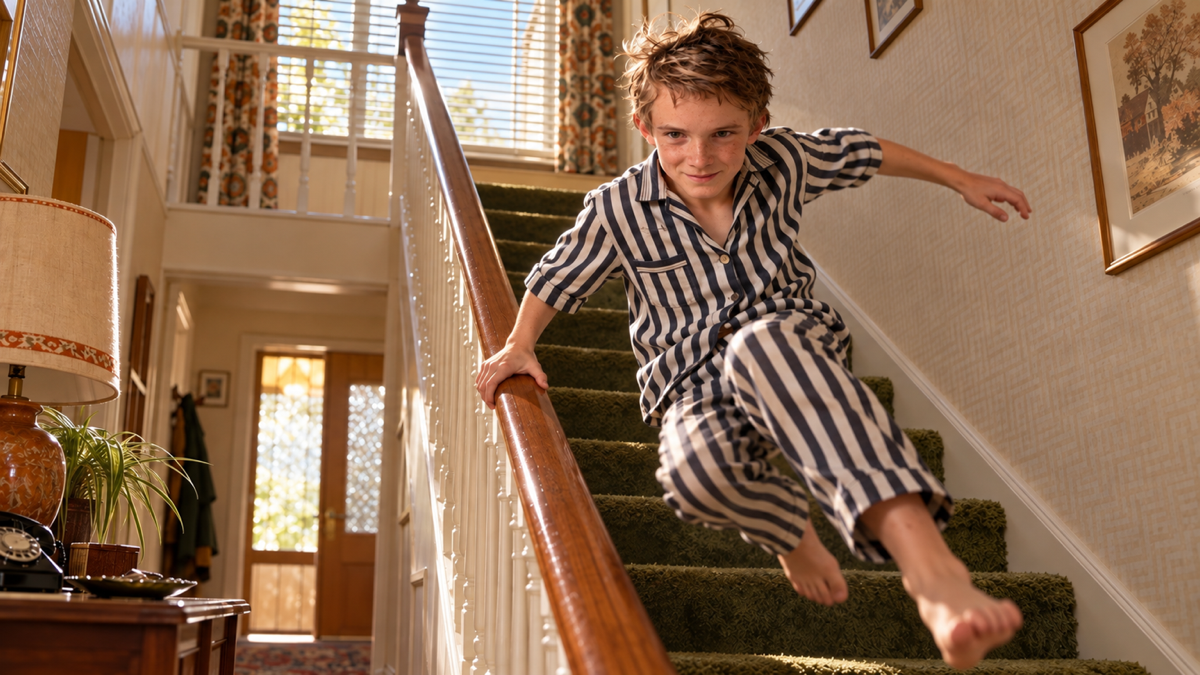
There was the white gloss-painted balustrade, the polished beechwood bannister and the green carpet. Venetian blinds hung in front of the window that looked out onto the top of the garage.
I moved around the house like a monkey. Swinging, sliding, hurtling. Rick did much the same. I’d practised and refined the business of getting downstairs for elegance and speed.
I swung off the top bannister to clear three steps, took two leaps over a further four steps, and narrowly missed sliding into the hall table. Crashing into the hall table wasn’t unknown either.
All this had seemed worth recording.
And not simply what I did, but what I thought about doing, the decisions I took, everything I noticed along the way.
For a period I’d made a conscious effort to travel through the day taking everything in. Being observant. Sniffing the air, touching things, seeing and feeling textures, noticing colours, feeling warmth or a draft.
I thought a good deal about my body, what it meant to be alive, whether I could trust my thoughts, why I did certain things, and whether everybody thought the same things in the same way.
Sometimes everything seemed hyperreal and I couldn’t quite believe what it meant to be alive.
What did it mean?
I could lie in bed thinking about it, or wallow in the bath. I could stand barefoot on the concrete of the garage, conscious of the sensation under my feet, or look very closely at the coloured pixels of a television screen.
I was fascinated by the detail of things. We had a magnifying glass and toy microscopes with sets of slides. I liked looking at things close up.
I didn’t read much, though I looked at books. Colour illustrations of the human body fascinated me.
There was something extraordinary about having a body, being conscious of it, and wondering how it all worked.
Could I trust my thoughts? Did everybody experience being alive in the same way? Was I alone in thinking these things? What was right and wrong? Why were we here?
The meaning of life.
I didn’t talk about these thoughts. They were entirely private.
My grandfather was telling me detailed, grisly accounts of his experiences as a machine gunner on the battlefields of the Somme and Passchendaele during the First World War. There was certainly plenty to think about.
Trying to remain so observant for an entire day was exhausting and unsustainable.
Writing it all down was worse.
I had the pages I’d written in 1970 in front of me, and rather than take the story any further, I was tempted to add still more detail to the moments I’d already recorded.
The appearance of my bedroom. What I thought about on waking. The sounds of Mum downstairs. Getting dressed. The decisions involved in leaving the room. The silence along the landing. The bannister. The stairs. The hall table.
Everything.
The original account was over the top. No parameters. No beginning, middle and end.
But it was an archive. A moment captured. Something I’d extracted from my head and put on the page.
This time I was copying it out, improving the English and turning it into a story.
I added my sister. Perhaps the two of us got as far as sitting in front of the television, or getting the guinea pigs out. It was still a memoir of an eight-year-old, written by a fifteen-year-old.
But I could take it somewhere else.
Suppose the children came downstairs and discovered that Mum wasn’t there?
Suppose there was no electricity?
Suppose the guinea pigs could talk?
That sort of thing.
The ordinary day could become something altogether different.
Yet the problem remained. The original description was so detailed that I could spend pages getting out of bed and going downstairs without the story having begun.
If I was going to write about an entire day, I supposed it would have to be as long as it took. I imagined getting to the end only as I fell asleep, adding the final full stop.
‘And now I fall asleep.’
But I hadn’t even got to breakfast.
I worried that I could spend all day writing about writing all day.
There was the conundrum.
My efforts to write up the day ended before I even got to breakfast.

Leave a Reply