What was your first ever videogame?

My first instinct was not to answer this question because I was convinced I had never played a video game!
But of course I have. Quite a few, as it turns out. It’s just that my experience is so prehistoric compared with today’s video games that it’s rather like comparing Michelangelo’s ceiling of the Sistine Chapel with a child’s stick drawing of a dog. Though perhaps that’s unfair to the stick drawing. There was something wonderfully inventive about those early games.
My first video game was Pong. But the first one that really got its hooks into me was Age of Empires.
Pong (1972). We played it as children and thought it a technological marvel. Two rectangular bats, a little square ball and a black-and-white television screen. You moved your bat up and down to play a crude approximation of table tennis. That was it. No characters, no scenery, no storyline, no spectacular graphics. Yet the idea that you could control something happening on a television screen was extraordinary. Until then, television had been something you watched, not something you played.
Space Invaders (1978), which I played at every opportunity, though those opportunities were rare. Rows of descending aliens, a little laser cannon at the bottom of the screen and the increasingly desperate business of shooting them before they reached you. Simple, repetitive and utterly addictive. You put your money in the machine and tried to make it last.
Asteroids (1979) followed, with its little triangular spaceship spinning about in space, firing at rocks that broke into smaller rocks. Then Pac-Man (1980), racing around a maze eating dots while being pursued by ghosts. Each was a refinement of the last, introducing different challenges and demanding quicker reactions.
Eventually, games migrated from the amusement arcade to the personal computer. Tetris, which I came to know in its 1989 incarnation, was a particular favourite on my Mac. Falling geometric shapes that had to be rotated and fitted together to complete horizontal lines. Deceptively simple, infuriatingly difficult and almost impossible to put down. There was always the temptation to have one more go.
All these games were suitably addictive, but none truly captured me for days on end.
That honour belongs to Age of Empires (1997).

Here was something altogether different. A game that combined my love of history and geography with strategy, problem-solving and the business of building and managing a civilisation. You gathered resources, established settlements, developed technologies, trained armies and fought battles. You had to think ahead, manage competing priorities and decide whether to invest in economic development or military strength.
I was engrossed.
I played for days, determined to complete every stage before I could consider the game finished. Then came Age of Empires II: The Age of Kings (1999), which was even better, and eventually Age of Empires III (2005).
These were games I could lose myself in. Not simply because they were entertaining, but because they demanded thought, planning and persistence. There was always another civilisation to develop, another campaign to complete, another strategy to try.
I wonder how many days of my life I devoted to building imaginary civilisations, only to see them destroyed because I hadn’t trained enough cavalry.
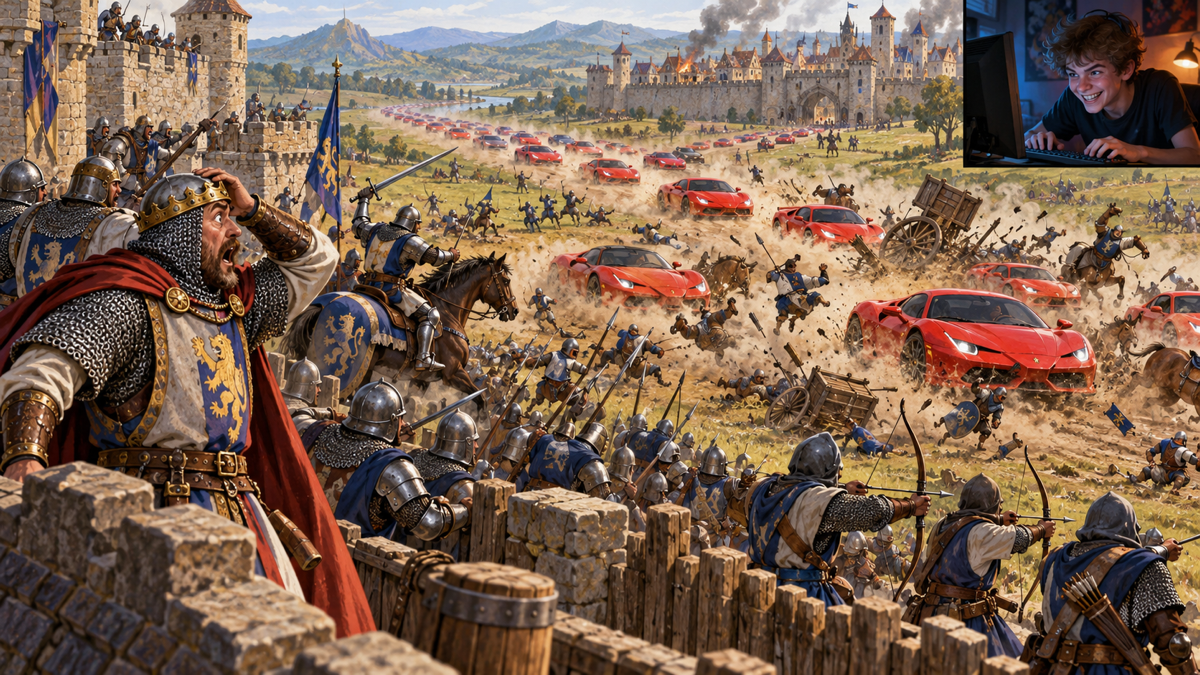
Or to have my carefully constructed medieval world invaded and conquered by a swarm of twenty-first-century sports cars!
That was my son’s doing. When he took to playing Age of Empires, he discovered the delights of the game’s various cheats. While I was diligently gathering timber, mining gold, training archers and assembling my cavalry, he was summoning fleets of sports cars to overwhelm my medieval armies. Hundreds of years of technological development bypassed at the stroke of a keyboard.
He loved his cheats. I was confounded.
Talking of which, he also tried to introduce me to World of Warcraft.
I had an educational interest in this. I wanted to explore how living through the experiences of an imaginary character in a virtual world might influence someone’s behaviour in the real one. What happened when you adopted an alternative identity, developed skills, accumulated possessions and formed relationships in a world that existed entirely inside a computer? Could experiences in that world change the way you behaved outside it?
Anyway, we created a fantastical female fighter whom we called Val d’Esire.

I took to it rather well. I learnt how to navigate this extraordinary world, fight enemies, complete quests and improve my character’s abilities. There was something compelling about inhabiting this alternative identity and watching her develop.
Until I came home one day to discover Val d’Esire wandering around in what amounted to bikini-like underwear.
Where had all her clothes gone? Her armour? Her equipment?
My son had sold the lot.
Apparently, he had decided that my character’s possessions were a useful source of funds with which to upgrade his own equipment. Val d’Esire’s carefully accumulated kit had been converted into spending money for his character. She was left wandering about virtually naked while he enjoyed the benefits.
I don’t know what educational lesson that taught me.
Perhaps something about the dangers of trusting your offspring with your virtual possessions. Or the difference between my earnest desire to understand identity, behaviour and learning in immersive environments and my son’s more pragmatic approach to getting ahead.
And I mustn’t forget Tomb Raider (1996), with Lara Croft exploring ancient tombs, solving puzzles and performing increasingly improbable feats of athleticism. That appealed to a different part of me: the explorer, the adventurer, the person who wanted to discover what lay around the next corner.
Looking back, there is a clear progression from those first two white rectangles batting a square across a television screen to the elaborate historical and fantastical worlds of Age of Empires and World of Warcraft.
What strikes me is that the games that really held my attention were not necessarily those demanding the fastest reactions. They were the ones that combined exploration, learning, problem-solving and a challenge worth mastering.
And perhaps that’s why, despite initially thinking I had never played a video game, I can remember these so clearly.
So my first video game was Pong. But the first one that really got its hooks into me was Age of Empires.
And if I learnt anything from World of Warcraft, it was never to leave my son in charge of my wardrobe.



Leave a Reply