
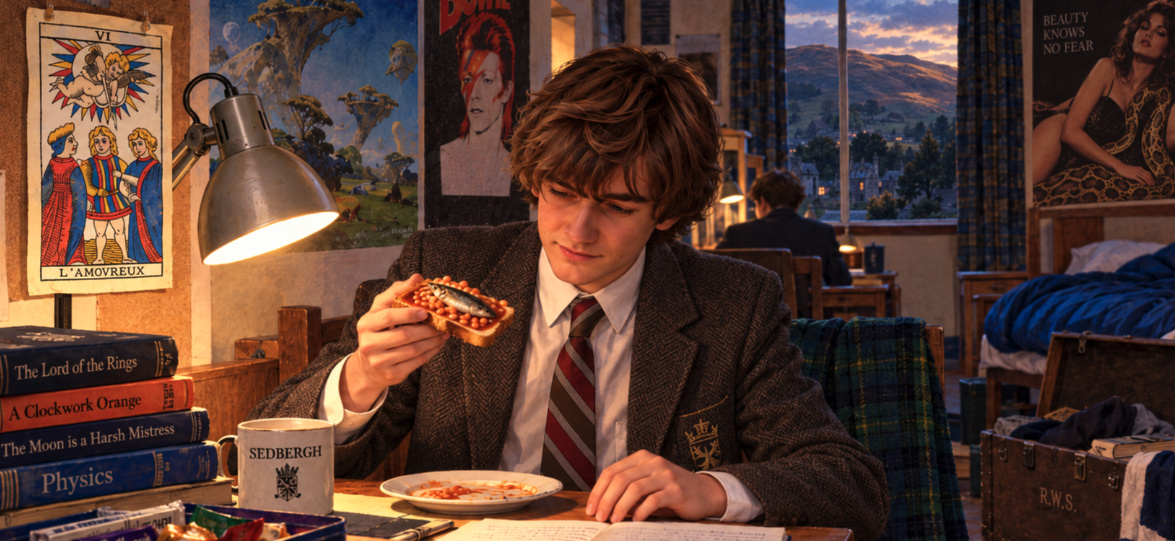
Fifty Years On. I find myself thinking about the nature of the education I received at Sedbergh School in the mid-1970s. I kept a diary badly. I have the evidence in cryptic, often mystifying codes and abbreviations.
It’s the North Yorkshire Moors; we’re surrounded by the Howgills. It’s winter from September to May. Even in summer the Sun rarely shines. 1976 turned out nice though.
We’re as far away from civilisation as you can get in England. An Alcatraz of an establishment, surrounded by hills greasy with grass, the only way in and out on narrow single lanes embarked with dry stone walls. It wasn’t an educational institution with pretensions at being a centre of learning like Winchester or Harrow; at Sedbergh it was about ‘character building’ – you took the shit and the religion and you survived, thrived or left. Departures routes included: expulsion, a long trek out policed by aggressive sheep, or hitchhiking- tourists passing through were your best bet.
Too many of the teachers were dull. Were they even qualified? The Army, Navy or Church was the only qualification for some – and whar did that qualify rhem for? Some teachers came to Sedbergh to escape, others for the boys.
The boys (myself included) came from various backgrounds. There were no scholarships; everyone had money. We were the sons of industrialists, corporate climbers, merchants, farmers, members of the armed services, and the clergy. Or so it seemed. Too many were brutish.
The buildings are far less grand than they claim. Functional, not a statement. The chapel is exactly that, not a cathedral to Christianity.
The routines verged on the fanatical. Religion was tagged into every corner of the day.
Because I gave Tarot Card readings, a Korean priest exorcised me. They asked me to wear a crucifix. I was made to destroy one card in the pack. It was like something out of The Omen. I had two packs. I didn’t believe in any kind of spiritual force, good or evil, I just made it up. It staggered me how much those I read for wanted to believe what I said. I can fix the deck so that the cards played out as I wanted. I always liked to end with drama:
The Tower > Sudden collapse. Illusions destroyed. Institutions fail.
Death > Irreversible ending → transformation. Not symbolic “change”— loss.
The Devil > Entrapment, addiction, power structures, moral compromise.
The Lovers > Choice under emotional pressure; desire meets consequence.
My father’s point of view didn’t help: he called public schools dinosaurs and thought they were on the way out. Despite that, he paid the hefty boarding bills for two of us. He even became a governor of Rossall School, his Alma Mater.
Boys were expected to work, run, play, attend chapel, and do prep. Prefects, to keep the machinery of school life turning. Everything had its place in the timetable. There was fagging: running errands, cleaning shoes, emptying bins, and, notoriously, warming bog seats and providing toast to boys in a bath. There were tedious punishments given out by prefects called ‘maps’ (Japan was the usual option) and by teachers called ‘impositions’ (impots: for short). Boys were regularly caned – usually for drinking-related offenses. Boys caught with a girl were expelled. Boys caught together were sent to the chapel to pray, or to the rifle range to shoot off.
I am a professional educator. I have experience in schools and corporates, with an MA in Open and Distance Education, and a Dip.Ed, as well as degrees in History and in Geography, and Senior Coaching qualifications. How we learn fascinated me. I was an online support teacher for Coursera’s ‘Learning How to Learn’. I have grave reservations about what Sedbergh was doing in the 1970s. There was too little love of learning and a poor understanding of what it required.
Some parents were paying school fees to have other boys beat the shit out of their son. Boys were bullied; I’m staggered at the lack of suicides. Boys ran off (I did eventually). I was ‘bated’- malicious and relentless name-calling, which in my case turned into violent scrapping.
The Machinery of School
The system was religious and regimented; the armed services was the destination for many. Each day ran to a strict timetable.
Prayers in House. Certainly in assembly. Grace said before every meal. Evening prayers in House every day, Chapel on Sunday morning – all compulsory unless you were Jewish. I was an atheist – this didn’t count. For my sins in giving Tarot Card readings, I was exorcised by a South Korean priest. He asked me to wear a crucifix. I was also made to destroy one card in the pack. It felt like I was a character in the Omen.
Lessons followed one another with brisk efficiency. I recall 45 minutes per class, 90 minutes for a double period is my guess.
English, French, Maths, Latin, Geography, Chemistry, Physics, Biology. I’d read somewhere that History was a waste of time for school students, so I didn’t take it.
Break back at the House: coffee and a Milky Way.
Lunch back at the House.
Games: Rugger in winter and spring. Running, especially in March, for the Ten Mile. Cricket in summer. Alternatives: swimming in a four-lane pool; squash or fives. Shooting.
Then back to class for late afternoon lessons except on Wednesday.
Supper back in House.
Then Evening prep under supervision by house prefects.
Saturday was a school day
We had classes in the morning and games in the afternoon. The only difference was the lack of formal prep in the evening. Instead, we’d expect to pay for and attend something turgid and worthy in Powell Hall. We had to dress up like little Lord Fauntleroy in our Sunday Best. We then got to hear an opera singer or harpsichordist. At best, we had a slideshow about climbers falling off K2. All of this was ‘character building’. We, too, could climb Everest in our bare feet while listening to Elgar on our soon-to-be-invented Sony Walkman.
If you stayed inside ‘The System’, and did what was required, the assumption was that knowledge would gradually accumulate. Your mediocre education would be followed by attendance at a mediocre university and a mediocre job.
There was very little sense that the system might adjust to the individual boy.
Textbooks and Rote Learning
Much of the teaching relied on set texts and repetition. Reading out loud. Copying stuff out. In French, we worked our way through Le Petit Nicolas, translating line by line. In English, we read A Midsummer Night’s Dream. Latin involved endless verb and noun tables. Geography sometimes meant copying notes from film strips or textbooks.
The method was straightforward and unimaginative:
Text → Exercise → Prep → Mark.
The emphasis was on memorising and reproducing material rather than exploring ideas.
Looking back, it feels like a curriculum designed for efficiency rather than curiosity.
If You Fell Behind
One feature of the system stands out in hindsight. It moved forward relentlessly.
Lessons progressed, whether or not you had fully understood the previous one. If you fell behind, the expectation was that you would catch up during prep. There was little sense of structured support or recovery.
Some boys managed perfectly well under that arrangement. Others simply drifted further behind, quietly and without much comment.
The school did not pause.
The Problem of Boredom
Reading my five year diary entries from the time, certain words and phrases reappear again and again: dull.
“Very dull.”
“Bored”
“Bished it.”
“Confused.”
It wasn’t that the subjects themselves were uninteresting. Far from it. What was missing was a sense that the material connected to the wider world. The engaging teacher was the exception to the rule. We had a few too many societal misfits, and at least one alcoholic taking our classes.
I often found real intellectual excitement in what I was reading outside the classroom. I read books like 2001: A Space Odyssey or Suedehead. Those books felt alive in a way the classroom often did not.
I suspect much of my real education was happening in parallel to the official one.
Results, When Required
When the time came for exams, however, I could produce results:
- Geography — A
- Maths — A
- Additional Maths — A,
- Biology — A
- Physics — B
- English Literature — B
- English Language — B
- Chemistry — C
- French — C.
I should have got straight As.
Which suggests that the system worked, at least in its own terms. If a boy applied himself to the requirements of the syllabus, he could do well enough.
But doing well in exams and being intellectually engaged are not quite the same thing.
Where is art? Where is creativity?
What the School Gave Me
It would be unfair to suggest that Sedbergh gave me nothing.
It gave structure. It taught independence. It assumed boys could manage their own work and get on with things. There was an expectation of incompetence and little space to grow independently. My diary was stolen from my locker. It was read out to the junior common room – a fight followed in which I came out the loser. It only put me off for a few weeks.
The school provided the scaffolding – I’m surprised only one boy is known to have hanged himself.
Looking Back in Anger
Fifty years later, what I see is a system that was good for one thing. It maintained an elitist tradition, neither it nor the boys attending warranted, and produced so-so exam results.
It failed to recognise that we learn in different ways.
Curiosity, imagination, and exploration were largely left to chance.
In my case, those instincts survived. In fact, they may even have been strengthened by the need to pursue them independently. I scabbed off games to head into the fells to read and draw. The most curious outcome of all was that the education shaping me most was not on the timetable.
Footnote
Were all the teachers qualified?
Were some teachers by dint of their experience in the church or the armed services alone? Did teachers seek to advance their understanding of how we learn? Some teachers had a hunger and knack for teaching, but several fell a long way short of the mark. I had the impression that some fell into teaching. They didn’t enjoy it. They felt that a posting to Sedbergh was like being sent to Siberia. Some made a short foray north and then returned to the southern uplands of a ‘proper’ public school like Charterhouse. More likely, Sedbergh was their dead end and their sentence – like mine. Three years of posh prison that I could have done without.
Fifty years on I am only into my second term at Sedbergh, Spring Term 1976. I’ve got a further seven terms to get through: Summer 1976, the academic year 1976/1977, and the academic year 1977/1978. After that, I was off to the Royal Grammar School, Newcastle. The diary doesn’t stop there. We get Balliol College, Oxford and beyond. History at Birmingham. The School of Communication Arts, London. An MA in Education from the Open University. A Dip.ed from Brighton. And various swim coaching qualifications from the Institute of Swimming.



Leave a Reply