
Fifty Years Ago: Saturday, 4th September 1976
(Gosforth — Age 14:11)
I decided to go for a swim.
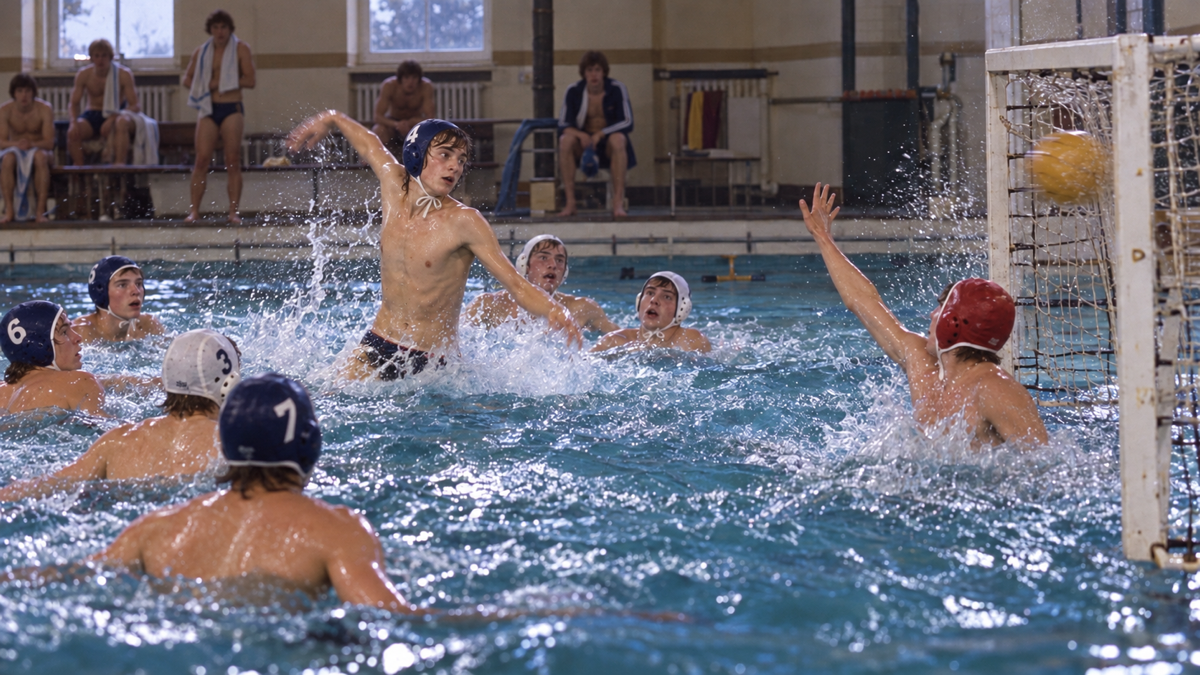
I thought of it as swimming training, but my desire and need to swim felt more like my spirit returning to where it needed to be. No one had suggested this to me. It was just what I routinely did. I didn’t only do ‘lengths’ – tricky in a pool without lane ropes where many people preferred to swim widths.
I often treated water as sanctuary – a place to meditate. At some point, maybe two or three times in any session, I’d settle at the deep end, or halfway up the pool. The depth mattered. I’d drop to the bottom, let my legs bend, then gently push back to the surface, take one deep breath, then sink again. Always in a tight streamline. Gradually I’d spend a little bit longer underwater. I never timed it, but I took my time. I might do this ten times or even twenty.
Part of the bobbing up and down was waiting for a gap up the pool. There were no lane ropes and the chance of having to contend with someone doing widths was high. At the deep end there was a High Diving Board and a spring board. I couldn’t do lengths if these were open.
At some point I’d decide the moment was approaching when I’d sprint the length of the pool. I’d feel my heart rate increase and my body psych itself up. One last, intoxicating breath of air, a hastened drop, bounce off the bottom, then I’d anchor my feet on the side of the pool and push off like a water creature on a quest.
The glide, the accelerating fly kick, then swim would build into a frenzied yet controlled and exhilarating sprint. I felt myself cruise down the pool like a powerboat and hit the wall at speed. It was a thrilling sensation to skim through the water. I intuitively knew that breathing slowed me down, so probably took only a couple of breaths. It was a 25m pool.
I didn’t look for applause. But I felt it was a performance.
I hoped heads turned. Did you see that? How fast was that?
As a competitive swimmer, this feel for the water and preparation to race stood me in good stead.
As I set off from the Swimming Baths, I realised the chain was broken on my bike.
I walked. It was only a mile, a journey I’d been making since the pool opened in 1968. I knew every building and shop. Probably every tree (There weren’t many).
I turned Right out of the pool towards the Great North Road. The Regent Centre Buildings opposite did not yet exist, or were minimal. There was no Metro Station either. Past Gosforth Library on the right. Sometimes I’d pop in to browse, use a reference book, or borrow a book Mum had recommended.
The Greyhound stadium on the other side of the main road was a landmark, with advertising hoardings in front of it.
Then left, following the Great North Road all the way home.
Heading down a gentle hill, on my left was the Territorial Army Reserves Centre and a bus stop, then the substantial playing fields in front of the campus of Gosforth Comprehensive. Then a couple of stand-alone warehouse-like shops, carpets or furniture, then a petrol garage. I remembered when attendants filled up.
Cross Park Road to Ebletts, the corner shop and newsagents.
My grandfather lived along Park Road on Kensington Avenue. There were various shops and a bus stop there. A few hundred yards of semi-detached houses lined the road, then another bus stop at the bottom of the hill.
I’d have got off at all of these bus stops at some point for one reason or another: traffic jam, to go to Granny and Grandpa’s, to stop off for sweets and, and on a couple of occasions, simply because, “I’ve never got off here before.”
Then the major roundabout. Cross.
A golf club on the left. Onwards to the iconic Three Mile Garage, which was our sweet shop. At the time it was both a petrol station and a repairs workshop. For a memorable period, it had a dragster parked up in front of it.
Onwards to Gosforth Rugby Club. Their colours were the same as our Mowden Hall School colours: green and white stripes. I played at least one game there and remembered the plunge bath, which was effectively a small square room with a sunken bath. You stepped into the room and into the murky, soapy, muddy, hot waters of a shared pool.
Then I was well into the home stretch.
The shoulder-high sandstone wall by the path enclosed the historic Fencer Hill Park Estate, which, in two phases in the 1940s and then the 1960s, sold two batches of four plots, each a little under a quarter of an acre, to build large detached homes. Our five-bedroom home was one of these.
I turned into the narrow private Fencer Hill Drive. There was a painted white gate, permanently open, and a single-storey lodge. Then the densely wooded Rookery, thick with rooks and forever stinking of their guano.
Up Fencer Hill Park.
Our house was set back from the drive, directly opposite the original manor house, Dursley.
I was home.
Orchard House stood on a half-acre plot with a wrap-around garden and drive.
Sometimes, halfway home, I could pop in and see Granny and Grandpa. They were elderly and their back sitting room was as warm as a sauna because of the gas fire.
At the Swimming Baths, even the floor gave me things to look at. The toilets had terrazzo-effect safety vinyl or speckled, mottled sheet vinyl. I saw faces in it.
I watched Junior TV.
Saturday morning television was still replacing the morning matinee of cartoons and B movies at the local cinema, the Royalty. Junior TV was on ITV, Tyne Tees Television, and featured things like The Brady Bunch and The Flintstones. At 10:45 there was Paulus the Wood Gnome, before The Geordie Scene for local music.
It was Saturday. I had lunch, and in the afternoon played the flute
I’d started the flute at eleven and also played piano. Both had been chosen for me. I went on to Grade V flute, Grade V Theory and Grade III piano. We didn’t even have a piano at home. I’d been in the school choir since I was eight or nine. This had serious work to do: every morning assembly, Church every Sunday, a season of carols and readings at Christmas, the Tynedale Music Festival and the odd wedding and record.
I’d wanted to learn the guitar, but Mowden, in their wisdom, wouldn’t permit it. Guitars, like radios, comics and biros, were banned.
So I played the flute. I was a Grade V flautist and played in the school orchestra. I could read music and used the flute to pick out tunes from sheet music. But I wasn’t ever competent enough to truly enjoy it.
A Mowden friend had come over while I was out. I didn’t see him.
He’d been in the year above me at Mowden, an awkward age/cohort difference that I always found difficult because I had age, school year and school so embedded in my DNA. He wasn’t even at Sedbergh. He went to Fettes.
He was great at sports. I’d swum with him at school but never matched his talents at cricket or rugby. I had, though, played and beaten Peter at squash.
People would drop in if they had been at Northern Rugby Club opposite for a game, to watch a game, or because they’d been playing squash. I think Fettes went back during the following week.
Sally from Australia came. A close friend of Mum’s had emigrated to Australia in the 1950s. Sally was her daughter, paying a visit to Mum. I guessed she was nineteen or twenty, on a gap year.
We watched The Duchess of Duke Street on TV. It wasn’t my cup of tea, but Mum enjoyed it.
After Match of the Day (which not being a football fan I never watched), at 10:30, we (Mum and I and my kid sister) watched what I described as a ‘maddish film about a mentally retarded girl who fell in love and it ended happily’.

(George Hamilton and Yvette Mimieux in Light in the Piazza as featured in IMDb)
It was ‘Light in the Piazza’
About a young American woman Clara Johnson’s visiting Italy with her mother. Clara has an intellectual disability (resulting from a childhood head injury) that leaves her with the mental age of a child. She falls in love with a handsome young Italian man who is unaware of her condition and loves her for her innocence. Her mother initially tries to prevent the romance, but the film culminates in an emotional, happy ending as they get married in Florence with her mother’s blessing.
Meanwhile the countdown tomorrow be returned to Sedbergh the following Saturday afternoon was on.
Before then there would be all the usual preparations. Kit lists. Labels sewn into clothes. Haircut. Shoes. Trunk. Tuck box. Visits to Isaac Walton’s for kit.
Mum once gave me a handwritten note which said, “please give my son a school jacket and a skirt (size 7).”
I hadn’t read the note.
I went into town to visit my favourite hangout, the Kard Bar. She gave me a signed blank cheque. I hadn’t expected the strange look I got from the shop assistant when I dropped into Isaac Walton’s by Grey’s Monument.
My mum’s name probably gave them a clue. She had been purchasing both boys’ and girls’ uniforms for over ten years. Her name would have been in a ledger somewhere, along with lists of clothes first required for Mowden Hall Prep School, then Sedbergh for her sons, and Central High Junior and Senior schools for her daughters. By then my younger sister had moved to Westfield.
The private girls’ schools, all five of them, were differentiated by uniform colour. Central High: brown with gold highlights. Church High: bottle green. Westfield: navy blue and black. La Sagesse: also navy blue, but with a navy kilt. Dame Allan’s: maroon with red jumpers.
This time next week we’d be putting our trunks and tuck boxes on the private hire coach that would take us back.
I hadn’t coined the phrase “posh prison”, but that was exactly how I felt. I may have thought of it as a posh borstal.
I’d felt the same about Mowden. That I’d been sent there was some kind of punishment for something, and after my parents separated and divorced, it was to get rid of us so they could go off and find a new boyfriend or girlfriend.
I also thought of it as a boot camp. Sport was part of the culture 24/7.
Sedbergh was a kind of Shangri-La as well, surrounded on all sides by high, bleak, treeless moors and fells, from the Howgills to Baugh Fell. The journey across the Pennines in winter could be cut off by snowdrifts.
It felt remote.
An Alcatraz. An oil rig. An island.
I was resigned to my fate.
No more telly. No more trips to the shops, to the swimming pool. No more friends dropping in. No more seeing girls, not my girlfriend, not my sisters, not my mum.
No more soaking in a private bath.
No bedroom to myself.
Even lavatories at school felt like a public space. All meals were a collective experience with people you might like or loathe or feel nothing at all for. Often people you’d do your utmost to avoid in ‘Real’ life.
And in a week’s time, I was going back



Leave a Reply