
Fifty Years Ago: Wednesday, 8th September 1976
Gosforth — Age 14:11
I stayed in my room, avoiding the world, and then had a bath – another escape beneath the Badedas bubbles. I could be a boy for a while longer.
There was nowhere to hide at Sedbergh. At school I was, in effect, on permanent display. Rather than simply be myself, I might play the part, play the fool, turn into a ghost or get angry.
I had played the part to perfection at Mowden: not quite the model pupil, but a rule keeper rather than a rule breaker, good at sport and music, taking part in everything. I became a school prefect and Dormitory Captain and won the DC’s Prize a few times for the best-kept dormitory. I rejected most of that once I got to Sedbergh. I didn’t want to be somebody else’s internal police force or sergeant major.
There was a mould available if you wanted to fit into it: choir, chapel, rugger, cricket, orchestra, keen runner, looking after younger boys, sticking to the rules. I didn’t want it.
But following your own path carried risks too. Boys were horribly bullied, and because our world was essentially our House, at Winder I knew exactly who the bullies were and who was bullied. If I was baited — that was the word actually used, hideous as it sounds, like baiting dogs — I could get angry. So sometimes I became a ghost instead. Or I played the fool: not necessarily being comical, but producing some wisecrack, peculiar behaviour or attitude that made the boys, and sometimes a teacher, laugh.
Even having a bath at home mattered. At Sedbergh there were six bathtubs in one large tiled room, without cubicles, as well as communal showers. In theory you could bathe whenever you liked; in practice almost every part of the day was accounted for. There were perhaps three opportunities: before House breakfast, after games in the middle or late afternoon, or, if you were quick, after House supper or Prep.
I had already spent five years at boarding prep school getting dressed and undressed in front of other boys, with a communal plunge bath and showers, so there was nothing new about nudity. Puberty made it different. Bodies were changing at wildly different speeds. At twelve or thirteen some boys already looked like young men; at fourteen another might still look like a prepubescent twelve-year-old, while others had broken voices and were shaving. We noticed, of course, but generally left it alone. We had all been through some version of it, and picking on somebody for something they had no control over would have been considered mean.
So I stayed in my room and had my bath while I still could.
There wasn’t much incentive to start anything new anyway. The summer was ending. The parties were over. The swimmers were beginning to return to club swimming just as I was leaving again. There had never really been time to catch up.
Aunty Pat came – a close family friend. She’d been behind my getting a second-hand portable manual Smith Corona for Christmas two years earlier, along with touch-typing lessons. She would probably have been impressed by how much I used it. I typed stories and poems on it, and anything else that gave me an excuse to type.
Louise came over too, but she was there to see my kid sister. She was the sister of Tina, who had been a sort of girlfriend when I was eleven or twelve. My sister and her friends were generally two or more years younger than me and there was no real overlap between our circles. Tina was my age, though she often seemed older: more mature, more grown up.
There was a curious pattern to friendships between boys and girls in our circle. Girls at day schools might see boarding-school boys intensely in the holidays and then hardly at all during term. It probably suited plenty of parents. Their daughters could get on with schoolwork while the boys disappeared again.
Everything for Sedbergh was coming together. It was like mounting an expedition.
Had I got everything I needed?
It was easy enough to imagine I was preparing for Antarctica, moving to another country, searching for the source of the Nile or going to the Moon. Mum organised the trunk from the school list. The tuck box was mine.
It was a traditional wooden box with metal clasps and corners, a padlock and my initials — J F V — on the front. Inside was a raised compartment running across the width for pens, pencils and smaller things. Mine survived for at least another decade and was useful later for carting possessions between one home and another.
At school it contained chocolate spread, peanut butter, tins of beans and soup, sandwich spreads, dried pasta or rice. There were one or two gas rings on each corridor, and boys took turns heating things in pans, making toast or boiling water. I put books in there too: science fiction, and factual books about glaciers or the weather.
The tuck box was also private.
Everybody understood that. Boys and staff alike. I was never conscious of much stealing. I remember a Housemaster demanding that one boy open his tuck box. The boy refused. He was threatened with the cane and refused again. He was expelled.
I thought that was wrong.
A boy ought to have somewhere for his secrets, small or large.
If you were going to take anything illicit to school — cash, alcohol, cigarettes, an adult magazine or book — the expedition fantasy became rather more relevant. What did you take? What mattered enough to pack? What did you want with you if you were being sent away?
Eventually I asked Mum for money. Supposedly for Scott Joplin.
I had been putting it off. My fifteenth birthday was at the end of September and I would be at boarding school for it. It was recognised that I should have something early. Otherwise it was a sad sort of birthday: no family or friends coming over, nobody arriving with presents, nothing particularly special happening. So I could get something before I went back on Saturday, either to take with me or leave at home.
Scott Joplin was probably a record. We had seen The Sting together when it came out, so it was a perfectly likely purchase.
I went round to Granny W’s because I wanted my birthday money, which had already been promised. She was out, but I talked with Grandpa.
I didn’t have to seek him out. He was simply there. He never imposed himself and never tried to become a replacement father. He knew we already had one. He was just the most brilliant grandfather. My father was often elsewhere and Grandpa was around, though most of my actual talking was with Mum.
I would soon be away until Christmas, so there was every reason to pop round anyway.
I came home when Gran arrived after lunch.
I bought Monty Python.
It may have been a cassette, perhaps even a double cassette. I had a portable cassette recorder at school, nothing fancy. Scott Joplin and Monty Python were both entirely plausible purchases, so there may have been less deception in “supposedly” than it now sounds.
Monty Python was slightly for older boys, which helped. They were certainly preferable to The Goodies. I wasn’t one for quoting sketches, though. If I had to memorise lines for a play, it took a good deal of time and effort.
Then I started packing for home.
That was what I wrote.
Home.
Not a slip of the tongue but a slip of the pen. Somehow I had described returning to Sedbergh as going home.
There was an uncomfortable logic to it. Sedbergh offered the guaranteed familiarity of its daily and weekly routine. Home could be chaotic: parents in different countries, new partners, lives increasingly separate from ours; my older sister living with my father, going away to school herself and now perhaps heading for university.
Sedbergh, however much I resented returning, would still be there exactly as before. House breakfast, lessons, games, supper, Prep. The day accounted for.
Perhaps the pen knew that much.
What I rejected was the notion that the Housemaster and his wife somehow stood in for parents to an adopted family of about seventy boys. There was, as I remember it, no pastoral care worthy of the name. A boy was supposed to turn to God or to an older boy for succour. Matron was a martinet. The supposed parental arrangement was largely fiction.
At the time, though, I didn’t think much about boarding school as a social privilege. We operated inside our own circle. Privilege meant whether somebody had two skiing holidays or one. It was simply assumed that we would remain above the hoi polloi. Only much later could I put it another way: our privilege came at a cost.
Mum dealt with the trunk. I dealt with the tuck box.
At nine-ish I rang Julie-Anne.
She was definitely my girlfriend by then. We had been on several dates, kissed and held hands. Once I was back at school, contact would mostly mean letters and perhaps a rare phone call from the box in town.
I told her I was getting my hair cut.
She didn’t want it short.
That brought a wry smile. She cared enough to tell me how she wanted me to look. She seemed to prefer a certain trendy softness to the clipped, military or conservative public-school-boy look.
I listened.
The clipped hair, along with my aspirations to join the RAF, was over. Sedbergh itself was fairly lax by then. Beards weren’t allowed, but some boys had hair down to their shoulders. Nor was it simply about fitting in at school. At home I didn’t particularly want to advertise myself as the posh public-school boy either. I was perfectly willing to experiment with appearance, and would become more so.
So my hair was getting longer.
Of course I was about to disappear for the best part of three months. Whatever the hairdresser did now would have grown out by the time Julie-Anne saw me again.
At school we all talked about girlfriends: the ones we had, the ones we wanted and the ones we had lost. There was endless speculation about how you met, what happened on dates, how far you had got and whether you had “scored”.
You wanted to believe it all and believed nothing.
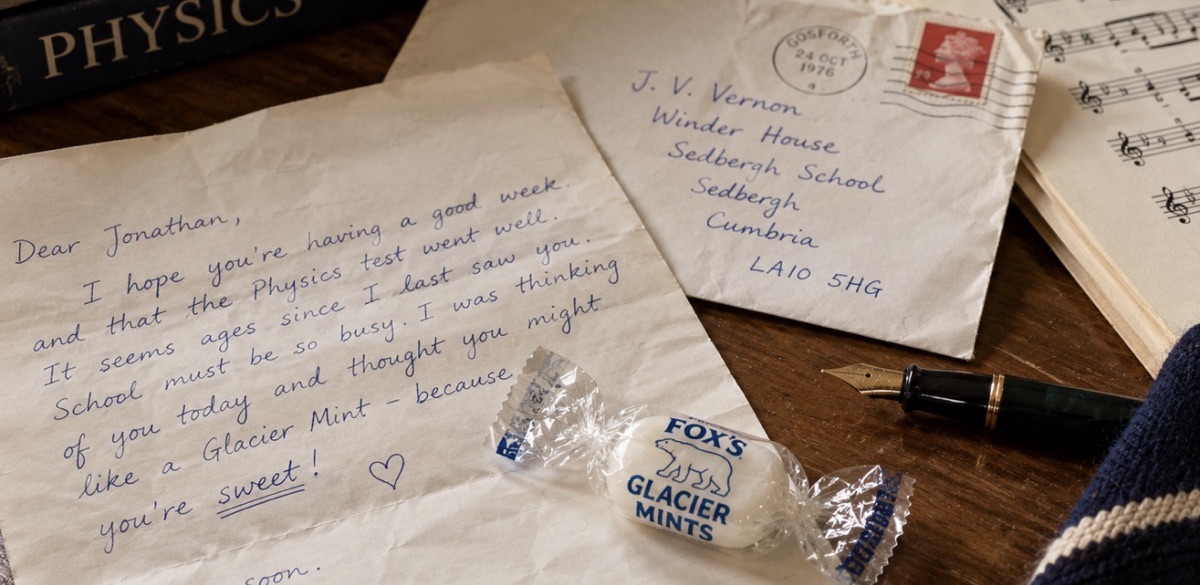
The letters themselves were different. They were as private as a tuck box. I never shared mine and, remarkably, nobody stole, read or ridiculed them. Even the worst bully might hesitate over that boundary, because once one boy’s letters or private things were fair game, everybody’s were.
Every letter and card sent to me from 1975 onwards still exists in its original envelope. Most I read on the morning they arrived and have never opened since.
For now Julie-Anne was still at the other end of the telephone, telling me not to cut my hair too short.
I watched TV



Leave a Reply