
Wednesday, 6th October 1976
(Winder House, Sedbergh School. Age 15.)
Geography: quite easy. Geography usually was one of the subjects I enjoyed rather than endured. I read around it anyway, in articles, magazines and books, so prep rarely felt like a chore. It was a pleasure to indulge. I was interested in places like California on the west coast of the United States and Ghana on the west coast of Africa, and once I started on something I could easily get carried away.
That was what happened with the last question. Getting carried away was not necessarily a good thing in a test. I could head off down a rabbit hole and use up time that ought to have gone on the other questions. I much preferred a blank sheet of paper to multiple choice. Give me choices and I would start doubting myself. Give me a blank page and I could trust my first thought and get on with it.
A Geography test might simply mean putting our names at the top of a sheet and numbering the answers one to ten. Sometimes the papers were handed in. Sometimes we exchanged them with the boy next to us and marked each other’s. This introduced its own possibilities. Fifteen-year-old boys could always manage a bit of mischievous gaming of the system: pretend to exchange papers, mark your own and quietly put in the correct answer. Whether the mark was entirely deserved or not, perhaps the right information still ended up embedding itself in your head.
Doing well academically was not necessarily admired in Winder, and to some extent not across the school either. There were plenty of other ways of establishing your place.
French: it went better because I had read the right chapter. I had been known not to. That could happen simply because an instruction had been given in French, I had not quite understood it and had not checked, or because I had assumed that the chapter for that week naturally followed the one we had just done.
The previous year we had read Le Petit Nicolas. By now we had moved on. I cannot remember exactly what we were reading that week — perhaps something from a book such as Madame Bovary, perhaps a Xeroxed article from Paris Match. It still seems a shame we were not simply working our way through Asterix the Gaul in French.
Biology: We’re working through Nuffield Biology, Introducing Living Things, roughly a chapter a week, and had reached reproduction and development in animals and man: external and internal fertilisation, eggs and sperm, mating toads, tadpoles and human reproduction.
A classroom full of fifteen-year-old boys could be serious, embarrassed, giggling and performatively knowledgeable at the same time. Mr Grey treated it straightforwardly, though naturally everyone’s attention and interest were heightened.
I noticed the diagrams more when they looked wrong.


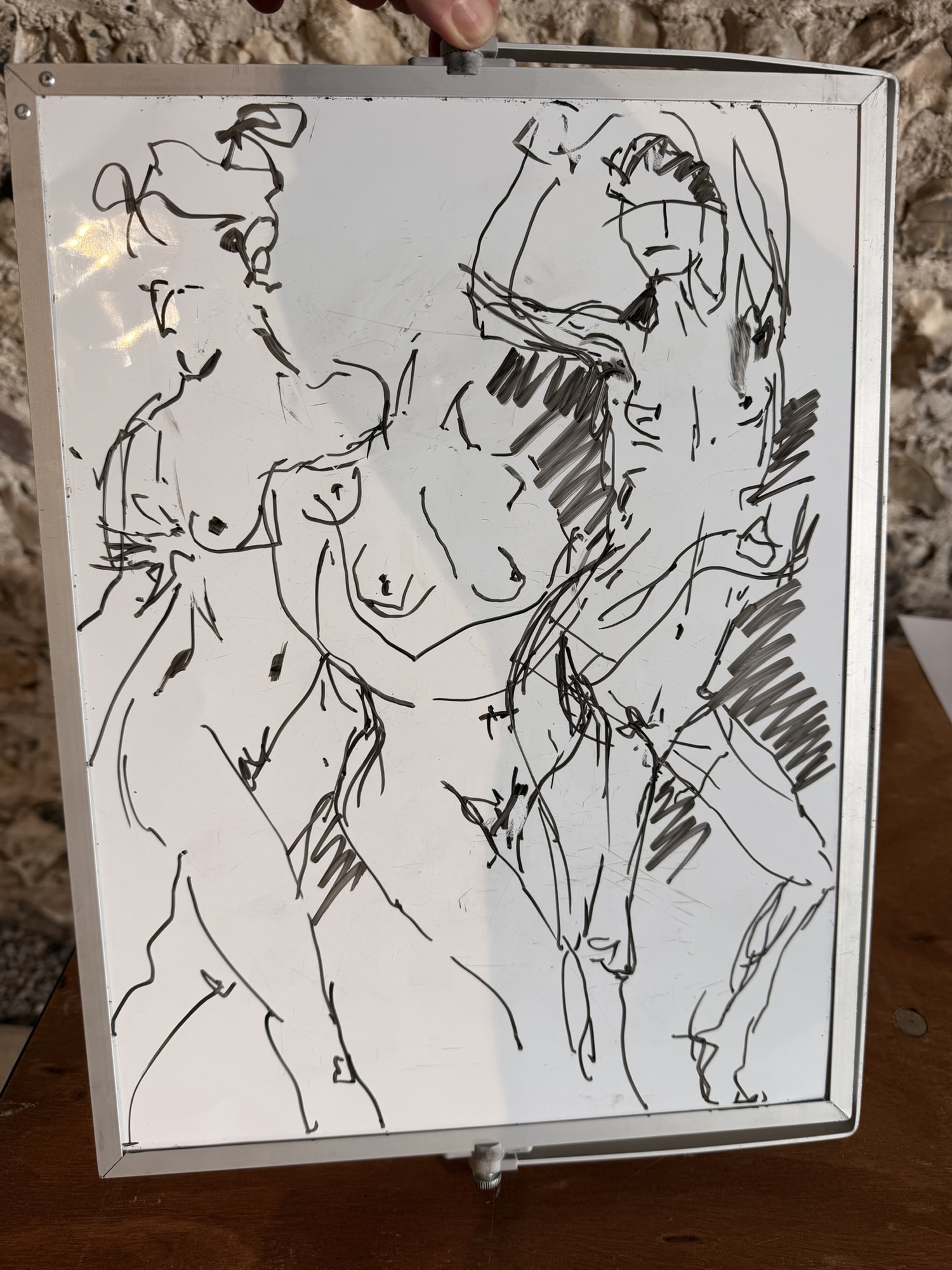
I drew people myself and was interested above all in the human figure. Girls had hips and pinched waist. It was one of the things that made them look like girls; I liked the way a girl stood and moved because she had hips. Boys did not. Yet the diagrams in Nuffield give both sexes hips, while other anatomical details were missing or disguised. It looked wrong. Or just lacking.
I did OK in the Biology test. The 18/20 belonged to the practical from the day before – a dissection. I remember a rat soaked in formaldehyde, cut open and pinned down with its legs splayed on a wooden board, like a miniature medieval torture rack.
P.E. with Mr Ken West, the new P.E. teacher who’s arrived that term. He was a sergeant-major type. We played basketball.
Basketball was rather like water polo without the water, except that catching and throwing balls had never been one of my strengths. We had not spent childhood throwing and catching balls with our father, so those skills did not feel natural to me in the way swimming did.
After Rugger I went swimming as well. I did not escape rugby in order to swim; somehow I managed both. That probably meant not enough of either.
I came in from rugby, changed, showered, drank water from a tap, got into the pool and got on with it.
I swam 4 × 200m in good times. They may have been something like 2:35, 2:34, 2:32 and 2:29, perhaps going on 3:00 or 3:30. My natural inclination was to get faster once I was warmed up and in the flow.
This may have been part of the change brought by Mr Stuart. I don’t think we had had a proper swimming coach through the academic year 1975–76. Stuart arrived that September as a Geography teacher, but he had been a Scottish national-level breaststroke swimmer, so the swimming background came with him as a considerable bonus. That was how boarding schools worked: teachers were employed to teach their academic subject and were also expected to take sports and extracurricular activities. Whether he had any coaching qualifications or not is another matter.
A timed set of four 200s, rather than simply going to the pool and swimming, suggests that someone was beginning to treat us as swimmers.
Projects: I made two mistakes. The diary said “snapped connections” — the mitre joints on the wooden tea tray I was making — and cracked wood. I had probably glued the tray and then tightened the vice or clamp too much.
I was not great at following prescribed ways of doing things.
The finished object was going to be a rather naff-looking wooden tea tray: dull and utilitarian, like something that might have been used in the hospital where I had broken my leg. That probably did not help my enthusiasm for making it properly.
Brass Band was ‘good’.
That was different. I enjoyed being able to sight-read music, seeing the notes on the page and connecting them immediately with the finger positions on the flute. I liked being able to pick out a tune, and especially the pleasure when everybody came together and it became music rather than separate people playing parts.
School was performative. Everything you did, everywhere you went, was measured, tested and judged.


Leave a Reply