
Author’s Note: ‘Ten Days in Beadnell’ is based on real events, drawn from diary entries, letters, and personal recollection. Every effort has been made to preserve the emotional truth of the experience while protecting the privacy of those involved. Some names, dates, and details have been altered or withheld. What happened mattered deeply to those who lived it, including the author. This version is one of many possible tellings.
Ten Days in Beadnell
What caught Robbie’s eye was the girl’s smile. She wore a loose, summery outfit, with her hair slightly frizzy from the warmth of the barn. She was tall, blonde, and slim. She laughed at something her friend said, turned her head and caught Robbie’s eye. Robbie looked away. Too fast. Too obvious. But not before she’d noticed him.
He let the night unfold around him, his mind focused on the girl. A few hellos and a few glasses of wine passed by. A DJ was hired to provide music, but it wasn’t much. A few bored bodies shuffled about until “I Don’t Know Anymore” by Christopher Cross drifted through the barn, too slow for disco, too sentimental for the crowd. No one moved. It wasn’t Robbie’s usual style either; however, the girl he had his eye on seemed to enjoy it, mouthing the words as though she knew the song. Maybe out of instinct or sheer hope, Robbie stepped forward, and she joined him.
“Is it a game to be played?” she said following the song.

He offered his hands, and she took them. They danced slowly, swaying without any fancy moves. Her body was close over his shoulder, enough to feel real; her face was too close to stare at. She smelled faintly of citrus, and her hand on his shoulder felt warm and confident. She knew the words of the song.
“No one will ever touch me that way
The way that you did that very first day
And I’ll never be the same without you here.”
Robbie tried to identify her accent; he thought it was German. When the song ended, he said hi, and she told him her name. She was called Hildy. She was a German exchange student from Bremen.
She was staying with Lily Foster, the older girl, she pointed her out. “In a cottage in Beadnell’ she added with a slight tone of regret, thinking there would be more to see and do in Newcastle.
“Do you know this place? Beadnell?” Hildy asked.
Robbie was delighted and told her he was going there the next day.
She blinked. “That’s where I am”.
Robbie explained that he would be staying in Beadnell from the next day while working down the road at Alnwick Castle. It was closer than getting in from Newcastle every day.
Hildy searched for Lily and took Robbie over. She said something in German. Robbie only caught the rhythm, the glance back at him, and the playful lift of her eyebrows.
“Hildy is asking if she can see you again,” Lily said.
“She said you’re staying in Beadnell?” she asked.
“Not yet. I’m arriving tomorrow. I’ll be at Harry Godfrey’s place on Meadow Lane opposite the Church.”
Lily smiled and shook her head in disbelief as she explained to a delighted Hildy.
“He’s just down the road, opposite us”.
Fate aligned. Robbie felt it. Hildy thought it. She was so pleased.
As they turned back inside, she took his hand and muttered something in German. He didn’t catch it.
“Spazieren gehen mit mir?” She asked. “It means ‘come for a walk with me.’”
Hildy was doing more subjects than Robbie—five in all. She called it an Abi, a Baccalaureate. Her exchange, Lily, was doing languages: French, English, and German, of course.
Robbie got to Beadnell early the next day. Harry Godfrey’s was empty. The key was exactly where he had said it would be: inside an empty Quality Street tin behind the coal bunker. He let himself in and then looked for the Fosters’ place where Hildy was staying for two weeks. It was across the road.
Robbie wasn’t staying in the house. He pitched the tent at the bottom of the garden. He could let himself into the house to use the kitchen and bathroom.
Lily’s mum said the girls were down at the sailing club.
By early afternoon, Robbie didn’t have to look far; they were on top of the Lime Kilns looking over the harbour.
Robbie raised a hand and waved.
Hildy saw him and grinned.
“Hello, Robbie.”
No one said much at first. It felt strangely formal, meeting someone in the brightness of the day for the first time. Lily, older than these two, made her excuses.
“I’m helping at the Sailing Club this afternoon”, she said and left.
Robbie held his hand over Hildy’s head to get the measure of her. ‘You’re quite tall for a girl! I like that!” He said.
Hildy jabbed Robbie playfully in the chest.
“You are not a small English Boy. What is it they say? 6ft? What is feet?! They are all different sizes!”
Robbie could never remember his height in metric. “180 cm or something like that. You must be 160cm. 5 feet 8 or 9 inches in English money!?”
He pulled off a shoe to gauge her height. “What are you, five shoes and 8 or 9 inches, something like that?”
Hildy laughs and steps closer as Robbie puts the shoe back on. “A perfect fit,” she said, stepping closer and playfully gazing at him and dipping her knees. “Much chin to see from down here,” she said, joking with him.
Robbie was in love—right there and then. He was impulsive like that, but he knew his heart.
“Spazieren gehen mit mir?” Hildy asked, taking his hand like they were best buddies and had just bumped into each other in the playground at primary school.
Robbie was happy to be taken onto the beach and up a path into the dunes. When she smiled, it felt familiar—like he’d known it a long time. Not déjà vu exactly—something gentler.
Hildy described her feelings for the North Sea as they viewed Beadnell Bay from the top of a dune. “It’s the Nordsee, just as cold as in Wilhelmshaven over there,” she said, pointing to the horizon.
“I like it here,” she said, removing her shoes to let her toes play in the sand. It is quiet, and the air is always salty.”
They found themselves walking up and down the paths between dunes, a roller coaster taken at walking pace, the harbour and lime kilns shrinking behind them.
“What are you thinking?” she asked.
“That this feels… good,” Robbie said.
She nodded, turning back to face him.
“It does.” She said.
They kissed: a peck on the lips. Hildy raised a finger like a warning and touched Robbie’s lips.
“Just a little one. I have a boyfriend.”
What she had said didn’t phase Robbie. ‘All the best girls’ he reasoned ‘had a boyfriend’.
The garden backed onto the dunes, a rectangle of trimmed grass hemmed in by a dry stone wall.
Robbie’s tent sat to one side. It had seen better days. One of the guy ropes had snapped and been tied with an old shoelace. The zip stuck. The canvas smelled of sweat, grass, and salt.
Robbie kept his belongings in neat piles: his rucksack for clothes, a collection of books, a guitar, a pad of paper and a German grammar which he now flicked through.
Hildy called from over the garden wall.
“Knock! Knock!” she said.
Robbie stuck his head out from inside the tent.
“Der große böse Wolf ist gekommen” she said, “um dein Haus umzublasen.”
“Something about the big bad wolf?” Robbie asked.
Hildy was pleased Robbie got it. “All those lessons then, not so bad after all?” She said.
He leant in for a kiss, hesitantly. “May I?” he asked, “just a little one?”
Hildy was open to a kiss. Perhaps more. However, she wanted to explain about her boyfriend. Sitting on the grass before Robbie’s tent, they talked about ‘two-timing,’ ‘holidays, ’ and ‘the one’. “In German we say: ‘den Schlüssel finden, um das Schloss zu öffnen’. ‘You have to find the key to open the lock. ’”
So there was the challenge, thought Robbie. She wasn’t all stone. There was hope. There might be a way to prize her away from the boyfriend in Germany, just for a bit.
“Can I see?” Hildy asked, seeing the open flap of Robbie’s tent.
“It’s not exactly the Ritz.” He said.
“That’s okay. I am not a little rich girl,” she says nonchalantly. “I’m a ‘smartas, ’ according to Lily’s little brother.”
Hildy ducked inside the tent. Robbie stood awkwardly outside for a moment, then followed her in.
Inside, Hildy thought it smelled of sun-warmed nylon and damp socks.
“I’ve been at work all day. I’ve only just changed,” said Robbie, making excuses for his quickly discarded clothes.
Hildy did as she always did when visiting a friend’s house and went through everything. Robbie didn’t want to stop her but felt exposed and vulnerable. Maybe this was the ‘key’ she spoke about, being open and letting her in. Then, she came across something that interested her.
“You keep a diary?”
She looked at him and smiled.
“You’re brave.” She said, holding up his Five Year Diary.
“I would never let anyone read mine.”
Robbie’s heart skipped a beat. Should he take it from her? What had he said? Does he let her read it? This is new. No one had ever, ever looked at his diary before.
“I wouldn’t let anyone read mine either.” He said.
“Except me?” Hildy asked, putting on a winning smile.
He shook his head, but gently. This could blow everything.
She held the diary to her chest. “Do you write about me?” She wondered.
Robbie was taken aback by his heart racing. The chance of exposure, of ridicule, scared him.
“Not yet,” he lied.
She narrowed her eyes, amused. Then turned serious.
“Sie müssen den Schlüssel finden, um das Schloss zu öffnen” Hildy said, toying with the lock around Robbie’s Five Year diary and flipping it open.
Robbie was weighing things up. How good was her English? Would she be able to read his handwriting? Worse, might she mock him? Could this be the end to something before it had even begun?
He queried the German she used. Translation was one thing, meaning another. “‘Schlüssel’”, and “das Schloss?” He asked.
“You must find the key to open the lock,” Hildy said, toying with the diary, hoping to get a look inside, but not about to do so without permission.
Trust, that was what Robbie thought. This is all about trust. And asking first.
‘What had he said about her?’ he wondered. He then nodded his agreement, and she opened his diary.
The bookmark took her straight to yesterday.
“Many years,” she said, impressed that he’d been writing since 1975. “‘Three years now?’ she noted. “That’s a lot”.
She held up Robbie’s Five Year Diary and asked him, “Every day?”
“Every day.” He said
“Any missed?” he asked.
Robbie shook his head. He’d never missed a day. Maybe a few, if he’d been ill. But if that happened, he’d try and catch up afterward.
Hildy crossed her legs and sat up.
“This year in red? Red Biro? 1978 is an important year?”
Robbie happened to be using a red biro. Next year, he’d go back to blue. Or black.
Hildy flicked back a few days. It was easy enough to find. It may be hard to decipher. But yes, she could read his handwriting. And she had the page that mattered to her most.
“You play the guitar? It says. Well, I can see that.” She taps Robbie’s guitar. “A new guitar strap,” she reads, “Bought from Windows” she added, perfectly deciphering the writing. “And you’re interested in girls, like, Lucinda and Belinda. Mm, old girlfriends, I think? And that’s me!” Hildy is thrilled and reads, “Like Lucinda – but more attractive. Beautiful vibes? Is that me or the music? ‘Girl’ you write, ‘yes, I am’, and ‘turns out to be German’ I am! You know my name this night? Had you forgotten it already?”
Robbie blushes from ear to ear. There’ll be something awful in there. Something that will put her off forever and blow his chances.
“Here I am, again,” she laughs. You have spelt my name like Holliday; it is Hildy, H I L D Y.” She then reads, ‘Think of her so much,’ adding, “Ahh, that’s nice. “
‘Should I read more?” She asks.
Robbie shook his head.
“What will you write about today?”
Robbie swallows his words and mumbles something.
“It depends on what happens.” He said, adding, “I don’t have the key.”
She leaned close. “You might. One day.”
Then she kissed him. Her hands held his face. Her mouth was soft, unhurried. Their breath mingled—a proper, lover’s kiss.
They lay down, side by side. His hand brushed her waist. She didn’t pull away.
But he didn’t move further.
Not yet.
She was worried he’d tell someone—some idiot mate. That would ruin everything. But at this moment, she didn’t want to break the spell.
And just like that, it passed.
She crawled back into the garden, pulling her jumper tightly around her. She turned to say one last thing: “I have a boyfriend.”
“I won’t write it down,” Robbie said. I’ll stop keeping a diary from today.“
“Walk me home?” She asked.
“It’s the other side of the road!” Robbie said.
That wasn’t the point, though. Robbie went round the other side of the wall.
“Kann ich dich lieben?” She asked.
Robbie got the gist of this and replied. “Ich kann dich lieben. Ich liebe dich.”

Alnwick Castle has enough historic charm to serve as the backdrop for many films. Disney moved in a couple of months ago. Hundreds of extras were needed- young and old. Robbie, his sister, his mum, and dozens of friends from Gosforth were all making the daily trip in or camping nearby.
Robbie was used to spending the best part of a day in costume, standing around or practising fight moves. He could use a sword or a halbert. Luck and his sister, dating the Third Assistant Director, had seen him go from soldier to knight to King’s Guard Special. He was in every shot that required one of the leads, Kenneth More, as an elderly King Arthur. King Arthur had asked his mum for a meal; Robbie liked that. Robbie enjoyed the novelty and the money but wasn’t willing to stand around. He saw now where the action was, behind the camera. His job was not to get food on his tunic.
He had the lot, chain mail (a string vest spray painted silver), a tabard, leggings, and a helmet. The public was permitted to come and watch the production so long as they stayed behind the set.
Hildy had mentioned they had hoped to visit. He went over to Hildy and Lily when he spied them.
“Kiss for the brave Knight?” He asked Hildy, who wasn’t pleased at the suggestion or implication. She let him kiss her on the cheek, as the French do. Lily got the same.
“Show us your sword!” Lily asked.
Robbie obliged and did a few moves.
“We’ve been taught to stage fight.” He said.
A total stranger took his picture. Robbie explained that he was just an extra. Someone else wanted to know if he’d been in ‘Dr Who’.
“I’m just an extra,” he repeated as someone thrust forward an autograph book.
“I could get you Kenneth More or John Le Mesurier?” Robbie offered.
He then turned to Hildy and Lily. “I might be able to get you in,” Robbie said.
He returned later and indicated that Hildy and Lily could enter behind the cordon.
“I won’t be needed until later this afternoon. I can give you a tour if you like.”
Robbie had been on the set for the last five weeks, joining straight after term had ended.
“I’m a Kings Guards Special,” Robbie explained.
“I guard the king,” he said, “mostly standing around. We’ve had a couple of fight scenes.
“I like it. You look… older.” Hildy said.
“I don’t have a beard. I was supposed to have a beard! I’m the only Kings Guard who doesn’t have one.”Robbie said.
Robbie gave them the full tour, including the meal, costume, and make-up tents. He also pointed out the various trailers for the stars.
“Anyone famous?” Lily asked.
Robbie reeled off the names: Jim Dale, Ron Moody, Kenneth More and John le Mesurier.”
They meant nothing to Hildy, and Lily had to be reminded: Jim Dale from the ‘Carry On’ films, Ron Moody from ‘Oliver the Musical’, Kenneth More from a batch of British Classics, and John Le Mesurier from ‘Dad’s Army’.
“You look great, zehr mutig,” Hildy told him.
Robbie shrugged. “It’s just a summer job.”
That evening, Robbie and Hildy sat on the seawall by the Black Cat Cafe, eating chips from newspaper wrapping, their fingers brushing as they reached for the crispiest bits.
“You looked like someone else,” Hildy said.
“I felt like someone else.”
“Someone older?”
He nodded. “Someone… fictional.”
She looked at him sideways, brushing her hair from her face. “Maybe you’re better at fiction than you think.”
He took that as a compliment. Or a warning.
The North Sea in front of them looked black. The tide was out, and a few kids were exploring the pools on the rocks.
“I know every pool, every rock,” Robbie said. “I used to live my life out there”.
Hildy watched them for a while, then turned back.
“Do you think,” she suddenly asked, “that we meet people at the right time for a reason? Is it by chance?”
“You chose to come to England,” Robbie replied.
Robbie blinked. “Maybe, most of the time, we meet the wrong people. Which makes it all the more special when you meet the right person.”
Hildy laughed softly. “Spoken like a man who reads too many books.”
“So, I’m a man now?” Robbie said.
“You know what I mean,” Hildy replied.
“I prefer ‘when boy meets girl,’” Robbie adds.
He almost said “Ich liebe dich” right then, just to try the words. But the thought that he loved falling in love came to mind and spoiled it.
“You know,” Hildy said, licking salt from her thumb, “you were not the only boy I danced with.”
Robbie stared at the cold chips that remained. “Right.” He said, feeling like one of these chips, easily thrown away.
“But you are the only one I wanted to see fight with a sword.”
He looked up, unsure whether she meant it as a joke. She wasn’t laughing.
She watched him with that look she sometimes gave, head tilted slightly, as if he were the tube map she was trying to read.
“Have you been to London?”
Hildy shook her head; she hadn’t it.
“Will you take me?”
Now, that was an offer.
“Do you believe in fate?” she asked, brushing a strand of hair off her cheek.
“I don’t.” He kicked a pebble off the wall. “We create our opportunities, don’t you think? We write our own stories.”
“I think I like detours,” she said. “And accidents. And teenage boys who wear their sister’s loon pants to discos.”
He laughed. “You heard about that. Who from?”
“Your sister. Your younger sister was at the riding school yesterday.” She said.
“She didn’t tell me she was coming up.”
“I know a lot of things about you. From your sister. Your second cousin. From a couple of boys.”
Robbie didn’t like the sound of any of this.
There was a long silence between them.
“Do you know,” she said finally, “what I meant when I said about the lock and the key?”
He nodded, slowly. “I might. You need to say it.”
That made her smile. She reached for his hand and didn’t let go this time.
The beach below them was empty now, and the sky was a wash of peach and bruised blue. A large vessel of some sort was out on the horizon. They watched it for a moment.
“I’m going to remember this – you- for a long time,” he said.
Hildy squeezed his hand. “Don’t write it down. I don’t want to be a character in your diary.”
That evening, Robbie started a second diary. He had an A4-sized hardback notebook. There was much more space. He could write for pages and pages if he wished. He wrote these exact words. ‘Don’t write it down. I don’t want to be a character in your diary.’
Opening his old diary, he turned to Friday 17th August 1978 and wrote.
‘She’s the one. We’re in love’ and crossed out the following pages.
Sunbathing is a rare treat in Beadnell. It’s rarely that warm, but with no shooting scheduled that Saturday morning, Robbie headed for the beach with a book. Hildy joined him much later.
They lay in the sun chatting all morning. The tide came in as they spoke. It was a Spring Tide. They were just a little way above the line of dried seaweed, which marked how far the highest tides would reach.
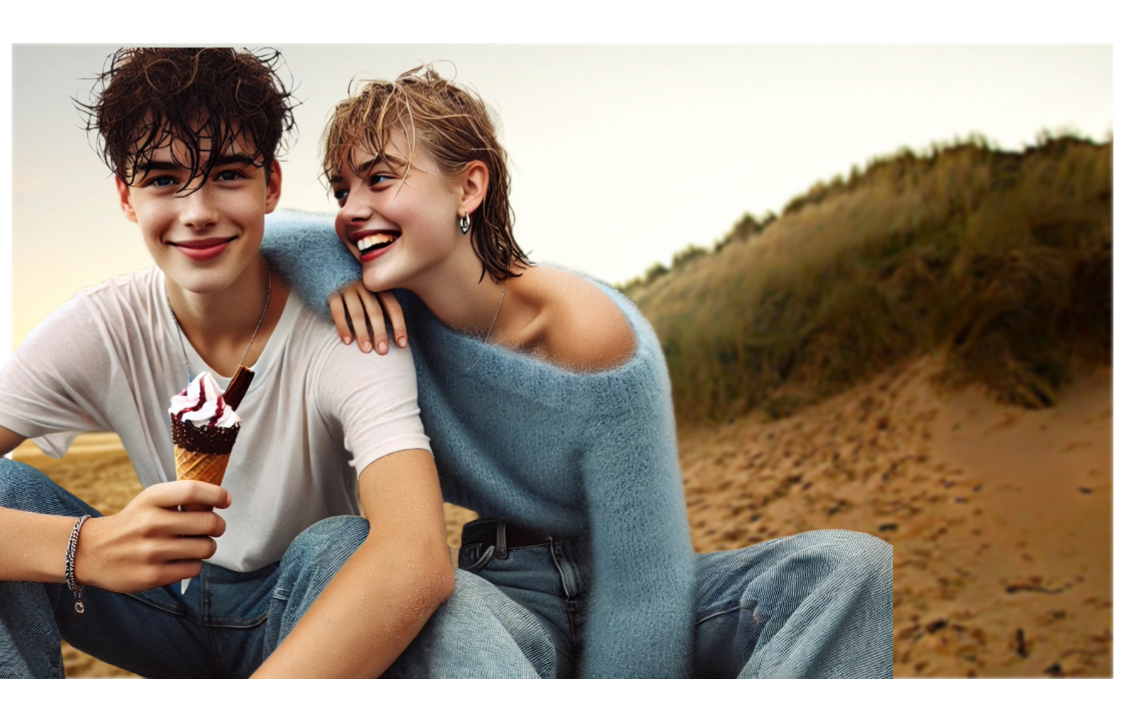
When the ice cream van showed up, Robbie insisted on having a 99 with monkey’s blood. This took some explaining to Hildy, who took everything he said literally. The Monkey’s blood was raspberry sauce.
Afterwards, Hildy fancied a swim. Robbie did not.
“That’s the North Sea,” he explained. “It’s freezing!”
Hildy was having none of it. Where Hildy went, Robbie followed, Towel in hand and wearing flip-flops. Hildy headed for the harbour wall.
“We could just paddle. Paddlings good?” Robbie hoped.
“I want to dive in and swim to shore,” Hildy declared.
When Robbie joined her on the harbour wall, Hildy was halfway across the stone lip, barefoot, hair in a salt-laced tangle, eyes squinting against the sun. She glanced back once—not to check if he was following, but to confirm that he was watching. Then she dives in.
The swell swallows the splash, and she’s gone.
Seconds pass. Too many.
Robbie leans forward, shielding his eyes from the glare. No sign of her. Just sunlight dancing on the water. His chest tightens. Is she all right? Is this a joke? Did she do it just to see if he’d panic?
Then—there. A flash of arm, a sleek arc of motion like a seal in mid-turn. She surfaces twenty yards out, brushing hair from her face, calling something he can’t hear but understands anyway.
The drop looks steeper now. And the sea looks and smells cold. But he’s sixteen, and she’s watching, and there’s no chance he’ll find any key or lock or whatever it is she requires if he backs out.
So he pulls off his clothes and goes in after her.
The shock bites hard. The cold knocks the wind out of him. His body seizes for a second—then kicks, surges forward. Hildy is already cutting through the water like she’s in her element. He tries to keep up.
When they return to the beach, both are shivering and breathless. The North Sea is cold. She pulls herself up first, long-limbed and laughing. Robbie flops onto the sand beside her, heart thumping like a drum. Their arms brush. Neither moves.
For now, nothing else exists.
“What about the towels?” Robbie asks.
“You can get them, my knight in shiny armour,” she says. She closed her eyes to enjoy the sun on her body like a lizard enjoying the first rays of summer.
Later, wrapped in a towel that smelled faintly of salt and sand, Hildy stood barefoot on the edge of the dunes, watching Robbie as he tried to brush the sand from his chest and thighs. She helped him. He helped her. They dusted each other down.
By now, the tide was halfway out. The sun dipped lower over the dunes, sharpening shadows.
She knew then that he might be the one. Or one of the ones. Not forever, of course. But for these few magical days.
“Let’s take a walk,” she says.
“Spazieren gehen wir?” Robbie said in his best attempt at German.
As they began to walk, he fell in beside her without a word. They matched each other’s stride without trying. She liked that.
She glanced across the bay. With the tide going out, they could walk a more direct route to the Long Nanny. Lilly and her family had walked that way with the dogs on her first day.
Soon, the harbour and lime kilns were lost on the horizon while the tallest sanddunes arched up like the sides of pyramids. Robbie knew each one from the many games of kick the can he had played on the paths as a boy or from sliding down the larger dunes on a plastic sledge following bobsleigh paths they had made. A concrete pillbox was hunkered into one dune, its form slightly toppled. He hadn’t thought to bring that one into the conversation, a grandfather who had served in the First World War and the other who had served in the second.
Typically, walkers would round the bend to the edge of the long Nanny River and turn back, or go as far as the footbridge, maybe even cross the bridge, and then make their way back as the tide turned. But on this occasion, Hildy had other plans; he crossed the bridge and marched on. Robbie worried she had in mind a ten-mile hike to Dunstunburgh Castle and back.
She let the sea air dry her hair and pretended not to notice the nervous way Robbie glanced at her.
They were holding hands. This wasn’t enough, Hildy thought. He could put his arm around her shoulders, she thought, and he then did it.
“Sehr romantisch,” she said, snuggling in under his shoulder.
‘Are there other things she could get him to do simply by wishing it?’ she wondered.
She didn’t know it yet, but she had already decided. The question wasn’t whether he would find the key but if he could turn the lock.
There was something gloriously unsupervised about their escape. No parents. No younger siblings. No one from the disco who might snicker or spread stories. Just the sand, the sea, seabirds and the dunes.
He couldn’t quite believe it. He also couldn’t stop looking at her from the corner of his eye.
She wasn’t like the other girls. Not just because she was German. There was something clear-eyed and secret about her—like she knew things. Like she saw things.
She’d watched him that day at Alnwick. She’d come to find him. That mattered.
And all this stuff about the key – some strange, poetic phrase in German that had lodged itself in his brain like a puzzle to solve.
He’d written it down and pondered its meaning by torchlight in the tent. He thought he understood it now.
He wanted to ask her if he’d got it right. But instead, here he was, with a girl of dreams in his arms.
The wind lifts sand from the dunes. The tide is out, and the sand stretches wide. They cross the narrow wooden footbridge over the Long Nanny and follow the bay’s edge into a nature reserve.
They speak in half-thoughts, teasing, laughing, stopping now and then when something catches their eyes.
Eventually, they leave the beach and climb into the dunes.
The grass here grows tall and tangled, windblown into hollows that feel like hiding places. Hildy chooses one, drops her bag, and lies back. Robbie joins her, the sound of his heart loud in his ears.
They kiss. It’s not the first time. But here, alone and far from everything, it feels different. Slower. Warmer. The world narrows to the closeness of skin and breath and pulse.
For now, nothing else exists.
She leaned back, propping herself on her elbows. He watched how her blue eyes caught the light, how the wind flushed her cheeks and tangled her hair. When she leant over to kiss him, it wasn’t a surprise. It was soft. Certain. It wasn’t playful or teasing.
He kissed her back, feeling the sun’s heat through his shirt, the sudden thud of his heartbeat, the wild wonder that she wanted him.
Later, they lay side by side, hands clasped, looking up at a sky following racing clouds.
They didn’t move right away. The wind had dropped, the sand cooling gently beneath them. The sea was still audible, somewhere beyond the rise, a slow hush-hush, hush-hush that matched the pace of their breathing.
“No words in red biro in your diary”. Hildy said.
Robbie had turned on his side, propped on one elbow, watching her. Hildy stared straight up at the sky, hands laced behind her head.
“What if we were birds?” she said suddenly, her voice light and lazy.
He blinked. “What kind?”
“Rare ones,” she said. “Seen only in this region. Difficult to spot. Prone to nesting in dunes and feeding on salty chips.”
“You’d be a Lesser-Freckled Bremen. Plumage: blonde. Call: sings in German and moans like a foghorn.
She laughed, a proper head-back laugh, delighted. “And you’d be… a Long-Necked Northumbrian Shag.”
“I’m nobody’s shag,” Robbie said. “Like you, I’m still a virgin.”
“Who said I was a virgin? Hildy asked.
“You did,” he said.
“I’ll always think of you as my Northumberland Shag” she said.
“But it’s not true!” Robbie said.
They both erupted into giggles that began small and then swelled uncontrollably, the kind that left you wiping your eyes afterward. When the laughter faded, they were still smiling, albeit more softly. Something had shifted.
She turned to him.
“You’re funnier than you look,” she said.
“And you’re weirder than you act,” he replied.
“Good weird?”
“The best kind.” He said.
They lay there longer, watching a kestrel hover above the dunes.
They shared a mint from his pocket, she sucks in it for a while than passes it to Robbie’s mouth.
After a while, Robbie rolled onto his back, looking at the sky.
“Why this. Why now? Why us?” he wondered.
She looked at him with her eyes half closed and said, softly, “Ich bin dein Liebling.”
He blinked. “Wait—mein ‘Liebling’
“I hope so,” she said. “It means… ‘darling. ’ Or… ‘favourite’.”
His smile was slow, blooming. “I like that. My Liebling.”
“You don’t own me, English boy,” she said, mock stern. “I’m wild. You must let me fly.”
“I am the Lesser-Freckled Bremen Girl. Remember?” she tries turning it into a compound noun in German. “Eine BremerMädchenwenigerSommersprossen.
“And you know what I am,” he said, climbing over her for another firm cuddle.
She rolled him over onto his back, got on top of him instead, and said more quietly, “Ich weiss es noch nicht.”
Robbie hadn’t understood.
She hesitated, then whispered, “It means… ‘I don’t know yet.’”
Robbie wanted to say something back in German. Something small and honest. He tried.
“Du bist… sehr schön.”
She raised an eyebrow. “Very beautiful?”
He blushed. “Too much?”
She kissed his lips and once again, they lay quietly.
Perhaps they were asleep, as the shadows of the dunes stretched across their legs. The wind had picked up again, stirring the grasses with a dry whisper. Somewhere behind them, a seabird gave a piercing cry.
Hildy turned to Robbie, chin propped on her hand.
They lay side by side in the dunes, sand in their hair, their arms brushing against each other occasionally, as if unintentionally. The sea was somewhere below them, churning softly, while the sky above resembled the end of a day that might never come again.
Hildy turned to him and said it quietly. No grand gesture. No music cue.
“Ich liebe dich.”
Just that.
Robbie swallowed. He knew the phrase. He’d read it in poems and heard it in war films. It wasn’t “I fancy you.” It wasn’t even “I adore you” how pop songs said it.
Or was it?
He looked at her, unsure if it was a test, gift, or something.
“Me too,” he said, because he didn’t trust his German. Then, after a breath, “Ich liebe dich… auch?”
She smiled just enough to let him think he’d passed that the key was in his eyes.
But her eyes searched his face, like she was still waiting for a better answer.
Maybe that’s what those words meant at sixteen. A dare. A lock to be tried. A truth not yet earned.
“You know what I could say to you right now?” she asked.
He wanted to know. “Go on, tell me,” he said, his expression indicating a desire to learn.
She leaned in closer and whispered as if sharing a secret:
“Du bist mein Mann.”
Robbie pondered this for a second. “Wait—‘Mann’?”
She nodded, mock-serious. “My man.”
He looked at her, properly now.
“My man friend.”
“You are. But when you kiss me —” she tapped a finger gently to her lips, “and … the other, you are not a boy.”
“Don’t I have to be 21 to be a man? 18 at least?”
“It’s not an age thing. I like you in armour, with a sword. That was manly.”
“That’s dressing up.”
Hildy smiled, not unkindly. “It’s just a phrase, Robbie. I don’t mean you have to build me a house.”
He let out a nervous breath, trying to laugh. After all, he had school to finish, then Oxbridge. All this man stuff could wait a few years.
She softly added, “It means something different to me than you. In German, ‘Mann’ is also just… the one you’re close to. It doesn’t mean old. You don’t have to be my husband. Or my father. Or how do you say, over the hill?”
Rivbie looked at her hand resting near his. He touched it.
“I like boy and girl,” he said. “But I don’t mind being your… Mann. If I get to say similar grown-up things like that back to you.”
Hildy nodded. “Go ahead and try it.”
He swallowed and leaned closer.
“Du bist… meine Frau.”
She wrinkled her nose. “Too much”.
They laughed again, and the tension broke.
“You’re a ‘Mädchen’, is that right?”
She turned, a little amused. “That’s what they taught you in school?”
He shrugged. “First lesson. Ich bin ein Junge. Du bist ein Mädchen: boy and girl. Felt easy. Neat.”
“Neat?” she laughed. “You know ‘Mädchen’ is neuter, yes? Not die, not der, but das.”
“Yeah. That bit always confused me. Why is the word for girl… neuter? Does it imply virgin?”
“It’s just grammar. But sometimes—” she hesitated, “—sometimes it feels… wrong.”
He looked at her- not just her legs, her tan, or the way the light caught the curve of her mouth, but her. The way she leaned into him, the way she listened.
“You don’t feel like a Mädchen,” he said.
She gave him a small smile. “What do I feel like?”
He opened his mouth. Closed it.
Then touched her: “You feel wonderful.”
She laughed gently. “Good answer.”
When Robbie returned from Alnwick Castle the following afternoon, he washed and changed. Then, he heard Hildy calling him from over the garden wall.
It was very ‘High School Prom’. She had her hair up and wore a light summer maxi dress. He’d found a jacket and tie. It was all a big act. They were role-playing adults.
Robbie had booked them a table at the Tower Hotel for a meal out. It was her last night. The next day, she was off to Edinburgh and then flying back to Germany.
The menu was printed in looping gold script, full of dishes Robbie wouldn’t have ordered in a hundred years. Hildy scanned it with practised elegance, though she kept glancing at him as if to say help me out here. Neither spoke for a while.
Their table was near the window, but the view looked out onto the dark backs of parked cars and the sodium glow of the road beyond. The restaurant was mostly empty. A couple in their fifties sat two tables over, speaking in low voices, barely looking up from their wine.
Hildy looked beautiful but like someone else’s version of her.
They ordered the prawn cocktail. It arrived in glass goblets, drowning in pink sauce.
“I should have taken you for fish and chips,” Robbie said.
Hildy smiled, but not with her eyes. “We are practising being adults. It is… strange.”
“It is,” he said. “I miss the dunes already.”
She looked at him, then looked at the condensation on her glass. She drew a little circle with her fingertip.
“You go back to your castle tomorrow?” she asked.
“Yeah. Helmet. Sword. Defending King Arthur again.” He said.
“Not defending the maidenhood of the girl you love?”
“And you go to Edinburgh,” he added. “Never to return.”
That hung in the air for too long. The waitress arrived with chicken in white wine sauce and boiled vegetables. Robbie stabbed a potato like it had wronged him.
“You’ll write?” he asked, not looking at her.
She paused, then nodded. “Of course. But what do I say? That I’m back with my boyfriend?”
He flinched. “Not especially.”
She exhaled, slow. “He has a motorbike.”
“You’ve told me. Don’t fall off. I’d hate the idea of you with a missing leg.”
Another silence. Not angry. Just full of what they weren’t saying.
The rest of the meal was light talk—jokes about the décor, the absurdly yellow dessert, and the framed photograph of the Queen Mother on the mantelpiece. But it was surface talk.
When they parted outside, the wind was rising off the north sea.
She kissed him quickly on the cheek. Her hand lingered on his sleeve. “You were my Liebling,” she said. “Just for these ten days. You understand?”
He nodded. It was more than he deserved.
She stepped back. “Robbie,” she said softly, “if you ever learn German
“Ich sprech keine deutsh,” Robbie said, nailing the accent he’d learnt from Hildy.
She blows him a kiss.
He catches it and kisses his fist. Then opens his hand, and lets it fly away.
Hildy runs over. Clings to him. They kiss and make their wishes.
“I’ll love you always. A little bit.”
“Let me walk you home.”
“To Germany? That’s too far.”
Robbie smiles. “And they say Germans don’t have a sense of humour.”
“They don’t. I do.”
“Don’t talk about us to anyone. Remember, this is just for us these ten days?”